

If you’re looking for what’s another way to say you’re welcome, try “my pleasure,” “no problem,” “no worries,” “anytime,” or “happy to help.” The best choice depends on the situation and tone. Use “my pleasure” for a polished response, while “no worries” or “anytime” feels more casual and friendly.
Key Takeaways
- “My pleasure” is a polished choice for professional and formal situations.
- “No problem” works well in everyday American English.
- “Happy to help” is useful when responding to a request or favor.
- “Anytime” gives your response a warm, friendly tone.
- Choose your response based on the relationship, setting, and level of formality.
What’s Another Way to Say You’re Welcome?
When someone thanks you, saying “you’re welcome” is always appropriate, but it is not your only option. Depending on the situation, you may want to sound warmer, more professional, more relaxed, or more enthusiastic.
Knowing what’s another way to say you’re welcome can help you avoid repetition and make your conversations sound more natural. From “my pleasure” in a business setting to “no worries” with friends, each alternative carries a slightly different tone.
What Does “What’s Another Way to Say You’re Welcome” Mean?
The phrase “what’s another way to say you’re welcome” means you are looking for different expressions to use after someone says “thank you.” These alternatives can communicate the same basic idea while changing the tone or level of formality.
People commonly search for another way to say “you’re welcome” when writing emails, responding to customers, talking with coworkers, or having casual conversations with friends and family.
For example, “my pleasure” sounds polished and courteous, while “no worries” feels relaxed and informal. Choosing the right expression helps your response fit the conversation.
Why Use Other Ways to Say “You’re Welcome”?
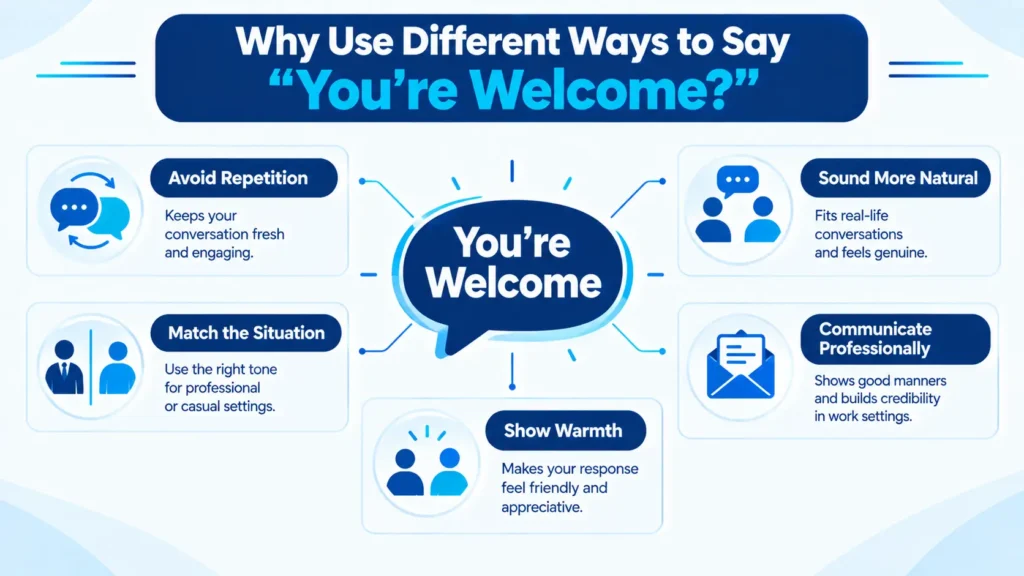
Using different responses to “thank you” can make your communication more natural and appropriate for the situation.
You might choose an alternative to:
- Avoid repeating “you’re welcome” too often.
- Sound more friendly and conversational.
- Create a warmer or more personal response.
- Match the tone of a professional conversation.
- Show that you genuinely enjoyed helping someone.
- Make casual conversations feel more relaxed.
The goal is not to replace “you’re welcome” every time. Instead, choose an expression that fits the relationship and context.
10 Best Other Ways to Say “You’re Welcome”
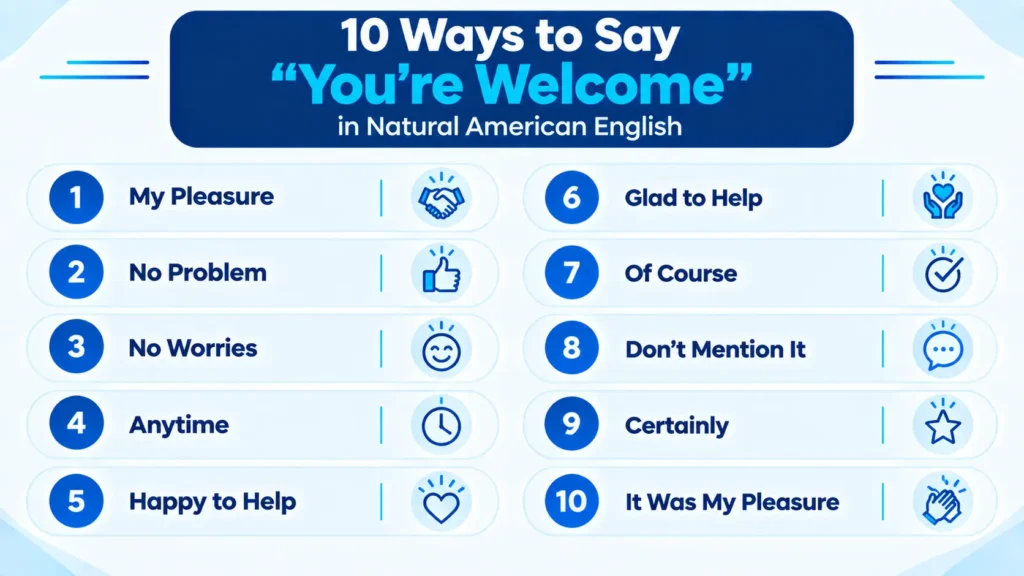
1. My Pleasure
Meaning
“My pleasure” tells someone that you were happy to help them. It sounds courteous and polished without feeling overly formal, making it one of the most versatile alternatives to “you’re welcome.”
Best For
- Professional
- Formal
- Friendly
- Polite
- Warm
Example 1
“Thank you for taking the time to walk me through the process.”
“My pleasure. I’m glad I could help.”
Example 2
“Thanks for sending those documents so quickly.”
“My pleasure. I wanted to make sure you had everything you needed.”
Quick Tip
Use “my pleasure” when you want to emphasize genuine willingness to help, especially in professional or customer-service situations.
2. No Problem
Meaning
“No problem” means that helping someone was not difficult or inconvenient for you. It is common in American English and works naturally in many everyday situations.
Best For
- Casual
- Friendly
- Polite
Example 1
“Thanks for picking up my package.”
“No problem. I was heading that way anyway.”
Example 2
“Thank you for explaining that again.”
“No problem. It can be confusing the first time.”
Quick Tip
“No problem” is a safe everyday option, but choose a warmer phrase such as “my pleasure” when a more polished tone is needed.
3. No Worries
Meaning
“No worries” is a relaxed way to reassure someone that their request or favor was not a burden. It has a friendly, informal feel.
Best For
- Casual
- Friendly
- Warm
Example 1
“Sorry for making you wait.”
“No worries. I wasn’t in a hurry.”
Example 2
“Thanks for helping me move the chairs.”
“No worries. Happy to pitch in.”
Quick Tip
Use “no worries” with friends, family, coworkers, or in relaxed conversations rather than highly formal business correspondence.
4. Anytime
Meaning
“Anytime” suggests that you would be happy to help again in the future. It communicates generosity and openness without sounding overly formal.
Best For
- Casual
- Friendly
- Warm
- Polite
Example 1
“Thanks for helping me prepare for the presentation.”
“Anytime. I’m glad it worked out.”
Example 2
“I really appreciate you checking on the house.”
“Anytime. Just let me know if you need anything else.”
Quick Tip
“Anytime” works particularly well when you want to show that helping was easy and that you are willing to do it again.
5. Happy to Help
Meaning
“Happy to help” directly communicates that you were pleased to assist. It is especially useful when someone thanks you for completing a task or providing support.
Best For
- Professional
- Friendly
- Polite
- Warm
Example 1
“Thank you for helping me resolve the billing issue.”
“Happy to help. I’m glad we got it sorted out.”
Example 2
“Thanks for answering all my questions.”
“Happy to help. Please reach out if anything else comes up.”
Quick Tip
Use “happy to help” when you want your response to sound helpful and professional without becoming stiff.
6. Glad to Help
Meaning
“Glad to help” expresses satisfaction about being useful to someone. It feels slightly more personal than a simple “you’re welcome” while remaining appropriate in many settings.
Best For
- Professional
- Friendly
- Warm
- Polite
Example 1
“Thank you for helping me find the right department.”
“Glad to help. I hope they can take care of it.”
Example 2
“I appreciate you staying late to finish this.”
“Glad to help. We made good progress tonight.”
Quick Tip
Choose “glad to help” when you want to sound sincere and supportive without being overly casual.
7. Of Course
Meaning
“Of course” communicates that helping was natural or expected. It can sound warm and reassuring, particularly when responding to a friend, family member, or someone you know well.
Best For
- Casual
- Friendly
- Polite
- Warm
Example 1
“Thanks for picking me up from the airport.”
“Of course. I was happy to do it.”
Example 2
“Thank you for keeping this between us.”
“Of course. You can trust me.”
Quick Tip
Use “of course” when you want to make the person feel that their request was completely reasonable.
8. Don’t Mention It
Meaning
“Don’t mention it” means the favor was small enough that the other person does not need to keep thanking you. It has a courteous, understated quality.
Best For
- Friendly
- Polite
- Formal
Example 1
“Thank you for helping me carry those boxes.”
“Don’t mention it. I was glad to help.”
Example 2
“Thanks for giving me a ride home.”
“Don’t mention it. It was on my way.”
Quick Tip
This phrase is best when you want to downplay the favor and reassure the other person that it was no trouble.
9. Certainly
Meaning
“Certainly” is a polished response that communicates willingness and courtesy. It can work particularly well in customer service, workplace communication, and other situations where a professional tone matters.
Best For
- Professional
- Formal
- Polite
Example 1
“Thank you for helping me update my account.”
“Certainly. I’m glad I could assist.”
Example 2
“Thanks for providing the information I requested.”
“Certainly. Let me know if you need anything else.”
Quick Tip
“Certainly” is more formal than “no problem,” so it is a good choice when you want your response to sound professional and respectful.
10. It Was My Pleasure
Meaning
“It was my pleasure” expresses genuine satisfaction about helping someone. It sounds warm, gracious, and slightly more formal than “my pleasure.”
Best For
- Formal
- Professional
- Warm
- Polite
Example 1
“Thank you for making the introduction.”
“It was my pleasure. I’m happy the connection was useful.”
Example 2
“Thank you for hosting such a wonderful event.”
“It was my pleasure. I’m glad you enjoyed it.”
Quick Tip
Use “it was my pleasure” when you want to give your response a gracious and thoughtful tone, especially in professional or formal interactions.
Comparison Table
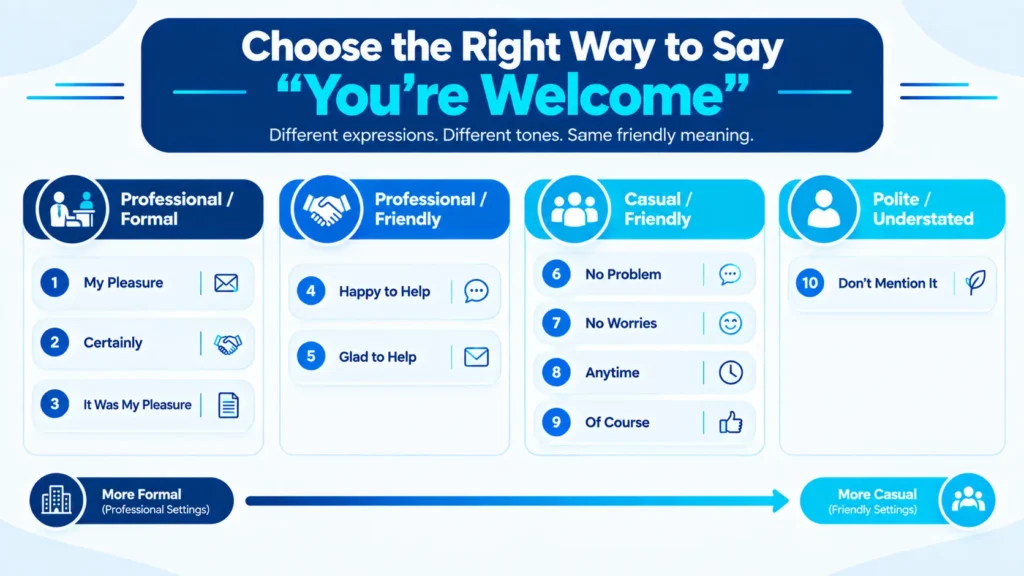
| Alternative | Best Used In | Tone |
| My pleasure | Professional conversations, customer service | Warm, polished |
| No problem | Everyday conversations | Casual, relaxed |
| No worries | Informal conversations | Friendly, casual |
| Anytime | Friends, family, casual work settings | Warm, generous |
| Happy to help | Workplace and service interactions | Helpful, professional |
| Glad to help | Work and personal conversations | Warm, sincere |
| Of course | Friends, family, familiar relationships | Friendly, reassuring |
| Don’t mention it | Small favors and polite exchanges | Courteous, understated |
| Certainly | Professional and formal settings | Formal, polite |
| It was my pleasure | Formal or professional interactions | Gracious, warm |
Common Mistakes
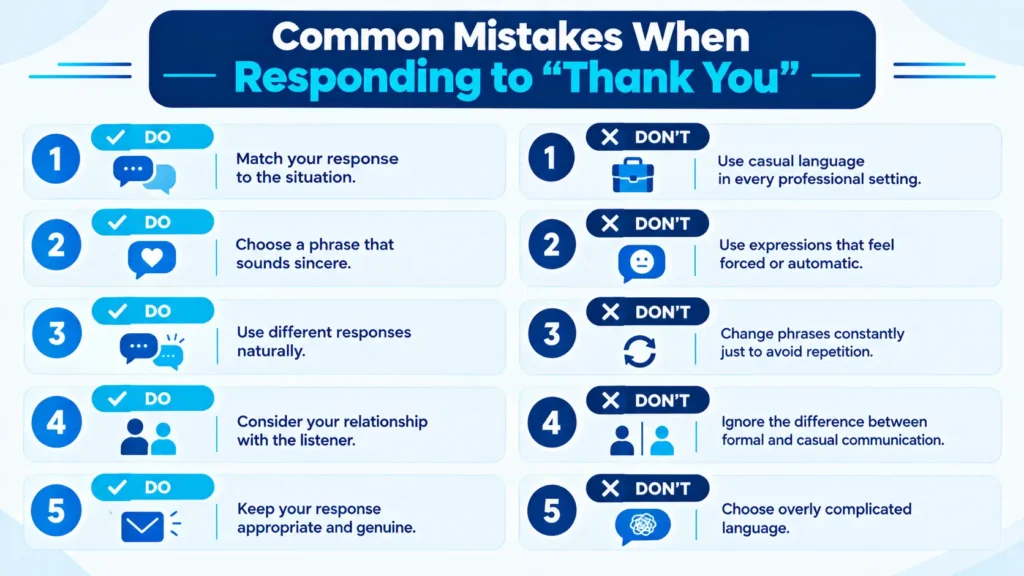
1. Using Casual Phrases in Professional Emails
Expressions such as “no worries” can sound too relaxed in some business settings. When writing to a client, manager, or unfamiliar professional contact, “my pleasure” or “happy to help” is often a safer choice.
2. Choosing Overly Formal Language
Not every conversation requires a formal response. Saying “certainly” to a close friend may sound unnatural when “of course” or “anytime” would fit better.
3. Repeating the Same Phrase
Using “you’re welcome” after every “thank you” can make conversations feel repetitive. Having several natural alternatives gives you more flexibility without forcing variety where it is unnecessary.
4. Forgetting the Context
The best response depends on who you are talking to and why they thanked you. A phrase that works perfectly with a coworker may not have the same effect in a customer-service interaction or a personal conversation.
5. Sounding Insincere
Some phrases can feel automatic if your tone does not match your words. When someone has expressed genuine appreciation, choose a response that sounds sincere and reflects how you actually feel.
Frequently Asked Questions

What is a professional way to say “you’re welcome”?
“My pleasure,” “happy to help,” and “certainly” are strong professional alternatives to “you’re welcome.” “My pleasure” sounds warm and polished, while “happy to help” emphasizes your willingness to assist. For more formal situations, “certainly” can provide a courteous and professional response.
What is a casual way to say “you’re welcome”?
For casual conversations, try “no problem,” “no worries,” “anytime,” or “of course.” These expressions sound natural in everyday American English and work well with friends, family, classmates, and coworkers you know well. The best choice depends on how relaxed and familiar the conversation is.
Is “no worries” a good way to respond to “thank you”?
Yes. “No worries” is a common informal response to “thank you,” especially in friendly conversations. It reassures the other person that helping them was not a burden. However, it may be too casual for some formal emails, business situations, or highly professional interactions.
Is “my pleasure” better than “you’re welcome”?
Neither is universally better. “My pleasure” can sound warmer and more gracious, while “you’re welcome” is a straightforward and universally familiar response. Use “my pleasure” when you want to emphasize that you were genuinely happy to help.
Can I say “happy to help” instead of “you’re welcome”?
Yes. “Happy to help” is an excellent alternative when someone thanks you for assisting with a task, answering a question, or solving a problem. It is especially useful in professional communication because it sounds positive, courteous, and service-oriented without being overly formal.
What can I say instead of “you’re welcome” in an email?
In a professional email, consider “my pleasure,” “happy to help,” “glad to help,” or “certainly.” Your choice should match the formality of the message. “My pleasure” is warm and polished, while “happy to help” sounds approachable and professional.
What is a warm way to respond to “thank you”?
“Anytime,” “my pleasure,” “glad to help,” and “of course” can all create a warm response. “Anytime” suggests that you are willing to help again, while “my pleasure” emphasizes that you genuinely enjoyed helping. For personal conversations, “of course” can sound especially reassuring.
How do Americans commonly respond to “thank you”?
In American English, common responses include “you’re welcome,” “no problem,” “no worries,” “my pleasure,” “of course,” and “anytime.” The choice usually depends on the relationship and setting. Professional conversations tend to favor polished expressions, while informal conversations allow more relaxed responses.
Conclusion
There are many natural answers to what’s another way to say you’re welcome, and the best choice depends on the situation. For professional or formal conversations, “my pleasure,” “happy to help,” and “certainly” offer polished alternatives.
If you want to emphasize genuine willingness, “glad to help” is a strong choice. For a gracious and slightly more formal response, “it was my pleasure” works well.
The key is to match your words to the person, setting, and tone. You do not need to avoid “you’re welcome” altogether—just use these alternatives when you want your response to feel more natural, personal, or appropriate to the moment.

Melody Schaefer is the Founder and Editor-in-Chief of FrontiersPost, where she oversees the publication of clear, useful, and thoughtfully researched content for modern readers. Her editorial focus includes language, communication, vocabulary, writing, and practical topics that help readers understand information with greater clarity and confidence.
At FrontiersPost, Melody works with writers and editors to maintain consistent editorial standards, improve content quality, and ensure that published articles are useful, accessible, and easy to understand. She is particularly interested in clear communication and presenting complex or easily confused topics in a straightforward way.
As Editor-in-Chief, she is also responsible for guiding the site’s editorial direction, reviewing content standards, and helping ensure that articles are regularly maintained and improved as information evolves.