

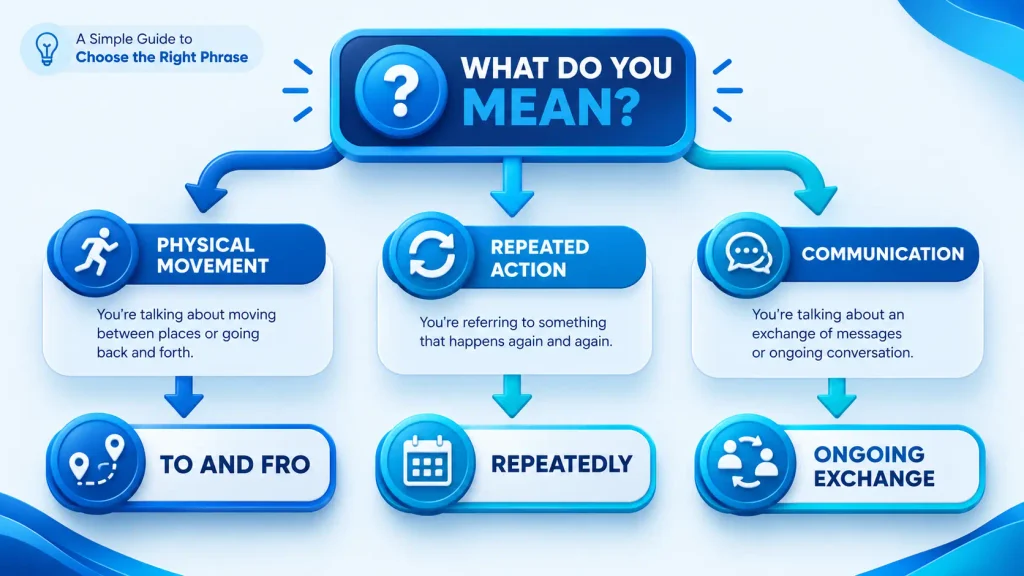
Another way to say back and forth is “to and fro,” “back and forth repeatedly,” “between two places,” “in both directions,” or “back-and-forth exchange.” The best alternative depends on the context. Use “to and fro” for movement, “in both directions” for travel or communication, and “ongoing exchange” for discussions or debates.
Key Takeaways
- Use “to and fro” to describe repeated movement between two points.
- Choose “in both directions” when explaining travel, traffic, or two-way communication.
- Use “ongoing exchange” for conversations, negotiations, or discussions.
- Try “repeatedly” when an action happens several times.
- Match your wording to the situation to keep your writing clear and natural.
The phrase “back and forth” describes repeated movement, communication, or changes between two points, people, or ideas. Although it works in everyday conversation, using a different expression can make your writing more precise and professional.
Whether you are describing a discussion, explaining a commute, or writing a work email, the right alternative helps readers understand exactly what you mean. Here are 10 natural alternatives, with examples and tips for choosing the best one.
What Does “Another Way to Say Back and Forth” Mean?

“Back and forth” usually describes movement between two places or repeated communication between people. It can also refer to changing opinions, exchanging messages, or moving between different options.
For example, someone might walk back and forth while waiting for an appointment. Two coworkers might go back and forth over an email, while a team might go back and forth between two possible solutions.
The phrase is common in American English. Its best replacement depends on whether you mean physical movement, repeated action, or an exchange of ideas.
Common Uses of “Back and Forth”
- Physical movement: Walking between two rooms or traveling between locations.
- Communication: Exchanging emails, texts, or comments.
- Discussion: Debating a decision or considering different opinions.
- Repeated actions: Switching between tasks, activities, or choices.
Why Use Other Ways to Say “Back and Forth”?
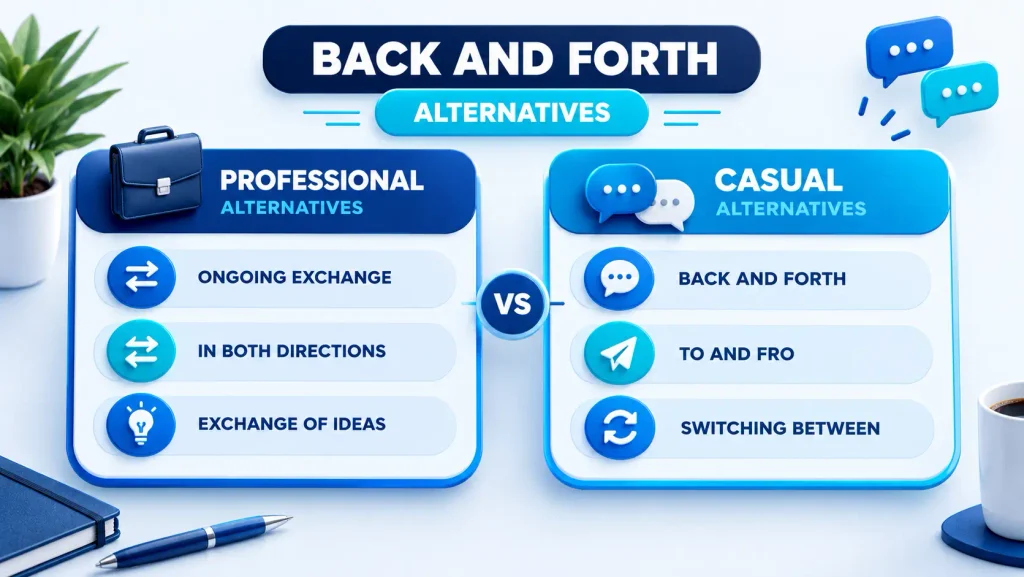
Choosing an alternative can help you communicate more clearly and avoid repeating the same expression. It can also make your language better suited to professional writing, casual conversation, or formal explanations.
Consider these benefits:
- Improve clarity: Explain whether you mean movement, discussion, or repetition.
- Sound more natural: Choose expressions that fit everyday American English.
- Strengthen professional writing: Describe negotiations and communication more precisely.
- Avoid repetition: Keep longer articles, emails, and reports engaging.
- Match the tone: Use a casual phrase with friends or a more precise expression at work.
10 Best Other Ways to Say “Back and Forth”

1. To and Fro
Meaning
“To and fro” describes repeated movement in one direction and then the opposite direction. It has a slightly literary or traditional feel and is less common in everyday American conversation than “back and forth.”
Best For
- Formal
- Friendly
Example 1
The children ran to and fro across the playground.
Example 2
She paced to and fro while waiting for the interview to begin.
Quick Tip
Use “to and fro” when describing physical movement. For everyday American English, “back and forth” will often sound more natural.
2. In Both Directions
Meaning
“In both directions” means that movement, travel, or communication occurs each way. It is a clear and practical alternative when you want to explain two-way activity without suggesting constant repetition.
Best For
- Professional
- Formal
- Polite
Example 1
The shuttle runs in both directions between the airport and downtown.
Example 2
Please make sure the information reaches the team in both directions.
Quick Tip
Choose this expression for instructions, travel information, and workplace communication when clarity matters more than style.
3. Repeatedly
Meaning
“Repeatedly” means that something happens several times. It works when “back and forth” describes repeated actions rather than literal movement between two places.
Best For
- Professional
- Formal
Example 1
The customer repeatedly asked for an update on the delivery.
Example 2
He checked the figures repeatedly before submitting the report.
Quick Tip
Use “repeatedly” when the number or frequency of actions matters. It does not necessarily imply movement between two points.
4. Between Two Places
Meaning
“Between two places” describes movement or travel connecting two locations. This expression is useful when you want to explain where someone travels without emphasizing every individual trip.
Best For
- Professional
- Casual
- Polite
Example 1
I travel between two offices several times a week.
Example 2
The delivery driver works between the warehouse and the distribution center.
Quick Tip
Use this phrase when the locations matter most. Add words such as “daily” or “several times” if you need to show how often the travel occurs.
5. An Ongoing Exchange
Meaning
“An ongoing exchange” describes communication that continues between two or more people. It works well for discussions, negotiations, and professional correspondence that involve several responses.
Best For
- Professional
- Formal
- Polite
Example 1
We had an ongoing exchange of emails about the project deadline.
Example 2
The manager and the client continued an ongoing exchange about the revised proposal.
Quick Tip
This expression suits professional writing, but avoid it when describing simple physical movement. It specifically emphasizes communication or the sharing of ideas.
6. A Two-Way Conversation
Meaning
“A two-way conversation” emphasizes that both people participate rather than one person doing all the talking. It is especially useful when describing open communication, feedback, or a discussion where both sides contribute.
Best For
- Professional
- Friendly
- Warm
- Polite
Example 1
Our meeting became a two-way conversation about improving customer service.
Example 2
I appreciate a two-way conversation in which everyone feels comfortable sharing ideas.
Quick Tip
Use this phrase when mutual participation matters. It is not a direct replacement for “back and forth” when you mean physical movement.
7. An Exchange of Ideas
Meaning
“An exchange of ideas” describes people sharing opinions, suggestions, or possible solutions. It presents communication as a collaborative process instead of focusing on repeated responses or disagreement.
Best For
- Professional
- Formal
- Friendly
Example 1
The workshop encouraged an exchange of ideas among new employees.
Example 2
We had a productive exchange of ideas before choosing the final design.
Quick Tip
Choose this expression when the discussion is constructive. If the conversation involves disagreement, “a debate” or “a back-and-forth discussion” may be more accurate.
8. A Continuous Cycle
Meaning
“A continuous cycle” describes a process that keeps repeating. It can replace “back and forth” when a task, decision, or pattern repeatedly returns to an earlier stage.
Best For
- Professional
- Formal
Example 1
Without clear approval rules, the document review became a continuous cycle.
Example 2
The team fell into a continuous cycle of revising the same proposal.
Quick Tip
Use this expression for recurring processes or patterns, especially when repetition causes delays. Avoid it for a single conversation or one simple trip.
9. Switching Between
Meaning
“Switching between” means moving from one activity, choice, place, or subject to another. It is particularly useful when someone alternates between two tasks or changes focus several times.
Best For
- Professional
- Casual
- Friendly
Example 1
She spent the afternoon switching between customer calls and project updates.
Example 2
I kept switching between two versions of the presentation before making a decision.
Quick Tip
Use “switching between” when the focus changes from one thing to another. Name the two activities or options to make your meaning clear.
10. A Back-and-Forth Exchange
Meaning
“A back-and-forth exchange” describes communication in which people respond to one another repeatedly. It preserves the familiar meaning of the original expression while making it clear that the subject is a conversation or discussion.
Best For
- Professional
- Casual
- Friendly
Example 1
After a back-and-forth exchange with the supplier, we agreed on a delivery date.
Example 2
The editor and writer had a back-and-forth exchange about the article’s opening paragraph.
Quick Tip
This phrase works well when several responses are involved. For a shorter or more formal sentence, consider “discussion,” “correspondence,” or “negotiation,” depending on the context.
Comparison Table
| Alternative | Best Used In | Tone |
|---|---|---|
| To and fro | Physical movement | Traditional |
| In both directions | Travel and communication | Clear, professional |
| Repeatedly | Actions that happen several times | Direct, formal |
| Between two places | Travel and commuting | Neutral |
| An ongoing exchange | Emails and negotiations | Professional |
| A two-way conversation | Meetings and discussions | Friendly, collaborative |
| An exchange of ideas | Brainstorming and teamwork | Constructive |
| A continuous cycle | Repeating processes | Analytical |
| Switching between | Tasks and choices | Natural, conversational |
| A back-and-forth exchange | Repeated communication | Neutral, conversational |
Common Mistakes When Replacing “Back and Forth”
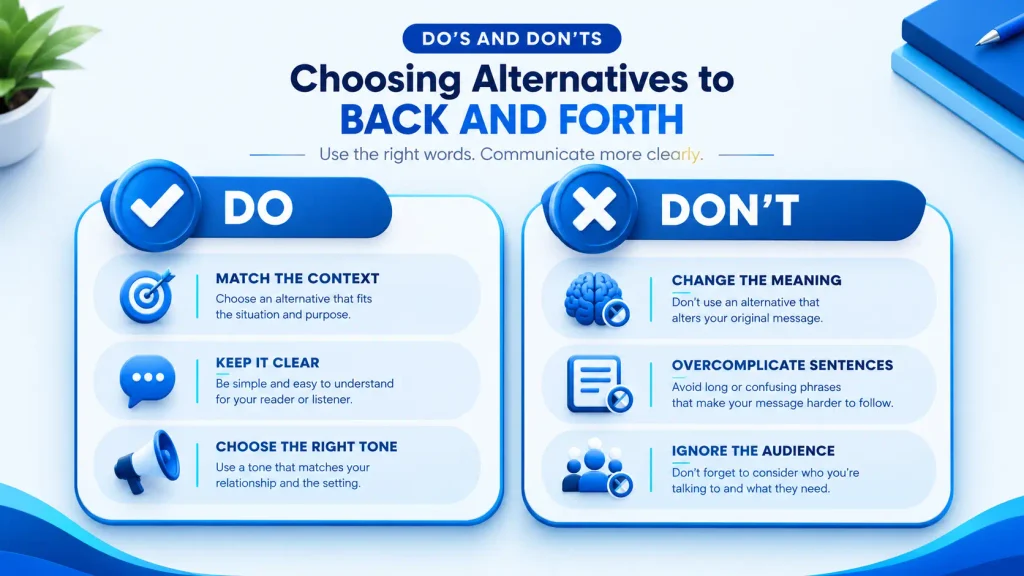
1. Choosing a Phrase That Changes the Meaning
Not every alternative describes the same action. “Repeatedly” emphasizes frequency, while “in both directions” emphasizes movement or communication in two directions.
How to avoid it: Identify whether you mean movement, repetition, or an exchange before selecting a replacement.
2. Using Casual Language in Formal Emails
Expressions that sound natural in conversation may not be precise enough for a business report or formal email.
How to avoid it: Use phrases such as “an ongoing exchange” or “in both directions” when they accurately describe the situation.
3. Making the Sentence Unnecessarily Complicated
Replacing a short, familiar phrase with a long expression can make writing harder to read.
How to avoid it: Choose the simplest wording that communicates your meaning. You do not need a sophisticated alternative for every occurrence.
4. Using “To and Fro” in Every Situation
“To and fro” usually describes movement. It does not naturally replace every instance of repeated communication or discussion.
How to avoid it: Use “an exchange of ideas” for collaboration or “a back-and-forth exchange” for repeated responses.
5. Ignoring the Context
The best alternative for a commute may not work for an argument, an email thread, or a repeating work process.
How to avoid it: Read the full sentence before changing the phrase. Make sure the alternative preserves the original meaning and tone.
Frequently Asked Questions
1. What is another word for “back and forth”?
Possible alternatives include “repeatedly,” “alternately,” and “to and fro.” The best choice depends on the sentence. Use “repeatedly” for actions that happen several times, “alternately” when two things take turns, and “to and fro” for physical movement between points.
2. What is a professional way to say “back and forth”?
“In both directions,” “an ongoing exchange,” and “a discussion” can sound professional in the right context. For example, you could describe repeated emails as an ongoing exchange or explain that information must travel in both directions. Choose the phrase that accurately describes the situation.
3. What is another way to say “back and forth” in an email?
For an email conversation, try “an ongoing exchange,” “continued correspondence,” or “a series of messages.” For example, “After several rounds of correspondence, we finalized the agreement” sounds clear and professional. Avoid overly formal wording when a simple phrase communicates the same idea.
4. What does “back and forth” mean in a conversation?
In a conversation, “back and forth” usually means that two or more people exchange comments, questions, or opinions. It may describe a friendly discussion, a negotiation, or a disagreement. The expression can be neutral, so the surrounding words determine whether the exchange sounds productive or argumentative.
5. Is “to and fro” the same as “back and forth”?
The expressions are similar when describing movement in opposite directions. However, “to and fro” often sounds more literary or traditional in American English. “Back and forth” is more common in everyday conversation and can also describe discussions, messages, and repeated changes between choices.
6. How do you describe going back and forth between two places?
You can say “traveling between two places,” “commuting between locations,” or “moving between two points.” If you want to emphasize repeated trips, add a word such as “frequently” or “daily.” For example, “She travels between the two offices every weekday” is specific and natural.
7. What is another way to say “back-and-forth discussion”?
You could use “discussion,” “debate,” “exchange of ideas,” or “ongoing conversation.” Use “debate” when people disagree, “exchange of ideas” when they share suggestions, and “ongoing conversation” when communication continues over time. The right choice depends on the purpose and tone of the discussion.
8. Is “back and forth” formal or informal?
“Back and forth” is a standard English expression used in both casual and professional settings. It works well in everyday conversations and many workplace messages. However, more specific alternatives, such as “an ongoing exchange” or “in both directions,” may be clearer in formal reports or technical explanations.
You may also find these guides useful: Another Way to Say “Best of Luck”, Polite Alternatives to “Bye” for Any Situation and Another Way to Say “Called Out”.
Conclusion
Choosing another way to say “back and forth” depends on what you want to communicate. For physical movement, “to and fro” or “between two places” may fit. When describing travel or two-way communication, “in both directions” offers a clear alternative. For repeated actions, “repeatedly” keeps your sentence direct and easy to understand.
If you are writing about emails, negotiations, or workplace discussions, consider “an ongoing exchange,” “a two-way conversation,” or “an exchange of ideas.” When a process keeps returning to the same stage, “a continuous cycle” may express the problem more precisely.
The key is to choose wording that preserves your original meaning and matches your audience. You do not need to replace “back and forth” every time you use it. Instead, select an alternative when it makes your sentence clearer, more natural, or more appropriate for the situation. Understanding the meaning and usage of “back and forth” can also help you choose the right expression for your context.

The FrontiersPost editorial team writes and reviews every guide to word and phrase alternatives, with clear meanings, tone notes and example sentences for everyday, academic and professional English.