

Another way to say “per our conversation” includes “as we discussed,” “following our discussion,” “as agreed,” “based on our conversation,” and “as mentioned earlier.” These expressions help you refer to previous discussions in professional emails, workplace communication, and business messages while maintaining a clear, polite, and natural tone.
Key Takeaways
- “As we discussed” is a natural and widely useful alternative to “per our conversation.”
- “As agreed” works best when referring to a decision or commitment.
- “Following our discussion” is ideal for professional emails and follow-up messages.
- “As mentioned earlier” is useful when repeating information from a previous conversation.
- Choose an expression based on whether you are referring to a decision, reminder, agreement, or general discussion.
“Per our conversation” is a common phrase in professional emails, business communication, and workplace follow-ups. However, it can sometimes sound overly formal or stiff.
If you want your emails to sound more natural, polite, and professional, choosing a suitable alternative can make your message easier to understand. Below are 10 useful expressions you can use in different situations.
What Does “Per Our Conversation” Mean?

“Per our conversation” means according to, or based on, a discussion that took place earlier. It is used to refer to information, decisions, instructions, or agreements shared during a previous conversation.
For example:
“Per our conversation, I have attached the updated report.”
This sentence means that the report is attached based on what the sender and recipient previously discussed.
The expression is commonly used in business emails, workplace communication, project updates, and professional follow-ups. Although it is grammatically correct, some people prefer alternatives that sound less formal and more conversational.
Why Use Alternatives to “Per Our Conversation”?
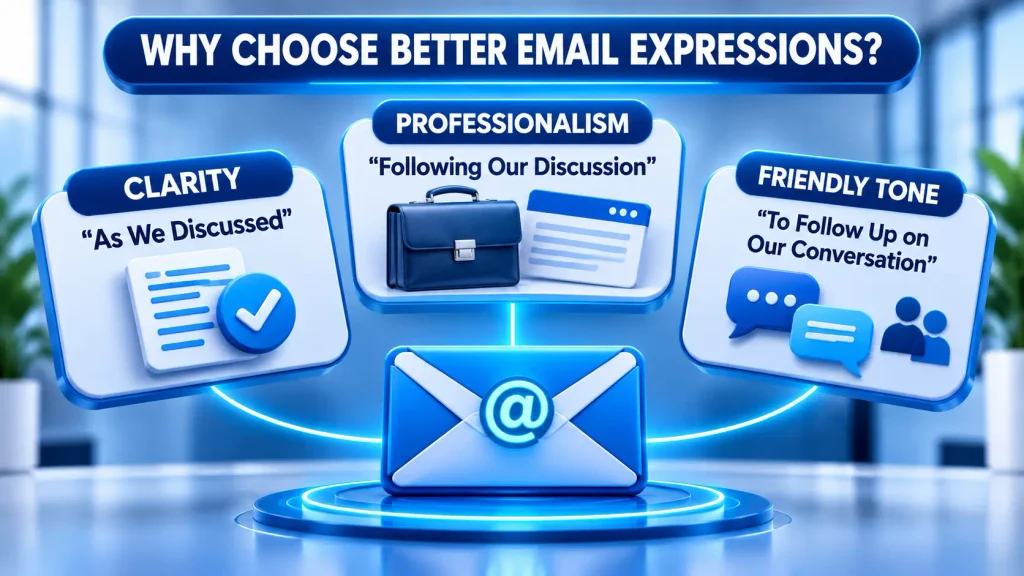
Using different expressions can help you communicate more naturally and avoid repeating the same phrase in every email.
For example, “as we discussed” sounds friendly and professional, while “as agreed” emphasizes a shared decision. “Following our discussion” is particularly useful when explaining what you are doing next.
Choosing the right wording also helps clarify your intention. You can remind someone of a conversation, confirm an agreement, summarize instructions, or provide an update without making your message sound unnecessarily formal.
10 Best Alternatives to “Per Our Conversation”
1. As We Discussed
Meaning and Usage
“As we discussed” is one of the most natural and versatile alternatives to “per our conversation.” It refers to information or a topic that both people previously talked about.
It sounds professional without being overly formal, making it suitable for most workplace situations.
Best For
- Professional emails
- Workplace follow-ups
- Project updates
- Everyday business communication
Example Sentences
- As we discussed, I will send you the revised proposal by Friday.
- As we discussed during the meeting, the deadline has been moved to next week.
- As we discussed, please review the attached document before our next call.
Quick Tip
Use “as we discussed” when you want your message to sound clear, natural, and professional. It is an excellent default choice for most situations.
2. Following Our Discussion
Meaning and Usage
“Following our discussion” means that something is happening or being communicated after a previous conversation. It often introduces an action, update, or next step.
This expression sounds polished and professional, especially in formal business correspondence.
Best For
- Formal emails
- Business follow-ups
- Project coordination
- Client communication
Example Sentences
- Following our discussion, I have updated the project timeline.
- Following our discussion yesterday, I am sharing the requested information.
- Following our discussion, we will proceed with the proposed changes.
Quick Tip
Use this phrase when you are describing an action taken after a conversation. It is especially effective in emails that summarize next steps.
3. As Agreed
Meaning and Usage
“As agreed” refers to something that both parties accepted or decided together. It emphasizes a mutual agreement rather than simply mentioning a previous conversation.
It is concise, professional, and direct.
Best For
- Confirming decisions
- Business agreements
- Meeting follow-ups
- Workplace commitments
Example Sentences
- As agreed, I will submit the final report by Monday.
- As agreed during our meeting, the payment will be processed this week.
- As agreed, we will begin the project next month.
Quick Tip
Use “as agreed” only when both parties actually reached an agreement. It may sound misleading if the conversation involved a suggestion rather than a confirmed decision.
4. Based on Our Conversation
Meaning and Usage
“Based on our conversation” means that your message, decision, or action comes from the information shared during a previous discussion.
It is a useful expression when explaining how a conclusion or recommendation was reached.
Best For
- Professional emails
- Recommendations
- Decision-making
- Project planning
Example Sentences
- Based on our conversation, I have prepared a revised proposal.
- Based on our conversation, I believe this approach will work best.
- Based on our conversation, I have included the additional requirements in the document.
Quick Tip
Use this phrase when the previous discussion directly influences your next action or conclusion.
5. As Mentioned Earlier
Meaning and Usage
“As mentioned earlier” refers to information that was already stated or shared before. It is useful when you need to repeat a detail without explaining the entire conversation again.
The tone is neutral and professional, although it can sound slightly direct depending on the context.
Best For
- Email reminders
- Workplace updates
- Repeating important details
- Clarifying previous information
Example Sentences
- As mentioned earlier, the application deadline is Friday.
- As mentioned earlier, please submit your documents before the end of the day.
- As mentioned earlier, the revised schedule is attached.
Quick Tip
Use this expression when referring to information you previously stated. Avoid using it in a way that makes the recipient feel criticized for forgetting.
6. As Previously Discussed
Meaning and Usage
“As previously discussed” refers to a topic, decision, or piece of information that was covered in an earlier conversation. It is slightly more formal than “as we discussed.”
This phrase is useful when you want to maintain a professional tone in written communication.
Best For
- Formal business emails
- Client correspondence
- Project documentation
- Professional reminders
Example Sentences
- As previously discussed, the final presentation will take place on Thursday.
- As previously discussed, I have revised the proposal to include your feedback.
- As previously discussed, we will move forward with the updated plan.
Quick Tip
Use “as previously discussed” in formal correspondence. For a friendlier tone, “as we discussed” is usually more natural.
7. In Line With Our Discussion
Meaning and Usage
“In line with our discussion” means that something follows or matches what was talked about earlier. It is often used to show that an action or decision is consistent with a previous conversation.
The expression sounds formal and business-oriented.
Best For
- Corporate communication
- Project updates
- Business decisions
- Formal emails
Example Sentences
- In line with our discussion, I have adjusted the project schedule.
- In line with our discussion, the team will focus on the revised priorities.
- In line with our discussion, please find the updated proposal attached.
Quick Tip
Use this phrase when you want to emphasize that your actions align with a previously discussed plan or direction.
8. As We Agreed During Our Meeting
Meaning and Usage
“As we agreed during our meeting” specifically refers to a decision made in a meeting. It makes the context of the agreement clear and reminds recipients of their shared commitment.
It is more specific than “as agreed.”
Best For
- Meeting follow-up emails
- Team communication
- Business planning
- Confirming responsibilities
Example Sentences
- As we agreed during our meeting, I will prepare the presentation.
- As we agreed during our meeting, the new schedule will begin on Monday.
- As we agreed during our meeting, each team member will submit their progress report.
Quick Tip
Use this expression when the agreement was made during a formal or informal meeting. If the discussion happened over the phone or through email, choose a broader alternative.
9. Further to Our Conversation
Meaning and Usage
“Further to our conversation” introduces additional information, an update, or a follow-up related to an earlier discussion.
It is a formal expression commonly used in business correspondence. In American English, it may sound more traditional or formal than “following our discussion.”
Best For
- Formal business correspondence
- Client follow-ups
- Additional information
- Professional updates
Example Sentences
- Further to our conversation, I am sending the requested documents.
- Further to our conversation this morning, please review the revised agreement.
- Further to our conversation, I have included the additional details below.
Quick Tip
Use this phrase when providing more information after a previous discussion. For a more conversational American English tone, “following our discussion” is often preferable.
10. To Follow Up on Our Conversation
Meaning and Usage
“To follow up on our conversation” means to continue a discussion, provide additional information, or take the next step after speaking with someone.
It is a natural and useful expression that clearly communicates the purpose of your email.
Best For
- Follow-up emails
- Client communication
- Job interviews
- Professional networking
Example Sentences
- I am writing to follow up on our conversation about the position.
- To follow up on our conversation, I have attached the requested information.
- I wanted to follow up on our conversation regarding the upcoming project.
Quick Tip
Use this phrase when your main purpose is to reconnect with someone or continue a discussion. It is particularly useful for job seekers, employees, and business professionals.
Comparison Table: 10 Alternatives to “Per Our Conversation”

The following table helps you choose the most appropriate phrase for your message.
| Alternative Phrase | Tone | Best Use | Formality |
|---|---|---|---|
| As we discussed | Natural, professional | General emails | Medium |
| Following our discussion | Polished, professional | Follow-ups | High |
| As agreed | Direct, confident | Confirming decisions | Medium |
| Based on our conversation | Clear, explanatory | Decisions and updates | Medium |
| As mentioned earlier | Neutral, direct | Reminders | Medium |
| As previously discussed | Formal, neutral | Business correspondence | High |
| In line with our discussion | Formal, precise | Plans and actions | High |
| As we agreed during our meeting | Clear, specific | Meeting follow-ups | High |
| Further to our conversation | Formal, traditional | Additional information | High |
| To follow up on our conversation | Friendly, professional | Follow-up emails | Medium |
Common Mistakes to Avoid

When replacing “per our conversation,” make sure your alternative accurately reflects what happened during the discussion.
1. Using “As Agreed” Without a Mutual Agreement
“As agreed” suggests that both people accepted a decision.
Incorrect: As agreed, you will complete the project today.
Better: As we discussed, the project is expected to be completed today.
The second sentence refers to the discussion without implying a firm commitment.
2. Making Your Email Sound Too Formal
Expressions such as “further to our conversation” and “in line with our discussion” can sound overly formal in everyday workplace emails.
Instead of:
“Further to our conversation, I am providing the requested information.”
You could write:
“As we discussed, I’m sharing the information you requested.”
The second version sounds more natural in American English.
3. Using “As Mentioned Earlier” in a Harsh Way
This expression can sometimes sound impatient, especially if the recipient has forgotten something.
Instead of:
“As mentioned earlier, you need to submit the report today.”
Try:
“As a reminder, please submit the report by the end of the day.”
The alternative communicates the deadline politely.
4. Using the Same Phrase in Every Email
Repeating “per our conversation” in every message can make your writing sound mechanical.
Vary your wording based on your purpose:
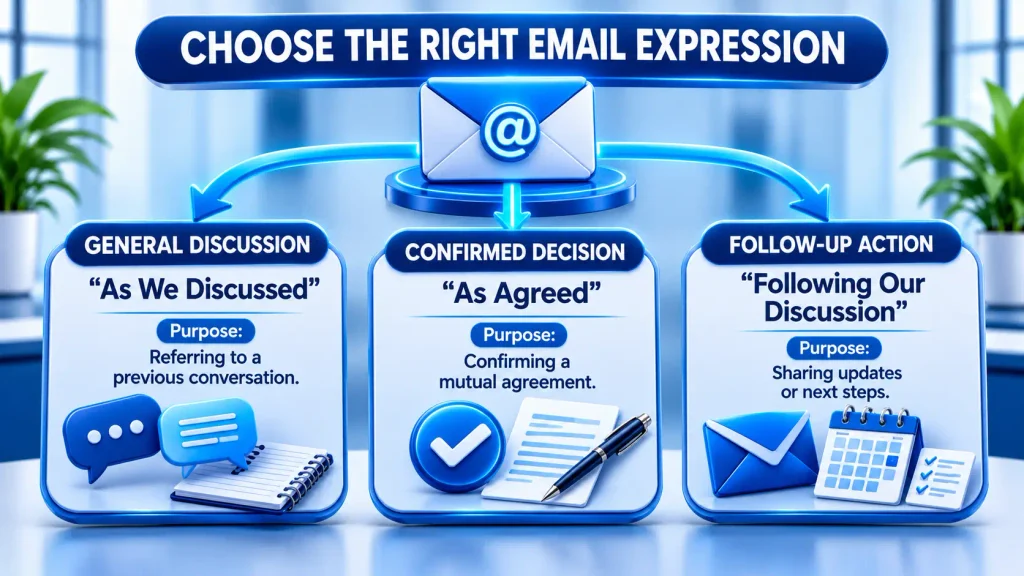
- To refer to a discussion: “As we discussed”
- To confirm a decision: “As agreed”
- To share an update: “Following our discussion”
- To continue a conversation: “To follow up on our conversation”
5. Using the Phrase Without Clear Context
A phrase such as “as previously discussed” may leave readers wondering which conversation you mean.
Instead of:
“As previously discussed, the changes are complete.”
Try:
“As we discussed during Tuesday’s meeting, the website updates are complete.”
Adding a specific reference makes the message clearer.
Frequently Asked Questions
What is the most professional way to say “per our conversation”?
“As we discussed” is one of the most professional and natural alternatives. It works well in business emails, workplace updates, and client communication. If you are referring to a confirmed decision, “as agreed” is a stronger choice.
Is “as per our conversation” grammatically correct?
Yes, “as per our conversation” is grammatically acceptable and means according to a previous discussion. However, it can sound formal or redundant. In most American workplace emails, “as we discussed” or “following our discussion” sounds smoother.
What is a polite way to say “per our conversation” in an email?
“As we discussed” and “following our discussion” are polite, professional choices. For example, “Following our discussion, I have attached the revised document for your review.” These expressions communicate the message without sounding demanding.
Can I use “per our conversation” in a formal business email?
Yes. “Per our conversation” is appropriate in formal business emails, especially when referring to instructions, decisions, or previously shared information. However, “as previously discussed” and “following our discussion” may sound more polished in certain contexts.
What is the difference between “as discussed” and “as agreed”?
“As discussed” refers to a topic that people talked about. “As agreed” refers to a decision or commitment that both parties accepted. Use “as discussed” for general information and “as agreed” when confirming a mutual decision.
How do I say “per our conversation” in a friendly way?
“As we discussed” is a friendly and professional alternative. You can also say “Just following up on our conversation” when sending a casual workplace email or continuing a discussion with a colleague.
What is another way to say “per our conversation yesterday”?
You can say “As we discussed yesterday,” “Following our discussion yesterday,” or “Based on our conversation yesterday.” The best choice depends on whether you are referring to a general discussion, an action, or a decision.
Is “following our discussion” better than “per our conversation”?
“Following our discussion” is often better when you are explaining an action or next step. “Per our conversation” is concise and formal, while “as we discussed” is generally more natural for everyday professional communication.
You may also find these guides useful: Better Ways to Say “Please Find Attached” in an Email, Another Way to Say Sincerely and Another Way to Say “Sounds Good to Me” Naturally.
Conclusion
Choosing another way to say “per our conversation” can make your emails sound more natural, clear, and professional. Expressions such as “as we discussed,” “following our discussion,” and “based on our conversation” work well when referring to previous discussions. If you want to confirm a decision, “as agreed” is a more precise option.
The key is to match your wording to the purpose of your message. Use friendly expressions for everyday workplace communication, formal phrases for business correspondence, and specific wording when confirming decisions or responsibilities. You do not need to make every email sound formal to appear professional. Clear, polite, and appropriate language is often more effective. By choosing the right expression, you can communicate confidently while maintaining a positive relationship with your colleagues, clients, and professional contacts.
“Clear, polite, and appropriate language is often more effective. For additional guidance on professional email etiquette, you can learn how to communicate clearly and courteously in workplace messages.”

The FrontiersPost editorial team writes and reviews every guide to word and phrase alternatives, with clear meanings, tone notes and example sentences for everyday, academic and professional English.