

Another way to say sincerely includes “best regards,” “kind regards,” “warm regards,” “respectfully,” and “yours truly.” These alternatives help you close emails and letters with the right tone. Choose a formal sign-off for business communication, a warm closing for friendly messages, or a simple phrase for everyday professional emails.
Key Takeaways
- “Best regards” is a versatile closing for professional emails.
- “Kind regards” sounds polite and approachable.
- “Respectfully” works well in formal or official communication.
- “Warm regards” adds a personal touch to a professional message.
- Choose your sign-off based on the recipient, purpose, and tone of your message.
Finding another way to say sincerely can help you make your emails, letters, and professional messages sound more natural. Although “sincerely” is a reliable closing, using the same phrase in every message can feel repetitive.
The best alternative depends on whom you are contacting and how formal your message needs to be. Whether you are writing to a manager, contacting a client, or sending a friendly note, the right sign-off leaves a positive final impression.
What Does “Another Way to Say Sincerely” Mean?
The phrase “another way to say sincerely” refers to alternative expressions you can use instead of “Sincerely” at the end of an email or letter.
“Sincerely” is a traditional closing that communicates respect and professionalism. It is common in formal letters, job applications, business correspondence, and messages to people you do not know well.
However, other sign-offs can communicate friendliness, appreciation, warmth, or respect more effectively in certain situations.
When Is “Sincerely” Commonly Used?
You will often see “Sincerely” in:
- Formal business letters and official correspondence.
- Cover letters and job application emails.
- Messages to clients, managers, and unfamiliar recipients.
- Requests that require a professional tone.
For everyday emails, alternatives such as “Best regards” and “Kind regards” may sound more conversational while remaining professional.
Why Use Other Ways to Say “Sincerely”?

Choosing a different email closing helps you match your words to the relationship and purpose of your message. It also keeps your writing from sounding repetitive.
Consider using an alternative when you want to:
- Avoid repetition: Vary your sign-offs across different emails.
- Sound more natural: Choose a closing that fits modern workplace communication.
- Match the situation: Use formal language for official letters and warmer expressions for familiar colleagues.
- Express appreciation: End a message with a thoughtful acknowledgment.
- Build professional relationships: Leave the recipient with a positive impression.
The key is to choose a phrase that feels appropriate rather than simply replacing “Sincerely” with a random synonym.
10 Best Other Ways to Say “Sincerely”

Here are 10 useful alternatives, along with their meanings, suitable contexts, and examples.
1. Best Regards
Meaning
“Best regards” is a polite, professional closing that expresses goodwill toward the recipient. It is less traditional than “Sincerely” but remains appropriate for most workplace emails.
Best For
Professional, Formal, Polite
Example 1
Thank you for reviewing the proposal. I look forward to hearing your thoughts.
Best regards,
Michael
Example 2
I have attached the updated report for your review.
Best regards,
Emily
Quick Tip
Use “Best regards” when emailing clients, coworkers, managers, or business contacts. It is one of the safest choices for routine professional communication.
2. Kind Regards
Meaning
“Kind regards” combines professionalism with a friendly tone. It communicates courtesy without sounding overly formal or too personal.
Best For
Professional, Friendly, Polite, Warm
Example 1
Thank you for your patience while we resolve this issue.
Kind regards,
Rachel
Example 2
Please let me know if you need any additional information about the schedule.
Kind regards,
Daniel
Quick Tip
Choose “Kind regards” when you want your email to feel courteous and approachable, especially when communicating with clients or colleagues.
3. Warm Regards
Meaning
“Warm regards” adds a personal touch to a professional message. It works well when you already have a positive relationship with the recipient.
Best For
Friendly, Warm, Professional
Example 1
It was wonderful speaking with you during the conference.
Warm regards,
Sophia
Example 2
I appreciate your continued support as we move forward with the project.
Warm regards,
James
Quick Tip
Use this closing when the conversation has been friendly or collaborative. For a strictly formal first contact, “Best regards” may be a better fit.
4. Regards
Meaning
“Regards” is a short, neutral sign-off that keeps an email professional and direct. It is less warm than “Kind regards” but works well for routine workplace messages.
Best For
Professional, Polite, Formal
Example 1
The revised meeting agenda is ready for your review.
Regards,
Olivia
Example 2
I will send the final figures once the finance team confirms them.
Regards,
Noah
Quick Tip
Choose “Regards” when you want a concise closing without adding extra emotion. If the message is sensitive, a warmer alternative may feel more considerate.
5. Respectfully
Meaning
“Respectfully” communicates deference and seriousness. It is particularly useful when writing to someone in a position of authority or addressing an official matter.
Best For
Formal, Professional, Polite
Example 1
Thank you for considering my request for an extension.
Respectfully,
David Thompson
Example 2
I appreciate your time and consideration of this proposal.
Respectfully,
Amanda Lee
Quick Tip
Reserve “Respectfully” for formal correspondence, official requests, or situations where respect and authority matter. It may sound unnecessarily stiff in casual workplace emails.
6. With Appreciation
Meaning
“With appreciation” emphasizes gratitude and acknowledges the recipient’s time, assistance, or support. It is a thoughtful alternative when your message expresses genuine thanks.
Best For
Professional, Formal, Warm, Polite
Example 1
Thank you for helping our team complete the project ahead of schedule.
With appreciation,
Lauren
Example 2
Your feedback has been extremely helpful as I prepare the final presentation.
With appreciation,
Ethan
Quick Tip
Use this closing when appreciation is a central part of your message. Make sure the email explains what you are grateful for so the sign-off feels sincere.
7. Thank You
Meaning
“Thank you” is a straightforward closing that expresses gratitude and ends a message on a positive note. It works especially well when you have asked for help, information, or action.
Best For
Professional, Friendly, Polite, Casual
Example 1
Please let me know if Friday works for the proposed meeting.
Thank you,
Megan
Example 2
I appreciate your help with the onboarding process and look forward to working together.
Thank you,
Ryan
Quick Tip
Use “Thank you” when the recipient has helped you or when you are making a reasonable request. Avoid using it as a substitute for an appropriate closing in every message, especially when no gratitude is intended.
8. All the Best
Meaning
“All the best” is a friendly sign-off that expresses goodwill. It is less formal than “Sincerely” and is especially suitable for colleagues, acquaintances, and people you know reasonably well.
Best For
Friendly, Warm, Casual, Professional
Example 1
Good luck with your presentation tomorrow. I am sure it will go well.
All the best,
Chris
Example 2
I enjoyed working with you on this campaign and hope our paths cross again.
All the best,
Jessica
Quick Tip
Choose “All the best” for friendly professional exchanges, farewell messages, or encouraging notes. For formal applications and official letters, use a more traditional closing.
9. Yours Truly
Meaning
“Yours truly” is a traditional sign-off that conveys formality and courtesy. It can suit formal letters, although it may sound old-fashioned in everyday business emails.
Best For
Formal, Polite
Example 1
Thank you for considering my application for the administrative position.
Yours truly,
Benjamin Carter
Example 2
I appreciate your attention to this matter and look forward to your response.
Yours truly,
Hannah Brooks
Quick Tip
Use “Yours truly” when a traditional letter-writing style fits the situation. In modern business emails, “Best regards” or “Kind regards” will usually sound more natural.
10. Cordially
Meaning
“Cordially” is a formal closing that communicates courtesy and goodwill. It is more traditional than most everyday email sign-offs and may suit official letters or formal invitations.
Best For
Formal, Professional, Polite
Example 1
We would be pleased to discuss your proposal at the upcoming meeting.
Cordially,
Victoria Adams
Example 2
Thank you for your interest in participating in our annual conference.
Cordially,
Robert Miller
Quick Tip
Choose “Cordially” when a formal, traditional tone is appropriate. For routine messages to coworkers, a simpler closing usually feels more natural.
Comparison Table
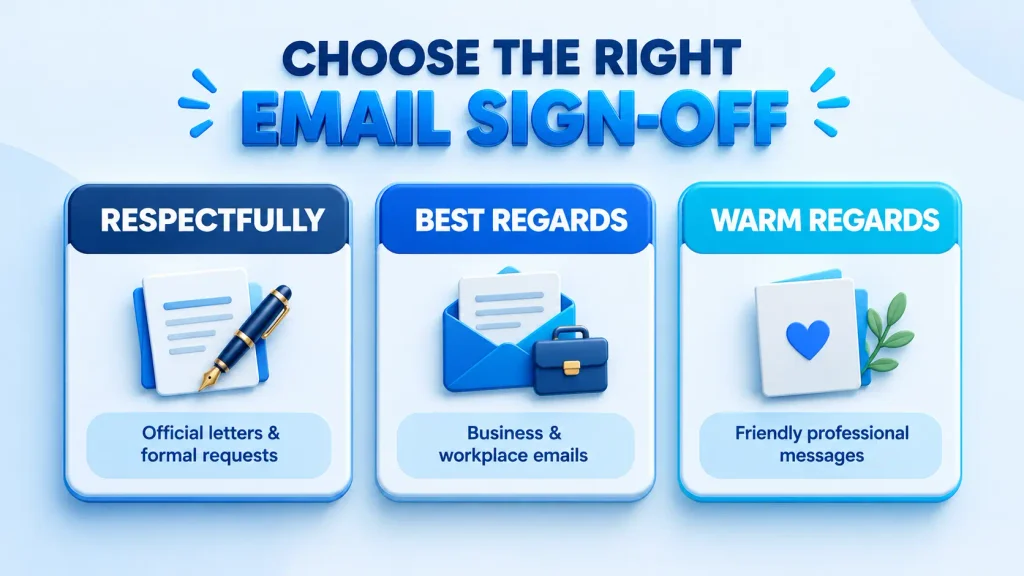
The following table makes it easier to select the right alternative for your message.
| Alternative | Best Used In | Tone |
|---|---|---|
| Best regards | Business and workplace emails | Professional, neutral |
| Kind regards | Client and colleague communication | Polite, friendly |
| Warm regards | Positive professional relationships | Warm, personal |
| Regards | Short, routine emails | Neutral, direct |
| Respectfully | Official letters and formal requests | Formal, deferential |
| With appreciation | Thank-you messages | Grateful, warm |
| Thank you | Requests and messages of gratitude | Polite, direct |
| All the best | Friendly emails and farewells | Casual, encouraging |
| Yours truly | Traditional formal letters | Formal, traditional |
| Cordially | Official correspondence and invitations | Formal, courteous |
Common Mistakes

Choosing a sign-off seems simple, but a mismatch can make an otherwise well-written message feel awkward.
1. Using Casual Phrases in Formal Emails
Closings such as “All the best” work well in many professional settings, but highly formal letters may require a more traditional option.
Better approach: Use “Respectfully” or “Yours truly” when the situation calls for a formal tone.
2. Making Every Email Sound Overly Formal
Using “Cordially” or “Yours truly” in every workplace message can sound stiff or outdated.
Better approach: Choose “Best regards” or “Kind regards” for ordinary professional exchanges.
3. Repeating the Same Closing Too Often
Ending every message with the same phrase can make your communication feel automatic, especially when you exchange emails with the same people regularly.
Better approach: Vary your closing naturally when the context changes. Do not change it simply for the sake of variety.
4. Ignoring the Relationship With the Recipient
A closing that works for a close colleague may not suit a first email to a senior executive or government official.
Better approach: Consider your recipient’s role, your relationship, and the purpose of the message before choosing a sign-off.
5. Using a Closing That Does Not Match Your Message
A warm sign-off may feel out of place in a complaint, while “Respectfully” may sound unnecessarily serious after a routine thank-you.
Better approach: Match the closing to the message’s overall tone. Genuine, consistent communication matters more than using an impressive phrase.
Frequently Asked Questions

1. What is the best alternative to sincerely in an email?
“Best regards” is one of the most versatile alternatives to “Sincerely” in professional emails. It works for clients, colleagues, managers, and business contacts. If you want a slightly warmer tone, choose “Kind regards.” For official correspondence, “Respectfully” may be more suitable.
2. What is a more professional way to say sincerely?
“Best regards,” “Kind regards,” and “Regards” are professional alternatives. The best choice depends on the message and recipient. “Best regards” works well for general business communication, while “Respectfully” is more appropriate for formal requests or official correspondence.
3. What can I use instead of sincerely in a formal letter?
You can use “Respectfully,” “Yours truly,” or “Cordially,” depending on the purpose of your letter. “Respectfully” emphasizes deference, while “Yours truly” has a traditional letter-writing style. For modern business correspondence, “Best regards” is often a natural choice.
4. Is best regards better than sincerely?
Neither is always better. “Sincerely” is a traditional formal closing, while “Best regards” is common in modern professional emails. Use “Sincerely” when a conventional formal sign-off is expected and “Best regards” for routine business communication.
5. Can I use kind regards instead of sincerely?
Yes. “Kind regards” is a polite and professional alternative to “Sincerely.” It adds a slightly warmer tone while remaining suitable for workplace communication. It is particularly useful when emailing clients, colleagues, or people with whom you have an established professional relationship.
6. What is a friendly alternative to sincerely?
“All the best” and “Warm regards” are friendly alternatives. “All the best” suits casual professional messages, farewell notes, and encouraging emails. “Warm regards” offers a more personal touch while maintaining professionalism. Choose the phrase that best reflects your relationship with the recipient.
7. Is sincerely too formal for everyday emails?
“Sincerely” is not necessarily too formal, but it can feel traditional in quick, everyday workplace exchanges. “Best regards,” “Kind regards,” and “Regards” often sound more natural in modern business emails. Your organization’s communication style and your relationship with the recipient also matter.
8. Should sincerely be capitalized in an email sign-off?
When “Sincerely” begins a sign-off on its own line, it is normally capitalized as the first word. For example, write “Sincerely,” followed by your name on the next line. The same convention applies to closings such as “Best regards,” “Kind regards,” and “Thank you.”
Writing something similar? Try Another Way to Say “Sounds Good to Me” Naturally, What to Say Instead of “Team Player” on a Resume or Another Way to Say Thank You for Your Support.
Conclusion
Choosing another way to say sincerely helps you make your emails and letters sound appropriate, natural, and professional. The right closing depends on your recipient, your purpose, and the tone you want to convey.
For everyday business emails, “Best regards” and “Kind regards” are reliable choices. Use “Warm regards” to add friendliness, “With appreciation” to express gratitude, and “Respectfully” for formal requests or official correspondence. If you prefer a traditional style, “Yours truly” and “Cordially” may also work.
Remember that the best sign-off is not necessarily the most formal or unusual one. It is the phrase that fits your message and relationship with the recipient. Choose your words thoughtfully, keep your tone consistent, and learn more about formal email sign-offs to make your communication more effective.

The FrontiersPost editorial team writes and reviews every guide to word and phrase alternatives, with clear meanings, tone notes and example sentences for everyday, academic and professional English.




