

Another way to say “team player” includes collaborative professional, team-oriented, works well with others, strong collaborator, supportive colleague, and cooperative teammate. The best choice depends on context. For resumes and cover letters, professional phrases such as “collaborative professional” or “works well with others” can sound more specific and polished.
Key Takeaways
- “Team player” describes someone who works effectively with others toward a shared goal.
- Collaborative professional is a strong choice for resumes and professional profiles.
- Works well with others sounds natural, clear, and widely applicable.
- More specific phrases can show how you contribute to a team instead of simply labeling you.
- Choose an alternative based on the situation, tone, and quality you want to emphasize.
If you are writing a resume, cover letter, performance review, or professional email, you may want another way to say team player. Although the phrase is positive, it is also very common, so using a more specific expression can make your writing sound fresher and more professional.
The right alternative depends on what you want to communicate. Some phrases emphasize collaboration, while others highlight cooperation, support, communication, or your ability to contribute to shared goals.
What Does “Another Way to Say Team Player” Mean?

“Another way to say team player” refers to an alternative expression for describing someone who works effectively with other people. A team player communicates well, supports colleagues, contributes to group goals, and is willing to cooperate.
The phrase is commonly used in resumes, job interviews, cover letters, performance reviews, workplace conversations, and professional bios. However, alternatives can help you describe the specific quality you bring to a team.
For example, instead of simply saying, “I am a team player,” you could write, “I work well with cross-functional teams” or “I am a collaborative professional who contributes to shared goals.”
Why Use Other Ways to Say “Team Player”?
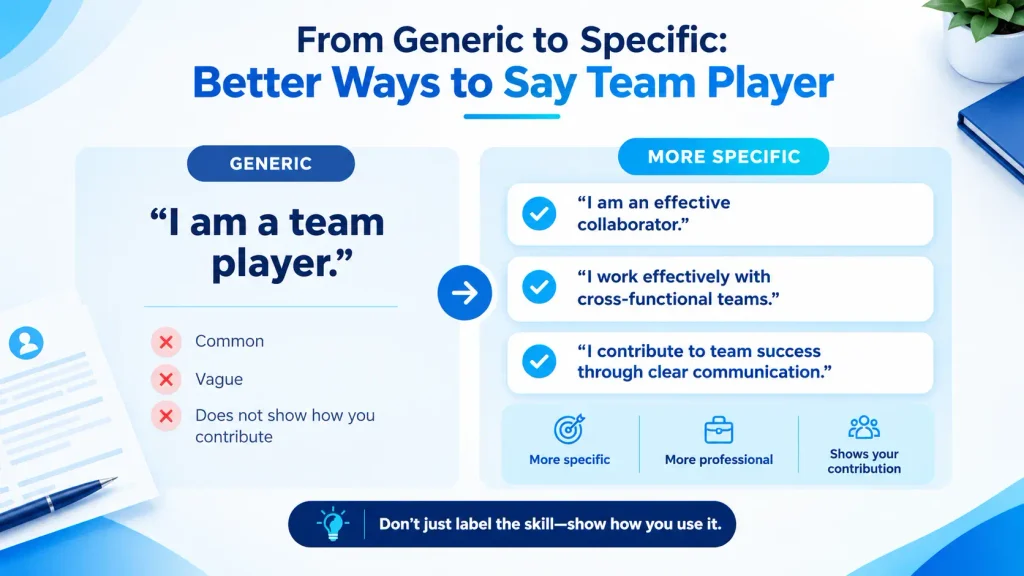
Using a more specific expression can make your writing more convincing and less generic. This is especially useful when you are describing your professional strengths.
Other phrases can help you:
- Avoid repeating the same common expression.
- Sound more natural and specific.
- Highlight collaboration as a professional skill.
- Match your wording to a formal or casual setting.
- Explain how you contribute to group success.
- Make resume and interview language more meaningful.
10 Best Other Ways to Say “Team Player”

1. Collaborative Professional
Meaning
A collaborative professional is someone who works effectively with colleagues, shares ideas, and contributes to common goals. It sounds polished and emphasizes collaboration as an important workplace strength.
Best For
- Professional
- Formal
- Resume writing
Example 1
I am a collaborative professional who enjoys working with cross-functional teams to solve complex problems.
Example 2
As a collaborative professional, I value open communication and shared responsibility.
Quick Tip
Use this phrase on a resume or LinkedIn profile when you want a polished alternative to “team player.”
2. Works Well With Others
Meaning
Works well with others is a simple and natural way to describe strong interpersonal and collaboration skills. It is easy to understand and does not sound overly formal.
Best For
- Professional
- Friendly
- Casual
Example 1
She works well with others and remains dependable when projects become demanding.
Example 2
My manager noted that I work well with others and communicate clearly under pressure.
Quick Tip
This is a good choice when you want your writing to sound straightforward rather than corporate.
3. Team-Oriented Professional
Meaning
A team-oriented professional focuses on group success rather than individual achievement alone. The phrase suggests that someone values cooperation, shared goals, and productive workplace relationships.
Best For
- Professional
- Formal
- Resume writing
Example 1
We are looking for a team-oriented professional who can contribute to a growing sales department.
Example 2
He is a team-oriented professional who consistently supports department-wide initiatives.
Quick Tip
Use this phrase when the job description emphasizes collaboration or group performance.
4. Strong Collaborator
Meaning
A strong collaborator is someone who works productively with others, exchanges ideas, and helps move projects forward. It is more specific than simply calling someone a team player.
Best For
- Professional
- Formal
- Friendly
Example 1
Maria is a strong collaborator who brings different departments together to meet project deadlines.
Example 2
The hiring manager described him as a strong collaborator with excellent communication skills.
Quick Tip
This phrase works particularly well when you can follow it with a specific example of successful teamwork.
5. Supportive Colleague
Meaning
A supportive colleague is someone who helps coworkers, shares knowledge, and contributes to a positive work environment. The expression places more emphasis on helping others than on general teamwork.
Best For
- Professional
- Friendly
- Warm
Example 1
James has always been a supportive colleague who is willing to help new employees learn the process.
Example 2
She is known as a supportive colleague who listens carefully and offers practical feedback.
Quick Tip
Choose this expression when you want to emphasize kindness, reliability, and support.
6. Cooperative Teammate
Meaning
A cooperative teammate is someone who is willing to work with others, compromise when necessary, and contribute to a shared objective. It highlights a positive and flexible approach to teamwork.
Best For
- Professional
- Friendly
- Casual
Example 1
He is a cooperative teammate who readily adjusts when project priorities change.
Example 2
Being a cooperative teammate helped us resolve the scheduling issue quickly.
Quick Tip
This phrase is useful when you want to highlight flexibility and willingness to compromise.
7. Contributes to Team Success
Meaning
Contributes to team success focuses on what a person actually does rather than simply describing a personality trait. It suggests that the person makes meaningful contributions toward shared results.
Best For
- Professional
- Formal
- Resume writing
Example 1
She consistently contributes to team success by sharing useful insights during planning meetings.
Example 2
I contribute to team success by meeting deadlines and helping colleagues overcome obstacles.
Quick Tip
This is particularly effective on resumes because it connects teamwork with an action or result.
8. Team-Focused Professional
Meaning
A team-focused professional prioritizes shared objectives and considers how individual work affects the larger group. It conveys cooperation while still sounding professional.
Best For
- Professional
- Formal
- Resume writing
Example 1
As a team-focused professional, I make clear communication a priority throughout every project.
Example 2
The company needs a team-focused professional who can balance individual responsibilities with department goals.
Quick Tip
Use this phrase when you want to show that you care about both personal performance and collective results.
9. Effective Collaborator
Meaning
An effective collaborator is someone who can communicate, coordinate, and work productively with different people. It suggests that teamwork produces useful outcomes rather than simply describing a positive attitude.
Best For
- Professional
- Formal
- Resume writing
Example 1
She is an effective collaborator who helps teams stay organized during large projects.
Example 2
The position requires an effective collaborator who can work with clients and internal departments.
Quick Tip
This is a strong option when applying for positions that require cross-functional communication.
10. Works Effectively With Others
Meaning
Works effectively with others communicates the same general idea as “team player” while sounding more descriptive. It focuses on a person’s ability to cooperate and produce results with colleagues.
Best For
- Professional
- Formal
- Polite
Example 1
I work effectively with others and adapt my communication style to different teams.
Example 2
Successful candidates should work effectively with others while managing their individual responsibilities.
Quick Tip
Use this phrase when you want a professional expression that sounds natural and avoids unnecessary jargon.
Comparison Table
| Alternative | Best Used In | Tone |
|---|---|---|
| Collaborative Professional | Resumes, profiles | Professional |
| Works Well With Others | General workplace writing | Natural |
| Team-Oriented Professional | Resumes, job applications | Formal |
| Strong Collaborator | Workplace communication | Professional |
| Supportive Colleague | Performance reviews, recommendations | Warm |
| Cooperative Teammate | Workplace conversations | Friendly |
| Contributes to Team Success | Resumes, performance reviews | Results-focused |
| Team-Focused Professional | Job applications, profiles | Professional |
| Effective Collaborator | Resumes, interviews | Formal |
| Works Effectively With Others | Professional writing | Polite |
Common Mistakes
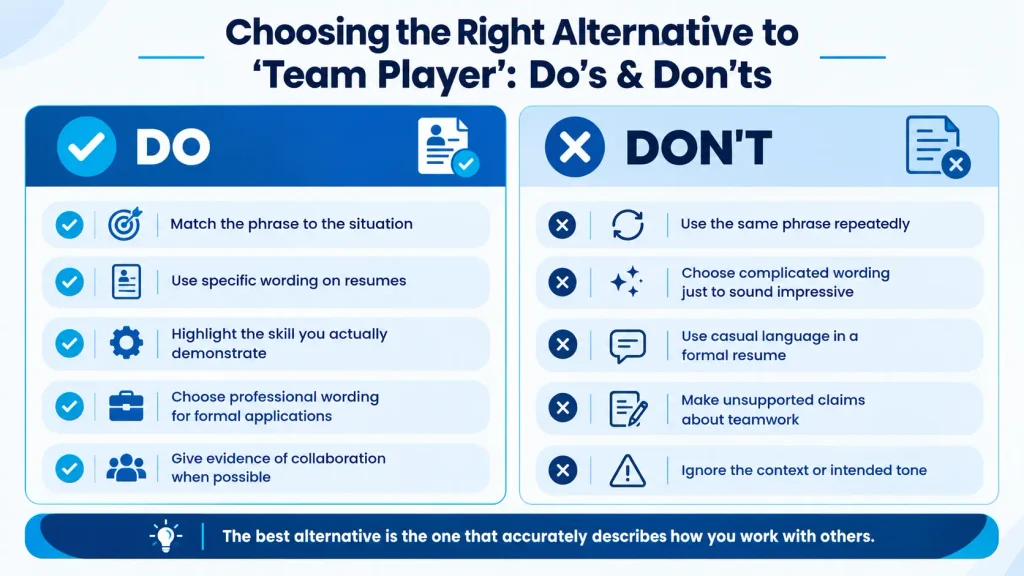
1. Using a Casual Phrase in a Formal Application
Expressions such as “great to work with” can sound too informal for some resumes or cover letters. Choose a polished phrase such as “effective collaborator” when the context calls for a professional tone.
2. Choosing Overly Formal Language
Professional writing does not need to sound complicated. A simple phrase such as “works well with others” may be stronger than an unnecessarily sophisticated expression.
3. Repeating “Team Player” Too Often
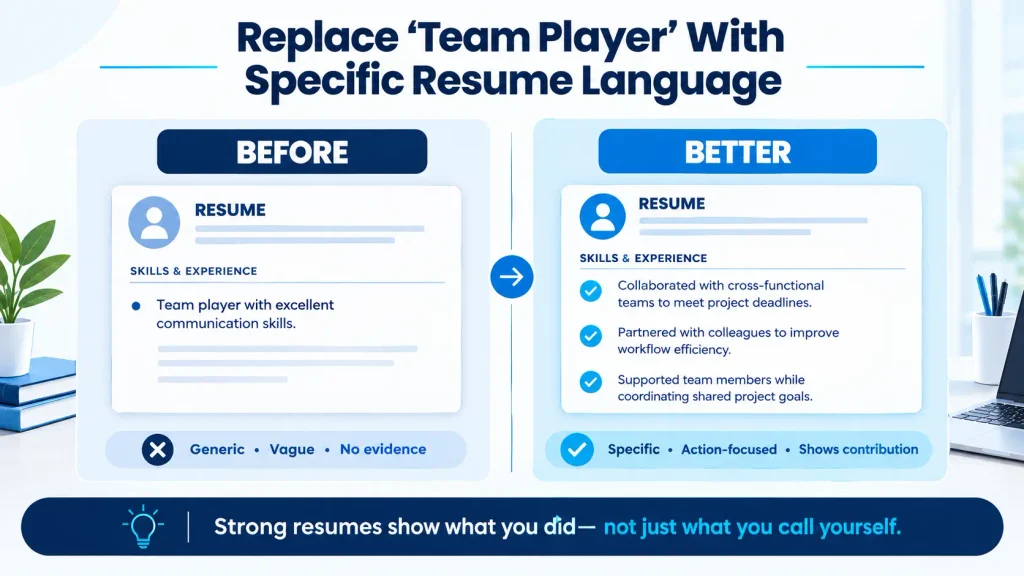
Using the same phrase throughout a resume can make your writing feel generic. Instead, describe specific behaviors, such as supporting coworkers, coordinating projects, or contributing to shared goals.
4. Forgetting the Context
Not every alternative fits every situation. “Supportive colleague” emphasizes helping others, while “effective collaborator” focuses more on productive cooperation.
5. Making an Unsupported Claim
Simply saying that you are a great team player does not prove the skill. Whenever possible, support the statement with a specific example, accomplishment, or result.
Frequently Asked Questions
What is a professional way to say “team player”?
A professional way to say “team player” is collaborative professional, effective collaborator, or team-oriented professional. These expressions work well in resumes, cover letters, interviews, and professional profiles because they describe collaboration without relying on a common workplace cliché.
What is another way to say “I am a team player” on a resume?
Instead of “I am a team player,” write something more specific, such as “I work effectively with cross-functional teams” or “I contribute to team success through clear communication and reliable project support.” Specific wording gives employers a better idea of how you actually contribute to group goals.
How do you say “team player” without using the phrase?
You can say “works well with others,” “strong collaborator,” “team-oriented professional,” or “effective collaborator.” The best choice depends on your goal. For a resume, action-focused wording is often stronger because it shows what you contribute rather than simply giving yourself a label.
What is a good synonym for “team player” at work?
Good workplace alternatives include collaborator, team-oriented professional, supportive colleague, cooperative teammate, and effective collaborator. Each one emphasizes a slightly different quality, so choose the expression that matches your actual strength and the responsibilities of the position.
How can I describe teamwork skills on a resume?
Describe teamwork skills with specific actions and outcomes. For example, you might say that you coordinated with cross-functional teams, supported colleagues during major projects, shared knowledge, resolved team challenges, or helped achieve a shared deadline. This approach is more convincing than simply writing “team player.”
Is “works well with others” professional?
Yes. Works well with others is professional, clear, and widely understood. It is less formal than “effective collaborator,” but it can sound more natural. It is especially useful when writing performance reviews, workplace descriptions, interview answers, or straightforward professional statements.
What is a better word than “team player”?
There is no single replacement that works in every situation. Collaborator is a strong general choice, while supportive colleague highlights helpfulness and team-oriented professional emphasizes a commitment to shared goals. Choose the word that describes the specific behavior you want readers to notice.
Should I use “team player” on a resume?
You can, but it is often better to show the skill through specific language and examples. Rather than relying only on “team player,” explain how you collaborate, communicate, support colleagues, or contribute to shared results. This makes your resume more informative and gives the employer evidence of your teamwork skills.
For related wording choices, see Another Way to Say Thank You for Your Support, How to Say Thank You in an Email More Professionally and “To Whom It May Concern”.
Conclusion
There are many effective ways to say team player, and the best choice depends on what you want to emphasize. For a resume or cover letter, collaborative professional, effective collaborator, and team-oriented professional are polished choices. If you want something simple and natural, works well with others is an excellent option.
There are many effective ways to say team player, and the best choice depends on what you want to emphasize. For a resume or cover letter, collaborative professional, effective collaborator, and team-oriented professional are polished choices.
For a warmer message, supportive colleague may be more appropriate, while contributes to team success works well when you want to focus on results. Instead of choosing an alternative simply because it sounds impressive, select one that accurately reflects how you work with others. The strongest professional writing does more than claim you are a team player—it shows the reader how your collaboration helps the team succeed.

The FrontiersPost editorial team writes and reviews every guide to word and phrase alternatives, with clear meanings, tone notes and example sentences for everyday, academic and professional English.