
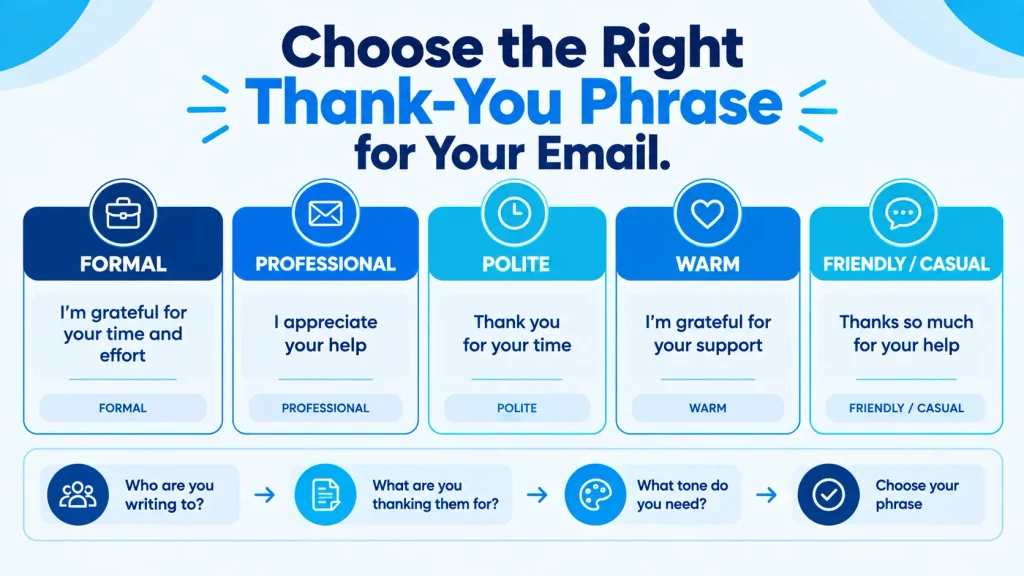
Another way to say thank you in an email includes phrases such as “I appreciate your help,” “Many thanks,” “I’m grateful for your support,” and “Thank you for your time.” The best choice depends on your relationship with the recipient, the purpose of the email, and whether you want to sound formal, professional, warm, or casual.
Key Takeaways
- Choose your thank-you phrase based on the email’s tone and purpose.
- “I appreciate your help” works well in most professional situations.
- Use “Many thanks” for a brief, polished closing or response.
- Warm phrases can make personal and professional messages feel more genuine.
- Avoid overly formal or casual wording when it does not fit the recipient.
What Does “Another Way to Say Thank You in Email” Mean?
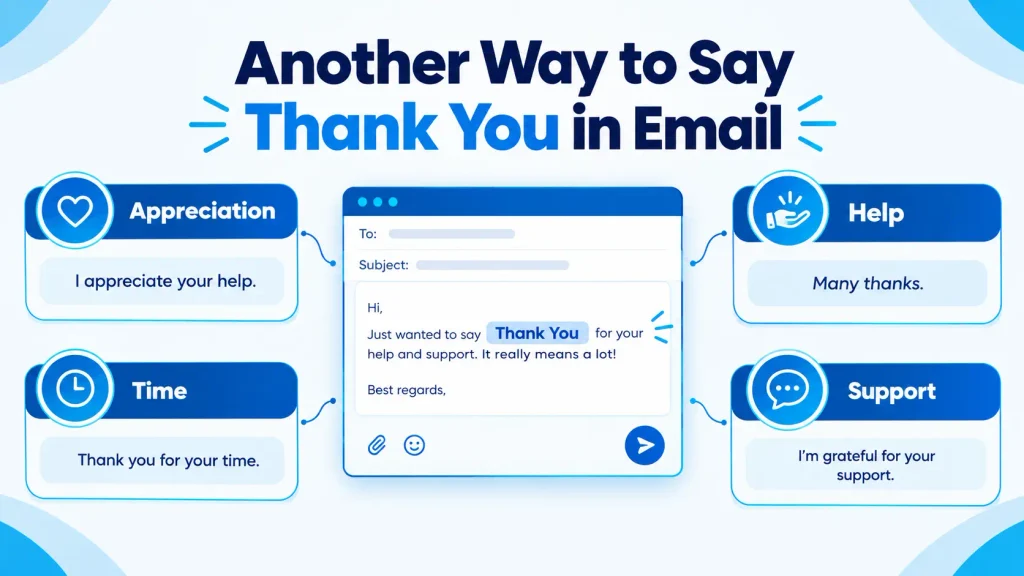
“Another way to say thank you in email” refers to alternative phrases you can use instead of repeating “thank you” in written communication. These expressions help you show appreciation while making your message sound more natural and specific.
People commonly search for these alternatives when writing professional emails, responding to assistance, thanking someone for their time, or acknowledging support. Choosing the right wording can make a simple thank-you feel more thoughtful and appropriate.
Why Use Other Ways to Say “Thank You in Email”?
Repeating “thank you” in every email can make your writing feel predictable. Using a suitable alternative lets you express appreciation while matching the situation and your relationship with the recipient.
Other expressions can help you:
- Avoid repeating the same phrase.
- Sound more natural and polished.
- Match formal and informal situations.
- Show appreciation more specifically.
- Make professional communication more engaging.
- Express warmth without sounding exaggerated.
10 Best Other Ways to Say “Thank You in Email”
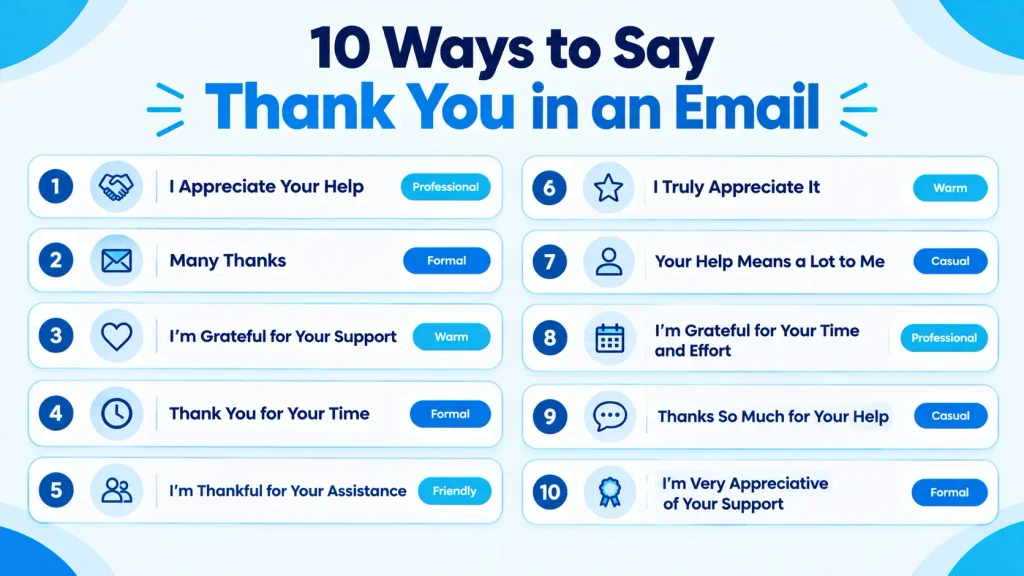
1. I Appreciate Your Help
Meaning
“I appreciate your help” directly recognizes someone’s effort or assistance. It sounds professional without being stiff, making it one of the most useful alternatives for workplace emails.
Best For
- Professional
- Polite
- Friendly
Example 1
I appreciate your help with organizing the client meeting.
Example 2
I appreciate your help in getting these documents ready before the deadline.
Quick Tip
Use this phrase when the recipient has taken action or provided practical assistance.
2. Many Thanks
Meaning
“Many thanks” is a concise way to express sincere appreciation. It is slightly warmer than a basic “thank you” while still fitting many professional emails.
Best For
- Professional
- Formal
- Friendly
- Polite
Example 1
Many thanks for sending the revised proposal so quickly.
Example 2
Many thanks for taking the time to review my application.
Quick Tip
This works especially well near the end of a short business email.
3. I’m Grateful for Your Support
Meaning
“I’m grateful for your support” communicates stronger appreciation than a routine thank-you. It is useful when someone has provided meaningful guidance, encouragement, or assistance.
Best For
- Formal
- Professional
- Warm
Example 1
I’m grateful for your support throughout the training process.
Example 2
I’m grateful for your support as we worked through this project.
Quick Tip
Reserve this expression for situations where the person’s support genuinely mattered.
4. Thank You for Your Time
Meaning
“Thank you for your time” specifically acknowledges the time someone spent speaking with you, meeting with you, reviewing something, or helping with a request.
Best For
- Professional
- Formal
- Polite
Example 1
Thank you for your time during yesterday’s interview.
Example 2
Thank you for your time and for answering all of my questions.
Quick Tip
Use this when the recipient’s time or attention is the main thing you want to acknowledge.
5. I’m Thankful for Your Assistance
Meaning
“I’m thankful for your assistance” clearly expresses appreciation for someone’s help. It has a slightly warmer feel than more routine business wording.
Best For
- Professional
- Polite
- Warm
Example 1
I’m thankful for your assistance with the registration process.
Example 2
I’m thankful for your assistance in resolving this issue.
Quick Tip
Use it when you want to emphasize that the recipient’s assistance made a difference.
6. I Truly Appreciate It
Meaning
“I truly appreciate it” adds sincerity to a thank-you without becoming overly formal. It works particularly well when the recipient has done something helpful or considerate.
Best For
- Friendly
- Warm
- Professional
- Polite
Example 1
I truly appreciate it, especially given how busy your schedule has been.
Example 2
Your quick response made a big difference, and I truly appreciate it.
Quick Tip
This phrase is most natural when the specific favor or action has already been mentioned.
7. Your Help Means a Lot to Me
Meaning
“Your help means a lot to me” communicates personal appreciation and emotional warmth. It is more personal than standard workplace expressions, so context matters.
Best For
- Warm
- Friendly
- Casual
Example 1
Your help means a lot to me as I prepare for this presentation.
Example 2
I was having trouble getting started, so your help means a lot to me.
Quick Tip
Use this with people you know well or when the assistance had a meaningful personal impact.
8. I’m Grateful for Your Time and Effort
Meaning
This phrase recognizes both the time and work someone invested. It is useful when a person has gone beyond simply answering a quick question.
Best For
- Formal
- Professional
- Warm
Example 1
I’m grateful for your time and effort in preparing the report.
Example 2
I’m grateful for your time and effort during the entire review process.
Quick Tip
Choose this wording when you want to acknowledge substantial effort rather than a simple favor.
9. Thanks So Much for Your Help
Meaning
“Thanks so much for your help” is friendly, natural, and more enthusiastic than a standard “thanks.” It works well in relaxed professional relationships and everyday email conversations.
Best For
- Casual
- Friendly
- Warm
- Polite
Example 1
Thanks so much for your help with the presentation slides.
Example 2
Thanks so much for your help—I was able to finish everything on time.
Quick Tip
Use this in friendly workplace conversations, but choose a more formal option for highly formal correspondence.
10. I’m Very Appreciative of Your Support
Meaning
“I’m very appreciative of your support” gives your message a thoughtful and respectful tone. It works particularly well when someone’s ongoing support has helped you reach a goal or handle a challenge.
Best For
- Professional
- Formal
- Warm
Example 1
I’m very appreciative of your support during this transition.
Example 2
I’m very appreciative of your support and guidance throughout the project.
Quick Tip
This phrase works best when you want to recognize continued support rather than a single small favor.
Comparison Table
| Alternative | Best Used In | Tone |
| I appreciate your help | Workplace emails | Professional, polite |
| Many thanks | Short professional messages | Formal, friendly |
| I’m grateful for your support | Meaningful assistance | Warm, professional |
| Thank you for your time | Meetings and interviews | Formal, polite |
| I’m thankful for your assistance | Help with a task | Professional, warm |
| I truly appreciate it | Personal or professional favors | Warm, friendly |
| Your help means a lot to me | Meaningful personal support | Warm, casual |
| I’m grateful for your time and effort | Significant contributions | Formal, professional |
| Thanks so much for your help | Relaxed workplace emails | Friendly, casual |
| I’m very appreciative of your support | Ongoing assistance | Professional, warm |
Common Mistakes
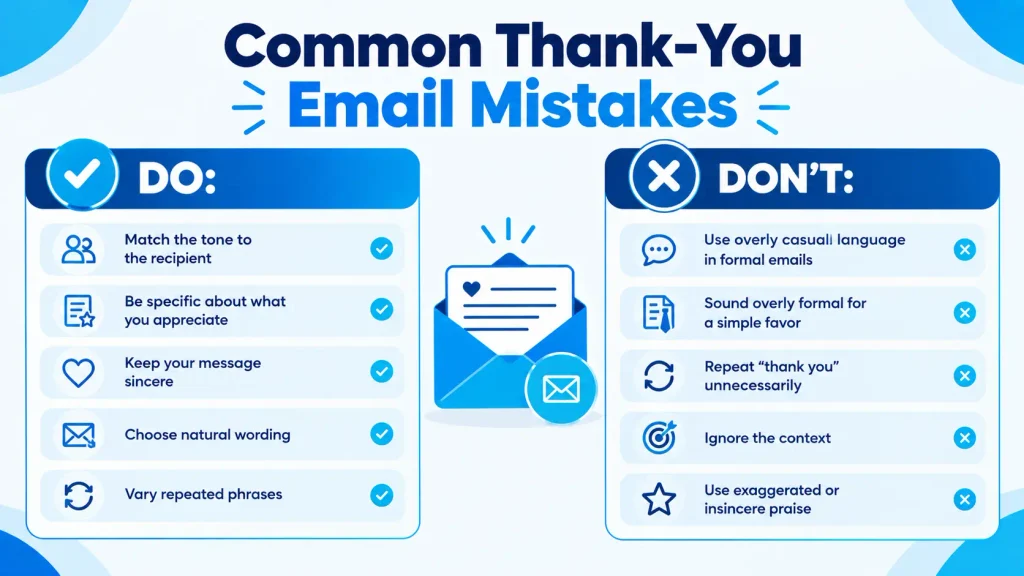
1. Using Casual Phrases in Professional Emails
Phrases such as “Thanks a bunch” or “You’re awesome” may sound too informal in a formal business email. Match your wording to the recipient and relationship.
2. Choosing Overly Formal Language
Not every email needs sophisticated wording. A simple phrase such as “I appreciate your help” can sound more natural than an unnecessarily elaborate expression.
3. Repeating the Same Phrase
Using “thank you” several times in the same email can feel repetitive. Vary your wording when you have multiple reasons to express appreciation.
4. Forgetting the Context
A thank-you after an interview is different from a thank-you to a coworker for completing a small task. Choose language that reflects the actual situation.
5. Sounding Insincere
Avoid adding strong emotional language when the situation does not call for it. A specific, honest statement of appreciation usually sounds more genuine.
Frequently Asked Questions
What is a professional way to say thank you in an email?
“I appreciate your help” is a reliable professional alternative to “thank you.” Other options include “Many thanks,” “I’m grateful for your support,” and “Thank you for your time.” The best phrase depends on what the recipient did and how formal your relationship is.
How do you say thank you professionally without saying thank you?
You can say “I appreciate your assistance,” “Many thanks,” or “I’m grateful for your support.” These phrases communicate appreciation without relying on the exact words “thank you.” For workplace emails, choose an expression that clearly connects to the recipient’s effort, time, guidance, or support.
What is a warm way to say thank you in an email?
“I truly appreciate it,” “Your help means a lot to me,” and “I’m grateful for your support” can make an email sound warmer. These expressions work especially well when someone has provided meaningful assistance or gone out of their way to help you.
How do you thank someone for their time in an email?
“Thank you for your time” is direct and professional. You can also write “I appreciate you taking the time to meet with me” or “I’m grateful for the time you spent discussing this with me.” These options work well after interviews, meetings, consultations, and calls.
What is another way to say “I appreciate your help”?
You can say “I’m grateful for your assistance,” “Many thanks for your support,” or “I truly appreciate it.” For most professional emails, “I’m grateful for your assistance” provides a polished alternative while clearly recognizing the person’s contribution.
Is “many thanks” professional?
Yes. “Many thanks” is widely suitable for professional emails, particularly when you want a concise and friendly expression of appreciation. It works well in messages involving documents, quick responses, introductions, information, or other forms of assistance.
How can I make a thank-you email sound more sincere?
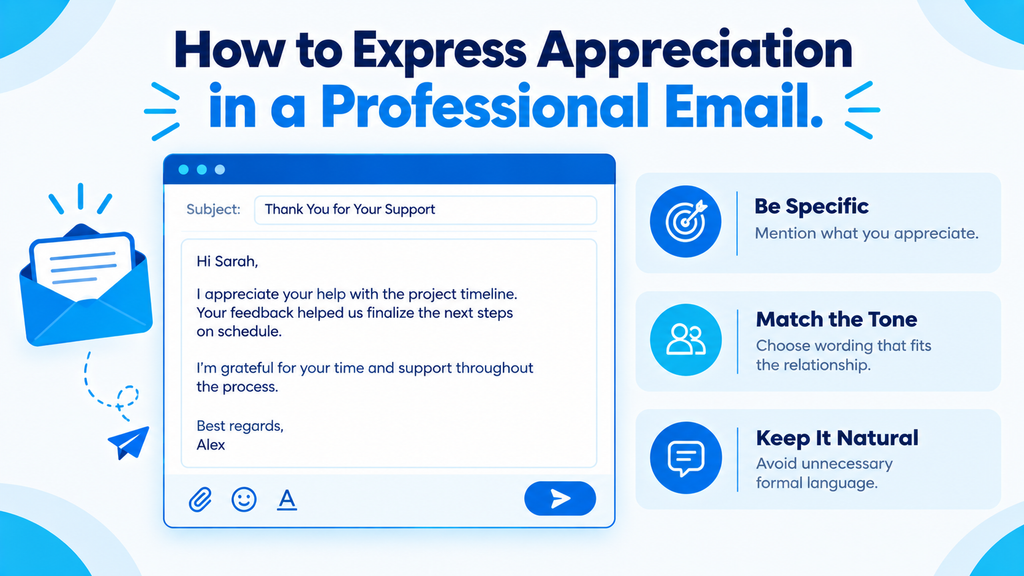
Mention what you appreciate instead of relying only on a general expression. For example, saying “I appreciate your detailed feedback on the proposal” gives the recipient a clear reason for your gratitude and usually sounds more genuine than a brief, unexplained thank-you.
Which thank-you phrase should I use in a formal email?
For formal emails, consider “I’m grateful for your support,” “I appreciate your assistance,” or “Thank you for your time.” These phrases are respectful and clear without sounding overly casual. Consider the recipient’s position and the seriousness of the communication before choosing your wording.
Conclusion
Knowing another way to say thank you in an email can help you communicate with greater variety and precision. The right expression depends on what you are thanking someone for, your relationship with the recipient, and the tone you want to create.
For most workplace situations, “I appreciate your help” is a natural and dependable choice. “Many thanks” works well for concise professional messages, while “I’m grateful for your support” adds warmth when someone’s assistance has been meaningful. If you are thanking someone for their time, “Thank you for your time” is direct and appropriate.
The key is to make your appreciation specific and sincere. Rather than searching for the most complicated alternative, choose the phrase that naturally fits the situation and clearly communicates why you are grateful.

Sarah Mitchell is a Senior English Editor at FrontiersPost, specializing in English usage, vocabulary, word choice, grammar, and effective communication. She focuses on helping readers understand subtle differences between commonly confused words, phrases, and expressions and use them naturally in everyday, professional, and academic writing.
At FrontiersPost, Sarah researches, writes, and edits educational content with an emphasis on clarity, accuracy, and practical examples. She works closely with the editorial team to ensure that articles are easy to understand while maintaining appropriate context, meaning, and usage.
Her editorial interests include English vocabulary, synonyms, phrasing, professional communication, and the practical nuances that can make written communication more precise and effective.