

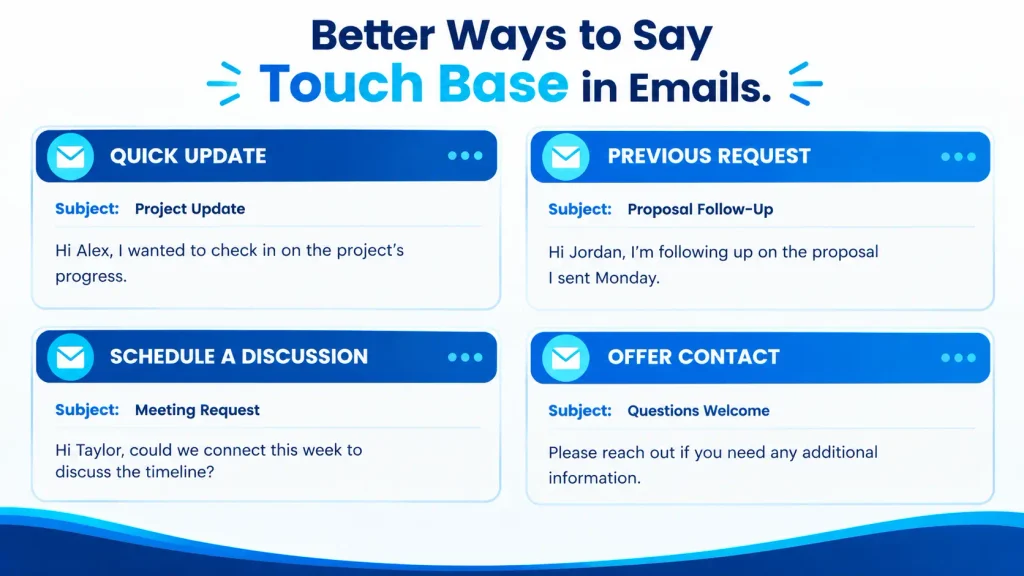
Another way to say touch base is check in, follow up, connect, get in touch, or catch up. These alternatives help you communicate more naturally in professional emails, meetings, and everyday conversations. Use “check in” for a quick update, “follow up” for an ongoing task, and “connect” when arranging a conversation.
Key Takeaways
- “Touch base” means contacting someone briefly to share an update or discuss something.
- “Check in” is a natural choice for quick updates and status requests.
- “Follow up” works best when continuing an earlier conversation or task.
- “Connect” and “get in touch” are useful when arranging professional communication.
- Choose an alternative based on your relationship with the recipient, your purpose, and the tone you want.
“Touch base” is a common expression in American English, especially in workplaces, emails, and business meetings. Although it sounds friendly and professional, using it too often can make your messages feel repetitive.
Fortunately, you have several alternatives that communicate the same idea more clearly. Whether you want to request an update, schedule a conversation, or reconnect with a colleague, the right phrase can make your message sound more natural.
What Does “Another Way to Say Touch Base” Mean?
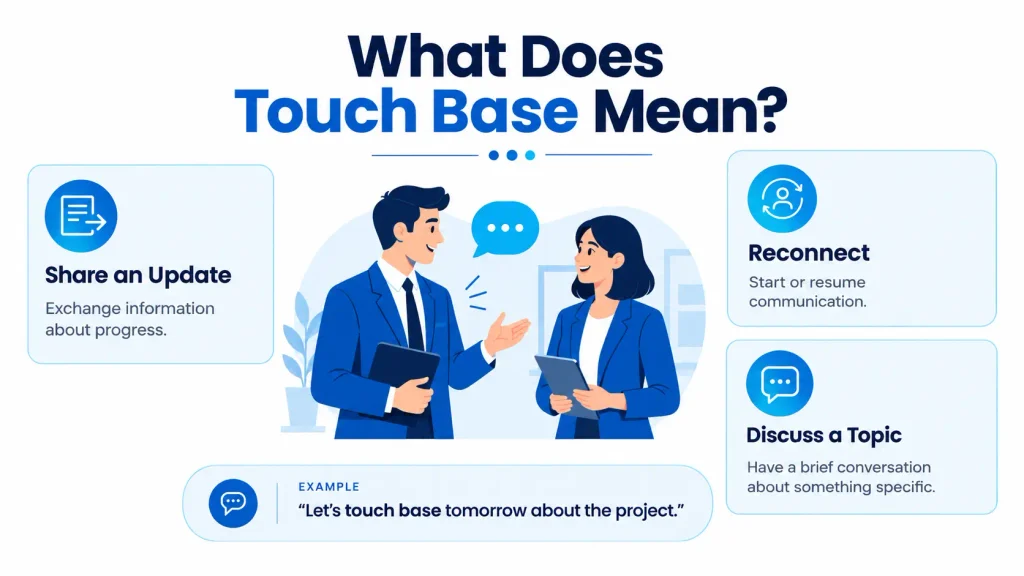
The expression “touch base” means to contact someone briefly to exchange information, discuss progress, or maintain communication. It usually suggests a short conversation rather than a long meeting.
People commonly use it in business emails, team discussions, project updates, and casual conversations. For example, a manager might say, “Let’s touch base tomorrow” to arrange a quick discussion about a project’s progress.
The expression is friendly and widely understood, but it can sometimes sound vague. Choosing a more specific alternative helps the recipient understand exactly why you want to communicate.
Why Use Other Ways to Say “Touch Base”?
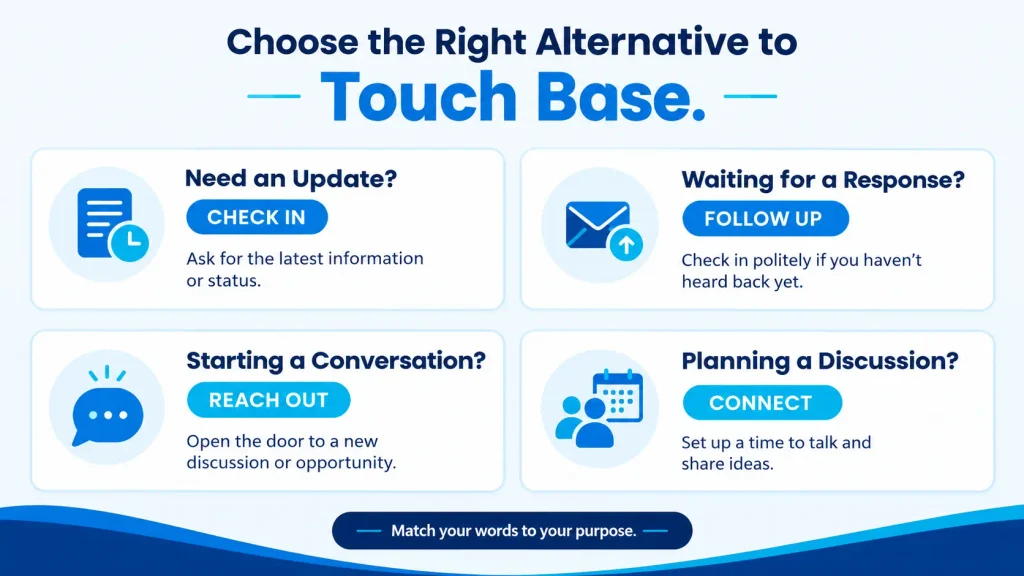
Using different expressions helps you communicate with greater clarity and avoid repeating the same phrase in every email or conversation.
Consider using alternatives when you want to:
- Avoid repetition: Keep your emails and conversations fresh.
- Be more specific: Explain whether you need an update, a response, or a meeting.
- Adjust your tone: Sound formal, friendly, polite, or conversational.
- Improve professional communication: Make requests clearer and more purposeful.
- Save time: Tell the recipient what you need without unnecessary wording.
For example, “I wanted to touch base about the report” could become “I’m following up on the report” if you have already discussed it. The second version gives the reader a clearer idea of your purpose.
10 Best Other Ways to Say “Touch Base”
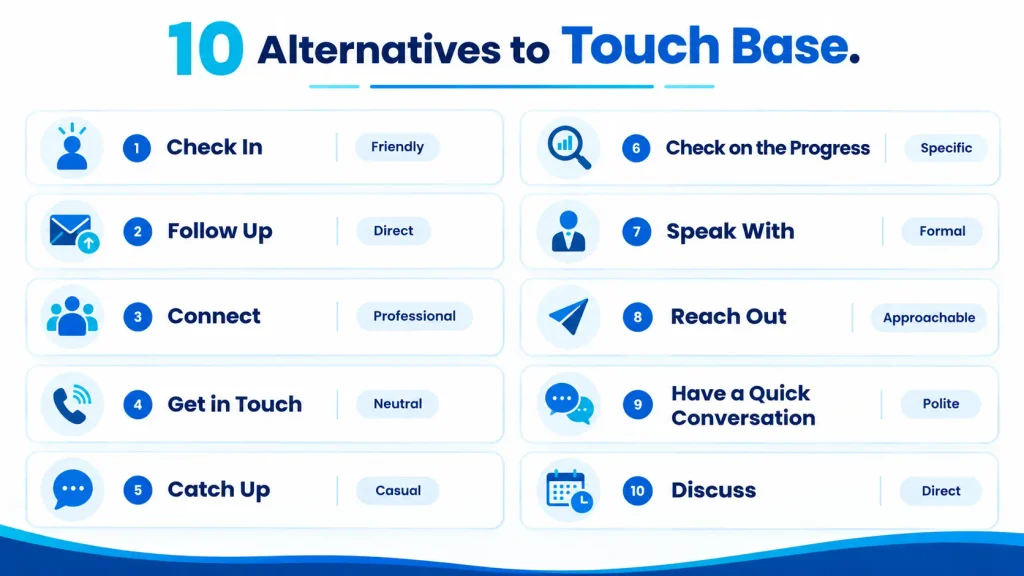
The best alternative depends on the situation. Here are 10 useful options, along with their meanings, appropriate contexts, and examples.
1. Check In
Meaning
“Check in” means contacting someone to ask how things are going, request a brief update, or see whether they need assistance. It sounds natural in professional and personal conversations without being overly formal.
This phrase is especially useful when you want to show interest without making your message feel demanding.
Best For
Professional, Friendly, Polite, Casual
Example 1
“I wanted to check in and see whether you need any help with the presentation.”
Example 2
“Let’s check in on Friday to review the team’s progress.”
Quick Tip
Use “check in” for brief updates or supportive messages. Add the subject of your inquiry to make your purpose clear.
2. Follow Up
Meaning
“Follow up” means contacting someone again about a previous conversation, request, or unfinished task. It is particularly effective when you are waiting for a response or checking the status of an earlier discussion.
Unlike “touch base,” this phrase clearly suggests that some communication has already taken place.
Best For
Professional, Formal, Polite
Example 1
“I’m following up on the proposal I sent earlier this week.”
Example 2
“Could you follow up with the supplier about the revised delivery date?”
Quick Tip
Use “follow up” when referring to an existing matter. In business writing, identify the original request or task so the recipient knows what you mean.
3. Connect
Meaning
“Connect” means communicating with someone, often to exchange ideas, discuss a topic, or explore a possible opportunity. It sounds professional without being stiff.
This alternative works well when you want to arrange a conversation but do not need to emphasize a previous interaction.
Best For
Professional, Formal, Friendly
Example 1
“Would you be available next week to connect about our marketing strategy?”
Example 2
“I’d love to connect with you and learn more about your experience in the industry.”
Quick Tip
Use “connect” when proposing a conversation or building a professional relationship. Include a topic or purpose when possible.
4. Get in Touch
Meaning
“Get in touch” means contacting someone by email, phone, message, or another communication method. It is versatile and works in both workplace and everyday settings.
The phrase often focuses on establishing communication rather than discussing a particular update.
Best For
Professional, Friendly, Polite, Casual
Example 1
“Please get in touch if you have any questions about the application process.”
Example 2
“I’ll get in touch with the design team once the final draft is ready.”
Quick Tip
Use “get in touch” when inviting someone to contact you or explaining that you will contact another person. Specify the next step if timing matters.
5. Catch Up
Meaning
“Catch up” means talking with someone to exchange updates about recent events, progress, or shared interests. It often sounds warmer and more conversational than “touch base.”
In a workplace, it can refer to reviewing developments with a colleague. In personal conversations, it can mean reconnecting after time apart.
Best For
Casual, Friendly, Warm
Example 1
“Let’s catch up over coffee and discuss how the new role is going.”
Example 2
“Can we catch up this afternoon about the changes to the project timeline?”
Quick Tip
Use “catch up” when the conversation involves exchanging updates or reconnecting. For a highly formal email, consider “discuss” or “schedule a meeting” instead.
6. Check on the Progress
Meaning
“Check on the progress” means finding out how much work has been completed or whether a task is moving forward as planned. It is more specific than “touch base” because it focuses on progress.
This phrase is useful when deadlines, project milestones, or deliverables matter.
Best For
Professional, Formal, Polite
Example 1
“I’d like to check on the progress of the website redesign before Friday’s review.”
Example 2
“Could you check on the progress of the order and let me know when it will ship?”
Quick Tip
Use this phrase when you need a status update. Keep your wording courteous so your request does not sound like unnecessary pressure.
7. Speak With
Meaning
“Speak with” means having a conversation with someone about a particular subject. It is direct and professional, making it suitable when you need to discuss an issue rather than simply exchange a quick update.
The phrase can suggest a phone call, video meeting, or in-person conversation, depending on the context.
Best For
Professional, Formal, Polite
Example 1
“I’d like to speak with you about the feedback we received from the client.”
Example 2
“Could I speak with you briefly about next month’s schedule?”
Quick Tip
Use “speak with” when you have a specific topic to discuss. Add “briefly” if you want to communicate that the conversation should be short.
8. Touch Base With You Personally → Reach Out
Meaning
“Reach out” means initiating contact with someone, usually to ask a question, offer help, share information, or start a conversation. It is common in American workplace communication and professional networking.
Although it can replace “touch base” in many situations, it emphasizes making contact rather than exchanging a progress update.
Best For
Professional, Friendly, Polite
Example 1
“I wanted to reach out about the training session scheduled for next week.”
Example 2
“Feel free to reach out if you need clarification on any part of the proposal.”
Quick Tip
Use “reach out” when initiating communication. Avoid pairing it with several vague phrases in the same message; state your reason for contacting the person.
9. Have a Quick Conversation
Meaning
“Have a quick conversation” means arranging a short discussion about a particular matter. It is clear and straightforward because it tells the recipient that you want to talk rather than merely exchange messages.
This phrase is useful when you want to set expectations about the length and purpose of a discussion.
Best For
Professional, Polite, Friendly
Example 1
“Could we have a quick conversation about the client’s latest feedback?”
Example 2
“I’d appreciate the chance to have a quick conversation before we finalize the schedule.”
Quick Tip
Use this phrase when you want to arrange a short discussion. If the subject is complex, avoid promising that the conversation will be quick.
10. Discuss
Meaning
“Discuss” means talking about a subject in order to exchange information, consider options, or reach a decision. It is more direct and task-focused than “touch base.”
Because it clearly identifies a conversation’s purpose, it works especially well in formal emails, project planning, and decision-making.
Best For
Professional, Formal
Example 1
“We need to discuss the proposed budget before submitting the final plan.”
Example 2
“Could we discuss your recommendations during tomorrow’s team meeting?”
Quick Tip
Use “discuss” when you know the topic you want to address. Pair it with a specific subject to make your request direct and useful.
Note: The most natural choice depends on your meaning. For an everyday update, use “check in.” For an earlier request, use “follow up.” For a planned conversation, use “connect,” “speak with,” or “discuss.”
Comparison Table
| Alternative | Best Used In | Tone |
|---|---|---|
| Check in | Quick updates and status requests | Friendly, polite |
| Follow up | Previous requests and conversations | Professional, direct |
| Connect | Arranging a conversation or networking | Professional, warm |
| Get in touch | Initiating or inviting contact | Neutral, friendly |
| Catch up | Exchanging updates or reconnecting | Casual, warm |
| Check on the progress | Project and task updates | Professional, specific |
| Speak with | Important or focused discussions | Formal, direct |
| Reach out | Starting communication | Friendly, professional |
| Have a quick conversation | Brief meetings and discussions | Polite, approachable |
| Discuss | Specific topics and decisions | Professional, direct |
Common Mistakes When Replacing “Touch Base”
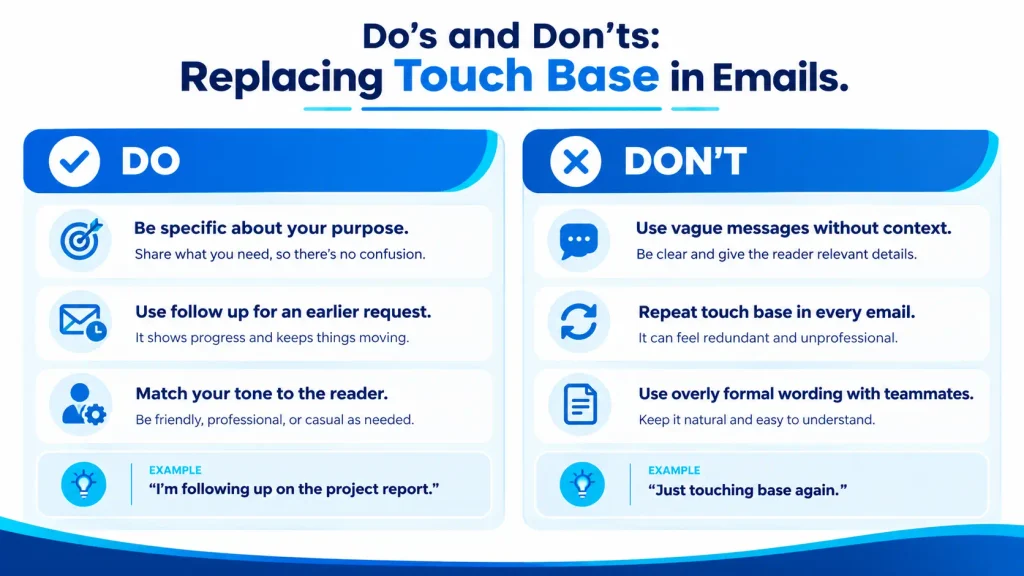
Choosing a different phrase does not automatically make your message better. Avoid these common mistakes to keep your communication clear and appropriate.
1. Using Casual Phrases in Formal Emails
“Catch up” works well with a familiar colleague, but it may sound too casual when writing to an unfamiliar client or senior executive.
Better approach: Use “follow up,” “discuss,” or “speak with” when the situation calls for a more professional tone.
2. Choosing Overly Formal Language
Not every short conversation needs formal wording. Saying “I would like to arrange a discussion regarding this matter” may sound unnecessarily stiff when messaging a teammate.
Better approach: Match your language to the relationship. “Can we check in tomorrow?” is often perfectly appropriate.
3. Repeating the Same Phrase
Using “touch base” in every email can make your writing sound repetitive and vague.
Better approach: Choose a phrase that matches your goal. Use “check in” for updates, “follow up” for pending matters, and “discuss” for specific topics.
4. Forgetting the Context
Some alternatives are not interchangeable in every situation. “Follow up” usually refers to an earlier interaction, while “connect” can introduce a new conversation.
Better approach: Consider whether you are starting a conversation, continuing one, or requesting progress before selecting your wording.
5. Sounding Insincere or Vague
A message such as “Just wanted to connect” may leave the recipient wondering what you need.
Better approach: State your purpose clearly. For example, “I’d like to connect about the revised project deadline” gives the recipient useful context.
Frequently Asked Questions
1. What is the most professional way to say “touch base”?
“Follow up,” “connect,” and “discuss” are strong professional alternatives. The best choice depends on your purpose. Use “follow up” when continuing an earlier conversation, “connect” when arranging communication, and “discuss” when you have a specific topic to address.
2. Is “touch base” appropriate in a business email?
Yes. “Touch base” is widely used in American business English and generally sounds friendly and professional. However, it can be vague if you do not explain your purpose. In formal or important messages, a clearer phrase such as “follow up on the proposal” may communicate your intention more effectively.
3. What is a less casual alternative to “touch base”?
“Follow up,” “speak with,” and “discuss” are suitable alternatives when you want a more direct or formal tone. For example, instead of writing “Let’s touch base about the contract,” you could write, “I’d like to discuss the contract before we finalize it.”
4. How do you say “touch base” in a formal email?
You can write “I am following up on,” “I would like to discuss,” or “Could we schedule a brief meeting to review.” These phrases make your purpose clearer than a general request to touch base. Choose wording that reflects whether you need an update, a decision, or a conversation.
5. What can I say instead of “just touching base”?
Try “I’m checking in on,” “I’m following up on,” or “I wanted to ask about.” For example, “I’m following up on the report we discussed last week” sounds purposeful and professional. Removing “just” can also make your message more direct without making it impolite.
6. What is a friendly way to say “touch base”?
“Check in” and “catch up” are friendly options. Use “check in” when asking how a task or person is doing, and use “catch up” when you want to exchange updates or reconnect. For example, “Let’s catch up sometime next week” sounds relaxed and welcoming.
7. Is “check in” the same as “touch base”?
The expressions are similar, but they are not always identical. “Check in” often emphasizes asking for an update or seeing how someone is doing. “Touch base” can refer more broadly to a brief exchange of information. Both work in professional settings, although the surrounding context determines the best choice.
8. How can I avoid saying “touch base” too often?
Choose alternatives based on the action you need. Use “check in” for updates, “follow up” for earlier requests, “reach out” to initiate contact, and “discuss” for a specific subject. You can also state your purpose directly, such as “Could you share an update on the project?”
Writing something similar? Try Better Ways to Say “Update Information” in Emails and Professional Writing, Another Way to Say We Appreciate You or Another Way to Say “Work Ethic” for Resumes, Reviews, and Professional Writing.
Conclusion
Although “touch base” remains common in American business English, understanding the meaning of “touch base” can help you choose a clearer alternative for each situation.
Use “check in” when asking for an update, “follow up” when referring to an earlier conversation, and “connect” when arranging a professional discussion. If you need to address a specific topic, “discuss” or “speak with” may communicate your intention more clearly. For friendly conversations, “catch up” is a natural choice.
Before sending a message, consider your audience, purpose, and preferred tone. A small change in wording can make your communication more effective. The key is to choose a phrase that tells the reader exactly why you want to get in touch.

The FrontiersPost editorial team writes and reviews every guide to word and phrase alternatives, with clear meanings, tone notes and example sentences for everyday, academic and professional English.




