

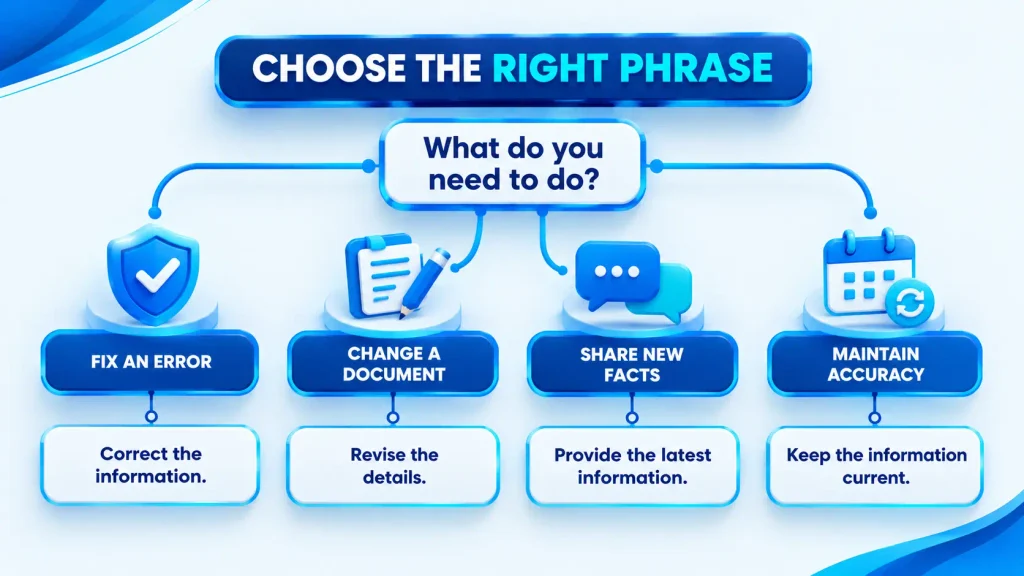
Another way to say update information is revise the details, update the records, provide the latest information, or bring the information up to date. The best alternative depends on your situation. Use professional phrases such as “update the records” at work, “revise the details” for documents, and “share the latest information” when communicating with others.
Key Takeaways
- Use “update the records” when changing information in a database or workplace file.
- Choose “revise the details” when correcting or improving existing information.
- Say “provide the latest information” when sharing new facts with someone.
- Use “keep the information current” when referring to ongoing accuracy.
- Match your wording to the audience, purpose, and communication channel.
The phrase “update information” is common in emails, workplace conversations, academic assignments, online forms, and everyday communication. However, repeating the same words can make your writing sound less natural or leave your meaning unclear.
Choosing a more specific expression helps readers understand whether you want someone to correct a record, add new details, replace outdated facts, or share recent developments. For example, asking a colleague to “update the client records” is more precise than simply asking them to “update information.”
Whether you are writing a professional email, completing an application, or explaining a change, the right phrase can make your message clearer and more effective.
What Does Update Information Mean?
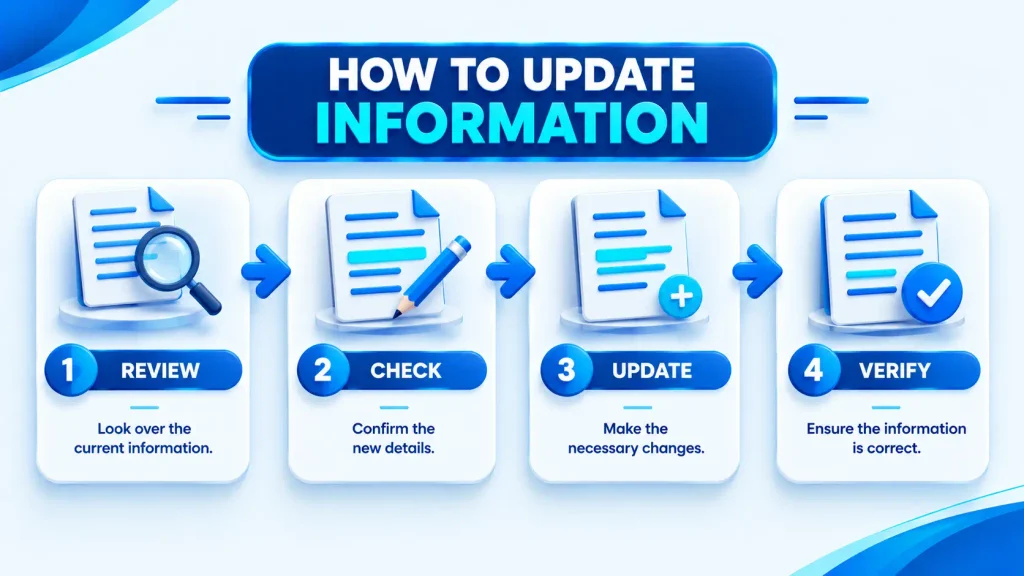
“Update information” means adding new details, correcting existing facts, or changing information so that it reflects the current situation. It can refer to personal details, business records, project documents, contact information, academic materials, or information on a website.
The phrase is generally neutral and works in both professional and casual settings. Its meaning depends on what needs to change.
For example:
- At work: “Please update the customer information before Friday.”
- In education: “Students should update their research notes with the latest findings.”
- In everyday life: “I need to update my contact information.”
- In technology: “The application needs to update the stored information.”
Although the phrase is widely understood, a more precise alternative can explain the task more clearly. “Correct the records” suggests fixing errors, while “add the latest details” emphasizes including new information.
Why Use Other Ways to Say Update Information?
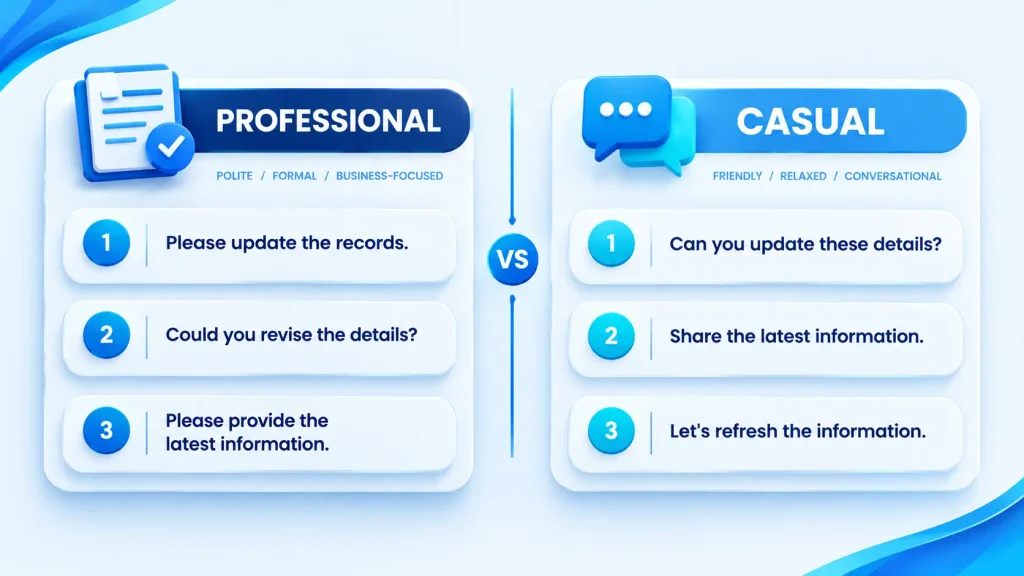
Using different expressions helps you communicate your purpose without relying on the same phrase in every situation.
Consider these benefits:
- Improve clarity: Explain whether you want to correct, replace, add, or share information.
- Sound more professional: Choose wording that fits workplace emails, reports, and formal requests.
- Avoid repetition: Keep longer documents and conversations engaging.
- Match the tone: Use friendly language with colleagues and more formal wording in official communication.
- Make requests actionable: Tell the reader exactly what needs to happen.
For example, “Please revise the project details before the meeting” gives a colleague a clearer task than “Please update information.”
The goal is not to replace every common phrase. It is to choose words that express your intended meaning accurately.
10 Best Alternatives to Update Information
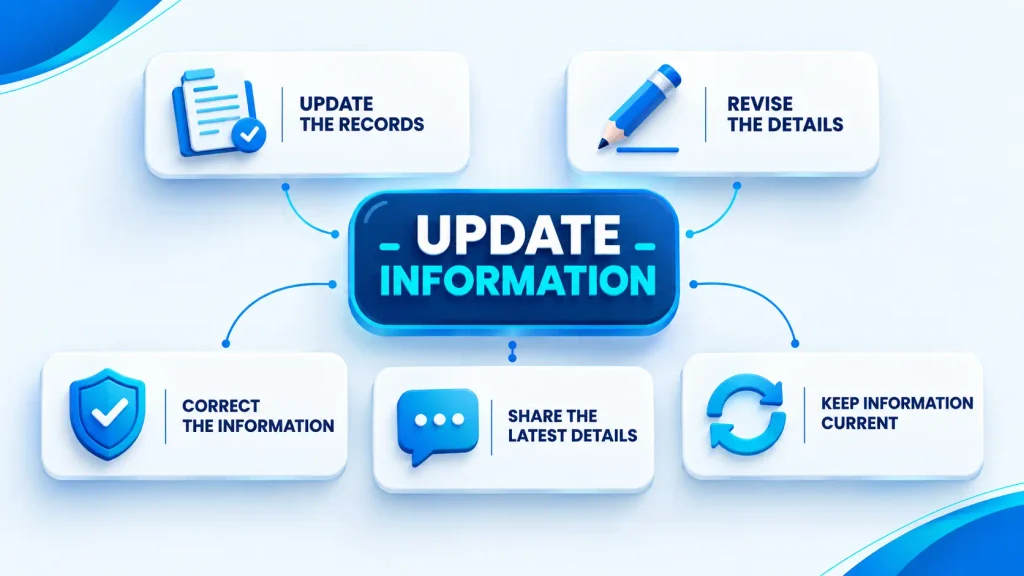
These ten phrases cover common situations in professional communication, academic writing, record management, and everyday conversation. Choose the one that best describes the action you want someone to take.
1. Update the Records
Meaning and Usage
“Update the records” means changing stored information so that it reflects the latest facts. It is especially useful when working with databases, customer profiles, employee files, or official documents.
Best For
Professional and Formal: Use this phrase for administrative tasks, business records, and requests involving organized information.
Example Sentences
- Please update the records to reflect the new billing address.
- Our HR team will update the employee records after reviewing the submitted forms.
Quick Tip
Use “records” when referring to stored or documented information rather than general news or informal updates.
2. Revise the Details
Meaning and Usage
“Revise the details” means reviewing and changing specific pieces of information. It can involve correcting mistakes, improving accuracy, or adjusting details that are no longer appropriate.
Unlike “update the records,” this phrase focuses on the information itself rather than where it is stored.
Best For
Professional, Formal, and Academic: Use it when editing reports, applications, project plans, or written documents.
Example Sentences
- Please revise the details in your application before submitting it.
- I revised the project details to reflect the client’s latest requirements.
Quick Tip
Choose “revise” when you need to review or modify existing content, not simply share new information with someone.
3. Provide the Latest Information
Meaning and Usage
“Provide the latest information” means giving someone the most recent facts or developments available. It emphasizes sharing information rather than editing a document or database.
This phrase works well when a person needs accurate details to make a decision or understand a situation.
Best For
Professional, Formal, and Polite: Use it in business emails, customer service messages, reports, and official communications.
Example Sentences
- Please provide the latest information about the shipment’s expected arrival.
- The admissions office will provide the latest information about application deadlines.
Quick Tip
Use this expression when the recipient needs to receive information, rather than make changes to an existing record.
4. Bring the Information Up to Date
Meaning and Usage
“Bring the information up to date” means making existing information current by adding recent facts or correcting outdated details. It is a clear, natural expression that works in both professional and everyday English.
The phrase emphasizes the result: the information becomes current and more useful.
Best For
Professional, Formal, and Academic: Use it for documents, research materials, websites, reference lists, and business files.
Example Sentences
- We need to bring the training materials up to date before the next session.
- The researcher brought the report up to date with the latest published findings.
Quick Tip
Use “bring something up to date” when you want to emphasize that information is outdated and needs attention.
5. Revise the Existing Information
Meaning and Usage
“Revise the existing information” means reviewing and changing information that is already available. It can involve replacing outdated details, correcting errors, or improving the accuracy of written content.
This expression is more explicit than “revise the details” because it identifies the existing information as the object of the task.
Best For
Formal, Professional, and Academic: Use it for research papers, policy documents, reports, and official records that need careful review.
Example Sentences
- The committee will revise the existing information before publishing the updated guidelines.
- Please revise the existing information in the project file to match the approved plan.
Quick Tip
Use this phrase when the task involves reviewing information already on file rather than creating entirely new content.
6. Add the Latest Details
Meaning and Usage
“Add the latest details” means including new facts in an existing document, message, or collection of information. Unlike “revise,” which may involve changing current content, “add” specifically emphasizes including something new.
It is straightforward and easy to understand.
Best For
Professional, Casual, and Friendly: Use it when asking a teammate, classmate, or colleague to include missing or recent details.
Example Sentences
- Could you add the latest details to the event schedule?
- I added the new contact numbers to the shared document.
Quick Tip
Choose “add” when the information needs additional content. If old facts must be corrected or removed, “revise” may be more accurate.
7. Keep the Information Current
Meaning and Usage
“Keep the information current” means maintaining accuracy over time rather than making a single change. It suggests an ongoing responsibility to review information and update it whenever circumstances change.
This phrase is particularly useful when information can become outdated quickly.
Best For
Professional, Formal, and Polite: Use it for policies, contact lists, online profiles, reference materials, and recurring administrative tasks.
Example Sentences
- Please keep the supplier directory current as new vendors join the network.
- We review our training resources regularly to keep the information current.
Quick Tip
Use this expression when updates are expected to happen regularly, not just once.
8. Correct the Information
Meaning and Usage
“Correct the information” means fixing inaccurate, incorrect, or misleading details. Unlike a general update, correction specifically implies that something is wrong and needs to be made accurate.
It is a good choice when precision matters.
Best For
Professional, Formal, and Polite: Use it for applications, invoices, official documents, customer records, and academic work containing errors.
Example Sentences
- Please correct the information on the invoice before sending it to the client.
- The student contacted the registrar to correct the information in her academic record.
Quick Tip
Use “correct” only when there is an error or inaccuracy. If the information is accurate but outdated, “update” or “revise” is usually more suitable.
9. Share the Latest Details
Meaning and Usage
“Share the latest details” means communicating new or recently confirmed information with another person or group. It sounds natural and approachable, making it useful for everyday workplace communication.
Unlike “update the records,” it focuses on sharing information with people rather than changing stored data.
Best For
Friendly, Casual, and Professional: Use it in team messages, project discussions, group emails, and informal workplace conversations.
Example Sentences
- Can you share the latest details about tomorrow’s client meeting?
- I’ll share the latest details with the team once the schedule is confirmed.
Quick Tip
Use this phrase when you want someone to communicate recent information. If you need a document changed, specify the document separately.
10. Refresh the Information
Meaning and Usage
“Refresh the information” means renewing or updating information so that it reflects current conditions. It is particularly natural in digital settings, such as online profiles, websites, dashboards, and informational resources.
Although it can overlap with “update,” the word “refresh” may suggest renewing content or replacing older material.
Best For
Professional, Casual, and Technical: Use it for website content, digital profiles, online listings, and informational displays.
Example Sentences
- We should refresh the product information before launching the new collection.
- Please refresh the information on your online profile so visitors can see your current experience.
Quick Tip
Use “refresh” when the information needs renewing. For official records or serious factual errors, “update” or “correct” may be more precise.
Comparison Table: 10 Alternatives at a Glance
| Alternative | Best Used In | Tone |
|---|---|---|
| Update the records | Databases and files | Professional |
| Revise the details | Reports and applications | Formal |
| Provide the latest information | Emails and announcements | Polite |
| Bring the information up to date | Documents and research | Professional |
| Revise the existing information | Policies and reports | Formal |
| Add the latest details | Shared documents | Friendly |
| Keep the information current | Ongoing maintenance | Professional |
| Correct the information | Errors and inaccuracies | Direct, polite |
| Share the latest details | Team communication | Friendly |
| Refresh the information | Websites and digital profiles | Casual, professional |
Common Mistakes When Choosing an Alternative
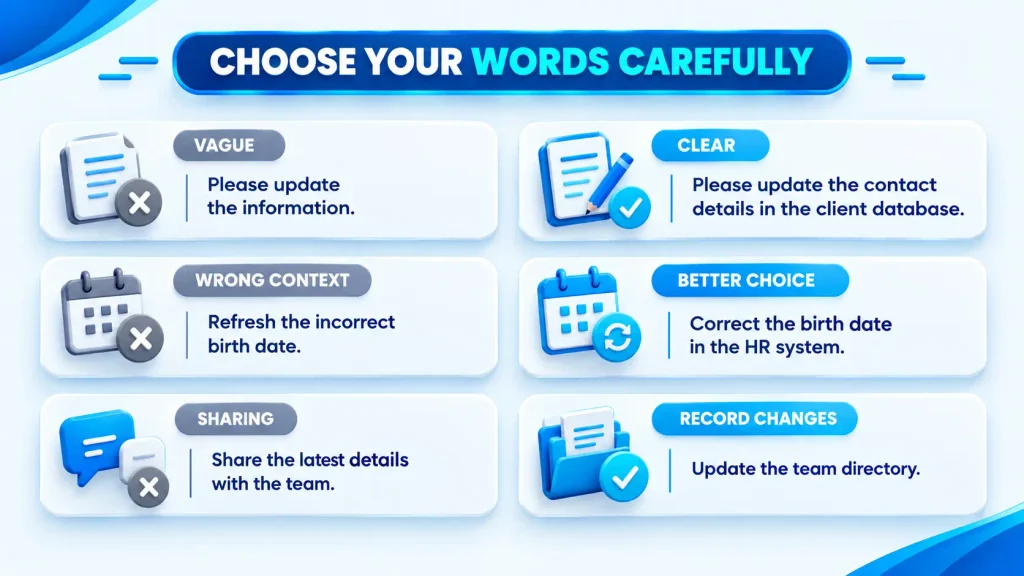
Even though these expressions have similar meanings, they are not interchangeable in every situation. Avoid these five common mistakes to make your writing clearer.
1. Using “Update” When You Mean “Correct”
Updating information does not always mean that something is wrong. Correcting information specifically means fixing an error.
- Less precise: Please update the incorrect date.
- Better: Please correct the incorrect date.
The second sentence makes the purpose clearer. You could also say, “Please update the date” if you simply want to change it without suggesting that it is incorrect.
2. Confusing Sharing Information With Changing It
“Share the latest details” means communicating information to someone. “Update the records” means changing stored information.
For example:
- Sharing: Please share the latest details with the team.
- Changing: Please update the team directory with the new contact details.
Choose your wording based on the action you expect.
3. Using Overly Formal Language in Casual Messages
Phrases such as “revise the existing information” may sound unnecessarily formal in a quick chat with a coworker.
Instead of writing, “Kindly revise the existing information at your earliest convenience,” you could say, “Could you update these details when you have a chance?”
Simple language often makes everyday communication sound more natural.
4. Forgetting to Specify What Needs Updating
A request such as “Please update the information” may leave the reader wondering which information you mean.
Provide enough context to make the task clear.
- Vague: Please update the information.
- Clear: Please update the contact information in the client database.
Naming the document, record, or subject helps prevent confusion and unnecessary follow-up messages.
5. Using “Refresh” for Every Type of Change
“Refresh the information” can work well for websites and digital content, but it may be less precise for official records or factual errors.
For example, “Correct the employee’s birth date in the HR system” is clearer than “Refresh the employee’s birth date.”
Choose a phrase that describes the actual task rather than simply replacing one word with another.
Frequently Asked Questions
1. What is the most professional way to say update information?
“Update the records” is an excellent choice when referring to databases, employee files, or customer details. For written documents, “revise the details” may be more appropriate. If you are asking someone to communicate recent developments, “provide the latest information” is often clearer and more natural.
2. What is another way to say update information in an email?
You can write “Please revise the details,” “Could you update the records?” or “Please share the latest information.” Choose the phrase based on your request. For example, use “update the records” when changing a file and “share the latest information” when asking someone to send you recent details.
3. How do you politely ask someone to update information?
Use a courteous request that explains the task clearly. For example, write, “Could you please update the contact details in the shared document?” You can also say, “When you have a chance, would you mind revising the project information?” Both expressions sound polite without being overly formal.
4. What is the difference between update, revise, and correct?
“Update” means adding recent information or making something current. “Revise” means reviewing and changing existing content, often to improve it. “Correct” means fixing something inaccurate or wrong. For instance, you update a contact list, revise a report, and correct a misspelled name.
5. What is another way to say keep information updated?
You can say “keep the information current,” “maintain accurate records,” or “ensure the details remain up to date.” These expressions work well when information needs regular attention. Use “keep the information current” for a general instruction and “maintain accurate records” when referring specifically to documented information.
6. Can I use “update information” in formal writing?
Yes. “Update information” is acceptable in formal writing, particularly when the meaning is clear from the context. However, a more specific phrase can improve precision. For example, “revise the report,” “update the records,” or “incorporate the latest findings” may communicate your intended action more effectively.
You may also find these guides useful: Another Way to Say We Appreciate You, Another Way to Say “Work Ethic” for Resumes, Reviews, and Professional Writing and Different Ways to Say “Make Sure” Naturally and Clearly.
Conclusion
Choosing another way to say update information can make your writing clearer, more professional, and easier to understand. The best alternative depends on what you want to accomplish. Use “update the records” for stored data, “revise the details” for written documents, and “correct the information” when fixing errors. If you need to communicate recent developments, “provide the latest information” or “share the latest details” may be more suitable. For ongoing tasks, “keep the information current” emphasizes the need for regular maintenance.
Before choosing a phrase, consider your audience, the type of information involved, and whether you need to add, change, correct, or communicate details. You do not need complicated wording to sound professional. A clear, specific expression helps others understand what needs to happen and makes your message more effective.
A clear, specific expression helps others understand what needs to happen and makes your message more effective. For additional guidance, explore how “update” is used in English.

The FrontiersPost editorial team writes and reviews every guide to word and phrase alternatives, with clear meanings, tone notes and example sentences for everyday, academic and professional English.