

Another way to say “to whom it may concern” includes “Dear Hiring Manager,” “Dear Admissions Committee,” “Dear [Recipient’s Name],” and “Dear [Department] Team.” The best choice depends on your audience and purpose. Using a specific name, role, or department usually makes a letter or email sound more personal and professional.
Key Takeaways
- “To whom it may concern” is a formal greeting used when the recipient is unknown.
- A specific person’s name is usually more direct and personal.
- “Dear Hiring Manager” works well for job applications and cover letters.
- Department-based greetings are useful when you know the recipient’s team but not their name.
- Choose the greeting based on the purpose, audience, and level of formality.
What Does “Another Way to Say To Whom It May Concern” Mean?
“To whom it may concern” is a formal greeting used at the beginning of a letter, reference, complaint, recommendation, or other professional document when you do not know exactly who will read it.
The phrase is grammatically correct, but it can sound distant or old-fashioned in some situations. A more specific greeting, such as “Dear Hiring Manager” or “Dear Admissions Committee,” can make your writing feel more relevant and intentional.
You may see “to whom it may concern” in employment letters, verification documents, recommendation letters, legal correspondence, and formal requests. However, when you know the recipient’s name, title, or department, a more targeted greeting is often clearer.
Why Use Other Ways to Say “To Whom It May Concern”?
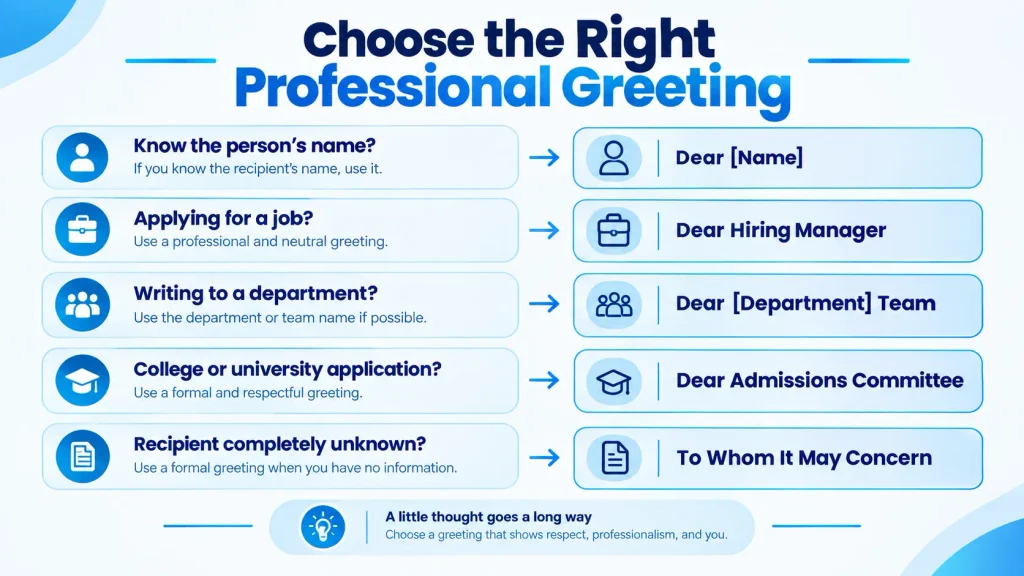
Choosing a more specific greeting can make professional writing sound more natural and reader-focused. It also shows that you have considered who is likely to receive your message.
Other options can help you:
- Avoid a generic or outdated-sounding greeting.
- Make your letter feel more personal.
- Match the tone to your audience.
- Address a department or role directly.
- Create a stronger first impression.
- Make emails and letters easier to read.
The key is to avoid choosing a greeting simply because it sounds formal. The best alternative is the one that accurately fits your recipient and situation.
10 Best Other Ways to Say “To Whom It May Concern”
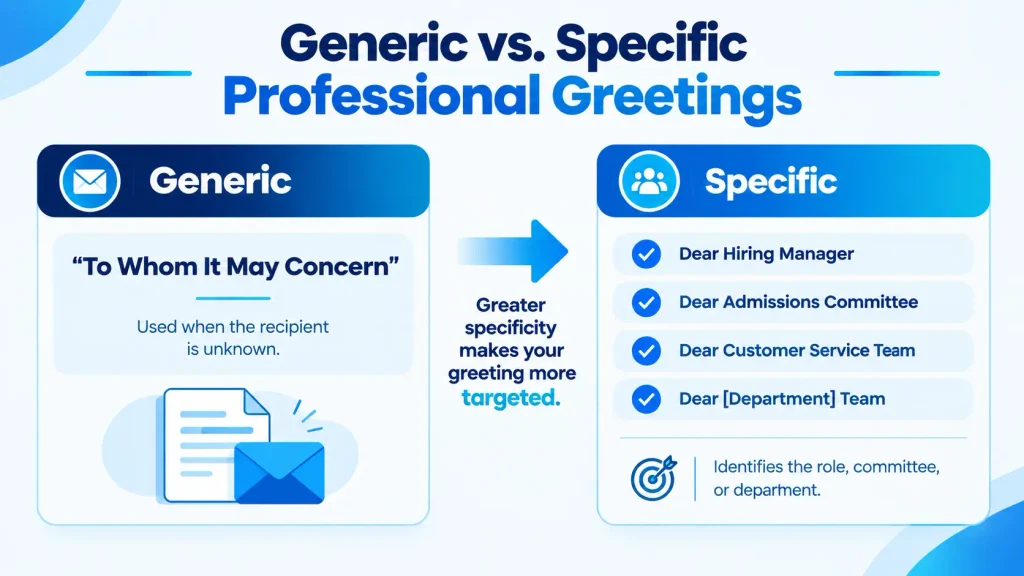
1. Dear Hiring Manager
Meaning
“Dear [Recipient’s Name]” is one of the most direct alternatives because it addresses the actual person reading your message. It works particularly well when you can find the recipient’s name through a company website, email signature, or other reliable source.
Best For
- Professional
- Formal
- Polite
- Friendly
Example 1
Dear Ms. Johnson, I am writing to follow up on my application for the marketing coordinator position.
Example 2
Dear Dr. Williams, Thank you for taking the time to review my recommendation letter.
Quick Tip
Use the recipient’s preferred title and spelling when you know them.
2. Dear Hiring Manager
Meaning
“Dear Hiring Manager” is a common professional greeting when you are applying for a job but do not know the recruiter’s name. It directly identifies the person responsible for reviewing candidates.
Best For
- Professional
- Formal
- Polite
Example 1
Dear Hiring Manager, I am excited to apply for the content writer position at your company.
Example 2
Dear Hiring Manager, Please find my résumé attached for consideration for the sales associate role.
Quick Tip
This is usually more relevant than “to whom it may concern” for a job application.
3. Dear [Department] Team
Meaning
“Dear [Department] Team” addresses a group rather than one individual. It is useful when you know which department will handle your request but cannot identify a specific employee.
Best For
- Professional
- Polite
- Friendly
Example 1
Dear Customer Support Team, I am contacting you about an issue with my recent order.
Example 2
Dear Human Resources Team, I would like to request a copy of my employment records.
Quick Tip
Replace “[Department]” with the actual team name, such as “Admissions,” “Billing,” or “Human Resources.”
4. Dear Admissions Committee
Meaning
“Dear Admissions Committee” is designed for applications to colleges, universities, graduate programs, and other educational institutions. It recognizes that several people may review the application.
Best For
- Formal
- Professional
- Polite
Example 1
Dear Admissions Committee, I am pleased to submit my application for the graduate program in education.
Example 2
Dear Admissions Committee, I appreciate your consideration of my application and supporting materials.
Quick Tip
Use this greeting when an admissions committee, rather than one named person, is responsible for reviewing your materials.
5. Dear Customer Service Team
Meaning
“Dear Customer Service Team” is a polite way to begin a complaint, question, refund request, or service-related message. It identifies the intended audience without pretending to know a particular employee’s name.
Best For
- Professional
- Polite
- Friendly
Example 1
Dear Customer Service Team, I am writing to request assistance with a recent billing issue.
Example 2
Dear Customer Service Team, Could you please help me update the shipping address for my order?
Quick Tip
This greeting is especially useful for general support inboxes.
6. Dear Sir or Madam
Meaning
“Dear Sir or Madam” is a traditional formal greeting used when the recipient is unknown. It remains understandable and appropriate in some formal correspondence, although a more specific greeting is often more natural when possible.
Best For
- Formal
- Polite
Example 1
Dear Sir or Madam, I am writing to request information about the certification process.
Example 2
Dear Sir or Madam, Please accept this letter as confirmation of the information provided below.
Quick Tip
Use it when you genuinely cannot identify the recipient and the situation calls for a traditional formal tone.
7. Dear [Job Title]
Meaning
“Dear [Job Title]” lets you address a specific role without needing the person’s name. For example, you might write “Dear Program Director” or “Dear Office Manager.”
Best For
- Professional
- Formal
- Polite
Example 1
Dear Program Director, I am writing to ask about the application requirements for the upcoming semester.
Example 2
Dear Office Manager, I would like to discuss the documentation required for my appointment.
Quick Tip
Use the official job title whenever possible rather than guessing a person’s name.
8. Hello [Department or Team Name]
Meaning
“Hello [Department or Team Name]” offers a slightly warmer alternative to traditional formal greetings. It works well for professional emails when you want to sound approachable without becoming too casual.
Best For
- Professional
- Friendly
- Polite
Example 1
Hello Recruiting Team, I wanted to follow up regarding my interview last week.
Example 2
Hello Benefits Team, Could you please clarify how I can update my enrollment information?
Quick Tip
This option works particularly well for modern workplace emails.
9. Greetings
Meaning
“Greetings” is a neutral, concise opening when you do not know the recipient’s identity. It is less personal than using a name or department, but it can work when the audience is genuinely unknown.
Best For
- Formal
- Professional
- Polite
Example 1
Greetings, I am writing to request additional information about your professional certification program.
Example 2
Greetings, Please review the attached document and let me know if any additional information is required.
Quick Tip
Use “Greetings” sparingly because a specific recipient or department is usually more engaging.
10. Dear [Organization or Office Name] Team
Meaning
“Dear [Organization or Office Name] Team” is useful when you are contacting an organization or office without knowing which employee will handle your message. It creates a professional but approachable tone.
Best For
- Professional
- Formal
- Friendly
- Polite
Example 1
Dear Student Services Team, I am writing to ask about the documents needed to complete my enrollment.
Example 2
Dear Legal Services Team, I would appreciate information about the next steps in my request.
Quick Tip
Use the organization’s actual department or office name to make the greeting more specific.
Comparison Table
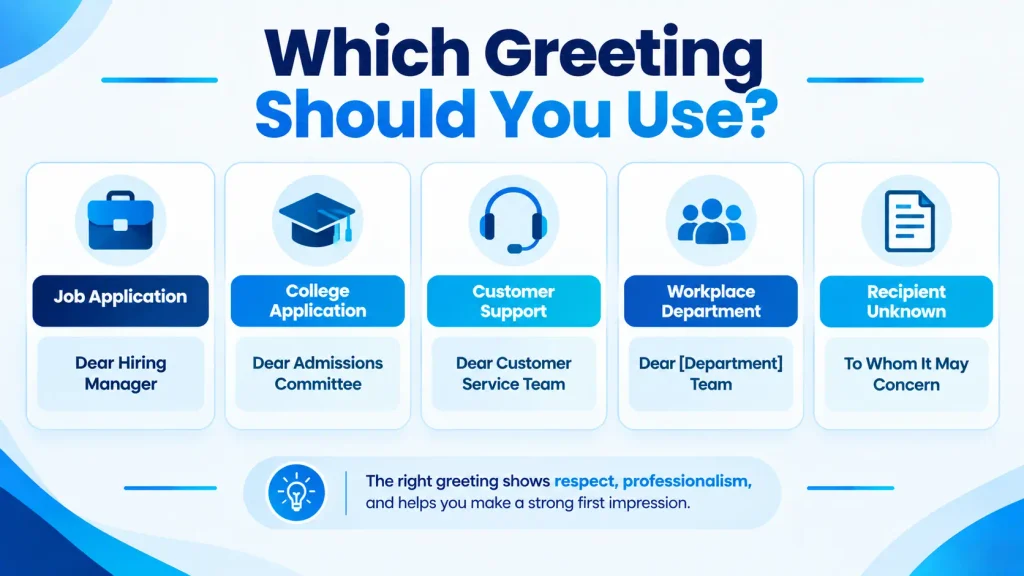
| Alternative | Best Used In | Tone |
| Dear [Recipient’s Name] | Letters, emails, applications | Professional and personal |
| Dear Hiring Manager | Job applications | Formal and professional |
| Dear [Department] Team | Workplace and service emails | Professional and friendly |
| Dear Admissions Committee | College applications | Formal and polite |
| Dear Customer Service Team | Support requests and complaints | Polite and professional |
| Dear Sir or Madam | Traditional formal letters | Formal |
| Dear [Job Title] | Official correspondence | Formal and professional |
| Hello [Department or Team Name] | Modern workplace emails | Friendly and professional |
| Greetings | General formal correspondence | Neutral and formal |
| Dear [Organization or Office Name] Team | Institutional correspondence | Professional and approachable |
Common Mistakes
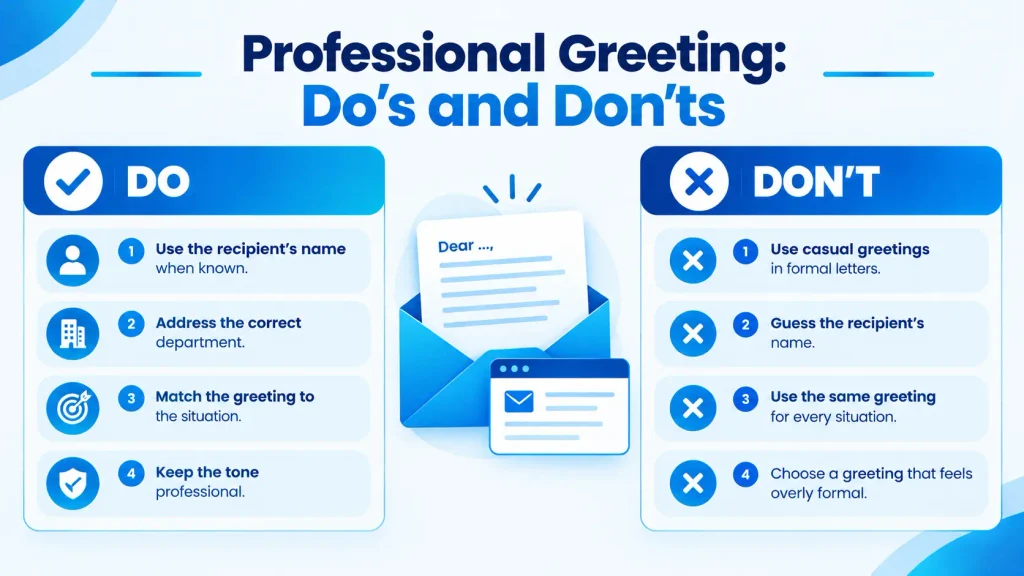
1. Using casual phrases in professional emails
Greetings such as “Hey there” or “Hi guys” may feel too informal for a formal application, complaint, or official letter. Match your opening to the seriousness of the message.
2. Choosing overly formal language
Not every professional message needs an old-fashioned greeting. If you know the recipient’s name or department, a straightforward greeting can sound more natural.
3. Repeating the same generic phrase
Using “to whom it may concern” for every letter can make your writing feel impersonal. Look for opportunities to identify the recipient by name, role, or department.
4. Forgetting the context
A greeting that works for a job application may not fit a customer complaint or college application. Consider who will read the message and what you want them to do.
5. Sounding insincere
A highly formal greeting can feel unnatural when the rest of the message is conversational. Keep the greeting and body of your message at a consistent level of formality.
Frequently Asked Questions
What is a professional alternative to “to whom it may concern”?
“Dear Hiring Manager,” “Dear [Recipient’s Name],” and “Dear [Department] Team” are useful professional alternatives. The best choice depends on the recipient. If you know the person’s name, using it is usually more direct. If you know only the department or role, address that group or position instead.
Is “Dear Hiring Manager” better than “to whom it may concern”?
“Dear Hiring Manager” is more specific when you are applying for a job and do not know the recruiter’s name. “To whom it may concern” is broader and can apply to many types of formal documents. Choose the greeting based on the actual audience rather than using one phrase for every situation.
What can I say instead of “to whom it may concern” in an email?
For an email, you can use “Dear [Name],” “Hello [Department] Team,” “Dear Customer Service Team,” or “Dear Hiring Manager.” If the email is less formal and you know the team receiving it, “Hello” followed by the department or team name can sound natural and professional.
What is a good alternative to “to whom it may concern” in a cover letter?
“Dear Hiring Manager” is a common choice for a cover letter when you cannot identify the recruiter. If the job posting provides a hiring manager’s name, address that person directly. A specific name makes the opening more targeted and avoids an unnecessarily generic greeting.
Can I use “Dear Sir or Madam” instead of “to whom it may concern”?
Yes. “Dear Sir or Madam” is a traditional formal alternative when you do not know the recipient. However, it is still generic. When possible, use a person’s name, job title, or department because those options provide more context and can make the correspondence feel more purposeful.
What should I write if I do not know the recipient’s name?
First, see whether you can identify the recipient through the organization’s website, job posting, email signature, or department information. If you still cannot find a name, address the relevant role or department, such as “Dear Admissions Committee” or “Dear Customer Service Team.”
Is “to whom it may concern” outdated?
The phrase is not incorrect, and it remains appropriate for some formal documents. However, it can sound generic in modern professional communication. When you can identify the recipient, role, or department, a more specific greeting often creates a clearer and more natural opening.
Should “to whom it may concern” be capitalized?
Yes. In a traditional letter opening, it is normally written as “To Whom It May Concern,” with the major words capitalized. It is often followed by a colon in formal business correspondence. If you choose a more specific greeting, follow the capitalization style appropriate for that greeting.
For related wording choices, see Another Way to Say Touch Base, Better Ways to Say “Update Information” in Emails and Professional Writing and Another Way to Say We Appreciate You.
Conclusion
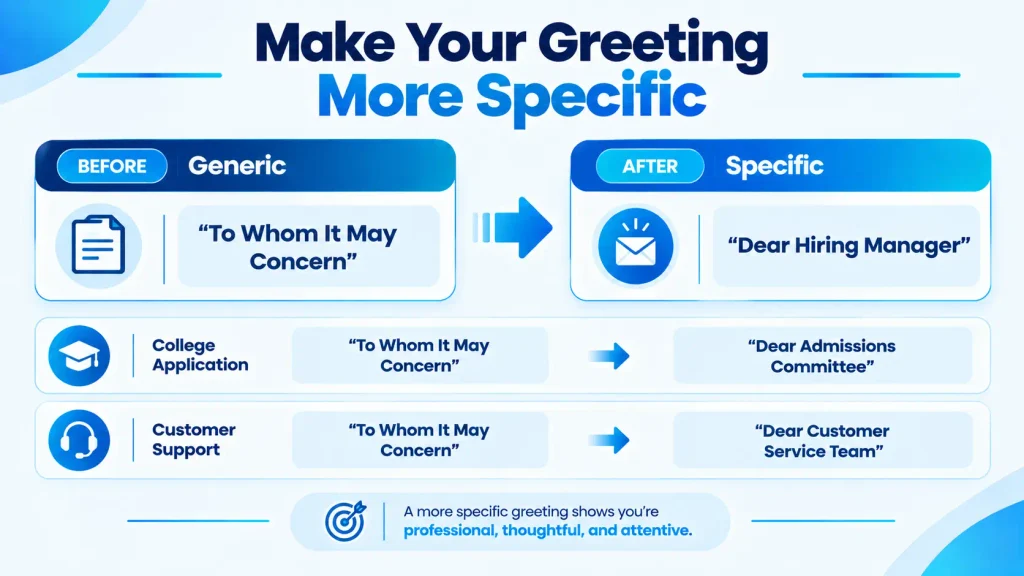
There are many useful alternatives to “to whom it may concern,” and the right one depends on who will receive your message. When you know the person’s name, “Dear [Recipient’s Name]” is direct and personal. For job applications, “Dear Hiring Manager” is a practical choice, while “Dear Admissions Committee” works well for academic applications.
If you know the department but not the individual, greetings such as “Dear Customer Service Team” or “Dear [Department] Team” provide useful context without guessing. Traditional options such as “Dear Sir or Madam” can still work in formal situations, but they remain general.
The simplest rule is to be as specific as the situation allows. Use the person’s name when you know it, the role or department when you know that, and a general greeting only when necessary.

The FrontiersPost editorial team writes and reviews every guide to word and phrase alternatives, with clear meanings, tone notes and example sentences for everyday, academic and professional English.




