

Another way to say called out depends on the context. You can say criticized, confronted, challenged, pointed out, singled out, reprimanded, held accountable, put on the spot, rebuked, or publicly criticized. Choose the phrase based on whether you mean criticism, confrontation, correction, or drawing attention to someone or something.
Key Takeaways
- “Called out” can mean criticized, confronted, corrected, or publicly identified.
- Criticized is a simple and versatile alternative for negative feedback.
- Confronted works best when someone directly addresses another person’s behavior.
- Pointed out is better when you simply want to identify a problem or detail.
- For professional communication, choose a precise phrase instead of relying on the informal “called out.”
What Does “Another Way to Say Called Out” Mean?

“Called out” is an informal phrase with several meanings. Most often, it means publicly criticizing someone for something they did or said, especially when the speaker believes the behavior was wrong or unfair.
For example, “The manager called him out for missing the deadline” means the manager directly criticized or confronted him about the missed deadline.
However, “called out” can also mean pointed something out, identified an issue, challenged someone, or singled someone out. The best alternative depends on what you want to communicate.
You may hear the phrase in casual conversations, social media posts, workplace discussions, interviews, and everyday American English.
Why Use Other Ways to Say “Called Out”?
Using a more precise alternative can make your writing clearer and better suited to the situation. Since “called out” is informal and can have different meanings, replacing it with a specific phrase helps readers understand exactly what happened.
Other alternatives can help you:
- Avoid repeating the same expression.
- Make professional writing sound more polished.
- Choose the right level of criticism or confrontation.
- Clarify whether someone was corrected, challenged, or criticized.
- Adjust your tone for formal, casual, or sensitive situations.
10 Best Other Ways to Say “Called Out”

1. Criticized
Meaning
“Criticized” means expressing disapproval of someone or something because of a mistake, problem, or unacceptable action. It is one of the closest general alternatives when “called out” means openly expressing negative judgment.
Best For
Professional, Formal, Casual
Example 1
The supervisor criticized the team for failing to follow the updated safety procedures.
Example 2
Several customers criticized the company for delaying the product launch.
Quick Tip
Use “criticized” when you want to describe negative feedback without suggesting that the person was aggressively confronted.
2. Confronted
Meaning
“Confronted” means directly addressing someone about a problem, disagreement, or questionable behavior. It usually suggests a more direct interaction than simply criticizing someone.
Best For
Professional, Formal, Casual
Example 1
She confronted her coworker about taking credit for her idea.
Example 2
The reporter confronted the official with questions about the conflicting statements.
Quick Tip
Choose “confronted” when the important part of the situation is the direct conversation or challenge.
3. Challenged
Meaning
“Challenged” means questioning someone’s statement, decision, behavior, or position. Unlike “criticized,” it does not always sound negative because it can simply describe asking someone to defend or reconsider an idea.
Best For
Professional, Formal, Casual
Example 1
The employee challenged the director’s explanation during the meeting.
Example 2
A student challenged the assumption that the results proved the original theory.
Quick Tip
Use “challenged” when you want to emphasize disagreement or questioning rather than personal criticism.
4. Pointed Out
Meaning
“Pointed out” means drawing attention to a fact, mistake, detail, or issue. It is often the best choice when “called out” means identifying something rather than criticizing a person.
Best For
Professional, Formal, Friendly, Casual
Example 1
Maria pointed out a calculation error before the report was submitted.
Example 2
During the discussion, James pointed out that the deadline had already passed.
Quick Tip
Use “pointed out” for neutral situations where you want to highlight information without sounding confrontational.
5. Singled Out
Meaning
“Singled out” means selecting one person or thing for special attention, often when others are not treated the same way. It can describe either positive or negative attention, depending on context.
Best For
Professional, Formal, Casual
Example 1
The coach singled out Maya for her outstanding performance.
Example 2
He felt singled out when the manager questioned only his work.
Quick Tip
Use this phrase when the key idea is that one person received particular attention.
6. Held Accountable
Meaning
“Held accountable” means requiring someone to accept responsibility for their actions, decisions, or results. It is a stronger and more purposeful alternative when “called out” involves responsibility rather than simple criticism.
Best For
Professional, Formal
Example 1
The organization held the contractor accountable for failing to meet the agreed standards.
Example 2
Leaders should hold employees accountable while giving them a fair opportunity to improve.
Quick Tip
Use “held accountable” in workplace, leadership, academic, or policy contexts when responsibility is the main point.
7. Reprimanded
Meaning
“Reprimanded” means formally expressing strong disapproval of someone’s actions, usually because they violated a rule or standard. It sounds more serious and formal than “called out.”
Best For
Professional, Formal
Example 1
The employee was reprimanded for repeatedly ignoring company procedures.
Example 2
The official was reprimanded after failing to follow the required reporting process.
Quick Tip
Choose “reprimanded” when the criticism comes from someone in authority or has a formal disciplinary tone.
8. Put on the Spot
Meaning
“Put on the spot” means placing someone in a situation where they must respond immediately, often to an unexpected or uncomfortable question. It focuses more on pressure or embarrassment than criticism.
Best For
Casual, Friendly, Professional
Example 1
The unexpected question put the speaker on the spot during the interview.
Example 2
I didn’t mean to put you on the spot by asking about the project in front of everyone.
Quick Tip
Use this phrase when someone is forced to respond publicly or unexpectedly, rather than simply being criticized.
9. Rebuked
Meaning
“Rebuked” means strongly expressing disapproval of someone’s behavior or actions. It has a formal, serious tone and often suggests that the criticism was direct and forceful.
Best For
Formal, Professional
Example 1
The committee rebuked the company for ignoring the environmental guidelines.
Example 2
The judge rebuked the attorney for making an inappropriate remark in court.
Quick Tip
“Rebuked” works well in formal reporting, journalism, and serious professional writing, but it may sound too strong for everyday conversation.
10. Publicly Criticized
Meaning
“Publicly criticized” makes the public nature of the criticism clear. It is especially useful when someone openly expresses disapproval of another person, organization, decision, or action.
Best For
Formal, Professional, Casual
Example 1
The mayor was publicly criticized for changing the policy without consulting residents.
Example 2
The athlete publicly criticized the league after the controversial decision.
Quick Tip
Use this phrase when the fact that the criticism happened openly or in front of others is important.
Comparison Table
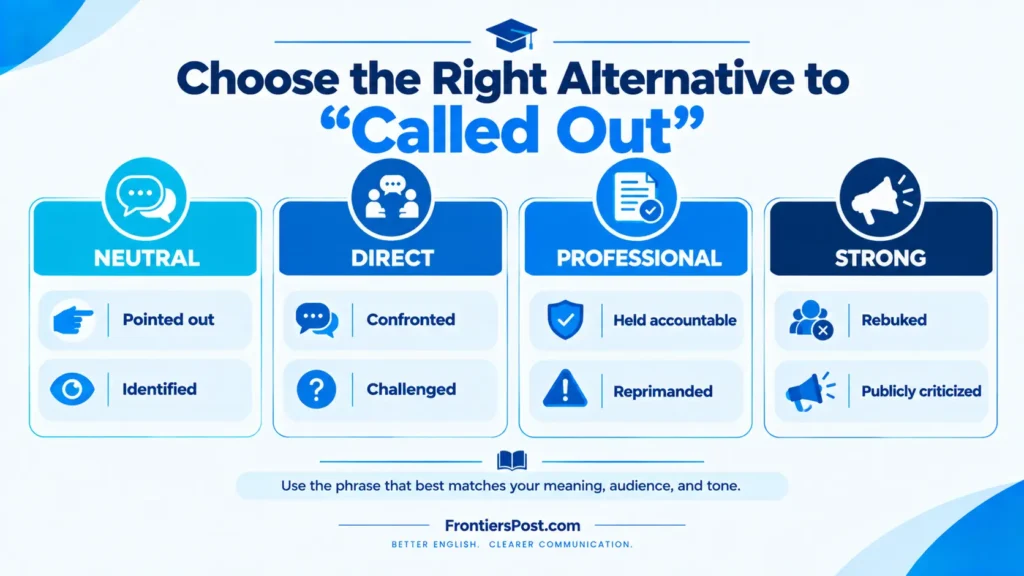
| Alternative | Best Used In | Tone |
| Criticized | Professional, formal, casual | Neutral to negative |
| Confronted | Professional, formal, casual | Direct |
| Challenged | Professional, academic, formal | Assertive |
| Pointed out | Professional, casual, friendly | Neutral |
| Singled out | Professional, casual | Neutral to negative |
| Held accountable | Professional, formal | Responsible, serious |
| Reprimanded | Professional, formal | Strong, disciplinary |
| Put on the spot | Casual, friendly, professional | Uncomfortable, informal |
| Rebuked | Formal, professional | Strong, serious |
| Publicly criticized | Formal, professional, casual | Direct, negative |
Common Mistakes
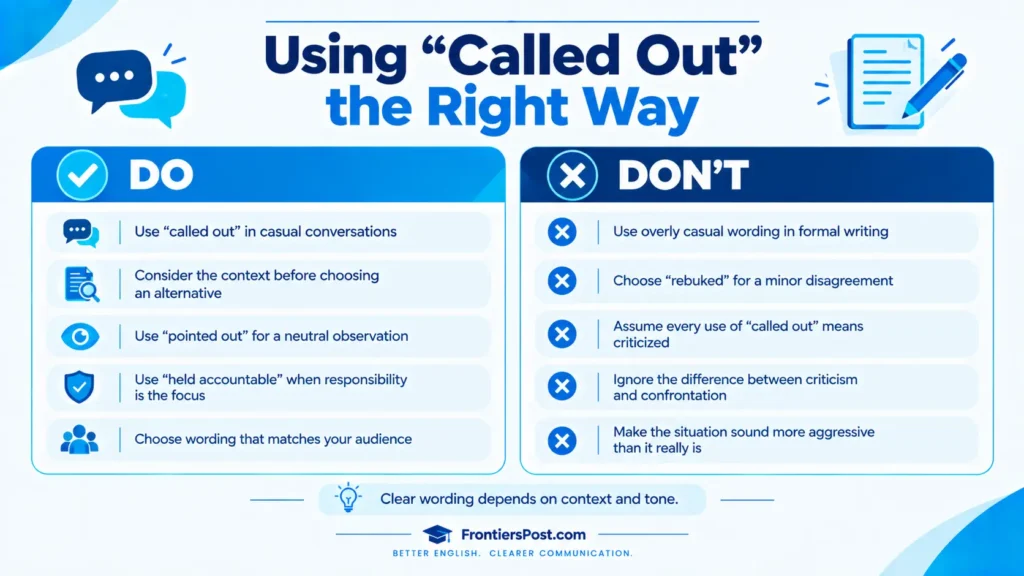
1. Using a Casual Phrase in a Formal Email
“Called out” can sound conversational in professional writing. In a formal email, “criticized,” “addressed,” or “held accountable” may communicate the idea more professionally.
2. Choosing a Phrase That Is Too Strong
Not every disagreement is a confrontation. If someone simply identifies an error, “pointed out” may be more accurate than “rebuked” or “confronted.”
3. Ignoring the Meaning of the Original Phrase
“Called out” can describe criticism, confrontation, identification, or public attention. Always determine which meaning applies before selecting a replacement.
4. Repeating the Same Alternative
Using “criticized” in every sentence can make your writing repetitive. Rotate between precise alternatives such as “challenged,” “pointed out,” and “held accountable” when their meanings fit.
5. Making the Tone Sound More Aggressive Than Intended
Some alternatives carry strong emotional weight. Words such as “rebuked” and “reprimanded” can make a situation sound much more serious, so use them only when the context supports that tone.
Frequently Asked Questions
What is another way to say “called out” professionally?
Professional alternatives include criticized, confronted, challenged, held accountable, and pointed out. The best choice depends on the situation. For example, “held accountable” emphasizes responsibility, while “pointed out” is more neutral. In a workplace setting, choosing a precise phrase can make your communication sound clearer and more professional.
What is a polite way to say “called out”?
A polite alternative is often pointed out because it sounds neutral and focuses on the issue rather than the person. You could also say that someone “raised a concern” or “addressed an issue,” depending on the context. These choices are useful when you want to communicate disagreement without making the situation sound confrontational.
Is “called out” formal English?
“Called out” is standard and widely understood in American English, but it is generally more conversational than formal. It works naturally in casual speech, social media, and informal writing. For academic or professional writing, a more specific word such as “criticized,” “challenged,” or “identified” may be a better choice.
What is another word for calling someone out?
Depending on the meaning, you can use criticizing, confronting, challenging, reprimanding, rebuking, or holding someone accountable. If you mean drawing attention to an issue rather than criticizing someone, “pointing out” is usually more accurate. The right word depends on the purpose and tone of the interaction.
What does “called out” mean in a negative context?
In a negative context, “called out” usually means openly criticizing or confronting someone about behavior, comments, or actions. For example, if a coworker is called out for missing an important deadline, the phrase suggests that the problem was directly brought to their attention, possibly in front of other people.
Can I use “confronted” instead of “called out”?
Yes, but the two phrases are not always identical. “Confronted” suggests a direct interaction in which someone addresses a problem or disagreement. “Called out” can also mean publicly criticizing someone or simply identifying a problem. Therefore, use “confronted” when direct contact is central to the situation.
Is “held accountable” the same as “called out”?
Not exactly. “Called out” focuses on openly pointing to or criticizing a problem, while “held accountable” focuses on responsibility for an action or result. Someone may be called out without facing any consequences. Being held accountable usually implies that the person is expected to take responsibility or correct the situation.
What is the best alternative to “called out”?
There is no single best alternative for every situation. Criticized is a strong general choice when you mean expressing disapproval. Use pointed out for neutral observations, confronted for direct discussions, challenged for disagreements, and held accountable when responsibility is the main idea.
You may also find these guides useful: 10 Better Ways to Say “Can’t Wait”, Another Way to Say “Check In” and Another Way to Say Definitely.
Conclusion
“Called out” is a useful everyday expression, but its meaning can change depending on context. If you mean expressing disapproval, criticized or publicly criticized usually works well. For a direct disagreement, confronted or challenged may be more precise. The phrase “call someone out” is generally used to describe openly criticizing someone or asking them to explain their actions.
Meanwhile, pointed out is a better neutral option when you simply want to identify an issue, while held accountable emphasizes responsibility. More formal choices such as reprimanded and rebuked are appropriate when the situation involves serious or official criticism.
The most effective alternative is the one that accurately describes what happened and matches your intended tone. Instead of replacing “called out” automatically, consider whether you mean criticism, confrontation, correction, or public attention first.

The FrontiersPost editorial team writes and reviews every guide to word and phrase alternatives, with clear meanings, tone notes and example sentences for everyday, academic and professional English.