

Another way to say definitely is “certainly,” “absolutely,” “for sure,” “without a doubt,” or “I’m certain.” Use “certainly” in professional settings, “absolutely” to show strong agreement, and “for sure” in casual conversations. The best alternative depends on your tone, the situation, and how strongly you want to express certainty.
Key Takeaways
- Use “certainly” for polite, professional, and formal communication.
- Choose “absolutely” to express strong agreement or enthusiasm.
- Say “for sure” in relaxed conversations with friends and coworkers.
- Use “without a doubt” when you want to emphasize confidence.
- Match your alternative to the context instead of repeating “definitely.”
“Definitely” is a common English word that expresses certainty, confidence, or strong agreement. However, using it repeatedly can make your conversations and writing sound predictable.
Fortunately, you can choose from several alternatives that communicate the same idea with different levels of formality and emphasis. Whether you are writing a business email, answering a question, or making plans with a friend, the right phrase can help you sound more natural.
What Does “Another Way to Say Definitely” Mean?

Looking for another way to say “definitely” means finding a word or phrase that expresses certainty, agreement, or a firm decision. Depending on the context, it can mean that something is certain to happen, that you strongly agree, or that you are willing to do something.
For example, you might write “I will certainly attend the meeting” in a professional email or say “Absolutely!” when agreeing with a friend. Both expressions communicate confidence, but their tones differ slightly.
People commonly use alternatives to “definitely” in everyday conversations, workplace communication, academic writing, and personal messages.
Why Use Other Ways to Say “Definitely”?
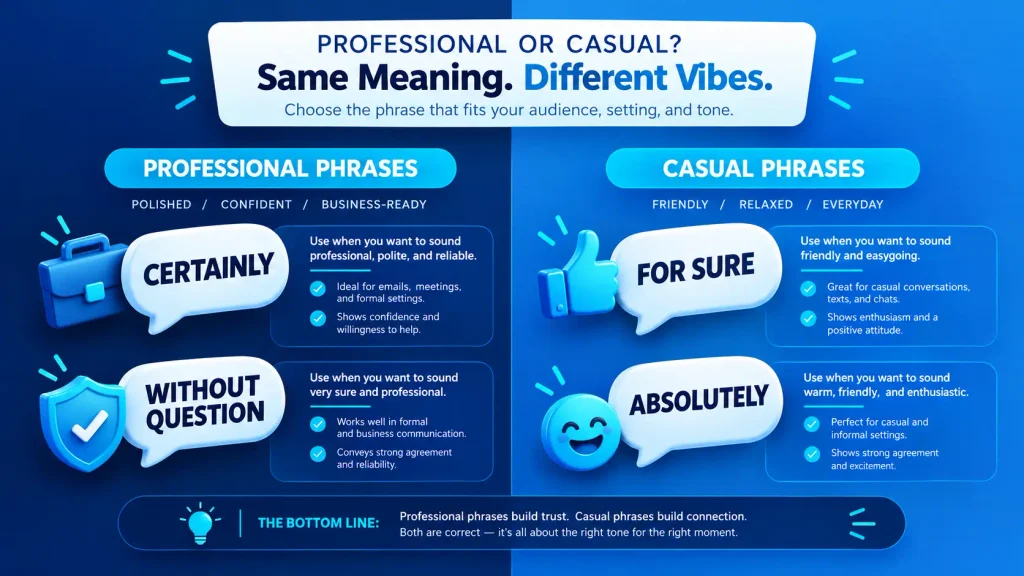
Although “definitely” works in many situations, varying your vocabulary helps you communicate with greater precision. Different expressions can make your message sound more professional, friendly, enthusiastic, or convincing.
Consider using an alternative when you want to:
- Avoid repetition: Keep conversations and written content interesting.
- Sound more natural: Choose expressions that fit everyday American English.
- Improve professional communication: Make emails and workplace responses more polished.
- Show enthusiasm: Express agreement with warmth and confidence.
- Communicate certainty: Make your position clear without unnecessary words.
The key is to choose a phrase that fits both your intended meaning and your audience.
10 Best Other Ways to Say “Definitely”
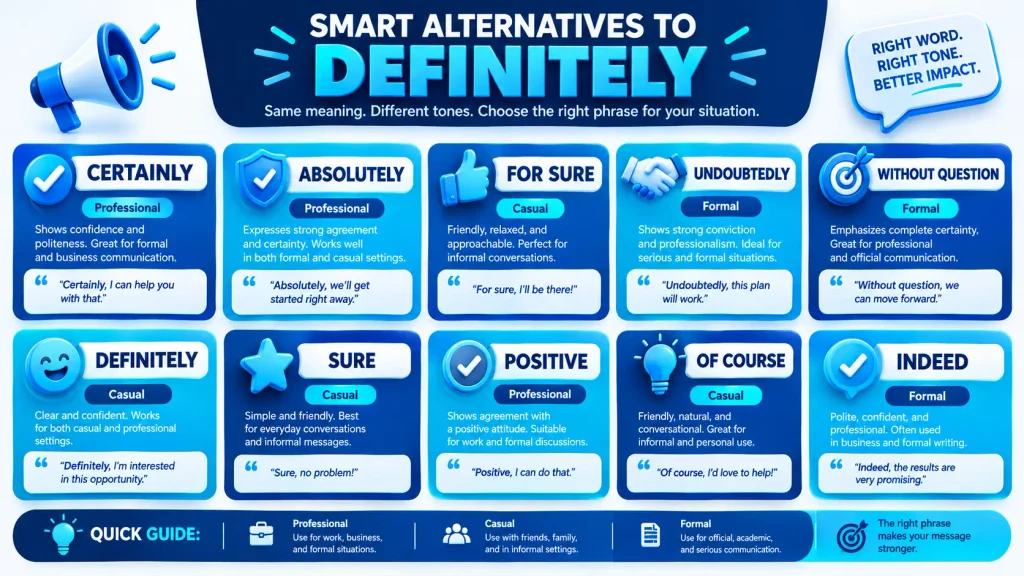
1. Certainly
Meaning
“Certainly” expresses confidence that something is true or will happen. It is a polished alternative to “definitely” and works especially well in professional conversations, customer service, and formal writing.
Best For
Professional, Formal, Polite
Example 1
“Certainly, I can send you the revised proposal before noon.”
Example 2
“We can certainly discuss your suggestions during tomorrow’s meeting.”
Quick Tip
Use “certainly” when you want to sound confident and courteous without appearing overly casual.
2. Absolutely
Meaning
“Absolutely” expresses complete agreement, strong certainty, or enthusiastic approval. It often sounds more energetic than “certainly,” making it useful when you want to emphasize your response.
Best For
Professional, Casual, Friendly, Warm
Example 1
“Absolutely! I’d be happy to help you prepare for the interview.”
Example 2
“We absolutely need to review the budget before approving the project.”
Quick Tip
Use “absolutely” to show strong agreement or emphasis, but avoid adding it to every sentence because it can lose its impact.
3. For Sure
Meaning
“For sure” is a relaxed expression that communicates confidence or agreement. It is common in spoken American English and informal messages, especially when confirming plans or responding positively.
Best For
Casual, Friendly, Warm
Example 1
“I’ll be there for sure, so save me a seat.”
Example 2
“That new restaurant is worth trying for sure.”
Quick Tip
Keep “for sure” for casual conversations and friendly messages. In formal business writing, “certainly” or “without a doubt” may be more appropriate.
4. Without a Doubt
Meaning
“Without a doubt” communicates strong confidence that something is true, correct, or likely to happen. It adds emphasis and can make a statement sound more decisive.
Best For
Formal, Professional, Warm
Example 1
“Without a doubt, Maya is one of the most reliable people on our team.”
Example 2
“This training program will, without a doubt, improve your presentation skills.”
Quick Tip
Use this phrase when you want to emphasize confidence in a statement. Avoid it when the situation calls for uncertainty or a balanced assessment.
5. For Certain
Meaning
“For certain” means that something is known or believed with confidence. It is especially useful when confirming information, although it can sound more emphatic or conversational than “certainly” in some sentences.
Best For
Professional, Casual, Polite
Example 1
“I know for certain that the application was submitted yesterday.”
Example 2
“We will have the final numbers by Friday for certain.”
Quick Tip
Use “for certain” when you want to stress that information is reliable or that a decision is firm. Do not use it if you are still guessing.
6. I’m Sure
Meaning
“I’m sure” expresses personal confidence that something is true or will happen. It often sounds natural and reassuring, especially when responding to questions or helping someone feel more confident.
Best For
Friendly, Warm, Polite, Professional
Example 1
“I’m sure your preparation will help you give a strong presentation.”
Example 2
“I’m sure we can find a time that works for everyone.”
Quick Tip
Use “I’m sure” for reassurance or personal judgment. If you need to communicate verified facts, state the evidence rather than relying only on your confidence.
7. Undoubtedly
Meaning
“Undoubtedly” means that something is true or certain with little or no reason for doubt. It is more formal than many everyday alternatives and often appears in essays, reports, reviews, and professional discussions.
Best For
Formal, Professional
Example 1
“Her research has undoubtedly contributed to a better understanding of the issue.”
Example 2
“Clear communication is undoubtedly an important part of successful teamwork.”
Quick Tip
Use “undoubtedly” in formal writing when you want a concise, confident statement. Make sure the surrounding evidence supports your claim.
8. No Question
Meaning
“No question” is an emphatic expression used to show that you have no doubt about something. In American English, it often appears in conversational statements about a person’s ability, the quality of something, or the importance of an issue.
Best For
Casual, Friendly, Professional
Example 1
“There’s no question that Jordan has the skills to lead this project.”
Example 2
“No question, this was our most successful event of the year.”
Quick Tip
“There’s no question that” fits more smoothly into complete sentences. The shorter “no question” is more conversational and works best when the context is clear.
9. Without Question
Meaning
“Without question” emphasizes that a statement is accepted as certain or beyond reasonable doubt. It is a strong alternative for formal discussions, professional writing, and statements that call for a confident tone.
Best For
Formal, Professional
Example 1
“Without question, customer feedback should guide our next product update.”
Example 2
“She is without question the most experienced candidate for the position.”
Quick Tip
Use “without question” for firm statements, but avoid it when reasonable disagreement exists or when you need to acknowledge competing viewpoints.
10. I’m Positive
Meaning
“I’m positive” communicates strong personal certainty about something. It is natural in everyday American English and can sound more emphatic than “I think,” making it useful when confirming details or correcting a misunderstanding.
Best For
Casual, Friendly, Professional
Example 1
“I’m positive I left the signed documents on your desk.”
Example 2
“I’m positive we discussed that deadline during last week’s call.”
Quick Tip
Use “I’m positive” when you feel very confident about your own knowledge or memory. For important details, verify the facts before making a firm claim.
Comparison Table
The following table summarizes the tone and best uses of all 10 alternatives.
| Alternative | Best Used In | Tone |
|---|---|---|
| Certainly | Business emails and formal requests | Polite, professional |
| Absolutely | Strong agreement and enthusiastic responses | Confident, energetic |
| For sure | Informal conversations and texts | Casual, friendly |
| Without a doubt | Emphatic statements and confident claims | Strong, assured |
| For certain | Confirming details and firm plans | Confident, direct |
| I’m sure | Reassurance and personal judgments | Warm, conversational |
| Undoubtedly | Essays, reports, and formal discussions | Formal, authoritative |
| No question | Everyday emphasis and team discussions | Direct, emphatic |
| Without question | Professional arguments and firm statements | Decisive, formal |
| I’m positive | Confirming memories or personal knowledge | Confident, conversational |
Common Mistakes When Replacing “Definitely”
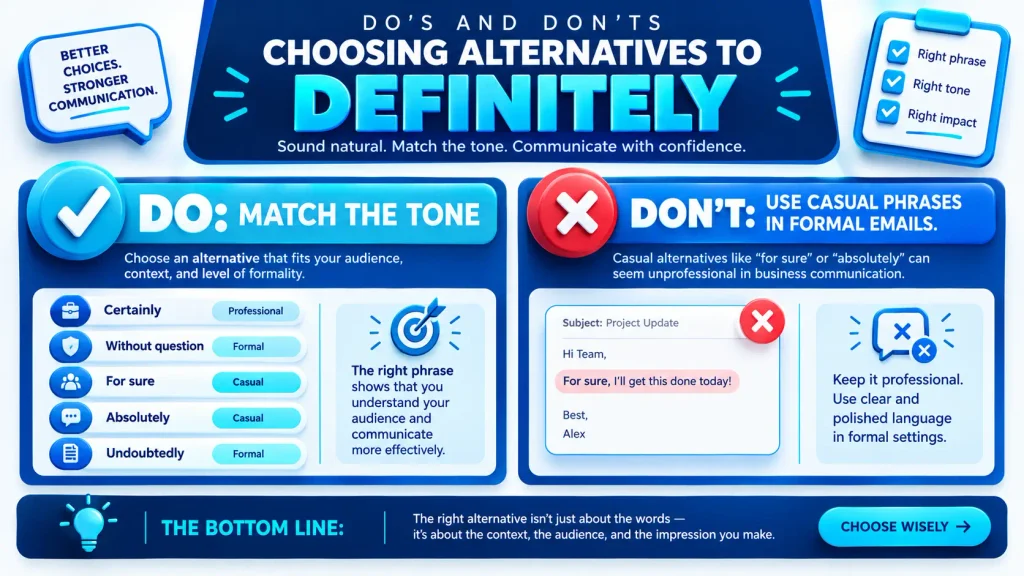
Choosing the right alternative is not just about finding a synonym. You also need to consider tone, meaning, and the situation.
1. Using Casual Phrases in Formal Emails
Expressions such as “for sure” may sound too informal in a proposal, business report, or formal request.
Better approach: Use “certainly” when confirming a professional commitment or responding politely to a request.
2. Making Every Statement Sound Absolute
Words such as “absolutely” and “without a doubt” communicate strong certainty. Using them when you have incomplete information can make your message sound misleading.
Better approach: Choose “I believe,” “I expect,” or “I’m reasonably confident” when the facts are not fully established.
3. Choosing Overly Formal Language
“Undoubtedly” can sound unnatural in a quick text to a friend. Similarly, a formal expression may make a simple conversation feel stiff.
Better approach: Match the phrase to the situation. Use “for sure” in relaxed conversations and save more formal expressions for appropriate contexts.
4. Repeating the Same Alternative
Replacing every instance of “definitely” with “certainly” does not necessarily improve your writing. Repetition can still make your sentences sound monotonous.
Better approach: Vary your wording naturally, but do not force a new phrase into every sentence.
5. Ignoring the Difference Between Agreement and Certainty
“Absolutely” often communicates enthusiastic agreement, while “I’m sure” expresses personal confidence. These expressions overlap, but they are not always interchangeable.
Better approach: Ask yourself whether you are agreeing with someone, confirming a fact, making a prediction, or reassuring another person. Then choose the phrase that expresses your actual meaning.
Frequently Asked Questions
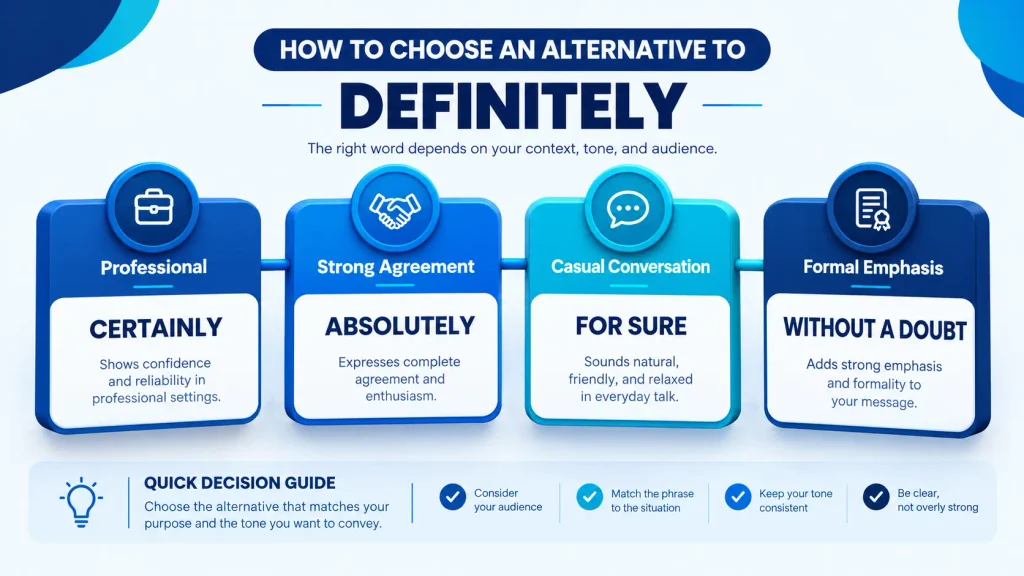
1. What is the best word to use instead of “definitely”?
“Certainly” is one of the most versatile alternatives because it works in professional, formal, and everyday communication. However, “absolutely” is often better for enthusiastic agreement, while “undoubtedly” fits formal writing. The best choice depends on whether you want to express certainty, agreement, reassurance, or emphasis.
2. What is a professional way to say “definitely”?
You can use “certainly,” “without question,” or “I can confirm that” in professional communication. For example, “I can confirm that the report will be ready by Friday” sounds clear and businesslike. Choose a phrase that reflects your actual level of certainty rather than making a commitment you cannot guarantee.
3. What is a casual way to say “definitely”?
“For sure,” “absolutely,” and “I’m positive” are natural alternatives in casual American English. You might say, “For sure, I’ll meet you there,” when confirming plans with a friend. “Absolutely” works particularly well when you want to respond with enthusiasm or show strong agreement.
4. Is “certainly” the same as “definitely”?
The two words are similar because both express confidence or certainty. However, “certainly” often sounds more polite or formal, while “definitely” can feel more direct and conversational. In some contexts, “certainly” also functions as a courteous response to a request, such as “Certainly, I can help with that.”
5. How do you say “definitely yes” more naturally?
You can simply say “absolutely,” “certainly,” or “without a doubt,” depending on the situation. For example, “Absolutely! I’d love to join you” sounds enthusiastic and natural. In professional settings, “Certainly” may be more appropriate, while “for sure” works well in informal conversations.
6. What is a formal synonym for “definitely”?
“Undoubtedly,” “certainly,” and “without question” are useful formal alternatives. “Undoubtedly” works well in essays and reports, while “certainly” is suitable for polite professional communication. Use “without question” when you want to make a strong statement, but ensure that the available evidence supports the certainty you express.
7. How can I avoid repeating “definitely” in writing?
Choose alternatives according to their meaning instead of swapping words randomly. Use “certainly” for polite confirmation, “undoubtedly” for formal emphasis, and “I’m sure” for personal confidence. You can also rewrite a sentence to express certainty directly, such as changing “I will definitely attend” to “I will attend the meeting.”
8. Can I use “absolutely” in a professional email?
Yes. “Absolutely” is appropriate in many professional emails, especially when agreeing to a request or expressing enthusiasm. For example, “Absolutely, I can review the document this afternoon” sounds positive and helpful. For a more formal or restrained tone, consider “Certainly” or a direct statement confirming what you can do.
Conclusion
Choosing another way to say “definitely” can make your communication more natural, precise, and effective. Understanding the meaning of definitely can also help you choose the right alternative for your audience and situation.
For professional emails, “certainly” is a reliable choice because it sounds polite and confident. Use “absolutely” when you want to show strong agreement, “for sure” in casual conversations, and “undoubtedly” in formal writing. When expressing personal confidence, “I’m sure” or “I’m positive” may sound more natural.
Remember that these expressions are similar but not identical. Some emphasize agreement, while others communicate certainty or reinforce a claim. Rather than replacing “definitely” mechanically, choose the phrase that best fits your intended meaning. This small adjustment can help you write clearer emails, participate in more natural conversations, and express your ideas with confidence.

Melody Schaefer is the Founder and Editor-in-Chief of FrontiersPost, where she oversees the publication of clear, useful, and thoughtfully researched content for modern readers. Her editorial focus includes language, communication, vocabulary, writing, and practical topics that help readers understand information with greater clarity and confidence.
At FrontiersPost, Melody works with writers and editors to maintain consistent editorial standards, improve content quality, and ensure that published articles are useful, accessible, and easy to understand. She is particularly interested in clear communication and presenting complex or easily confused topics in a straightforward way.
As Editor-in-Chief, she is also responsible for guiding the site’s editorial direction, reviewing content standards, and helping ensure that articles are regularly maintained and improved as information evolves.