
Another way to say quick learner is fast learner, adaptable, quick to grasp new concepts, or a rapid learner. On a resume, phrases such as “quick to master new skills” and “eager to learn” can sound more professional. Choose an alternative that reflects your actual abilities and fits the job or situation.
Key Takeaways
- Use fast learner or rapid learner when you want a simple alternative to quick learner.
- Choose phrases such as quick to grasp new concepts for professional communication.
- On a resume, support your claim with a specific skill, achievement, or example.
- Use adaptable when you can adjust to new tools, tasks, or working environments.
- Avoid exaggerating your abilities; choose wording that accurately describes your learning style.
What Does “Another Way to Say Quick Learner” Mean?
A quick learner is someone who understands new information, develops skills, and adapts to unfamiliar tasks in a short amount of time. People often use this expression to describe someone who learns efficiently and applies new knowledge with confidence.
The phrase appears frequently in resumes, cover letters, job interviews, performance reviews, and everyday conversations. Employers may use it to describe a candidate who can learn new software, follow procedures, or adjust to changing responsibilities.
However, simply calling yourself a quick learner may not tell an employer much about your abilities. A more specific phrase can communicate how you learn and help you present your strengths more clearly.
Why Use Other Ways to Say “Quick Learner”?
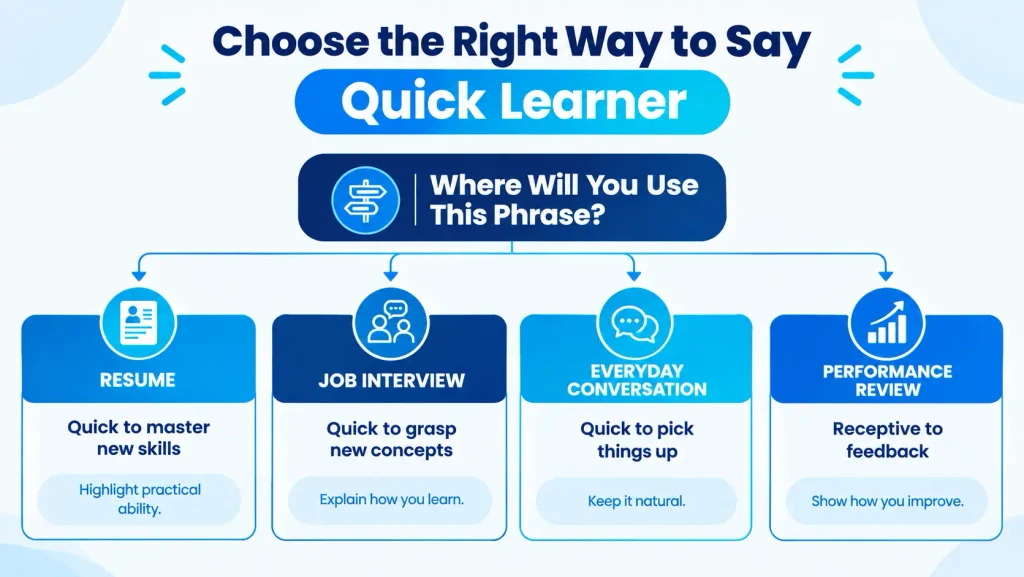
Using different expressions helps you avoid repetition and communicate your strengths more precisely. The best alternative depends on whether you are writing a resume, answering an interview question, or describing someone else’s abilities.
Consider using another phrase to:
- Sound more professional: Choose language that fits a resume or formal application.
- Show a specific strength: Explain whether you learn new concepts, master tools, or adapt to change.
- Improve your resume: Make your skills more relevant to the position.
- Communicate naturally: Avoid repeating quick learner in every section of your application.
- Provide stronger evidence: Connect your learning ability to a real accomplishment.
10 Best Other Ways to Say “Quick Learner”
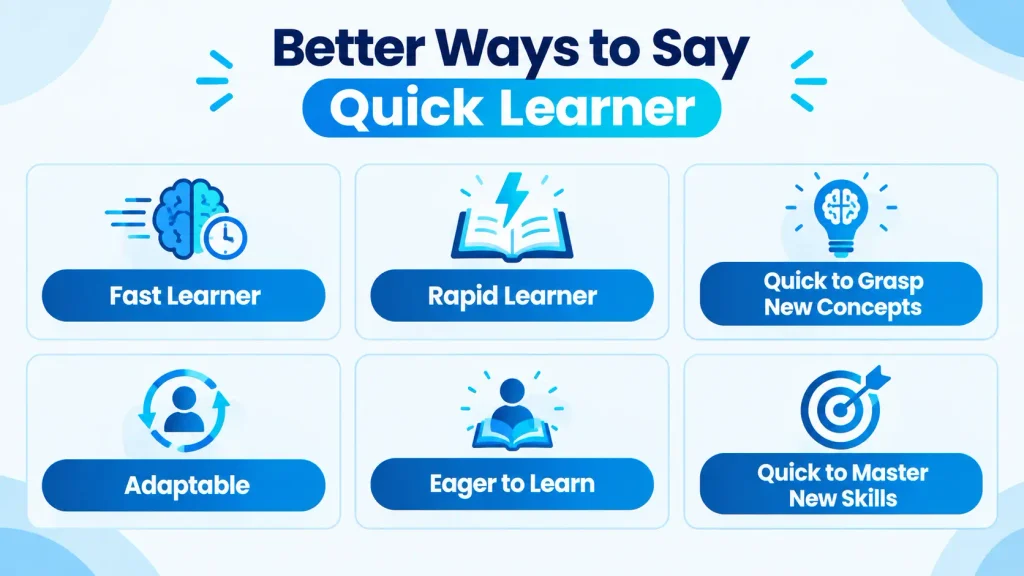
1. Fast Learner
Meaning
Fast learner is a simple, direct alternative to quick learner. It describes someone who understands new information or develops skills without needing excessive time or repeated instruction.
Best For
- Professional
- Casual
- Friendly
Example 1
“I’m a fast learner who can quickly become comfortable with new office software.”
Example 2
“Jordan is a fast learner and picked up the team’s reporting process within a week.”
Quick Tip
Use fast learner in everyday conversation or a resume summary, but add a specific example to make the claim more convincing.
2. Rapid Learner
Meaning
Rapid learner emphasizes the speed at which someone acquires knowledge or develops a skill. It sounds slightly more formal than fast learner and can work well in professional descriptions.
Best For
- Professional
- Formal
Example 1
“She is a rapid learner who adapts well to unfamiliar project requirements.”
Example 2
“Our new analyst proved to be a rapid learner during the software transition.”
Quick Tip
Choose rapid learner when you want a concise, professional description, especially in a performance review or candidate profile.
3. Quick to Grasp New Concepts
Meaning
This phrase highlights the ability to understand unfamiliar ideas, processes, or information quickly. It is more specific than quick learner because it focuses on comprehension rather than learning speed alone.
Best For
- Professional
- Formal
Example 1
“Alex is quick to grasp new concepts and applies feedback effectively.”
Example 2
“The role requires someone who is quick to grasp new concepts in a changing industry.”
Quick Tip
Use this expression when the position requires problem-solving, analytical thinking, or understanding complex information.
4. Adaptable
Meaning
An adaptable person adjusts to new circumstances, responsibilities, systems, or expectations. Although adaptability is not exactly the same as learning quickly, it can communicate a related strength when you learn and adjust well.
Best For
- Professional
- Formal
- Polite
Example 1
“I’m adaptable and comfortable learning new procedures as team priorities change.”
Example 2
“Her adaptable approach helped her transition smoothly into a leadership role.”
Quick Tip
Use adaptable when your ability to learn is closely connected to handling change. Support it with an example of a successful transition.
5. Eager to Learn
Meaning
Eager to learn describes someone who is enthusiastic about gaining knowledge and developing new abilities. Unlike fast learner, it emphasizes motivation and curiosity rather than how quickly someone learns.
Best For
- Professional
- Friendly
- Warm
Example 1
“I’m eager to learn new tools and contribute to the team’s long-term goals.”
Example 2
“The internship is ideal for an eager-to-learn candidate interested in digital marketing.”
Quick Tip
This phrase works especially well for entry-level candidates, students, and career changers who want to demonstrate a positive attitude.
6. Quick to Pick Things Up
Meaning
Quick to pick things up is a natural, conversational expression for someone who understands instructions or learns practical skills with little difficulty. It sounds less formal than many resume alternatives.
Best For
- Casual
- Friendly
- Warm
Example 1
“Don’t worry about training Maya on the new register; she’s quick to pick things up.”
Example 2
“My brother is quick to pick things up whenever he tries a new sport.”
Quick Tip
Use this expression in conversation or an informal recommendation. For a formal resume, consider a more precise alternative.
7. A Fast Study
Meaning
A fast study describes someone who learns a subject, task, or skill quickly. It is a concise expression that can sound natural in conversation, although it is less common in formal business writing.
Best For
- Casual
- Friendly
- Professional
Example 1
“Chris is a fast study and should be comfortable with the new system soon.”
Example 2
“Although the assignment was unfamiliar, Nina proved to be a fast study.”
Quick Tip
Use a fast study when describing someone’s ability to learn a particular task. In formal applications, quick to master new skills may sound clearer.
8. Quick to Master New Skills
Meaning
This phrase emphasizes the ability to develop practical skills and become proficient at them in a relatively short time. It is more action-oriented than quick learner because it focuses on building competence.
Best For
- Professional
- Formal
Example 1
“I am quick to master new skills and have learned several project management tools.”
Example 2
“He was quick to master the equipment and began supporting other team members.”
Quick Tip
This is a strong option for resumes and interviews when you can name the tools, techniques, or skills you have actually mastered.
9. Receptive to Feedback
Meaning
Receptive to feedback describes someone who listens to suggestions, considers constructive criticism, and uses it to improve. It does not directly mean quick learner, but it can demonstrate a valuable part of the learning process.
Best For
- Professional
- Formal
- Polite
Example 1
“I’m receptive to feedback and use it to improve the quality of my work.”
Example 2
“Taylor is receptive to feedback and makes thoughtful adjustments after each review.”
Quick Tip
Use this phrase when your learning ability comes from accepting guidance and improving through experience. Do not use it as a direct substitute when learning speed is the main point.
10. Self-Starter
Meaning
A self-starter takes initiative, works independently, and looks for ways to make progress without constant supervision. This phrase can complement quick learner, but it describes independence and motivation rather than learning speed itself.
Best For
- Professional
- Formal
Example 1
“We need a self-starter who can learn the workflow and manage routine tasks independently.”
Example 2
“As a self-starter, I research unfamiliar tools and apply what I learn to my projects.”
Quick Tip
Choose self-starter when you want to emphasize initiative and independence. Pair it with evidence of learning a new skill if both qualities matter to the role.
Comparison Table
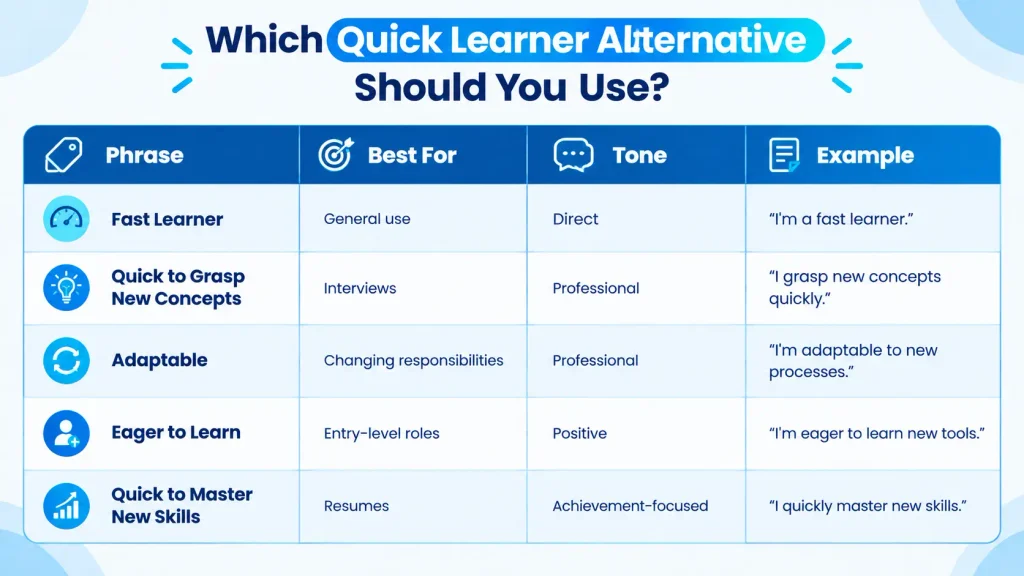
| Alternative | Best Used In | Tone |
|---|---|---|
| Fast learner | Resumes, conversations | Direct |
| Rapid learner | Professional profiles | Formal |
| Quick to grasp new concepts | Interviews, technical roles | Professional |
| Adaptable | Resumes, performance reviews | Professional |
| Eager to learn | Entry-level applications | Positive |
| Quick to pick things up | Everyday conversation | Casual |
| A fast study | Informal recommendations | Conversational |
| Quick to master new skills | Resumes, interviews | Achievement-focused |
| Receptive to feedback | Performance reviews | Constructive |
| Self-starter | Resumes, job interviews | Independent |
Common Mistakes When Using Alternatives to “Quick Learner”
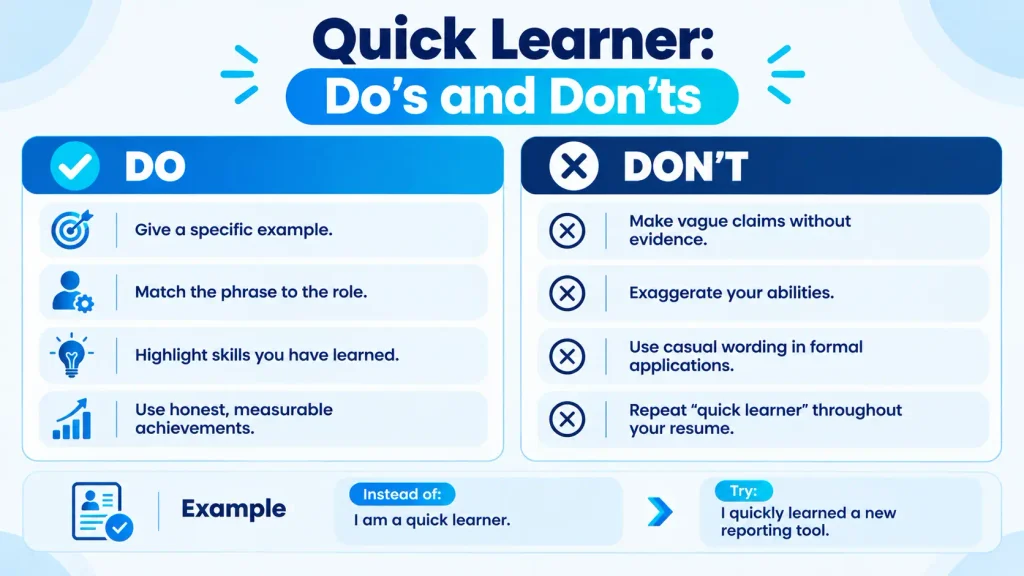
1. Using Casual Language in a Formal Resume
Expressions such as quick to pick things up may sound natural in conversation but less polished in a formal application.
Better Approach
Use quick to master new skills or quick to grasp new concepts when the context calls for professional language.
2. Choosing an Alternative That Changes the Meaning
Adaptable, eager to learn, and self-starter describe different strengths. They are related to learning but do not mean exactly the same thing.
Better Approach
Select the phrase that accurately reflects your ability. Use adaptable for adjusting to change and eager to learn for enthusiasm.
3. Repeating the Same Phrase
Using quick learner in your resume summary, skills section, and cover letter can make your application sound repetitive.
Better Approach
Vary your wording naturally. For example, describe yourself as adaptable in your summary and explain how you mastered a new tool in your experience section.
4. Making Claims Without Evidence
Calling yourself a rapid learner is less persuasive if you provide no proof of that ability.
Better Approach
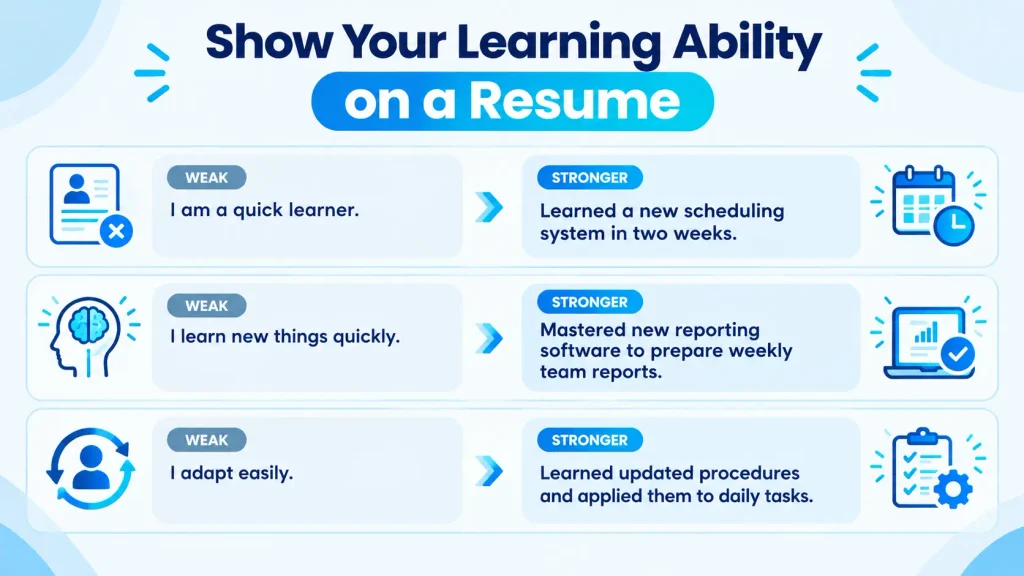
Include a concrete result, such as learning a new scheduling system in two weeks or completing training ahead of schedule. Use only details you can support.
5. Overstating Your Learning Ability
Phrases such as master any skill instantly can sound unrealistic and undermine your credibility.
Better Approach
Use measured language and describe what you have achieved. Employers generally gain more useful information from a specific example than from an exaggerated claim.
Frequently Asked Questions
1. What is another way to say quick learner on a resume?
Quick to master new skills, adaptable, and quick to grasp new concepts are useful alternatives for a resume. Choose the phrase that matches the job requirements, then support it with an example of a tool, process, or skill you learned. This approach makes your application more specific and credible.
2. What is a professional word for a quick learner?
Adaptable is a professional word that can describe someone who learns and adjusts to new responsibilities. Rapid learner is another concise option. However, neither expression captures every aspect of learning ability, so consider whether you want to emphasize speed, flexibility, or the ability to understand complex information.
3. How do you say you are a quick learner in a cover letter?
Explain how you learn and connect that ability to the position. For example, you could write, “I quickly develop proficiency with new software and enjoy learning tools that improve team efficiency.” Whenever possible, mention a relevant skill you have learned to make the statement more persuasive.
4. What is a synonym for quick learner in one word?
There is no perfect one-word synonym for quick learner. Adaptable, resourceful, and astute can communicate related qualities, but their meanings differ. Adaptable emphasizes adjusting to change, resourceful emphasizes finding solutions, and astute emphasizes sound judgment. Choose the word that best describes the quality you want to highlight.
5. How can students describe themselves as quick learners?
Students can use phrases such as eager to learn, quick to grasp new concepts, or able to master new skills. For example, a student might explain how they learned a research method or became proficient with new software for a class project. Real examples help demonstrate learning ability without relying on broad claims.
6. Is “fast learner” better than “quick learner”?
Both expressions are natural American English and have nearly the same meaning. Fast learner may feel slightly more conversational, while quick learner is also widely understood in professional settings. Neither is automatically better for a resume. The strength of your supporting example matters more than the small difference in wording.
7. How do you describe someone who learns quickly and works independently?
You can describe the person as a quick learner and a self-starter. These phrases communicate two different strengths: learning new information efficiently and taking initiative without constant direction. If you want a more concise description, explain that the person quickly learns new processes and applies them independently.
8. Should I write “quick learner” in my resume skills section?
You can, but a specific skill or accomplishment may provide stronger evidence. Instead of listing quick learner alone, mention your proficiency with relevant tools or describe how you learned a process. If you use the phrase, connect it to a concrete example that shows how your learning ability helped you perform a task.
Conclusion
Choosing another way to say quick learner helps you describe your abilities with greater precision. Phrases such as fast learner and rapid learner communicate learning speed, while quick to grasp new concepts emphasizes understanding. Adaptable highlights flexibility, and eager to learn shows enthusiasm for developing new skills.
For resumes and cover letters, quick to master new skills can be especially useful when you can support it with a real accomplishment. You can also learn how to highlight your learning skills on a resume to make your abilities more convincing to employers.
The key is to match your wording to the situation and avoid making claims you cannot support. Rather than relying on a label alone, show how you learned something new, applied your knowledge, or contributed to a successful result. A specific example will make your learning ability more convincing to employers and readers alike.

Melody Schaefer is the Founder and Editor-in-Chief of FrontiersPost, where she oversees the publication of clear, useful, and thoughtfully researched content for modern readers. Her editorial focus includes language, communication, vocabulary, writing, and practical topics that help readers understand information with greater clarity and confidence.
At FrontiersPost, Melody works with writers and editors to maintain consistent editorial standards, improve content quality, and ensure that published articles are useful, accessible, and easy to understand. She is particularly interested in clear communication and presenting complex or easily confused topics in a straightforward way.
As Editor-in-Chief, she is also responsible for guiding the site’s editorial direction, reviewing content standards, and helping ensure that articles are regularly maintained and improved as information evolves.