

Another way to say “is about” includes “concerns,” “focuses on,” “deals with,” “covers,” and “centers on.” Use “focuses on” to highlight a main topic, “concerns” for a specific subject, and “deals with” for a broader issue. The best alternative depends on your sentence, audience, and intended meaning.
Key Takeaways
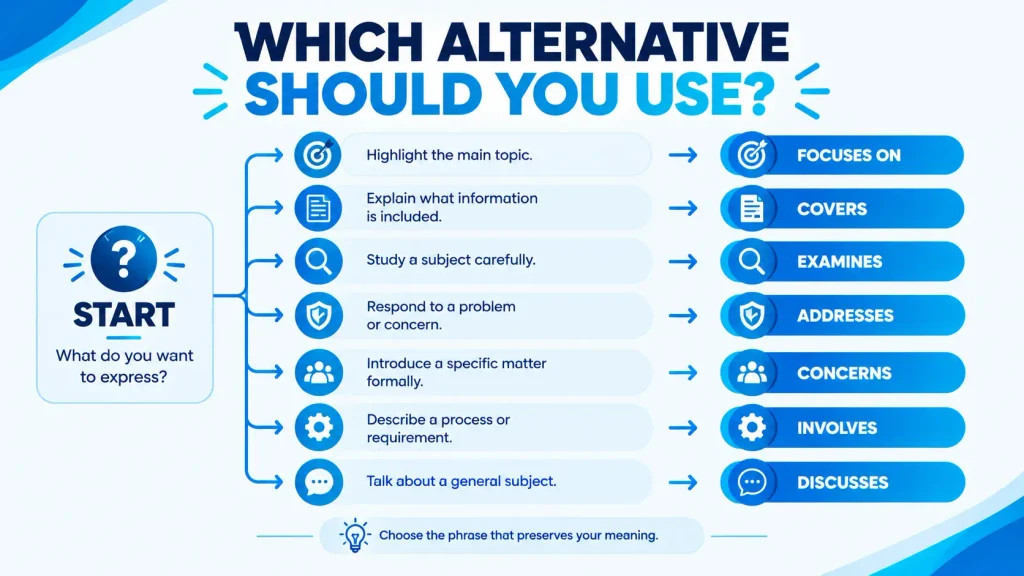
- Use “focuses on” when describing a main topic or central idea.
- Choose “concerns” for formal writing about a particular subject.
- Use “deals with” when discussing an issue, challenge, or situation.
- Try “covers” when explaining what a lesson, article, or presentation includes.
- Always choose an alternative that preserves the original sentence’s meaning and tone.
“Is about” is a common English expression, but repeating it can make writing sound basic or monotonous. Choosing a more specific phrase can help you communicate your meaning clearly in essays, emails, presentations, and everyday conversations.
The right alternative depends on what you mean. You might be introducing a topic, explaining a purpose, describing a problem, or referring to an approximate amount. The following options will help you find a natural replacement.
What Does “Another Way to Say Is About” Mean?
The phrase “another way to say is about” asks for alternative expressions that communicate the same or a similar meaning as “is about.” The expression itself commonly introduces the subject, purpose, or main idea of something.
For example, “The article is about climate change” can become “The article focuses on climate change.” Both sentences identify the topic, but the second sounds more specific.
People commonly use “is about” in academic writing, workplace communication, descriptions, and casual conversations. Alternatives can make these sentences more precise and engaging.
Why Use Other Ways to Say “Is About”?
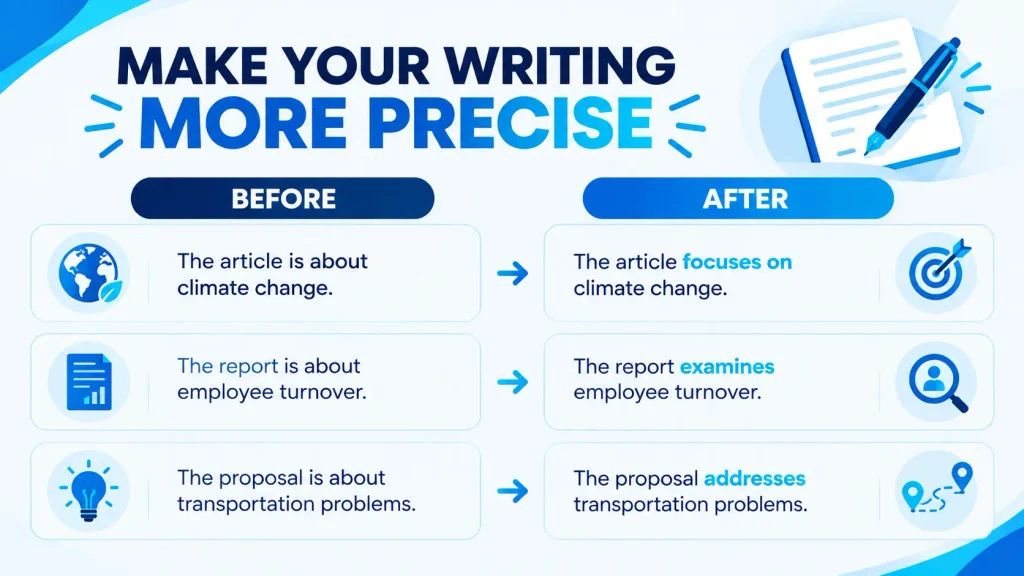
Although “is about” is correct English, choosing a more specific expression can improve your writing.
- Avoid repetition: Vary your language when several sentences introduce different topics.
- Improve clarity: Explain whether something discusses, examines, or addresses an issue.
- Match the tone: Select wording that suits academic, professional, or casual communication.
- Strengthen your writing: Use precise verbs to make descriptions more informative.
- Sound natural: Choose expressions that fit the context rather than replacing words mechanically.
10 Best Other Ways to Say “Is About”
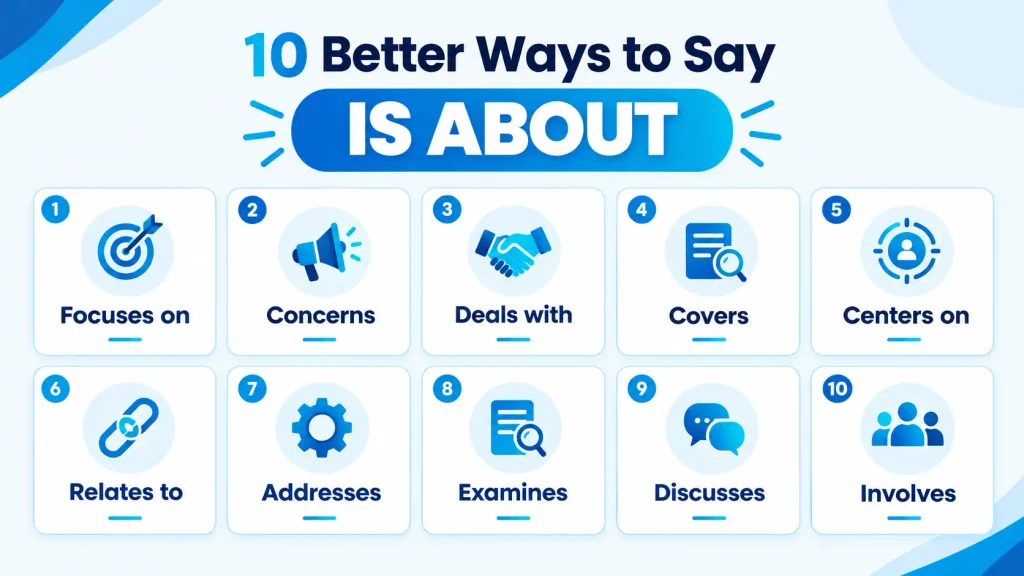
1. Focuses On
Meaning
“Focuses on” means that something gives particular attention to a topic, idea, or issue. It works well when identifying the central subject of an article, discussion, project, or presentation.
Best For
- Professional
- Academic
- Formal
Example 1
The research paper focuses on the effects of sleep deprivation on college students.
Example 2
Our next meeting focuses on improving customer service.
Quick Tip
Use this phrase when a subject receives special attention rather than merely appearing as one of several topics.
2. Concerns
Meaning
“Concerns” means relates to or deals with a particular matter. It often sounds more formal than “is about,” making it useful for reports, announcements, policies, and academic writing.
Best For
- Formal
- Professional
- Academic
Example 1
This policy concerns the use of company equipment outside working hours.
Example 2
Her latest study concerns language development in young children.
Quick Tip
Use “concerns” when referring to a specific subject or matter. Remember that it can also mean causes worry, depending on the context.
3. Deals With
Meaning
“Deals with” means discusses, handles, or addresses a subject. It is a flexible expression for topics ranging from everyday situations to complex problems.
Best For
- Professional
- Academic
- Casual
Example 1
The training manual deals with common workplace safety issues.
Example 2
His new book deals with the challenges of starting a small business.
Quick Tip
Choose “deals with” when the subject involves an issue, challenge, process, or situation that requires attention.
4. Covers
Meaning
“Covers” means includes or discusses particular information. It is especially useful when describing the contents of a course, article, report, presentation, or guide.
Best For
- Professional
- Academic
- Friendly
Example 1
The workshop covers the basics of effective business writing.
Example 2
This guide covers everything you need to know about preparing for an interview.
Quick Tip
Use “covers” when you want to emphasize the range of information included in something.
5. Centers On
Meaning
“Centers on” means has a particular subject, person, or idea at its core. It suggests that the subject is central to the discussion or story.
Best For
- Academic
- Professional
- Formal
Example 1
The documentary centers on the experiences of first-generation college students.
Example 2
Our discussion centered on ways to reduce unnecessary expenses.
Quick Tip
Use “centers on” when a single theme or idea is the main point of a piece of writing or conversation.
6. Relates To
Meaning
“Relates to” means connects with or has a connection to a subject. Unlike “focuses on,” it does not necessarily suggest that the subject is the main point.
Best For
- Professional
- Formal
- Polite
Example 1
The final section relates to the legal requirements for small businesses.
Example 2
Her question relates to the new attendance policy.
Quick Tip
Choose “relates to” when you want to show a connection without claiming that the subject receives the most attention.
7. Addresses
Meaning
“Addresses” means deals with a question, need, concern, or problem. It is useful when describing content that attempts to respond to an issue or provide a solution.
Best For
- Professional
- Academic
- Formal
Example 1
The proposal addresses the need for better public transportation.
Example 2
This chapter addresses common concerns about online privacy.
Quick Tip
Use “addresses” when the subject involves a question, concern, challenge, or problem that deserves a response.
8. Examines
Meaning
“Examines” means studies or considers something carefully. It is more analytical than “is about” and works particularly well when describing research, essays, reports, or investigations.
Best For
- Academic
- Professional
- Formal
Example 1
The essay examines the relationship between technology and student learning.
Example 2
The report examines why employee turnover has increased.
Quick Tip
Choose “examines” when a piece of content investigates a subject rather than simply introducing it.
9. Discusses
Meaning
“Discusses” means talks or writes about a particular subject. It is a straightforward replacement when describing what a speaker, article, book, or meeting considers.
Best For
- Academic
- Professional
- Friendly
Example 1
The professor discusses effective study habits during the first lecture.
Example 2
The newsletter discusses recent changes to the company’s benefits.
Quick Tip
Use “discusses” when information is presented or explored without necessarily implying a detailed investigation.
10. Involves
Meaning
“Involves” means includes something as a necessary part or feature. It works when “is about” refers to an activity, process, responsibility, or experience rather than just a topic.
Best For
- Professional
- Casual
- Friendly
Example 1
The position involves working with clients from different industries.
Example 2
Planning a successful event involves careful budgeting and coordination.
Quick Tip
Use “involves” to describe what an activity or process requires or includes. It is not always interchangeable with a phrase that simply identifies a topic.
Comparison Table
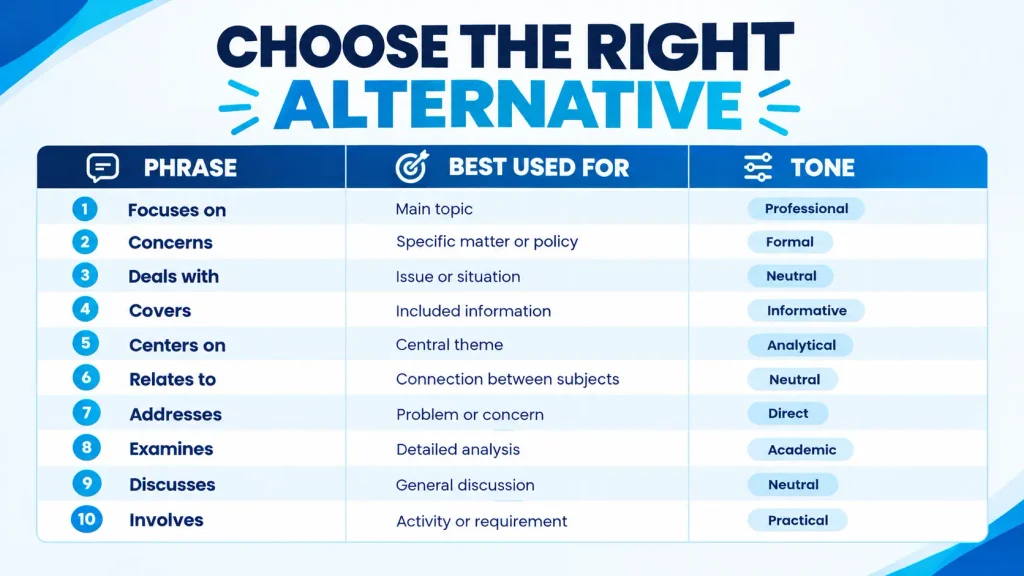
| Alternative | Best Used In | Tone |
|---|---|---|
| Focuses on | Main topics and central ideas | Clear, professional |
| Concerns | Policies, reports, and specific matters | Formal |
| Deals with | Issues, challenges, and situations | Neutral |
| Covers | Courses, guides, and presentations | Informative |
| Centers on | Main themes and storylines | Analytical |
| Relates to | Connections between subjects | Neutral, formal |
| Addresses | Questions, needs, and problems | Direct, professional |
| Examines | Research and detailed analysis | Academic |
| Discusses | Conversations, articles, and meetings | Neutral |
| Involves | Activities, processes, and responsibilities | Practical |
Common Mistakes When Replacing “Is About”
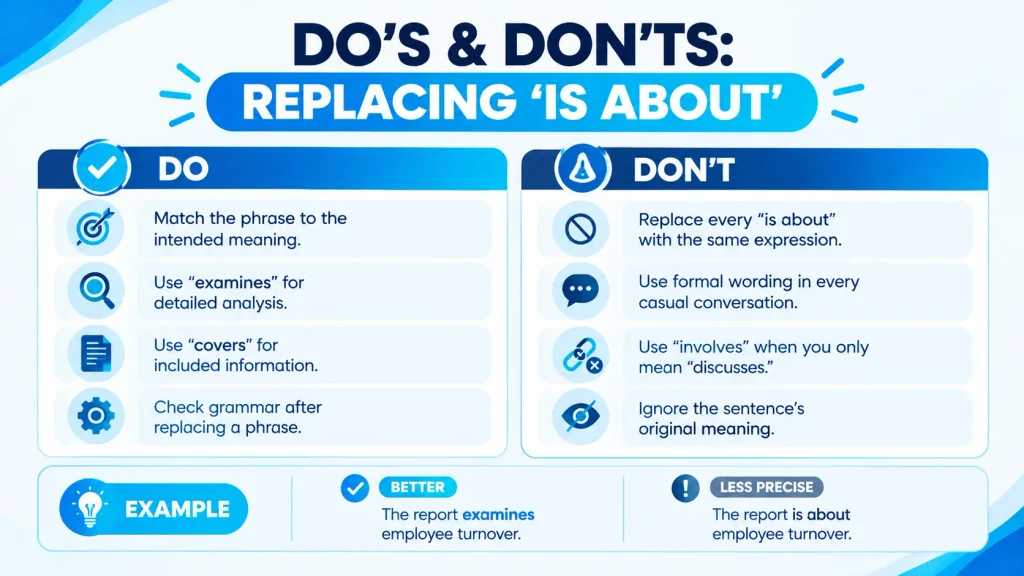
1. Choosing a Phrase That Changes the Meaning
“Examines” suggests careful analysis, while “covers” emphasizes included information. Select the expression that accurately describes the content.
2. Using Overly Formal Language
Words such as “concerns” may suit a policy document but sound stiff in casual conversation. Prefer natural wording for everyday messages.
3. Repeating the Same Alternative
Replacing every instance of “is about” with “focuses on” can create another repetitive pattern. Vary your expressions when the meaning allows it.
4. Ignoring the Sentence Structure
Not every alternative fits every grammatical pattern. For example, “The article focuses on health” is correct, but “The article focuses health” is not.
5. Using “Involves” for Every Topic
“Involves” usually describes participation, requirements, or included elements. It may not work when you simply want to identify the subject of an article.
Frequently Asked Questions
1. What is the best alternative to “is about”?
“Focuses on” is a strong general alternative when identifying the main subject of an article, presentation, or discussion. However, “covers,” “discusses,” and “concerns” may be better depending on the context. Choose the phrase that accurately reflects whether you are introducing, explaining, or analyzing a topic.
2. How can I say “is about” in an academic essay?
In academic writing, consider “examines,” “explores,” “addresses,” or “focuses on.” For example, “This essay is about social inequality” could become “This essay examines social inequality.” The stronger verb makes the sentence more precise and tells readers what the essay actually does.
3. What is a formal way to say “is about”?
“Concerns” is a useful formal alternative, especially when referring to a policy, matter, or subject. “Addresses” works well for problems and questions, while “examines” suits research and analysis. Choose the expression that fits your purpose instead of selecting a formal-sounding word automatically.
4. What is a casual way to say “is about”?
“Deals with” and “talks about” are natural choices in everyday conversation. For example, you could say, “The movie deals with friendship,” or “The podcast talks about healthy habits.” The best option depends on whether you are describing a serious issue or simply introducing a topic.
5. Can I use “focuses on” instead of “is about”?
Yes, when you want to emphasize the main topic. For example, “The presentation is about teamwork” can become “The presentation focuses on teamwork.” However, “focuses on” suggests that the subject receives particular attention, so it may be less accurate when something merely mentions a topic briefly.
6. What is another way to say “what the article is about”?
You can say “the article’s main topic,” “the article focuses on,” or “the article discusses.” For instance, instead of asking, “What is the article about?” you could ask, “What is the article’s main topic?” The second version is concise and works well in academic discussions.
7. Is “relates to” the same as “is about”?
The expressions overlap, but they are not identical. “Is about” usually identifies a subject, while “relates to” emphasizes a connection. For example, an article may be about workplace communication but only one section may relate to conflict resolution.
8. How can I avoid repeating “is about” in writing?
First, identify what each sentence means. Then alternate among accurate choices such as “covers,” “discusses,” “examines,” and “addresses.” You can also restructure sentences to name the topic directly. Avoid changing phrases solely for variety if the new wording makes your meaning less clear.
Conclusion
Choosing another way to say “is about” can make your writing clearer, more precise, and more natural. Understanding the meaning and usage of “about” can also help you choose the right expression for your intended meaning.
For formal writing, “concerns” and “relates to” may be appropriate, while “deals with” and “discusses” work well in many everyday situations. Remember that these expressions have slightly different meanings, so they are not always interchangeable.
Before choosing an alternative, consider your audience, purpose, and sentence structure. A precise verb is usually more effective than a complicated expression. By selecting words that match your intended meaning, you can improve your essays, professional emails, presentations, and everyday communication.

Sarah Mitchell is a Senior English Editor at FrontiersPost, specializing in English usage, vocabulary, word choice, grammar, and effective communication. She focuses on helping readers understand subtle differences between commonly confused words, phrases, and expressions and use them naturally in everyday, professional, and academic writing.
At FrontiersPost, Sarah researches, writes, and edits educational content with an emphasis on clarity, accuracy, and practical examples. She works closely with the editorial team to ensure that articles are easy to understand while maintaining appropriate context, meaning, and usage.
Her editorial interests include English vocabulary, synonyms, phrasing, professional communication, and the practical nuances that can make written communication more precise and effective.