

Another way to say making sure is ensuring, confirming, checking, verifying, or making certain. Use “ensuring” in professional writing, “confirming” when checking details, and “double-checking” when reviewing information for accuracy. The best alternative depends on your sentence, audience, and purpose.
Key Takeaways
- Use ensuring for professional and formal communication.
- Choose confirming when checking that information or plans are correct.
- Use verifying when accuracy or proof matters.
- Say double-checking in everyday conversations and informal workplace messages.
- Match your alternative to the context instead of replacing “making sure” mechanically.
“Making sure” is a common English expression, but repeating it can make your writing sound less precise. Choosing a suitable alternative can help you communicate clearly in professional emails, academic assignments, workplace conversations, and everyday situations.
The best replacement depends on what you mean. You might want to confirm information, prevent a problem, check a task, or guarantee that something happens. The following alternatives will help you express these ideas naturally.
What Does “Making Sure” Mean?
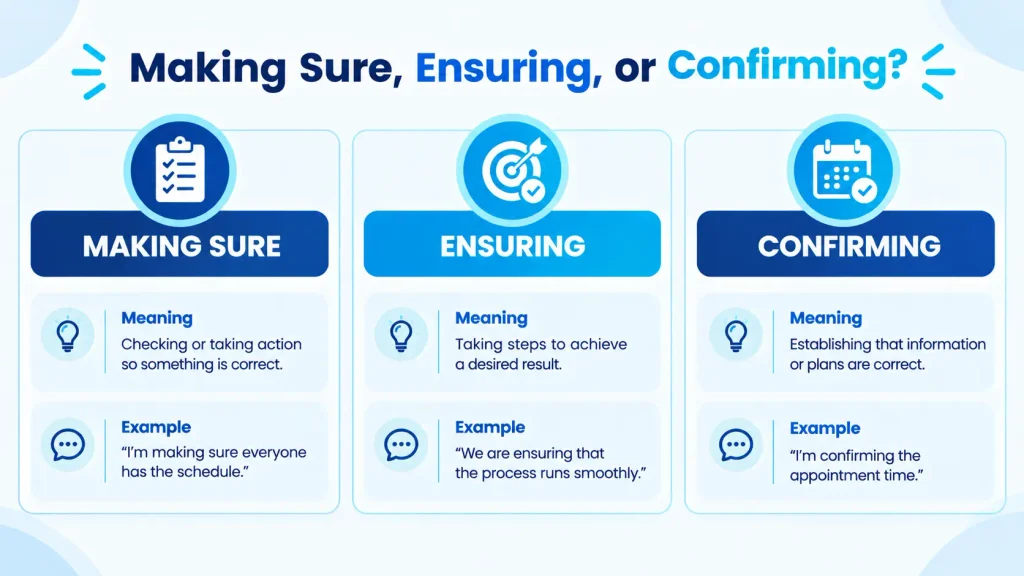
“Making sure” means taking steps to confirm that something is correct, complete, safe, or likely to happen as intended. It often involves checking information, reviewing details, or taking action to avoid mistakes.
For example, “I’m making sure everyone receives the meeting invitation” means you are checking that every person gets the invitation.
People commonly use this expression in workplace communication, instructions, personal conversations, and academic writing. Although it works in most everyday situations, a more specific verb can make your message clearer and more professional.
Why Use Other Ways to Say “Making Sure”?
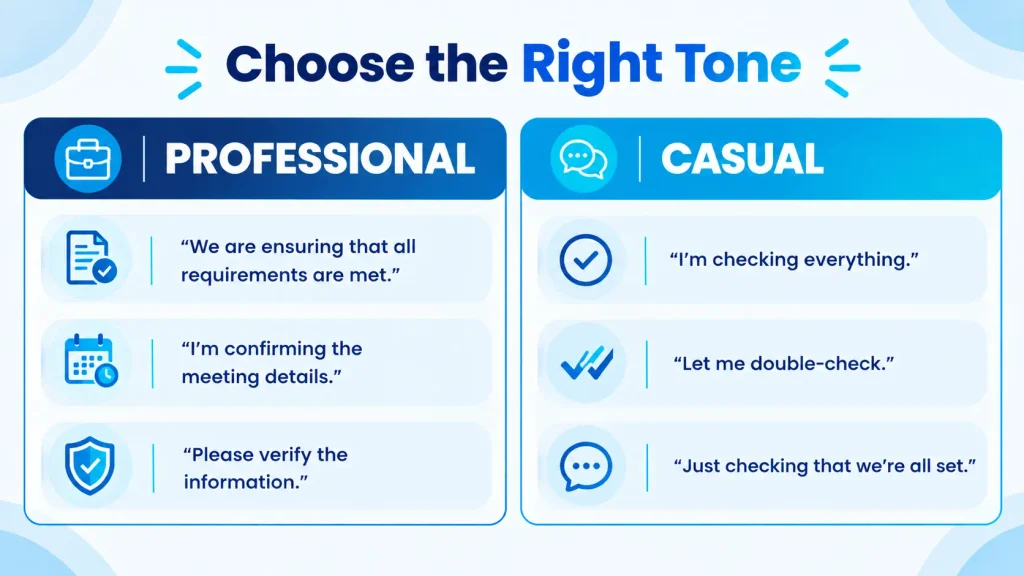
Using alternatives helps you communicate your exact intention without repeating the same expression. It also allows you to adjust your tone to suit your reader.
Consider these benefits:
- Avoid repetition: Keep emails and longer documents engaging.
- Improve clarity: Explain whether you are checking, confirming, or preventing something.
- Sound professional: Choose language that suits workplace and academic settings.
- Match your tone: Use conversational expressions with friends and precise wording at work.
- Express your intention: Make it clear whether you are reviewing information or taking responsibility for an outcome.
10 Best Other Ways to Say “Making Sure”
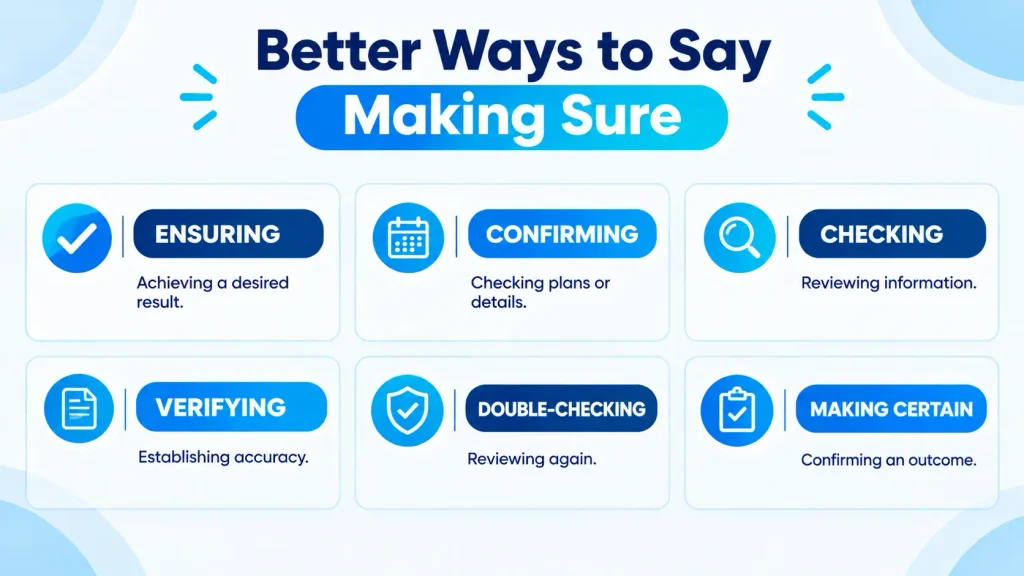
1. Ensuring
Meaning
“Ensuring” means taking the necessary steps to make a particular result happen or remain true. It works especially well in professional and formal writing.
Best For
Professional, Formal, Polite
Example 1
We are ensuring that every customer receives a timely response.
Example 2
The manager is ensuring that all safety procedures are followed.
Quick Tip
Use “ensuring” when you want to emphasize responsibility for an outcome rather than simply checking information.
2. Confirming
Meaning
“Confirming” means establishing that information, arrangements, or details are correct. It is especially useful when communicating about appointments, deadlines, bookings, and plans.
Best For
Professional, Formal, Polite
Example 1
I’m confirming the interview schedule before sending the invitations.
Example 2
Please call the supplier, confirming the delivery date before Friday.
Quick Tip
Use “confirming” when you need to establish that a specific detail is correct. For the second example, a more natural construction is: “Please confirm the delivery date with the supplier before Friday.”
3. Checking
Meaning
“Checking” means examining something to see whether it is correct, complete, or in good condition. It is a straightforward alternative that works in both casual and professional situations.
Best For
Professional, Casual, Friendly
Example 1
I’m checking the report for errors before submitting it.
Example 2
She checked the address before ordering the package.
Quick Tip
Choose “checking” when you want simple, direct wording without making your sentence sound overly formal.
4. Verifying
Meaning
“Verifying” means checking information or evidence to establish that something is accurate or true. It is more precise than “checking” when reliability matters.
Best For
Professional, Formal
Example 1
The finance team is verifying the figures before approving the budget.
Example 2
Please verify the applicant’s contact information before updating the database.
Quick Tip
Use “verifying” for records, facts, calculations, identities, and other details that require accuracy.
5. Double-Checking
Meaning
“Double-checking” means reviewing something again to catch mistakes or confirm that everything is correct. It sounds natural in everyday speech and workplace conversations.
Best For
Professional, Casual, Friendly
Example 1
I’m double-checking the presentation before the client meeting.
Example 2
Could you double-check that the front door is locked?
Quick Tip
Use this phrase when you want to emphasize a second review rather than an initial check.
6. Making Certain
Meaning
“Making certain” means taking action to establish that something is true or happens as intended. It is close in meaning to “making sure” and can sound slightly more deliberate.
Best For
Professional, Formal, Polite
Example 1
We are making certain that each application includes the required documents.
Example 2
He made certain that his parents had transportation to the airport.
Quick Tip
Use “making certain” when you want to retain the familiar structure of “making sure” while varying your wording.
7. Establishing
Meaning
“Establishing” means determining or demonstrating something through information, evidence, or investigation. It is useful when you need to find out whether a fact or condition is true.
Best For
Professional, Formal
Example 1
The researcher is establishing whether the results can be reproduced.
Example 2
Before proceeding, we need to establish that the equipment meets the required standards.
Quick Tip
Choose “establishing” when you are determining a fact, condition, or basis for a decision—not merely performing a routine check.
8. Taking Care to
Meaning
“Taking care to” means making a deliberate effort to do something correctly or avoid a problem. It emphasizes attention and responsibility.
Best For
Professional, Friendly, Polite
Example 1
Please take care to include the correct reference number on each invoice.
Example 2
She took care to explain the instructions in language everyone could understand.
Quick Tip
Follow this phrase with a base-form verb, such as “check,” “include,” or “review.”
9. Checking That
Meaning
“Checking that” introduces the specific condition or result you want to verify. It is particularly helpful when the reader needs to know exactly what you are reviewing.
Best For
Professional, Casual, Polite
Example 1
I’m checking that all team members have access to the shared folder.
Example 2
Before leaving, check that the windows are closed.
Quick Tip
Use “checking that” when you want to name the precise requirement instead of making a vague statement.
10. Guarding Against
Meaning
“Guarding against” means taking preventive steps to reduce the risk of a problem. Unlike “confirming,” it focuses on prevention rather than proving that something is correct.
Best For
Professional, Formal
Example 1
We introduced an additional review to guard against data-entry errors.
Example 2
The team follows a backup schedule to guard against unexpected data loss.
Quick Tip
Use “guarding against” when your main goal is to prevent a risk, mistake, or unwanted outcome.
Comparison Table
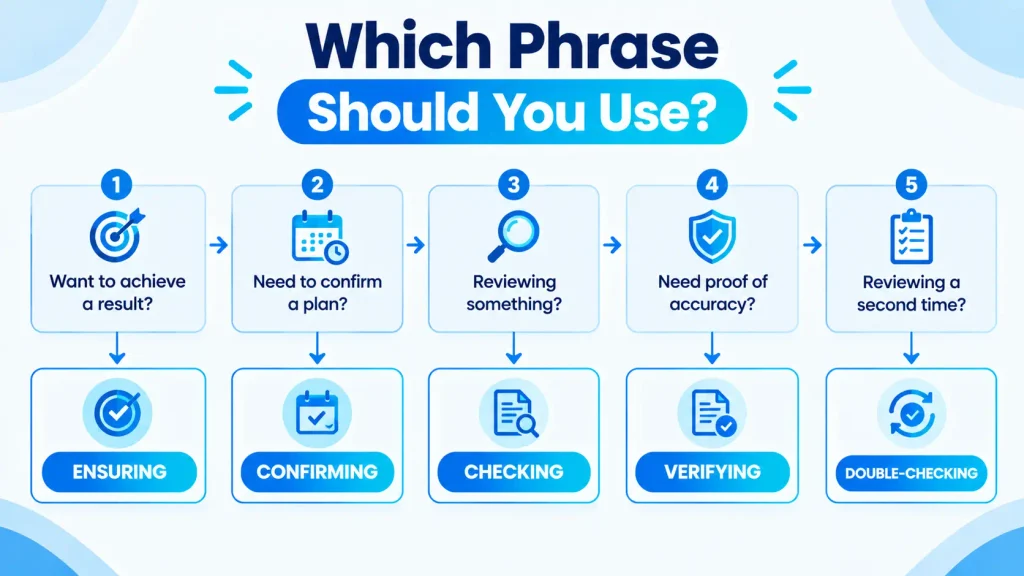
| Alternative | Best Used In | Tone |
|---|---|---|
| Ensuring | Work goals and procedures | Professional |
| Confirming | Plans and arrangements | Polite |
| Checking | Everyday tasks | Neutral |
| Verifying | Facts and records | Formal |
| Double-checking | Reviewing details again | Conversational |
| Making certain | Deliberate actions | Neutral |
| Establishing | Facts and evidence | Formal |
| Taking care to | Instructions and responsibilities | Considerate |
| Checking that | Specific requirements | Direct |
| Guarding against | Risk prevention | Professional |
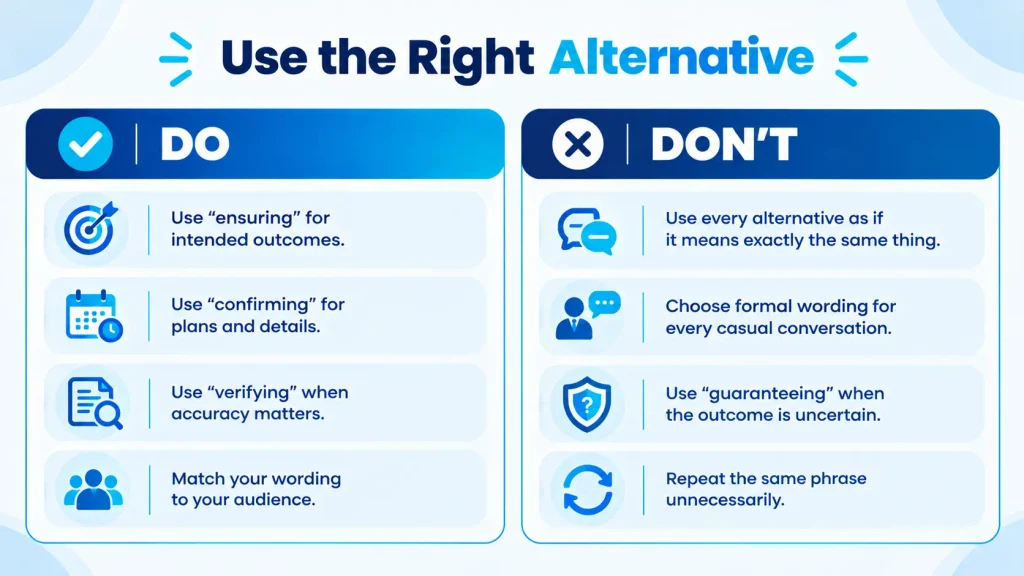
Common Mistakes When Replacing “Making Sure”
1. Using an overly formal alternative
“Verifying” may sound unnecessarily technical in a casual message to a friend. Choose language that fits the situation.
2. Treating every alternative as interchangeable
“Confirming” checks whether information is correct, while “guarding against” focuses on preventing a problem. Choose the phrase that matches your intention.
3. Using the wrong grammatical structure
Some expressions require different sentence patterns. For example, write “ensuring that the report is complete,” not “ensuring the report to be complete” in ordinary professional English.
4. Repeating the same expression
Using “making sure” several times in one paragraph can make your writing repetitive. Replace it with a precise alternative when doing so improves clarity.
5. Choosing a phrase that promises too much
“Guaranteeing” suggests a stronger commitment than “checking.” Do not imply that an outcome is certain when you can only review or confirm the details.
Frequently Asked Questions
1. What is the most professional way to say “making sure”?
“Ensuring” is often the best professional alternative when you are responsible for an outcome. For example, “We are ensuring that the final report meets all requirements” sounds direct and appropriate in workplace communication. Use “confirming” when your main goal is to check information or arrangements.
2. What is another word for “making sure”?
Common alternatives include ensuring, confirming, checking, verifying, and establishing. The right word depends on your meaning. “Checking” works for general reviews, “verifying” emphasizes accuracy, and “ensuring” focuses on achieving a desired result.
3. How do you say “making sure” in a formal email?
You can use “ensuring,” “confirming,” or “verifying,” depending on the context. For example, write, “I am confirming the meeting details before distributing the agenda.” This wording sounds professional because it explains the action and its purpose clearly.
4. Is “ensuring” the same as “making sure”?
The expressions are similar, but their emphasis can differ. “Making sure” is conversational and broad, while “ensuring” often sounds more formal and emphasizes taking responsibility for a result. Both can be correct when the sentence structure and meaning fit.
5. What is a casual way to say “making sure”?
“Checking” and “double-checking” are natural casual alternatives. You might say, “I’m checking that we have everything for the trip” or “Let me double-check the time.” These phrases sound relaxed without sacrificing clarity.
6. What is another way to say “just making sure”?
You can say “just checking,” “confirming,” or “following up to confirm.” For example, “Just checking that you received the attachment” is friendly and natural in an email. Use “following up to confirm” when you want a slightly more professional tone.
7. Can I use “making sure” in academic writing?
Yes, but a more precise expression may improve formal academic writing. Depending on your meaning, consider “ensuring,” “verifying,” or “establishing.” For example, “The researchers verified the results” is more specific than “The researchers made sure the results were correct.”
8. How can I avoid repeating “making sure” in a paragraph?
Identify what each sentence actually describes. If you are reviewing a document, use “checking”; if you are confirming a fact, use “verifying”; and if you are taking steps to achieve a result, use “ensuring.” Vary your wording only when the alternative preserves the intended meaning.
Conclusion
Choosing another way to say “making sure” can help you write more clearly and communicate with greater confidence. The best alternative depends on your purpose, audience, and tone. Understanding the meaning of ensure can also help you choose the right expression for professional and everyday communication.
Use “ensuring” when describing responsibility for an outcome, “confirming” when checking plans or details, and “verifying” when accuracy matters. For everyday conversations, “checking” and “double-checking” sound natural, while “guarding against” is useful when discussing risk prevention.
Remember that these expressions have slightly different meanings, so they should not be substituted mechanically. Consider what you want your reader to understand before choosing a replacement. With the right phrase, you can make your emails, academic assignments, and everyday conversations more precise, natural, and professional.

Melody Schaefer is the Founder and Editor-in-Chief of FrontiersPost, where she oversees the publication of clear, useful, and thoughtfully researched content for modern readers. Her editorial focus includes language, communication, vocabulary, writing, and practical topics that help readers understand information with greater clarity and confidence.
At FrontiersPost, Melody works with writers and editors to maintain consistent editorial standards, improve content quality, and ensure that published articles are useful, accessible, and easy to understand. She is particularly interested in clear communication and presenting complex or easily confused topics in a straightforward way.
As Editor-in-Chief, she is also responsible for guiding the site’s editorial direction, reviewing content standards, and helping ensure that articles are regularly maintained and improved as information evolves.