

Another way to say “check in” depends on the context. You can say touch base, follow up, connect, reach out, see how things are going, or get in touch. For hotels or travel, alternatives include register, arrive, sign in, or complete check-in.
Key Takeaways
- “Touch base” is a natural choice for professional conversations.
- “Follow up” works well when you are checking on a previous conversation or task.
- “Reach out” sounds friendly and professional when starting communication.
- “Connect” is useful when you want to communicate or catch up with someone.
- For hotels, use terms such as register, sign in, or complete check-in instead.
What Does “Another Way to Say Check In” Mean?
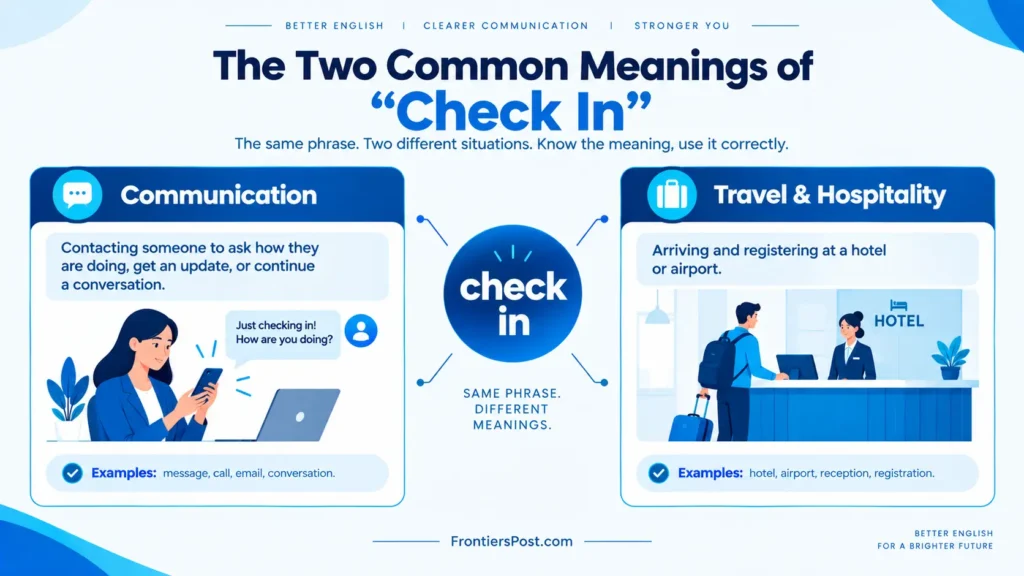
“Check in” can mean different things depending on the situation. In everyday and professional communication, it usually means contacting someone to ask how they are doing, get an update, or continue a conversation.
For example, you might check in with a coworker about a project or check in with a friend who has been having a difficult week. In travel and hospitality, however, “check in” means registering at a hotel, airport, or similar location.
Because the meaning changes with context, choosing the right alternative can make your message clearer and more natural.
Why Use Other Ways to Say “Check In”?
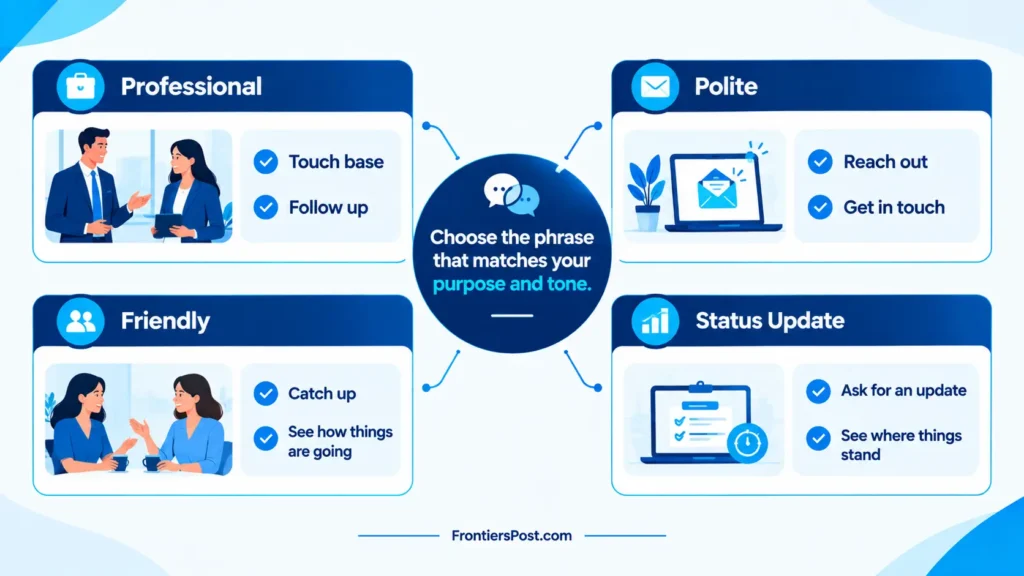
Using different expressions can help you communicate your exact meaning without repeating the same phrase. The best alternative also depends on your relationship with the person and the level of formality you need.
Other phrases can help you:
- Avoid repetitive language.
- Sound more natural in conversation.
- Choose the right tone for work or personal messages.
- Make professional communication more polished.
- Show warmth, interest, or politeness.
- Clarify whether you want an update, conversation, or simple contact.
10 Best Other Ways to Say “Check In”
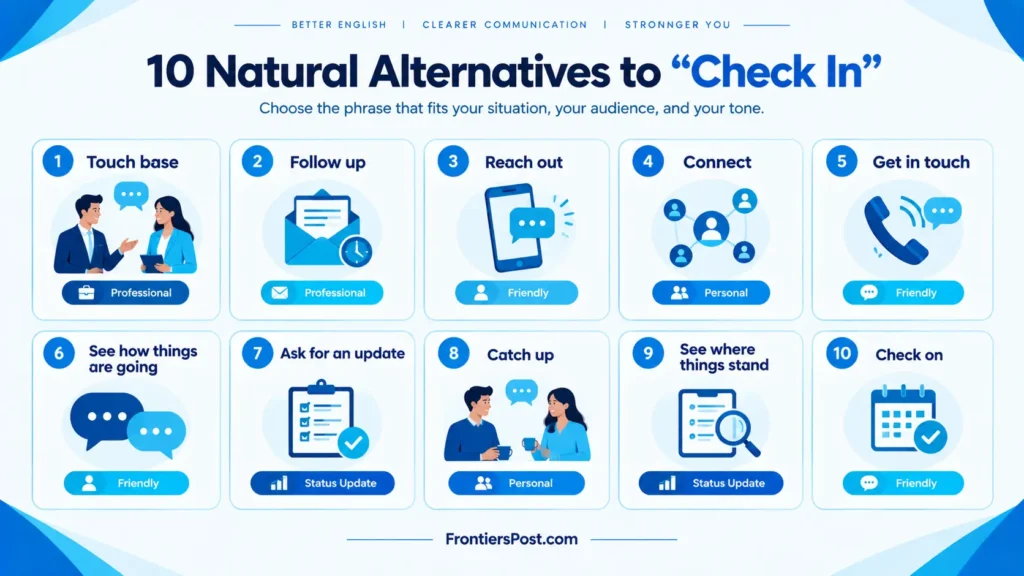
1. Touch Base
Meaning
“Touch base” means contacting someone briefly to exchange information or see where things stand. It is especially common in American professional English.
Best For
Professional, Casual, Friendly
Example 1
“I wanted to touch base about the presentation before Friday.”
Example 2
“Let’s touch base next week and see how the new process is working.”
Quick Tip
Use “touch base” when you want a short, purposeful conversation rather than a long meeting.
2. Follow Up
Meaning
“Follow up” means contacting someone again after an earlier conversation, request, email, or event. It often suggests that you are looking for an update or next step.
Best For
Professional, Formal, Polite
Example 1
“I’m following up to see whether you received my application.”
Example 2
“Can I follow up with you tomorrow about the proposal?”
Quick Tip
Use “follow up” when there is a clear previous interaction or unfinished matter.
3. Reach Out
Meaning
“Reach out” means contacting someone to communicate, offer help, ask a question, or start a conversation. It has a friendly and approachable tone.
Best For
Professional, Friendly, Warm, Polite
Example 1
“Please reach out if you have any questions about the schedule.”
Example 2
“I wanted to reach out and see how your first week is going.”
Quick Tip
“Reach out” works well when you want your message to sound welcoming rather than demanding.
4. Connect
Meaning
“Connect” means communicating with someone or spending time talking with them. It can suggest either a quick professional conversation or a more personal catch-up.
Best For
Professional, Casual, Friendly
Example 1
“Would you like to connect after the team meeting?”
Example 2
“I’d love to connect and hear more about your experience.”
Quick Tip
Use “connect” when the main goal is communication rather than requesting a specific status update.
5. Get in Touch
Meaning
“Get in touch” means communicate with or contact someone. It is a flexible phrase that works in both personal and professional situations.
Best For
Professional, Casual, Friendly, Polite
Example 1
“Please get in touch if you need additional information.”
Example 2
“I’m glad you got in touch. How have you been?”
Quick Tip
Choose “get in touch” when you want a simple, natural alternative to “contact.”
6. See How Things Are Going
Meaning
“See how things are going” directly expresses the idea of checking someone’s situation or progress. It sounds conversational and shows genuine interest.
Best For
Casual, Friendly, Warm
Example 1
“I’m calling to see how things are going with your new job.”
Example 2
“I thought I’d stop by and see how things are going.”
Quick Tip
This phrase is excellent for personal conversations when you want to sound caring and sincere.
7. Ask for an Update
Meaning
“Ask for an update” means requesting current information about a project, situation, decision, or task. It is more specific than simply saying “check in.”
Best For
Professional, Formal, Polite
Example 1
“I’m writing to ask for an update on the hiring process.”
Example 2
“Could you send me an update on the order when you have a chance?”
Quick Tip
Use this phrase when you specifically need information rather than simply wanting to talk.
8. Catch Up
Meaning
“Catch up” means talking with someone to learn what has happened since you last spoke. It usually has a relaxed, personal feel.
Best For
Casual, Friendly, Warm
Example 1
“Let’s catch up over coffee sometime this weekend.”
Example 2
“It was great catching up with you after so many months.”
Quick Tip
Use “catch up” with friends, family, or familiar coworkers rather than in highly formal communication.
9. See Where Things Stand
Meaning
“See where things stand” means checking the current status of a situation, plan, project, or decision. It is particularly useful when circumstances may have changed.
Best For
Professional, Formal, Polite
Example 1
“I’d like to check in with the client and see where things stand.”
Example 2
“Let’s meet tomorrow to see where things stand with the project.”
Quick Tip
This is a strong professional choice when you need a status update without sounding overly direct.
10. Check on
Meaning
“Check on” means making contact or looking into a person, task, or situation to make sure everything is okay. It can communicate concern, responsibility, or attention.
Best For
Professional, Casual, Friendly, Warm
Example 1
“I wanted to check on the team and make sure everyone has what they need.”
Example 2
“Thanks for checking on me while I was recovering.”
Quick Tip
Use “check on” when you want to emphasize care, well-being, or making sure something is progressing properly.
Comparison Table
| Alternative | Best Used In | Tone |
| Touch base | Workplace, business conversations | Professional, friendly |
| Follow up | Emails, requests, ongoing tasks | Professional, polite |
| Reach out | Work and personal communication | Warm, approachable |
| Connect | Networking, work, personal conversations | Friendly, professional |
| Get in touch | General communication | Neutral, polite |
| See how things are going | Personal conversations, informal work settings | Warm, caring |
| Ask for an update | Projects, applications, business matters | Direct, professional |
| Catch up | Friends, family, familiar coworkers | Casual, warm |
| See where things stand | Projects, negotiations, decisions | Professional, formal |
| Check on | People, tasks, well-being | Caring, attentive |
Common Mistakes
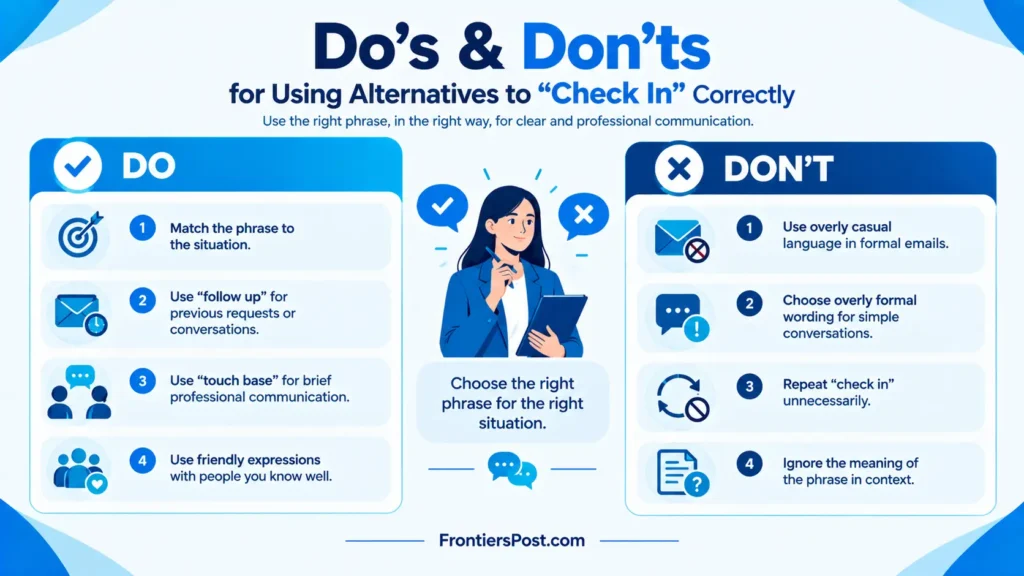
1. Using Casual Phrases in Professional Emails
Phrases such as “catch up” can sound too relaxed for formal business communication. In those situations, “follow up,” “ask for an update,” or “see where things stand” may be more appropriate.
2. Choosing Overly Formal Language
Not every situation needs polished corporate language. Saying “I would like to ascertain the current status” instead of “I wanted to see where things stand” can make a simple message sound unnecessarily stiff.
3. Repeating “Check In” Too Often
Using the same phrase throughout an email, article, or conversation can make your writing feel repetitive. Switching between accurate alternatives keeps your language fresh.
4. Forgetting the Context
“Check in” has different meanings. If you are talking about a hotel, “register” or “sign in” may be more accurate than “touch base.”
5. Sounding Insincere
Some expressions can sound generic when used without a clear reason. If you genuinely want to know how someone is doing, a specific message can feel more thoughtful than a routine “just checking in.”
Frequently Asked Questions
1. What is a professional way to say “check in”?
A professional way to say “check in” is follow up, touch base, connect, or ask for an update. The best choice depends on your purpose. “Follow up” works particularly well after an earlier email or request, while “touch base” is useful for a brief professional conversation.
2. What is a polite way to say “check in”?
“Reach out,” “get in touch,” and “follow up” are polite alternatives to “check in.” For example, you could write, “I wanted to reach out regarding your application” or “I’m following up on my previous email.” Both options sound respectful without being overly formal.
3. What is another way to say “check in” in an email?
In an email, you can say follow up, touch base, reach out, ask for an update, or see where things stand. Choose the phrase based on your purpose. If you need information, “ask for an update” is especially clear and direct.
4. Is “touch base” a good alternative to “check in”?
Yes. “Touch base” is a common American English expression for making brief contact, especially at work. For example, “I wanted to touch base about the project” sounds natural in many professional settings. However, it may feel less appropriate in highly formal writing.
5. What is a casual way to say “check in”?
For casual situations, you can use catch up, see how things are going, or see how you’re doing. These expressions work well with friends, family members, and people you know well because they sound relaxed and personal.
6. What is another way to say “check in” with a friend?
When contacting a friend, “see how you’re doing,” “see how things are going,” “catch up,” and “reach out” are natural choices. If your friend has been going through a difficult time, “I wanted to see how you’re doing” can communicate genuine care.
7. What does “check in” mean at a hotel?
At a hotel, “check in” means completing the arrival process and receiving access to your room. Alternatives such as register, sign in, or complete the arrival process can describe the same idea, although “check in” remains the standard expression in everyday American English.
8. Can I use “follow up” and “check in” interchangeably?
Sometimes, but not always. “Follow up” usually connects to a previous message, request, or action, while “check in” can simply mean making contact or asking how something is going. Therefore, “follow up” is more specific when you are seeking progress on an existing matter.
Conclusion
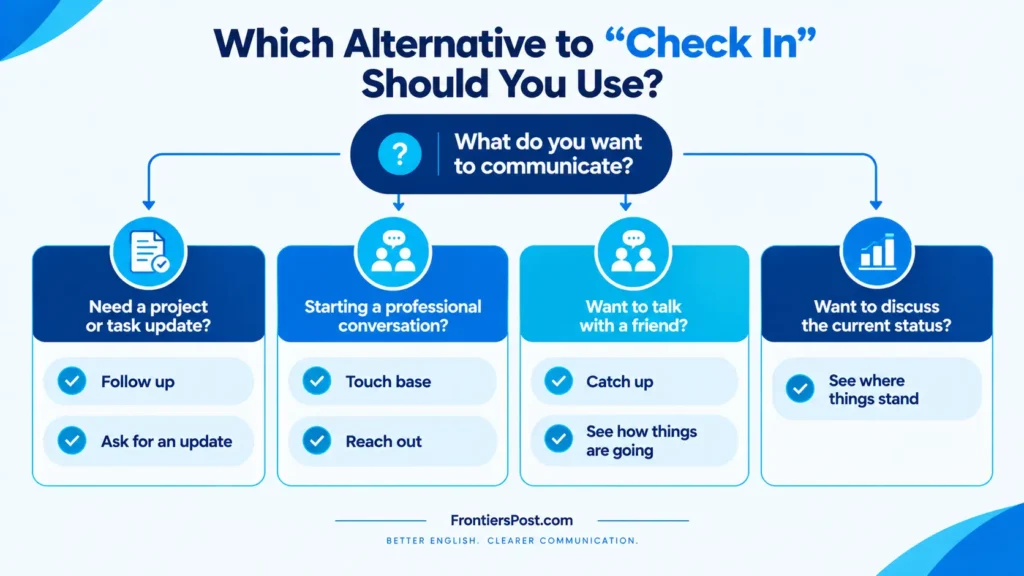
Choosing another way to say “check in” depends on what you want to communicate. For professional conversations, touch base, follow up, and ask for an update are strong choices. For friendly or personal situations, reach out, catch up, and see how things are going sound more natural and warm. You can also review the meaning and usage of check in in the Cambridge Dictionary for additional context.
Context matters, too. If you are discussing a project, “see where things stand” clearly asks about progress, while “check on” can show care or attention. Meanwhile, hotel and travel situations require a different meaning altogether.
The most effective alternative is the one that matches your purpose and relationship with the other person. When in doubt, choose a phrase that sounds clear, natural, and appropriate for the situation.

Sarah Mitchell is a Senior English Editor at FrontiersPost, specializing in English usage, vocabulary, word choice, grammar, and effective communication. She focuses on helping readers understand subtle differences between commonly confused words, phrases, and expressions and use them naturally in everyday, professional, and academic writing.
At FrontiersPost, Sarah researches, writes, and edits educational content with an emphasis on clarity, accuracy, and practical examples. She works closely with the editorial team to ensure that articles are easy to understand while maintaining appropriate context, meaning, and usage.
Her editorial interests include English vocabulary, synonyms, phrasing, professional communication, and the practical nuances that can make written communication more precise and effective.