
Another way to say “a long time” includes a long while, quite some time, for quite a while, an extended period, a prolonged period, for years, over the years, and for ages. The best choice depends on the context, tone, and how specific you want to be about the length of time.
What Does “A Long Time” Mean?
“A long time” refers to an extended or significant period whose exact length is not specified. The actual duration depends on the situation.
For example:
- “I haven’t seen Maya for a long time.”
- “It took a long time to finish the project.”
- “They have lived in this neighborhood for a long time.”
The phrase works naturally in casual conversation, professional communication, academic writing, and general English. Because it is broad, however, you may sometimes want a more precise or context-specific expression.
For instance, for three years gives the reader exact information, while for ages adds an informal, expressive tone.
Why Use Another Way to Say “A Long Time”?
Replacing “a long time” can be useful for several reasons.
You may want to:
- sound more conversational
- make professional writing more polished
- emphasize that something lasted unusually long
- specify that the period involved years
- describe gradual change over time
- avoid repeating the same phrase
- make your meaning more precise
Still, do not replace a simple phrase just to make your writing sound sophisticated. “A long time” is often clearer than a longer alternative.
For example:
The meeting lasted a long time.
is often better than:
The meeting lasted for a considerable length of time.
The second version is more formal, but it does not necessarily communicate anything more useful.
Best Alternatives to “A Long Time”
A Long While
Meaning
“A long while” means a lengthy or extended period. It is one of the closest natural alternatives to “a long time.”
Best for
Everyday conversation, general writing, friendly emails, and informal communication.
Formality
2/5 — Informal to neutral
Example 1
“I haven’t visited my hometown in a long while.”
Example 2
“She spent a long while organizing the files before the meeting.”
Quick Tip
Use “a long while” when you want a natural alternative without significantly changing the meaning or tone.
Quite Some Time
Meaning
“Quite some time” means a fairly long or considerable period. It is useful when the exact duration is unknown or unimportant.
Best for
Conversation, workplace communication, emails, and general writing.
Formality
3/5 — Neutral
Example 1
“We’ve been waiting for quite some time.”
Example 2
“I haven’t spoken with my former professor in quite some time.”
Quick Tip
This expression is useful when you want to emphasize duration while keeping the exact length vague.
For Quite a While
Meaning
“For quite a while” means for a fairly long period. It describes something that continued over time rather than happening briefly.
Best for
Everyday conversation and informal writing.
Formality
2/5 — Informal to neutral
Example 1
“She has been working on the presentation for quite a while.”
Example 2
“We sat outside and talked for quite a while after dinner.”
Quick Tip
Use this phrase when the sentence describes something that continued over a period of time.
For Some Time
Meaning
“For some time” describes an unspecified period that may be relatively long. It is a neutral expression that can sound more polished than “for a long time.”
Best for
Professional communication, general writing, and situations where a neutral tone is appropriate.
Formality
3/5 — Neutral
Example 1
“The issue has been under review for some time.”
Example 2
“She has been considering the offer for some time.”
Quick Tip
“For some time” can sound more professional than “for a long time,” but it may be less emphatic about the length of the period.
An Extended Period
Meaning
“An extended period” refers to a period that lasts longer than usual or longer than expected.
Best for
Reports, professional writing, academic writing, and formal communication.
Formality
5/5 — Very formal
Example 1
“The equipment remained unavailable for an extended period.”
Example 2
“Students who miss an extended period of instruction may need additional support.”
Quick Tip
Choose this phrase when your writing needs a professional or academic tone.
A Prolonged Period
Meaning
“A prolonged period” describes a period that continues for an unusually long time, often suggesting that it lasted longer than expected or desired.
Best for
Formal reports, academic writing, business communication, and discussions of delays or difficult situations.
Formality
5/5 — Very formal
Example 1
“The project experienced a prolonged delay.”
Example 2
“The region faced a prolonged period of unusually dry weather.”
Quick Tip
Do not use “prolonged” simply because it sounds formal. It often carries an implication of excessive or extended duration.
For Years
Meaning
“For years” means that something continued for multiple years. It is more specific than “for a long time.”
Best for
Personal stories, professional contexts, academic writing, and situations where years are genuinely involved.
Formality
3/5 — Neutral
Example 1
“They have worked together for years.”
Example 2
“She studied the subject for years before publishing her research.”
Quick Tip
Use “for years” when you know the period involves years. Do not use it simply as a stronger-sounding version of “a long time.”
Over the Years
Meaning
“Over the years” refers to the course of several years, often with an emphasis on gradual development or change.
Best for
Personal reflection, history, professional writing, and descriptions of development.
Formality
3/5 — Neutral
Example 1
“Her teaching style has changed considerably over the years.”
Example 2
“The company has expanded its services over the years.”
Quick Tip
Use “over the years” when you are discussing development, change, or events occurring across several years.
For Ages
Meaning
“For ages” means for a very long time. It is an informal expression that strongly emphasizes duration.
Best for
Casual conversation and informal messages.
Formality
1/5 — Very informal
Example 1
“I haven’t seen you for ages!”
Example 2
“We’ve been waiting here for ages.”
Quick Tip
Treat “for ages” as an informal expression rather than a precise measurement of time.
Forever
Meaning
“Forever” can mean an extremely long time. In everyday English, it is often used as an exaggeration rather than literally.
Best for
Casual conversation, texts, social posts, and expressive writing.
Formality
1/5 — Very informal
Example 1
“It feels like I’ve been waiting forever.”
Example 2
“We haven’t talked in forever!”
Quick Tip
Avoid “forever” when your writing requires objective or precise information.
A Considerable Period
Meaning
“A considerable period” refers to a fairly long or significant period. It emphasizes that the duration is substantial.
Best for
Formal and professional writing.
Formality
5/5 — Very formal
Example 1
“The proposal remained under consideration for a considerable period.”
Example 2
“The organization operated under the temporary policy for a considerable period.”
Quick Tip
This expression is formal, so it may sound unnecessarily stiff in casual conversation.
A Lengthy Period
Meaning
“A lengthy period” describes a period that lasts a considerable amount of time. It often works well when something takes longer than expected.
Best for
Formal writing, reports, and descriptions of delays or processes.
Formality
4/5 — Formal
Example 1
“The application process involved a lengthy review.”
Example 2
“The negotiations continued for a lengthy period.”
Quick Tip
“Lengthy” often fits better with processes, procedures, delays, or events than with simple personal statements.
Quick Comparison of Alternatives
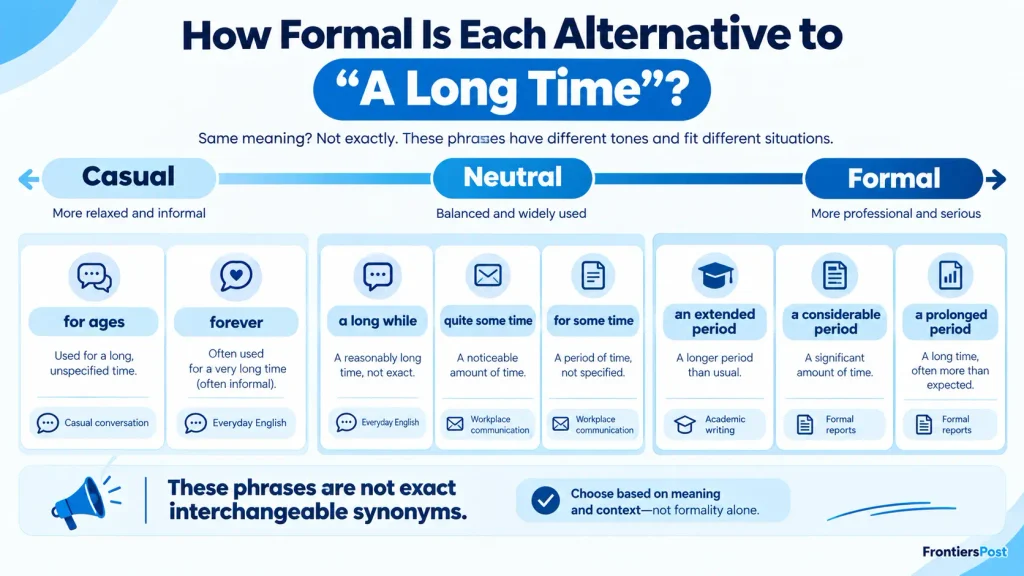
| Alternative | Best Used For | Tone | Formality |
| A long while | Everyday English | Neutral | 2/5 |
| Quite some time | General conversation and work | Neutral | 3/5 |
| For quite a while | Casual duration | Conversational | 2/5 |
| For some time | Professional communication | Neutral | 3/5 |
| An extended period | Reports and academic writing | Formal | 5/5 |
| A prolonged period | Unusually long duration | Formal | 5/5 |
| For years | Multi-year duration | Neutral | 3/5 |
| Over the years | Gradual change | Neutral | 3/5 |
| For ages | Casual emphasis | Informal | 1/5 |
| Forever | Strong informal emphasis | Casual | 1/5 |
| A considerable period | Significant duration | Formal | 5/5 |
| A lengthy period | Long processes or delays | Formal | 4/5 |
Which Alternative Should You Use?
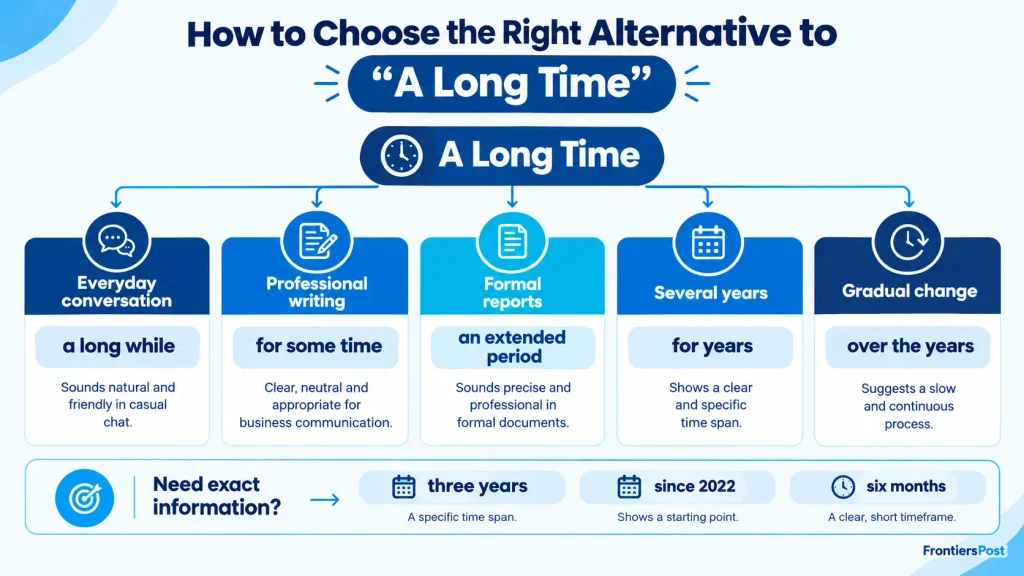
The best replacement depends on the situation.
| Situation | Recommended Option | Why |
| Talking to a friend | A long while / for ages | Sounds natural and conversational |
| Writing a work email | For some time / quite some time | Professional without sounding stiff |
| Writing a report | An extended period | Clear and formal |
| Describing an unusual delay | A prolonged period | Suggests the duration was excessive or unexpected |
| Talking about several years | For years | Gives more specific information |
| Describing gradual development | Over the years | Emphasizes change across time |
| Writing an academic paper | An extended period / for several years | Formal or precise |
| Exact duration is known | Six months / three years / since 2022 | More precise than a vague phrase |
How to Replace “A Long Time” in Real Sentences
Everyday Conversation
Original:
“I haven’t seen Daniel for a long time.”
Alternative:
“I haven’t seen Daniel for a long while.”
The second version sounds slightly more conversational while keeping almost the same meaning.
Professional Email
Original:
“We have been waiting for a long time for your response.”
Alternative:
“We have been awaiting your response for some time.”
The alternative is more polished and avoids sounding overly impatient.
Formal Report
Original:
“The system was unavailable for a long time.”
Alternative:
“The system remained unavailable for an extended period.”
The alternative better suits a formal report because it presents the duration in a neutral professional style.
When You Mean Several Years
Original:
“She has worked at the university for a long time.”
Alternative:
“She has worked at the university for several years.”
The second version is better if the writer knows that the period lasted several years.
When You Mean Gradual Change
Original:
“The company changed a lot during a long time.”
Alternative:
“The company changed significantly over the years.”
“Over the years” works better because the sentence focuses on development across a period.
“A Long Time” vs. “A Long While”
These expressions are very close.
- “It took a long time.”
- “It took a long while.”
Both are natural. “A long while” can sound slightly more conversational, while “a long time” is completely neutral.
If you are unsure which one to choose, “a long time” is usually the safest and clearest option.
“For a Long Time” vs. “For Years”
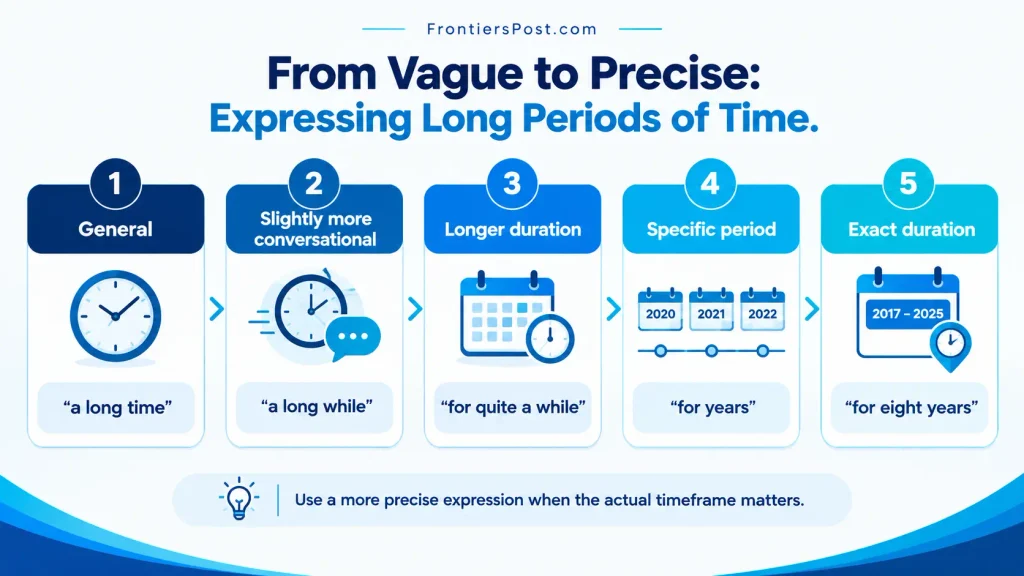
These expressions are not identical.
For a long time gives a general duration:
“I have lived here for a long time.”
For years tells the reader that the period involved years:
“I have lived here for years.”
If the exact duration is important, an even more precise expression is better:
“I have lived here for eight years.”
Use the most specific information you can support.
“For a Long Time” vs. “Since”
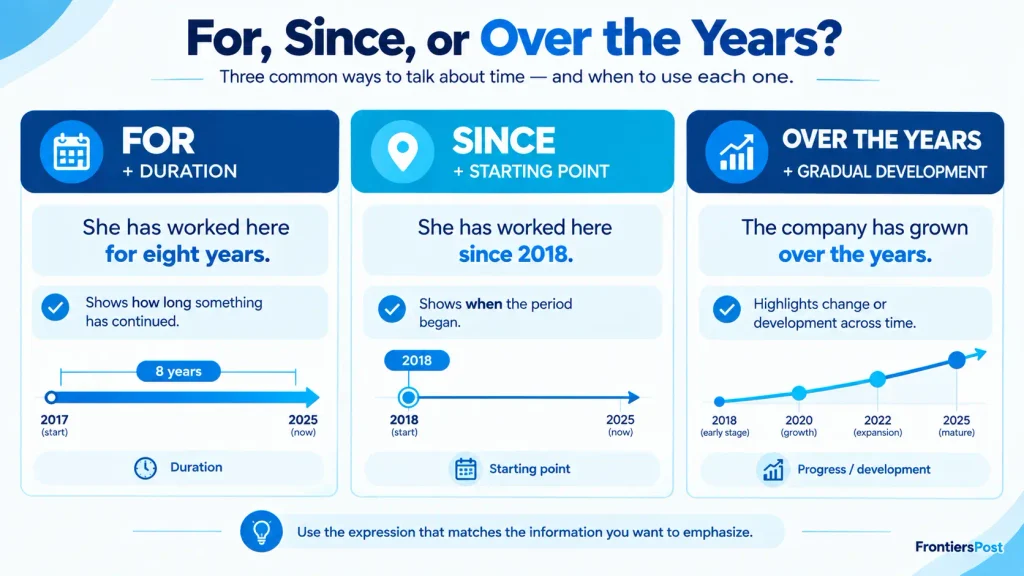
“For” describes duration, while “since” identifies the starting point.
“She has worked here for a long time.”
“She has worked here since 2018.”
These sentences communicate related information, but they answer different questions. The first emphasizes duration; the second tells the reader when the period began.
“Longstanding” and “Longtime” Are Different
Be careful with longstanding and longtime.
Longstanding describes something that has existed or continued for a long period:
“The organization has a longstanding policy.”
Longtime is commonly used as an adjective before a noun:
“She is a longtime customer.”
Neither one normally replaces the noun phrase “a long time” in a sentence such as:
“I haven’t seen him for a long time.”
In American English, “longtime” is commonly written as one word when it functions as an adjective before a noun.
Common Mistakes
Mistake 1: Assuming Every Synonym Is Interchangeable
Why it sounds wrong:
Some alternatives add meaning that “a long time” does not have.
Better approach:
Use “a long while” for a close replacement, “for years” when years are involved, and “over the years” when discussing gradual change.
Mistake 2: Using “Prolonged” for Any Long Duration
Why it sounds wrong:
“Prolonged” can suggest that something lasted longer than expected or was undesirable.
Better approach:
Use “an extended period” for neutral formal writing and “a prolonged period” when the extra nuance fits.
Mistake 3: Using Casual Expressions in Academic Writing
Why it sounds wrong:
Phrases such as “for ages” and “forever” are conversational and may sound informal in an academic paper.
Better approach:
Use “for an extended period,” “over several years,” or a precise timeframe when appropriate.
Mistake 4: Replacing “A Long Time” With Needlessly Complex Language
Why it sounds wrong:
Longer does not automatically mean better.
Better approach:
Keep “a long time” when it is already the clearest option.
Mistake 5: Using “Since” When You Mean Duration
Why it sounds wrong:
“Since” identifies a starting point rather than simply describing how long something has continued.
Better approach:
Use “for” with a duration and “since” with a starting point.
Frequently Asked Questions
What is a professional way to say “a long time”?
A professional alternative is “for some time,” “an extended period,” or “a considerable period,” depending on the sentence. “An extended period” is especially useful in reports and formal documents. However, professional writing does not require complicated wording, so “a long time” may still be the clearest choice.
What is a casual way to say “a long time”?
Common casual alternatives include “a long while,” “for quite a while,” “for ages,” and “forever.” “A long while” is a close replacement, while “for ages” and “forever” are more expressive and should generally be reserved for informal communication.
Is “a long while” the same as “a long time”?
“A long while” and “a long time” have nearly the same basic meaning. Both describe an extended period without specifying its exact length. “A long while” can sound slightly more conversational, so it is a useful alternative in everyday speech and informal writing.
What is another way to say “a long time” in formal writing?
Formal alternatives include “an extended period,” “a prolonged period,” “a considerable period,” and “a lengthy period.” The best choice depends on meaning. “Extended” is generally neutral, while “prolonged” can suggest that the duration was unusually long or longer than expected.
What is another way to say “a long time” in an essay?
For an essay, you can use “over an extended period,” “for several years,” “over the years,” or “for a considerable period,” depending on the context. If you know the exact timeframe, giving it directly is usually more informative than using a vague phrase.
Can I use “forever” instead of “a long time”?
You can use “forever” in informal speech when you are emphasizing an extremely long period, often as an exaggeration. For example, “I haven’t seen her in forever” is natural in casual conversation. It is generally unsuitable when you need precise or formal language.
What is the difference between “for a long time” and “over the years”?
“For a long time” focuses on duration, while “over the years” often focuses on what happened or changed during several years. For example, “They have lived there for a long time” describes duration, while “Their business has grown over the years” emphasizes gradual development.
Is “longtime” the same as “a long time”?
No. “A long time” is a noun phrase that describes duration, while “longtime” commonly functions as an adjective before a noun, as in “a longtime friend.” Therefore, “longtime” cannot normally replace “a long time” in sentences that express duration.
Conclusion
The best way to replace “a long time” depends on what you want the sentence to communicate. For everyday English, “a long while,” “quite some time,” and “for quite a while” are natural choices. In professional or academic writing, “for some time,” “an extended period,” or “a considerable period” can provide a more formal tone.
Choose “a prolonged period” when the duration was unusually long or longer than expected. Use “for years” when you specifically mean several years, and “over the years” when you are describing gradual development or change.
When “a long time” communicates your meaning clearly, it may still be the best choice. For a clearer understanding of how “long” is used to describe duration, see the Cambridge Dictionary’s definition of “long.”

Sarah Mitchell is a Senior English Editor at FrontiersPost, specializing in English usage, vocabulary, word choice, grammar, and effective communication. She focuses on helping readers understand subtle differences between commonly confused words, phrases, and expressions and use them naturally in everyday, professional, and academic writing.
At FrontiersPost, Sarah researches, writes, and edits educational content with an emphasis on clarity, accuracy, and practical examples. She works closely with the editorial team to ensure that articles are easy to understand while maintaining appropriate context, meaning, and usage.
Her editorial interests include English vocabulary, synonyms, phrasing, professional communication, and the practical nuances that can make written communication more precise and effective.