
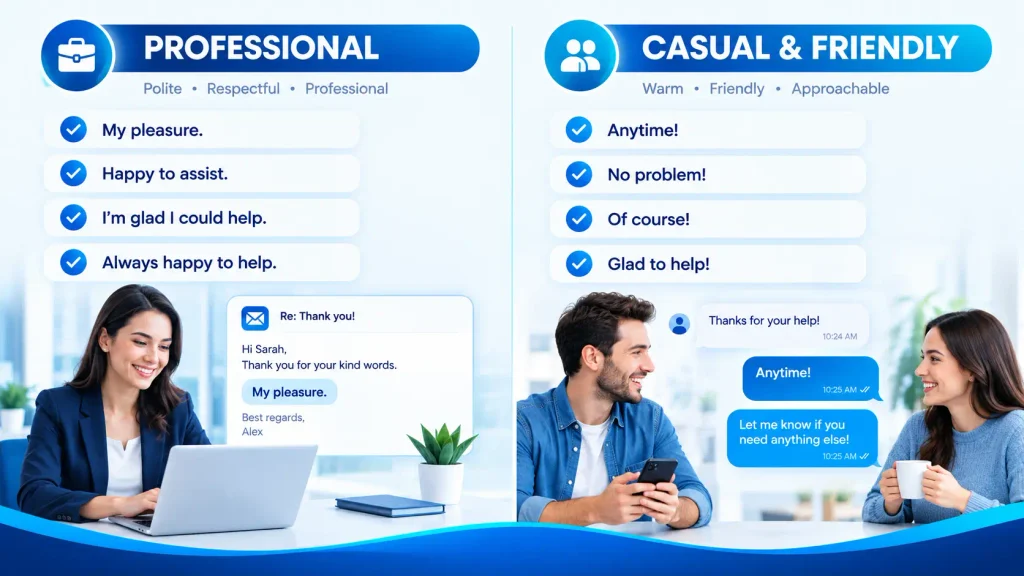
If you’re looking for another way to say “happy to help,” you can use phrases such as “glad to help,” “my pleasure,” “you’re very welcome,” “anytime,” or “I’m glad I could help.” The best choice depends on the situation, your relationship with the person, and how formal or friendly you want to sound.
Key Takeaways
- “Glad to help” is a natural alternative for everyday and professional conversations.
- “My pleasure” works well when you want to sound polite and courteous.
- “Anytime” is casual and friendly, especially with people you know well.
- “I’m happy I could help” adds a warmer, more personal tone.
- Choose your wording based on the relationship, setting, and level of formality.
What Does “Another Way to Say Happy to Help” Mean?
“Happy to help” is a polite expression people use after assisting someone. It shows that you were willing to provide assistance and that you do not see the favor as a burden.
For example, someone might say “Thank you for fixing this issue,” and you could respond, “Happy to help!” The phrase is common in customer service, workplace conversations, emails, texts, and everyday interactions.
People often search for another way to say “happy to help” because they want to avoid repeating the same expression or choose wording that better matches a particular situation.
Why Use Other Ways to Say “Happy to Help”?
Using different expressions can make your communication sound more natural and appropriate for the situation.
Other alternatives can help you:
- Avoid repeating the same phrase.
- Sound more conversational.
- Adjust your tone for professional or casual situations.
- Show genuine appreciation.
- Make customer or workplace communication warmer.
- Express politeness without sounding overly formal.
The key is to choose a phrase that fits both the conversation and your relationship with the other person.
10 Best Other Ways to Say “Happy to Help”
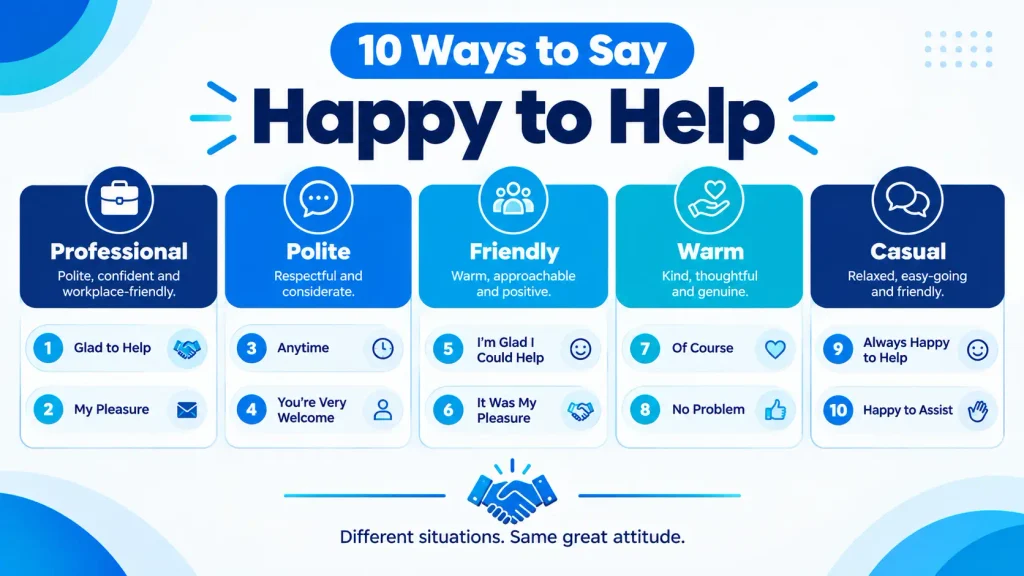
1. Glad to Help
Meaning
“Glad to help” is one of the closest alternatives to “happy to help.” It communicates that you were pleased to assist someone and sounds natural without being overly formal.
Best For
- Professional
- Friendly
- Polite
- Casual
Example 1
“Thanks for sending over the updated files.”
“Glad to help!”
Example 2
“I’m glad to help if you need anything else with the project.”
Quick Tip
Use “glad to help” when you want a simple, natural phrase that works in both professional and everyday conversations.
2. My Pleasure
Meaning
“My pleasure” is a polite response to someone who thanks you. It suggests that you were pleased to assist and did not consider the task an inconvenience.
Best For
- Formal
- Professional
- Polite
- Warm
Example 1
“Thank you for taking the time to explain the process.”
“My pleasure.”
Example 2
“It was my pleasure to assist you with your request.”
Quick Tip
“My pleasure” is especially useful in customer service, business emails, and situations where you want to sound courteous.
3. Anytime
Meaning
“Anytime” tells someone that you are willing to help again in the future. It has a relaxed and friendly tone.
Best For
- Casual
- Friendly
- Warm
Example 1
“Thanks for helping me move the boxes.”
“Anytime!”
Example 2
“If you ever need help with another update, anytime.”
Quick Tip
Use “anytime” with friends, coworkers, clients you know well, or other informal situations rather than highly formal correspondence.
4. You’re Very Welcome
Meaning
“You’re very welcome” is a warm way to respond to thanks. It places more emphasis on acknowledging the other person’s appreciation than on the act of helping itself.
Best For
- Polite
- Professional
- Warm
- Formal
Example 1
“Thank you for helping me understand the instructions.”
“You’re very welcome.”
Example 2
“You’re very welcome, and please feel free to reach out if you have more questions.”
Quick Tip
This phrase works particularly well when someone has directly thanked you and you want to give a courteous response.
5. I’m Glad I Could Help
Meaning
“I’m glad I could help” sounds sincere and personal. It shows that you are pleased your assistance made a difference.
Best For
- Professional
- Friendly
- Warm
- Polite
Example 1
“Your explanation made the problem much easier to understand.”
“I’m glad I could help.”
Example 2
“I’m glad I could help you get everything ready before the deadline.”
Quick Tip
Choose this expression when you want your response to sound warmer than a simple “happy to help.”
6. It Was My Pleasure
Meaning
“It was my pleasure” is a more complete and slightly more formal version of “my pleasure.” It communicates courtesy and genuine willingness to assist.
Best For
- Formal
- Professional
- Polite
- Warm
Example 1
“Thank you for helping us prepare for the presentation.”
“It was my pleasure.”
Example 2
“It was my pleasure to work with your team on this project.”
Quick Tip
This phrase is a good choice for professional emails, formal correspondence, and client communication.
7. Of Course
Meaning
“Of course” is a short and natural response that suggests helping was completely reasonable or expected. Its meaning depends heavily on tone and context.
Best For
- Casual
- Friendly
- Professional
- Polite
Example 1
“Could you send me the link again?”
“Of course.”
Example 2
“Thank you for helping me with the form.”
“Of course!”
Quick Tip
Use a friendly tone when saying “of course,” because the same words can sound warm or dismissive depending on delivery.
8. No Problem
Meaning
“No problem” tells someone that helping them was not difficult or inconvenient. It is common in everyday American English.
Best For
- Casual
- Friendly
- Polite
Example 1
“Thanks for picking up my package.”
“No problem!”
Example 2
“No problem—I can take another look at the document for you.”
Quick Tip
“No problem” is natural in casual conversations, but “my pleasure” or “glad to help” may sound more polished in formal business communication.
9. Always Happy to Help
Meaning
“Always happy to help” communicates that you are willing to provide assistance again. It can sound warm, supportive, and professional.
Best For
- Professional
- Friendly
- Warm
- Polite
Example 1
“Thanks for answering all my questions.”
“Always happy to help.”
Example 2
“If you have any questions about the website, I’m always happy to help.”
Quick Tip
This phrase works especially well when communicating with clients, customers, coworkers, or long-term professional contacts.
10. Happy to Assist
Meaning
“Happy to assist” has nearly the same meaning as “happy to help,” but it sounds more polished and business-oriented. It is common in customer service and professional communication.
Best For
- Professional
- Formal
- Polite
Example 1
“Please let me know if you need any additional information. I’m happy to assist.”
Example 2
“Our support team is happy to assist you with the next steps.”
Quick Tip
Use “happy to assist” when you want a professional alternative that fits emails, customer support messages, and business communication.
Comparison Table
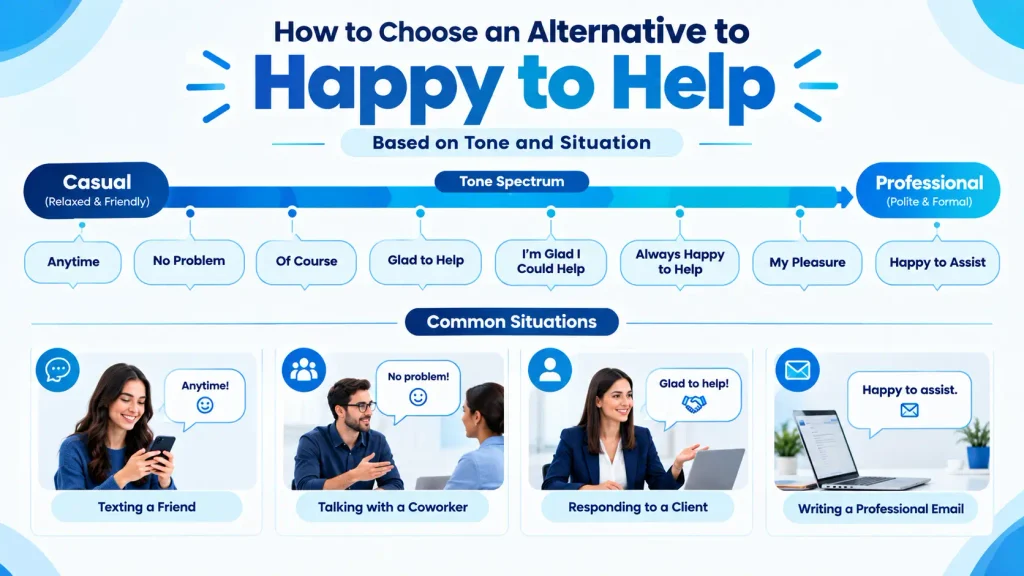
| Alternative | Best Used In | Tone |
| Glad to Help | Everyday and workplace conversations | Friendly, natural |
| My Pleasure | Customer service and professional settings | Polite, formal |
| Anytime | Casual conversations | Friendly, relaxed |
| You’re Very Welcome | Responses to thanks | Warm, polite |
| I’m Glad I Could Help | Personal and professional conversations | Warm, sincere |
| It Was My Pleasure | Formal emails and business settings | Formal, courteous |
| Of Course | Everyday conversations | Casual, friendly |
| No Problem | Informal conversations | Relaxed, casual |
| Always Happy to Help | Client and workplace communication | Warm, professional |
| Happy to Assist | Business and customer service | Professional, formal |
Common Mistakes
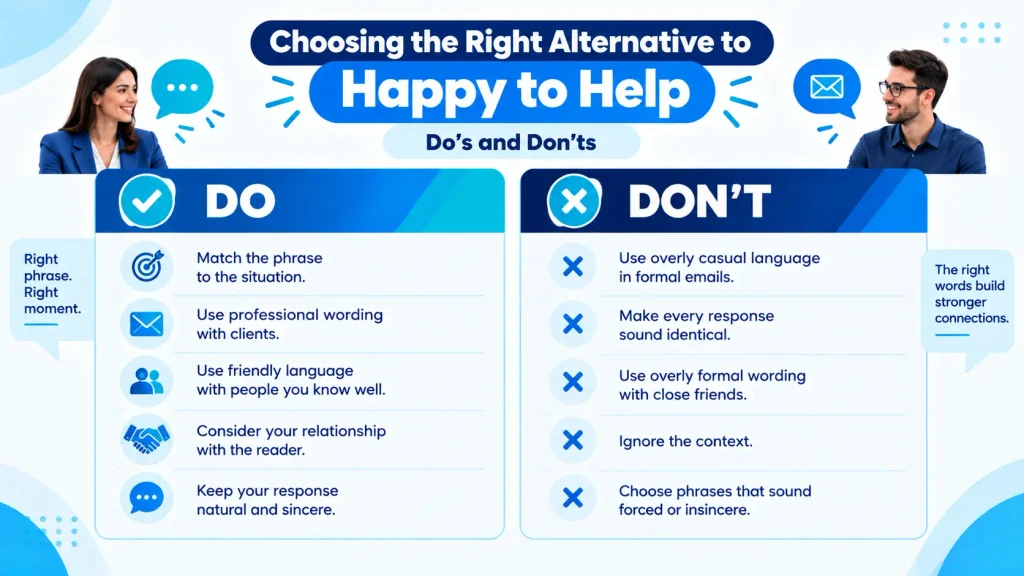
- Using casual phrases in formal emails
Expressions such as “no problem” or “anytime” may sound too relaxed for some business situations. Consider “my pleasure” or “happy to assist” instead. - Choosing overly formal language
Not every conversation requires polished business language. Saying “it was my pleasure” to a close friend may sound unnecessarily formal. - Repeating the same phrase
Using “happy to help” after every thank-you can make your communication feel repetitive. Having several alternatives makes your responses more natural. - Forgetting the context
A phrase that works well with a coworker may not fit a customer, manager, friend, or client. Always consider who you are speaking with. - Sounding insincere
Even polite phrases can feel automatic if they do not match the situation. Choose wording that reflects your actual tone and relationship with the other person.
Frequently Asked Questions
What is another way to say “happy to help” professionally?
Professional alternatives include “glad to help,” “my pleasure,” “happy to assist,” and “always happy to help.” “Happy to assist” is particularly suitable for customer service and business emails, while “glad to help” sounds more natural and conversational in workplace communication.
What is a polite way to say “happy to help”?
“My pleasure,” “you’re very welcome,” and “I’m glad I could help” are polite alternatives. They work well when someone thanks you for providing assistance and you want your response to sound courteous without being overly formal.
Is “glad to help” better than “happy to help”?
Both phrases have nearly the same meaning, so neither is universally better. “Glad to help” can sound slightly more conversational, while “happy to help” is equally natural and common. Choose the expression that fits your usual speaking or writing style.
How do you say “happy to help” in an email?
In an email, you can say “I’m glad I could help,” “I’m happy to assist,” “Always happy to help,” or “It was my pleasure.” For a professional client email, “I’m happy to assist” provides a polished and straightforward option.
What can I say instead of “happy to help” after someone says thank you?
You can respond with “my pleasure,” “you’re very welcome,” “glad to help,” “of course,” or “no problem.” Your choice depends on the tone. “My pleasure” is more polished, while “of course” and “no problem” are more relaxed.
Is “happy to assist” formal?
Yes. “Happy to assist” generally sounds more professional and formal than “happy to help.” It is commonly used in customer service, business emails, workplace communication, and other situations where a polished tone is appropriate.
Can I say “anytime” instead of “happy to help”?
Yes. “Anytime” is a natural alternative when you want to tell someone that you are willing to help again. It has a casual and friendly tone, so it is usually better suited to informal conversations or relationships where a relaxed style is appropriate.
What is the warmest way to say “happy to help”?
“I’m glad I could help” and “always happy to help” can sound especially warm because they show genuine willingness to assist. “It was my pleasure” also communicates warmth while maintaining a more polished or formal tone.
Conclusion
There are many natural ways to say “happy to help,” and the best phrase depends on the situation. For everyday conversations, “glad to help,” “of course,” and “anytime” sound easy and natural. For professional communication, “happy to assist,” “my pleasure,” and “always happy to help” can provide a more polished response.
If you want to sound warm and sincere, “I’m glad I could help” is a useful choice. When someone thanks you directly, “you’re very welcome” is another courteous option.
The main goal is not simply to replace one phrase with another. Choose wording that matches your relationship with the person, the setting, and the tone you want to communicate. For more guidance on choosing the right tone in workplace messages, see this guide to professional communication. A small change in phrasing can make your response feel more natural and appropriate.