
Another way to say yes depends on the situation. You can use phrases such as absolutely, certainly, of course, definitely, I agree, sounds good, that works for me, I’d be happy to, gladly, or you got it. Choose a phrase based on your desired tone, from professional and polite to casual and friendly.
Key Takeaways
- “Yes” has many alternatives that can make your communication sound more natural.
- Certainly and absolutely work well in professional and formal situations.
- Sounds good and that works for me are useful for casual conversations.
- I’d be happy to adds warmth and willingness to a response.
- The best alternative depends on your relationship with the person and the context.
What Does “Another Way to Say Yes” Mean?
“Another way to say yes” refers to different words or phrases that communicate agreement, acceptance, approval, or willingness without using the simple word “yes.”
People often look for alternatives when they want to avoid repetition or make their response fit a specific situation. For example, a workplace email may call for certainly, while a conversation with a friend may sound more natural with sounds good.
These alternatives are common in everyday conversations, emails, meetings, text messages, customer service, academic communication, and professional settings.
Why Use Other Ways to Say “Yes”?
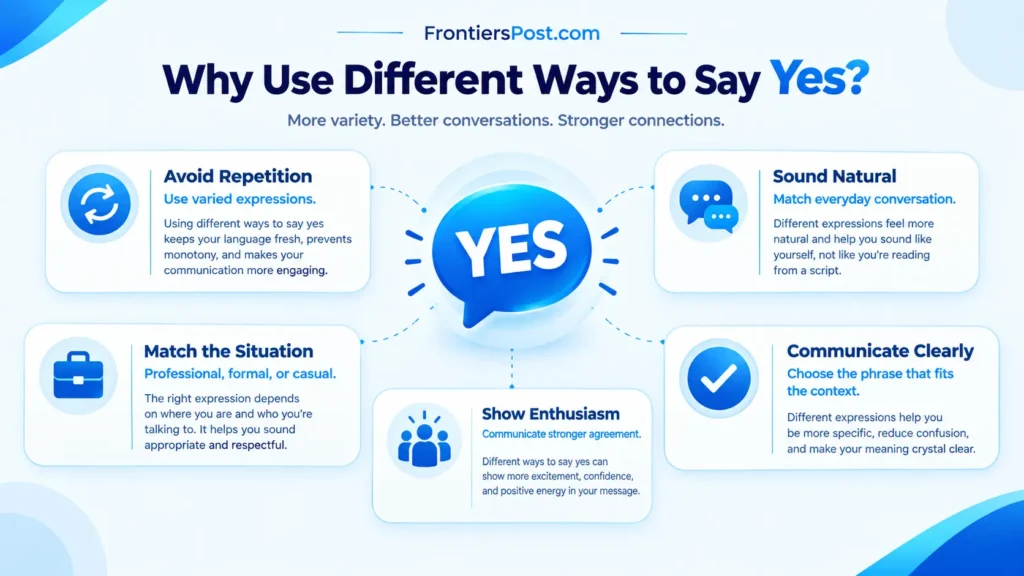
Using different ways to express agreement can make your communication more precise and natural. Instead of giving the same one-word response every time, you can choose language that reflects your tone and level of enthusiasm.
Other benefits include:
- Avoiding repetitive responses.
- Making conversations sound more natural.
- Showing enthusiasm or willingness.
- Matching professional and casual situations.
- Communicating agreement more clearly.
- Adding warmth, politeness, or confidence to your response.
10 Best Other Ways to Say “Yes”
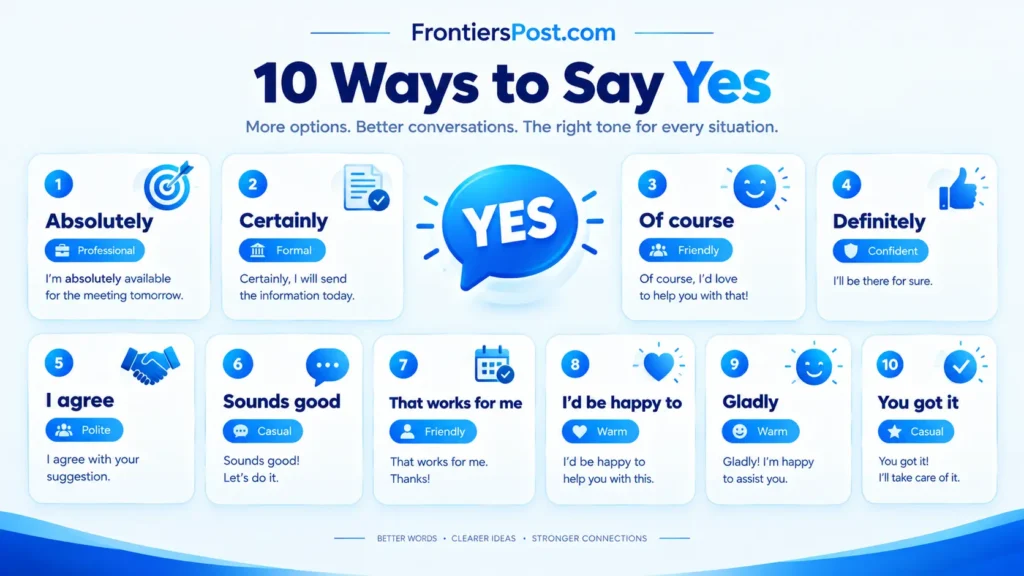
1. Absolutely
Meaning
“Absolutely” is a strong way to express agreement or confirm that something is acceptable. It usually sounds more enthusiastic and confident than a simple “yes.”
Best For
- Professional
- Formal
- Friendly
- Warm
Example 1
“Absolutely, I can send you the updated proposal before the meeting.”
Example 2
“Would you like to join us for dinner?”
“Absolutely. I’d love to.”
Quick Tip
Use absolutely when you want your agreement to sound confident and enthusiastic.
2. Certainly
Meaning
“Certainly” communicates clear agreement while maintaining a polite and professional tone. It works especially well when responding to requests or offering assistance.
Best For
- Professional
- Formal
- Polite
Example 1
“Could you review these documents today?”
“Certainly. I’ll take a look this afternoon.”
Example 2
“Certainly, we can arrange a follow-up call next week.”
Quick Tip
Choose certainly when you want to sound courteous and professional without being overly formal.
3. Of Course
Meaning
“Of course” expresses agreement while also suggesting that the request is reasonable or welcome. It can sound warm and natural in both personal and professional conversations.
Best For
- Friendly
- Polite
- Professional
- Warm
Example 1
“Can I borrow your notes from yesterday’s meeting?”
“Of course. I’ll send them to you.”
Example 2
“Of course, you can ask me if you need any help with the project.”
Quick Tip
Use of course when you want your agreement to feel friendly and reassuring.
4. Definitely
Meaning
“Definitely” shows strong agreement or certainty. It is common in everyday American English and works well when you want to emphasize that your answer is a firm yes.
Best For
- Casual
- Friendly
- Professional
Example 1
“Are you coming to the company picnic?”
“Definitely. I wouldn’t miss it.”
Example 2
“Should we discuss the budget before making a decision?”
“Definitely. That would be helpful.”
Quick Tip
Use definitely when you want to make your agreement sound certain rather than hesitant.
5. I Agree
Meaning
“I agree” directly communicates that you share someone’s opinion, judgment, or point of view. It is particularly useful when responding to an argument or suggestion.
Best For
- Professional
- Formal
- Academic
- Polite
Example 1
“I agree that we should give the team more time to complete the project.”
Example 2
“I agree with your point about improving communication between departments.”
Quick Tip
Use I agree when you are specifically agreeing with an idea, opinion, or statement.
6. Sounds Good
Meaning
“Sounds good” is a relaxed way to show that you accept a suggestion or plan. It is common in American English and feels conversational without being too informal.
Best For
- Casual
- Friendly
- Professional
Example 1
“Let’s meet at the coffee shop at 10 a.m.”
“Sounds good. See you then.”
Example 2
“I’ll email you the details tonight.”
“Sounds good. Thanks!”
Quick Tip
Sounds good is ideal for quick conversations, texts, chats, and informal workplace communication.
7. That Works for Me
Meaning
“That works for me” means that you agree with a proposed plan, time, arrangement, or solution. It focuses on acceptance rather than simply expressing general agreement.
Best For
- Professional
- Casual
- Friendly
Example 1
“We can move the meeting to Thursday at 2 p.m.”
“That works for me.”
Example 2
“If you prefer to review the draft tomorrow, that works for me.”
Quick Tip
Use this phrase when someone suggests a specific option that you are comfortable accepting.
8. I’d Be Happy To
Meaning
“I’d be happy to” expresses agreement while emphasizing willingness to help or participate. It adds a warmer, more positive feeling than a basic “yes.”
Best For
- Professional
- Polite
- Warm
- Friendly
Example 1
“Could you introduce me to the new team member?”
“I’d be happy to.”
Example 2
“I’d be happy to help you prepare for the presentation.”
Quick Tip
Use I’d be happy to when someone asks you to do something and you want to show genuine willingness.
9. Gladly
Meaning
“Gladly” means that you are willing to do something with pleasure. It gives a response a warm and cooperative tone, especially when accepting an offer or request.
Best For
- Friendly
- Warm
- Polite
- Formal
Example 1
“Would you like me to carry that box for you?”
“Gladly, thank you.”
Example 2
“I’ll gladly answer any questions you have about the new process.”
Quick Tip
Use gladly when you want your acceptance to sound willing and positive rather than neutral.
10. You Got It
Meaning
“You got it” is a casual American English expression meaning “yes,” “sure,” or “I’ll take care of it.” It often sounds confident, helpful, and upbeat.
Best For
- Casual
- Friendly
- Warm
Example 1
“Can you pick up some coffee on your way here?”
“You got it.”
Example 2
“Please send me the final version when you have a chance.”
“You got it. I’ll send it this evening.”
Quick Tip
Keep you got it for casual conversations and relaxed workplace settings rather than formal business correspondence.
Comparison Table
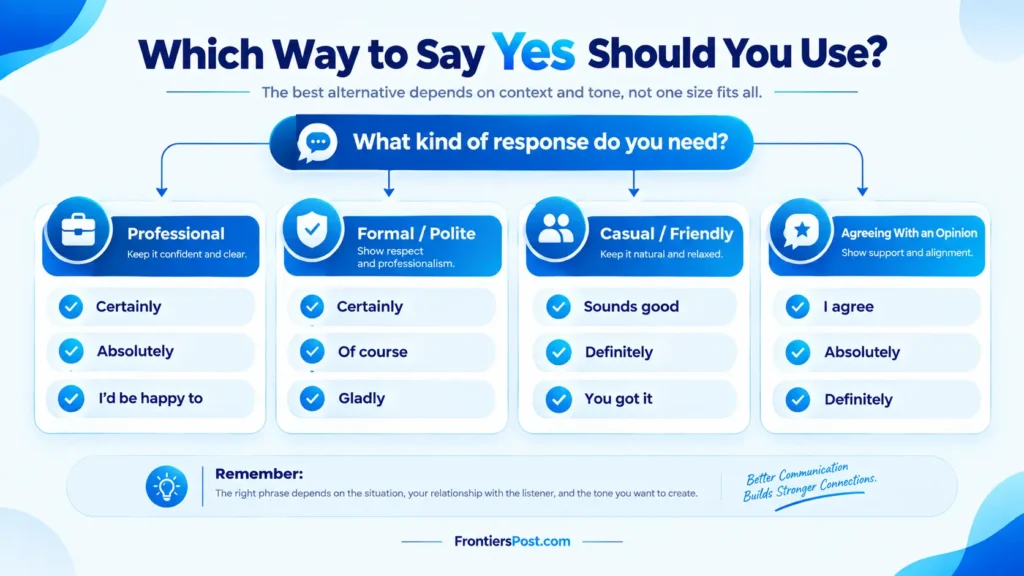
| Alternative | Best Used In | Tone |
| Absolutely | Professional, formal, friendly | Confident, enthusiastic |
| Certainly | Professional, formal | Polite, courteous |
| Of course | Friendly, professional | Warm, reassuring |
| Definitely | Casual, friendly, professional | Certain, enthusiastic |
| I agree | Professional, formal, academic | Direct, thoughtful |
| Sounds good | Casual, friendly, professional | Relaxed, positive |
| That works for me | Professional, casual | Cooperative, practical |
| I’d be happy to | Professional, friendly, polite | Warm, willing |
| Gladly | Friendly, polite, formal | Warm, willing |
| You got it | Casual, friendly | Upbeat, helpful |
Common Mistakes
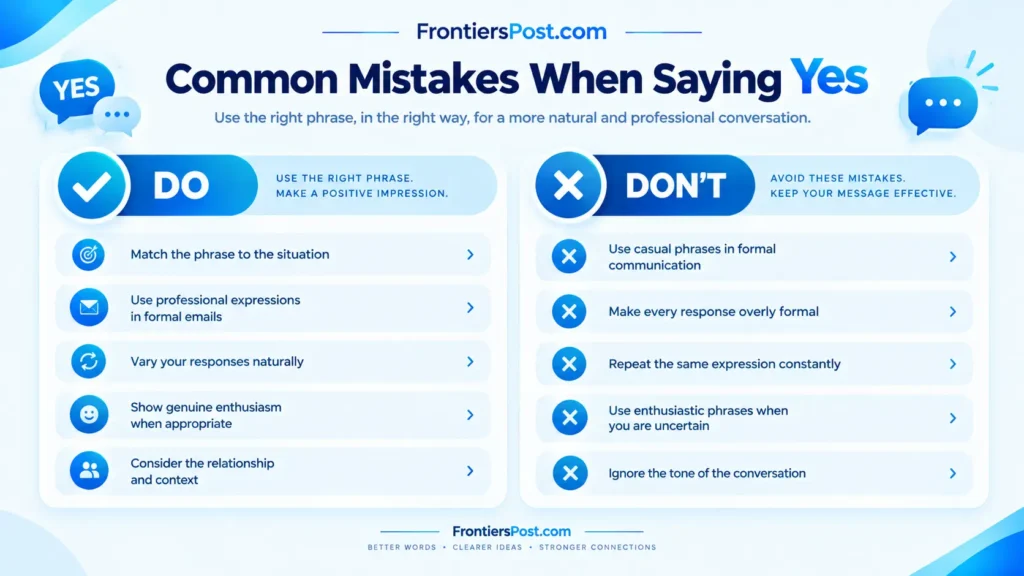
1. Using Casual Phrases in Formal Emails
Expressions such as “you got it” can sound too relaxed in a formal business email. Choose certainly, absolutely, or I’d be happy to when professionalism matters.
2. Choosing Overly Formal Language
Not every conversation needs polished business language. Saying “certainly” to a close friend may sound stiff when “sounds good” would feel more natural.
3. Repeating the Same Phrase
Using “absolutely” in every response can become repetitive. Rotate your alternatives based on the context instead of replacing every “yes” with one preferred phrase.
4. Forgetting the Context
An alternative should match what you are agreeing to. “I agree” works for opinions, while “that works for me” is better for schedules, plans, and arrangements.
5. Sounding Insincere
Strong phrases such as “absolutely” or “definitely” can sound unnatural if you are not genuinely enthusiastic. Select a neutral expression when your agreement is simply practical.
Frequently Asked Questions
What is another way to say yes professionally?
Professional alternatives to “yes” include certainly, absolutely, of course, I’d be happy to, and that works for me. The right choice depends on what you are agreeing to. For example, “certainly” works well when accepting a request, while “that works for me” is natural when agreeing to a schedule or arrangement.
What is a polite way to say yes?
Certainly, of course, and I’d be happy to are polite alternatives to “yes.” They show agreement while maintaining a respectful tone. “I’d be happy to” is especially useful when someone asks you to help because it communicates both acceptance and willingness.
What is a casual way to say yes?
For casual conversations, you can say sounds good, definitely, you got it, or of course. These phrases work naturally in texts, conversations with friends, and relaxed workplace chats. Your choice should reflect how enthusiastic or cooperative you want to sound.
What is another way to say yes in an email?
In a professional email, alternatives such as certainly, absolutely, I agree, and I’d be happy to can work well. For example, instead of “Yes, I can attend,” you could write, “Certainly, I can attend.” This sounds polished without becoming unnecessarily formal.
Can I use “absolutely” instead of “yes”?
Yes. Absolutely is a strong alternative to “yes” and often communicates enthusiasm or certainty. For example, if someone asks, “Can you help with the presentation?” responding with “Absolutely” shows that you are not only agreeing but also willing to help.
Is “sounds good” professional?
“Sounds good” can be professional in relaxed workplace communication, including emails, instant messages, and conversations with colleagues. However, it may be too casual for highly formal correspondence. In those situations, certainly or I’d be happy to may be a better choice.
What is a better way to say yes to a request?
The best alternative depends on the request. Certainly sounds polite and professional, I’d be happy to emphasizes willingness, and you got it sounds casual and helpful. Consider the relationship, setting, and level of formality before choosing your response.
What is the best alternative to “yes”?
There is no single best alternative because each phrase communicates a slightly different tone. Certainly is excellent for professional situations, absolutely adds enthusiasm, that works for me accepts a plan, and sounds good fits relaxed conversations.
Conclusion
Knowing another way to say yes can help you communicate with greater variety and precision. Instead of using the same response every time, choose a phrase that matches the situation and your relationship with the other person. Understanding the meaning of yes can also help you choose the right alternative for each context.
For professional or formal communication, certainly, absolutely, and I’d be happy to are strong choices. In everyday conversations, sounds good, definitely, and you got it feel more relaxed. Meanwhile, that works for me is useful when accepting a specific plan, while I agree clearly supports someone’s opinion.
The most effective alternative is the one that matches your intended tone. When you choose your words based on context, your agreement sounds more natural, genuine, and appropriate.

Sarah Mitchell is a Senior English Editor at FrontiersPost, specializing in English usage, vocabulary, word choice, grammar, and effective communication. She focuses on helping readers understand subtle differences between commonly confused words, phrases, and expressions and use them naturally in everyday, professional, and academic writing.
At FrontiersPost, Sarah researches, writes, and edits educational content with an emphasis on clarity, accuracy, and practical examples. She works closely with the editorial team to ensure that articles are easy to understand while maintaining appropriate context, meaning, and usage.
Her editorial interests include English vocabulary, synonyms, phrasing, professional communication, and the practical nuances that can make written communication more precise and effective.