

A good alternative to “this” depends on what you mean. Use “the following” to introduce information, “the issue” to identify a problem, “this approach” to describe a method, or “that idea” to refer to a suggestion. Choosing a specific expression makes emails, essays, and everyday conversations clearer and more natural.
Key Takeaways
- Use “the following” to introduce information that comes next.
- Choose “that idea” when referring to a previously discussed suggestion.
- Use “this approach” when describing a method or strategy.
- Replace vague references with specific nouns whenever possible.
- Keep “this” when its meaning is already clear; changing every instance is unnecessary.
What Does “This” Mean?
“This” is a demonstrative word used to identify a person, object, idea, situation, or piece of information. It can refer to something nearby, something currently being discussed, or an idea introduced in the previous sentence.
For example, “This is an important point” can refer to an idea in an essay or conversation. However, readers may struggle to understand the sentence if they cannot identify what “this” refers to.
The word is grammatically correct in many situations. The goal is not to eliminate it but to choose more specific wording when doing so improves clarity.
Why Use Alternatives to “This”?
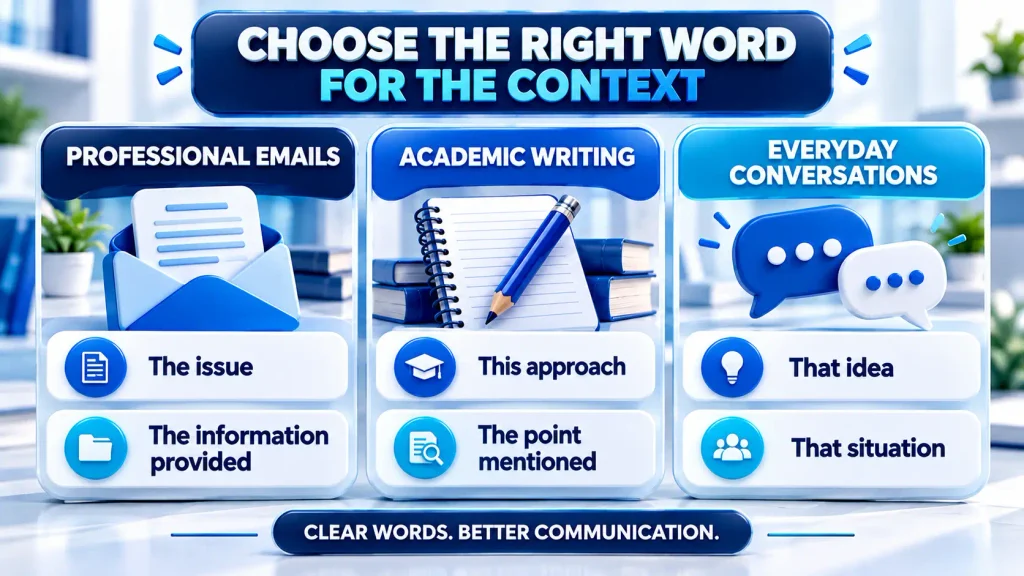
Finding another way to say “this” can help you communicate more precisely in different situations.
- Professional emails: Identify the exact issue, document, or request instead of relying on vague references.
- Academic writing: Connect arguments and evidence more clearly.
- Everyday conversations: Make your meaning easier to understand.
- Business reports: Use precise expressions to explain findings, decisions, and recommendations.
- Long-form writing: Reduce unnecessary repetition without making sentences complicated.
The best replacement depends on the noun or idea you want to describe. A phrase that works in a formal report may sound unnatural in a text message.
10 Best Alternatives to “This”
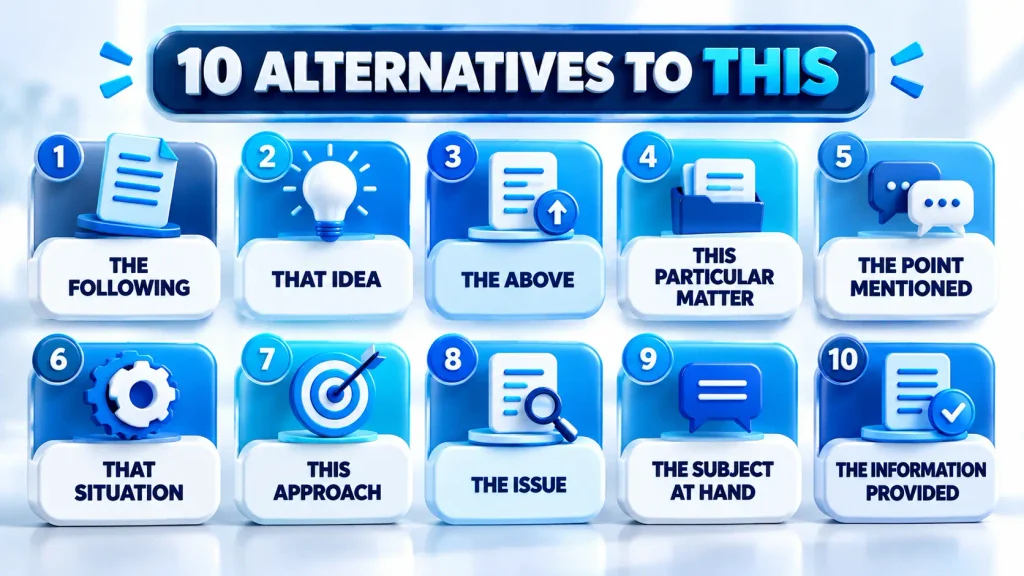
1. The Following
Meaning and Usage
“The following” introduces information that appears immediately afterward. It is particularly useful for instructions, lists, examples, and explanations.
Best For
Professional emails, reports, academic assignments, and announcements.
Example Sentences
- Please review the following instructions before submitting your application.
- The following examples explain how to use the phrase correctly.
Quick Tip
Use “the following” for upcoming information, not something already discussed.
2. That Idea
Meaning and Usage
“That idea” refers to a suggestion, concept, or thought that someone has already introduced. It works naturally in conversations and discussions.
Best For
Brainstorming, workplace discussions, everyday conversations, and essays about ideas.
Example Sentences
- That idea could help us improve the project.
- I would like to explore that idea in more detail.
Quick Tip
Make sure your reader knows which idea you mean before using this expression.
3. The Above
Meaning and Usage
“The above” refers to information presented earlier in a document or message. It is common in formal writing, although it can sometimes sound stiff.
Best For
Reports, formal instructions, business documents, and administrative writing.
Example Sentences
- Please review the above before completing the form.
- Based on the above, we recommend updating the proposal.
Quick Tip
“The information above” or “the points outlined earlier” may sound clearer when the reference needs more context.
4. This Particular Matter
Meaning and Usage
“This particular matter” identifies a specific subject, issue, or concern. It creates a formal tone and emphasizes the matter being discussed.
Best For
Professional correspondence, administrative documents, and formal discussions.
Example Sentences
- We need to discuss this particular matter before finalizing the agreement.
- Please direct your questions about this particular matter to our team.
Quick Tip
Use this expression when the situation requires a formal tone. For routine messages, “this issue” is usually more concise.
5. The Point Mentioned
Meaning and Usage
“The point mentioned” refers to a detail, argument, or observation raised earlier. It can help connect ideas in discussions and written explanations.
Best For
Academic writing, meeting summaries, feedback, and professional emails.
Example Sentences
- The point mentioned in your email requires further clarification.
- I agree with the point mentioned during yesterday’s meeting.
Quick Tip
Identify where the point appeared when necessary. “The point raised in your email” is often more specific.
6. That Situation
Meaning and Usage
“That situation” refers to circumstances or an event that the reader or listener already understands. It is useful when discussing experiences, challenges, or decisions.
Best For
Everyday conversations, personal messages, workplace discussions, and problem-solving.
Example Sentences
- I understand why that situation was difficult for you.
- We should consider what we learned from that situation.
Quick Tip
Use this phrase when the circumstances are already clear. Explain the situation first if it has not been introduced.
7. This Approach
Meaning and Usage
“This approach” describes a method, strategy, or way of completing a task. It is more informative than “this” when discussing how something should be done.
Best For
Business proposals, academic essays, project discussions, and recommendations.
Example Sentences
- This approach could reduce unnecessary steps in the process.
- This approach helps students organize their ideas more effectively.
Quick Tip
Use “this approach” for a method or strategy, not for a problem or individual piece of information.
8. The Issue
Meaning and Usage
“The issue” identifies a problem, concern, or matter that needs attention. It is direct and useful when communicating about workplace challenges or practical concerns.
Best For
Professional emails, reports, problem-solving, and workplace conversations.
Example Sentences
- We need to resolve the issue before the deadline.
- The issue raised in your message requires further discussion.
Quick Tip
If several problems are being discussed, specify which issue you mean to avoid confusion.
9. The Subject at Hand
Meaning and Usage
“The subject at hand” refers to the topic currently under discussion. It can help keep a meeting or conversation focused on the main subject.
Best For
Formal meetings, presentations, academic discussions, and structured debates.
Example Sentences
- Let us return to the subject at hand.
- We should focus on the subject at hand rather than unrelated concerns.
Quick Tip
This expression is relatively formal. “The current topic” is a simpler alternative for everyday communication.
10. The Information Provided
Meaning and Usage
“The information provided” refers to details or facts supplied by someone. It is useful when reviewing documents, responding to requests, or making decisions based on available information.
Best For
Business correspondence, applications, reports, and customer service messages.
Example Sentences
- The information provided will help us assess your application.
- Based on the information provided, we recommend revising the document.
Quick Tip
Use this phrase when referring to supplied information. If you mean a particular document or fact, naming it directly may be even clearer.
Comparison Table: Alternatives to “This”
| Alternative | Tone | Best Use | Formality |
|---|---|---|---|
| The following | Direct | Instructions and lists | Formal |
| That idea | Conversational | Suggestions and concepts | Neutral |
| The above | Concise | Reports and documents | Formal |
| This particular matter | Emphatic | Specific concerns | Formal |
| The point mentioned | Analytical | Discussions and arguments | Neutral |
| That situation | Natural | Events and circumstances | Neutral |
| This approach | Practical | Methods and strategies | Neutral to formal |
| The issue | Direct | Problems and concerns | Neutral to formal |
| The subject at hand | Emphatic | Meetings and discussions | Formal |
| The information provided | Professional | Reports and correspondence | Formal |
Common Mistakes to Avoid

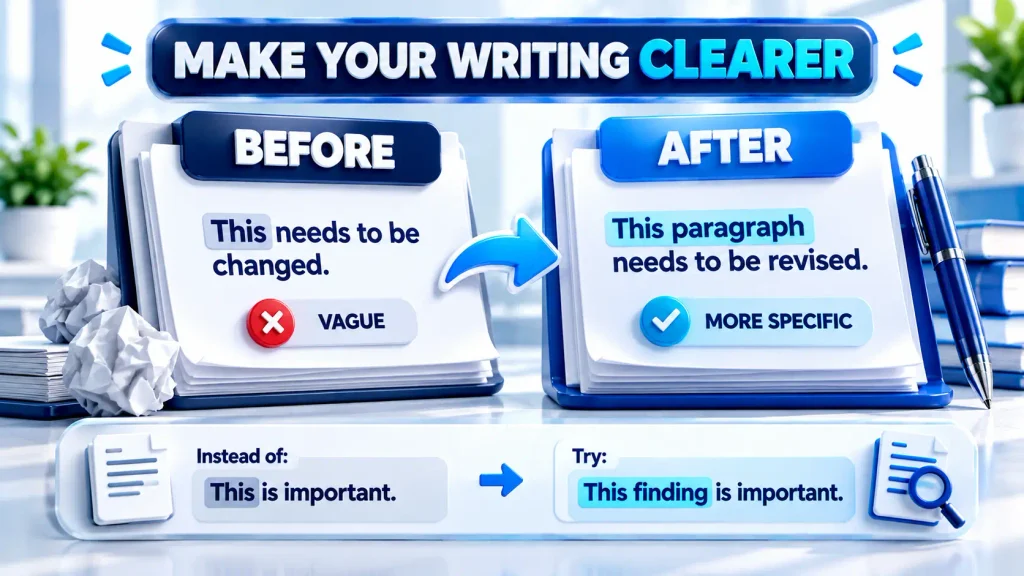
1. Using Vague References
Unclear: “This needs to be changed.”
Clearer: “This paragraph needs to be revised.”
Naming the subject helps readers understand exactly what requires attention.
2. Choosing an Alternative That Changes the Meaning
“The following” introduces upcoming information, while “the above” refers to information already presented. Using one in place of the other can confuse readers.
Better: Match the expression to the location of the information.
3. Making Simple Sentences Too Formal
Awkward: “I understand the circumstances pertaining to this particular matter.”
Natural: “I understand the situation.”
Professional writing should be clear, not unnecessarily complicated.
4. Repeating the Same Word Too Often
Repetitive: “This issue affects the project. This issue may delay the deadline.”
Improved: “This issue affects the project and may delay the deadline.”
Vary your wording when it improves readability, but do not replace words simply for the sake of variety.
5. Replacing “This” When It Is Already Clear
There is nothing wrong with “This result supports the argument” when the result has been clearly identified. Unnecessary replacements can make writing less natural.
Choose precision over forced variation.
Frequently Asked Questions

What is the most professional way to say “this”?
The best choice depends on the context. “The following” introduces information, “the issue” identifies a problem, and “the information provided” refers to supplied details. Choose the expression that communicates your intended meaning clearly without adding unnecessary words.
What can I use instead of “this” in an email?
You can use “the following,” “the issue,” or “the information provided,” depending on your message. For example, instead of writing “Please check this,” write “Please review the attached document.” Naming the specific item makes your email more direct and professional.
How can I avoid repeating “this” in an essay?
Replace vague references with specific nouns and combine closely related sentences when appropriate. For example, change “This shows the importance of education” to “This finding highlights the importance of education.” Ensure that readers can identify what each reference describes.
Is “the above” correct in formal writing?
Yes, “the above” is acceptable in formal documents and reports. However, it can sound stiff or vague when the reference is unclear. “The information above,” “the earlier point,” or the name of the specific subject may make your writing easier to understand.
What is another way to say “this shows”?
Depending on your meaning, you can use “this demonstrates,” “this illustrates,” “this suggests,” or “this highlights.” Use “demonstrates” when evidence supports a conclusion, “suggests” when the evidence indicates a possibility, and “highlights” when emphasizing an important detail.
Should I always replace the word “this”?
No. “This” is a normal and useful part of English. Replace it when the reference is unclear, the wording becomes repetitive, or a more specific expression improves the sentence. Otherwise, keeping the original word is often the clearest choice.
For related wording choices, see Another Way to Say “Too Much”, Another Way to Say “With This Being Said” in English and Another Way to Say “According To”.
Conclusion
The best alternative to “this” depends on what you want to communicate and the tone you need. Use “the following” to introduce information, “that idea” to discuss a suggestion, “this approach” to describe a method, and “the issue” to identify a problem. For professional documents, “the information provided” can also help clarify your meaning.
Before changing the word, consider whether your reader can identify the subject. If not, naming the exact person, document, idea, or problem is often the simplest solution. You do not need complicated vocabulary to write effectively. Choose expressions that suit your audience, keep sentences direct, and use alternatives only when they improve clarity and flow.

The FrontiersPost editorial team writes and reviews every guide to word and phrase alternatives, with clear meanings, tone notes and example sentences for everyday, academic and professional English.




