

If you need another way to say “according to,” you can use phrases such as as stated by, as reported by, based on, as noted by, in the words of, and as indicated by. The best choice depends on whether you are citing a source, reporting information, or explaining the basis for a claim.
Key Takeaways
- “According to” introduces information attributed to a person, source, or authority.
- As stated by and as reported by work well when referring to sources.
- Based on is useful when explaining the evidence behind a conclusion.
- As noted by is a polished choice for academic and professional writing.
- Choose the alternative that matches your source, purpose, and level of formality.
What Does “Another Way to Say According To” Mean?
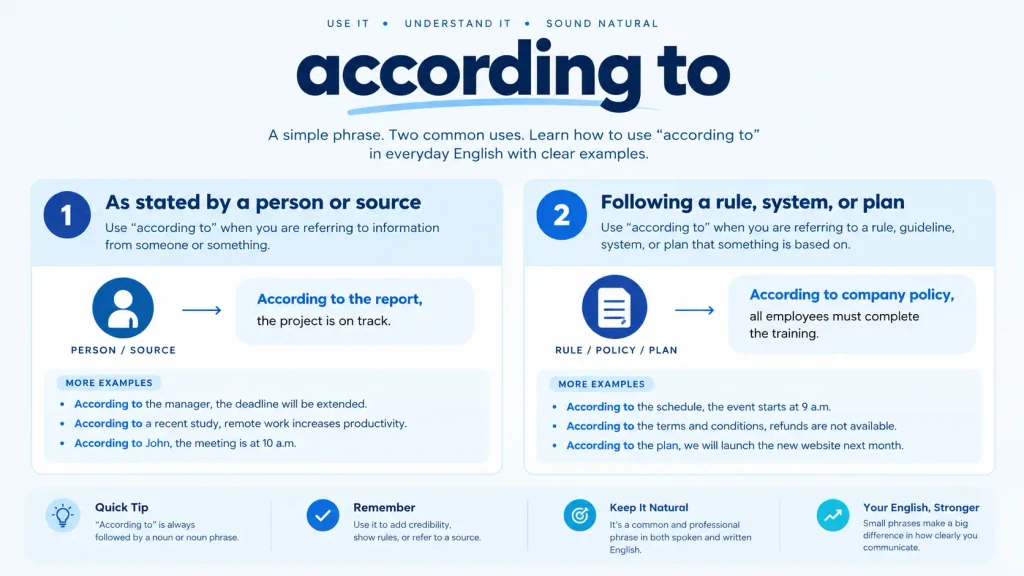
The phrase “according to” is used to show that information comes from a particular person, source, study, report, or authority. For example, you might write, “According to the report, customer satisfaction increased this year.”
People often look for another way to say “according to” because repeating the same phrase can make writing feel predictable. Using a suitable alternative can also make academic papers, reports, articles, and professional communication more precise.
Common contexts include essays, research papers, news writing, business reports, presentations, and everyday conversations. The right alternative depends on whether you are citing evidence, attributing a statement, or explaining the basis for an idea.
Why Use Other Ways to Say “According To”?

Using different expressions can make your writing smoother while preserving the original meaning.
Other alternatives can help you:
- Avoid repeating the same phrase.
- Make academic writing more varied.
- Sound more natural in professional communication.
- Clearly identify where information comes from.
- Match the tone of your sentence.
- Explain whether a statement is sourced, reported, or evidence-based.
10 Best Other Ways to Say “According To”

1. As Stated By
Meaning
“As stated by” means that a person or source directly expressed the information being discussed. It is especially useful when you want to clearly attribute a claim or statement to someone.
Best For
- Professional
- Formal
- Academic
Example 1
As stated by the university, applications must be submitted before the deadline.
Example 2
As stated by the researcher, the results require further investigation.
Quick Tip
Use “as stated by” when you want to emphasize that the information comes directly from a specific source.
2. As Reported By
Meaning
“As reported by” indicates that information was presented or published by a person, organization, publication, or other source. It works particularly well when discussing news, statistics, events, or findings.
Best For
- Professional
- Formal
- Academic
Example 1
As reported by the local newspaper, the company plans to open a new facility.
Example 2
As reported by the survey, most respondents preferred flexible working hours.
Quick Tip
Choose this phrase when your source has reported information rather than simply stated an opinion.
3. Based On
Meaning
“Based on” shows that an idea, conclusion, decision, or statement relies on particular information or evidence. Unlike “according to,” it often emphasizes the foundation for a conclusion.
Best For
- Professional
- Formal
- Academic
Example 1
Based on the available data, the team expects demand to remain steady.
Example 2
Based on customer feedback, the company revised its return policy.
Quick Tip
Use “based on” when you want to explain what evidence or information supports your conclusion.
4. As Noted By
Meaning
“As noted by” means that a person or source has pointed out or mentioned a particular fact or idea. It has a polished tone and fits naturally into academic and professional writing.
Best For
- Professional
- Formal
- Academic
Example 1
As noted by the author, clear communication can prevent unnecessary misunderstandings.
Example 2
As noted by the report, employee retention improved after the policy change.
Quick Tip
Use this expression when the source has highlighted an important point rather than simply providing raw information.
5. In the Words of
Meaning
“In the words of” introduces a statement, idea, or description associated with a particular person. It can be useful when you want to highlight someone’s own wording or perspective.
Best For
- Formal
- Friendly
- Warm
Example 1
In the words of the author, “Small changes can produce meaningful results.”
Example 2
In the words of the coach, consistent practice matters more than quick progress.
Quick Tip
Use this phrase when the person’s perspective or exact wording is especially important.
6. As Indicated By
Meaning
“As indicated by” suggests that information, evidence, or signs point toward a particular conclusion. It is common in formal, analytical, and research-oriented writing.
Best For
- Formal
- Professional
- Academic
Example 1
As indicated by the survey results, customers value faster delivery.
Example 2
As indicated by recent sales figures, demand has increased significantly.
Quick Tip
Use “as indicated by” when evidence points to a conclusion rather than when someone simply gives an opinion.
7. As Mentioned By
Meaning
“As mentioned by” refers to something previously brought up by a person or source. It is useful when connecting your current point to information already discussed.
Best For
- Professional
- Formal
- Casual
Example 1
As mentioned by the manager, the training session will begin at nine.
Example 2
As mentioned by our instructor, the assignment requires three sources.
Quick Tip
Use this phrase when the source has already mentioned the information earlier in a conversation, document, or presentation.
8. As Explained By
Meaning
“As explained by” indicates that someone has provided an explanation of a concept, process, reason, or situation. It is particularly useful when referring to expert guidance.
Best For
- Professional
- Formal
- Academic
Example 1
As explained by the professor, the experiment measures changes in temperature.
Example 2
As explained by the technician, the update should improve system performance.
Quick Tip
Choose this expression when your source has explained how or why something works.
9. In Line With
Meaning
“In line with” means consistent with, or supported by, a particular standard, policy, expectation, or source. It does not always work as a direct replacement for “according to,” so context matters.
Best For
- Professional
- Formal
Example 1
In line with company policy, employees must complete the form before requesting reimbursement.
Example 2
The findings are in line with previous research on workplace communication.
Quick Tip
Use “in line with” when you mean that something agrees with an established rule, policy, pattern, or body of evidence.
10. Per
Meaning
“Per” is a concise way to indicate that something follows a particular source, instruction, agreement, or rule. It is common in professional, business, and administrative communication.
Best For
- Professional
- Formal
Example 1
Per the contract, payment is due within 30 days.
Example 2
Per the director’s instructions, all employees should attend the meeting.
Quick Tip
“Per” is concise and professional, but it can sound stiff in casual conversation. Use it when brevity is useful.
Comparison Table

| Alternative | Best Used In | Tone |
| As stated by | Academic writing, reports | Formal |
| As reported by | News, research, reports | Formal |
| Based on | Analysis, decisions, essays | Professional |
| As noted by | Essays, reports, research | Formal |
| In the words of | Quotations, speeches, essays | Formal/Warm |
| As indicated by | Research, data analysis | Formal |
| As mentioned by | Conversations, emails, writing | Neutral |
| As explained by | Education, professional writing | Formal |
| In line with | Policies, standards, research | Professional |
| Per | Business, policies, instructions | Formal |
Common Mistakes

- Using casual phrases in academic writing
Expressions that sound natural in conversation may not fit a research paper. Choose a formal alternative when discussing scholarly sources. - Using “based on” when you mean direct attribution
“Based on” emphasizes evidence or reasoning. If you are simply identifying who provided the information, “as stated by” may be clearer. - Using “per” too often
“Per” is concise, but frequent use can make writing sound overly businesslike or stiff. - Forgetting the source of the information
When you attribute a claim, make sure your reader can tell who or what supports it. - Choosing an alternative that changes the meaning
Not every synonym works in every sentence. “In line with,” for example, usually means consistent with something rather than simply reporting information from a source.
Frequently Asked Questions
What is a professional way to say “according to”?
Professional alternatives include “as stated by,” “as noted by,” “as reported by,” and “as indicated by.” The best choice depends on your meaning. For example, “as reported by” works well for published information, while “as stated by” is better when directly attributing a statement to a person or organization.
What is another way to say “according to” in an essay?
For an essay, you can use “as stated by,” “as noted by,” “as indicated by,” “based on,” or “as explained by.” These alternatives can reduce repetition while keeping your writing clear. However, choose based on the relationship between your claim and the source rather than replacing “according to” automatically.
What can I say instead of “according to the author”?
You can write “as stated by the author,” “as noted by the author,” “as explained by the author,” or “in the author’s words.” If you are referring to the author’s interpretation rather than quoting them directly, “the author argues that” or “the author suggests that” may be more precise.
What is another way to say “according to research”?
Useful alternatives include “research indicates that,” “studies show that,” “evidence suggests that,” and “based on research.” Your choice should reflect the evidence. For example, “research indicates” is appropriate when referring to findings, while “based on research” emphasizes that your conclusion relies on existing evidence.
Is “per” the same as “according to”?
“Per” can mean “according to” when referring to a rule, instruction, agreement, or source. For example, “Per the contract” means that the information follows the contract. However, “per” is generally more concise and formal, so it may not sound natural in every context.
Can I use “based on” instead of “according to”?
Sometimes, but the two phrases are not always interchangeable. “According to the report” identifies the report as the source of information. “Based on the report” usually means that a conclusion, decision, or statement was formed using information from the report.
What is a formal alternative to “according to”?
“As stated by,” “as noted by,” “as indicated by,” and “as reported by” are formal alternatives. In academic writing, the most appropriate option depends on what the source actually does. Use “as reported by” for reported information and “as stated by” for a direct statement.
How do I avoid repeating “according to” in an essay?
Vary your wording according to the context instead of replacing every occurrence with the same synonym. You can use “as noted by,” “research indicates,” “based on,” “as explained by,” or “the author argues” when those expressions accurately describe your source and its role in your argument.
Writing something similar? Try What to Say Instead of “According To” in an Essay, Another Way to Say “As a Result Of” or Another Way to Say “At the Same Time” Naturally.
Conclusion
Finding another way to say “according to” can make your writing more varied, precise, and natural. However, the best alternative depends on what you are trying to communicate.
Use “as stated by” when attributing a direct statement, “as reported by” for published information, and “based on” when showing that a conclusion relies on evidence. For academic writing, “as noted by” and “as indicated by” can provide a polished alternative without changing your meaning.
The key is to choose an expression that accurately reflects your source and context. For a clearer understanding of the phrase itself, see this guide to according to meaning and usage. Instead of swapping “according to” for a synonym automatically, ask what role the source plays in your sentence.

The FrontiersPost editorial team writes and reviews every guide to word and phrase alternatives, with clear meanings, tone notes and example sentences for everyday, academic and professional English.




