

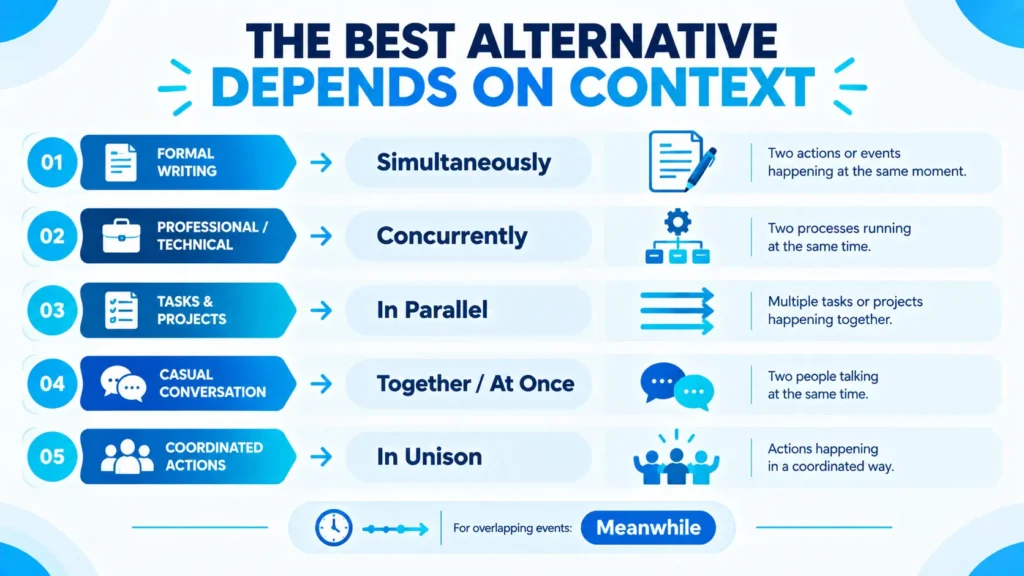
Another way to say “at the same time” is “simultaneously,” “concurrently,” “at once,” “in parallel,” or “at the same moment.” The best choice depends on context. Use “simultaneously” for clear, formal writing, “at once” for everyday English, and “in parallel” when describing tasks or processes happening together.
Key Takeaways
- “Simultaneously” is the strongest formal replacement for “at the same time.”
- “At once” sounds natural in casual and everyday American English.
- “Concurrently” works well in professional, technical, and academic contexts.
- “In parallel” is useful when two or more tasks happen during the same period.
- The best alternative depends on your tone, audience, and context.
Finding another way to say “at the same time” can make your writing sound smoother and more precise. Although the phrase is common and correct, repeating it too often can make emails, essays, conversations, and other writing feel predictable.
Fortunately, English offers many alternatives. Some sound formal and professional, while others work better in casual conversations or friendly messages.
What Does “Another Way to Say At the Same Time” Mean?
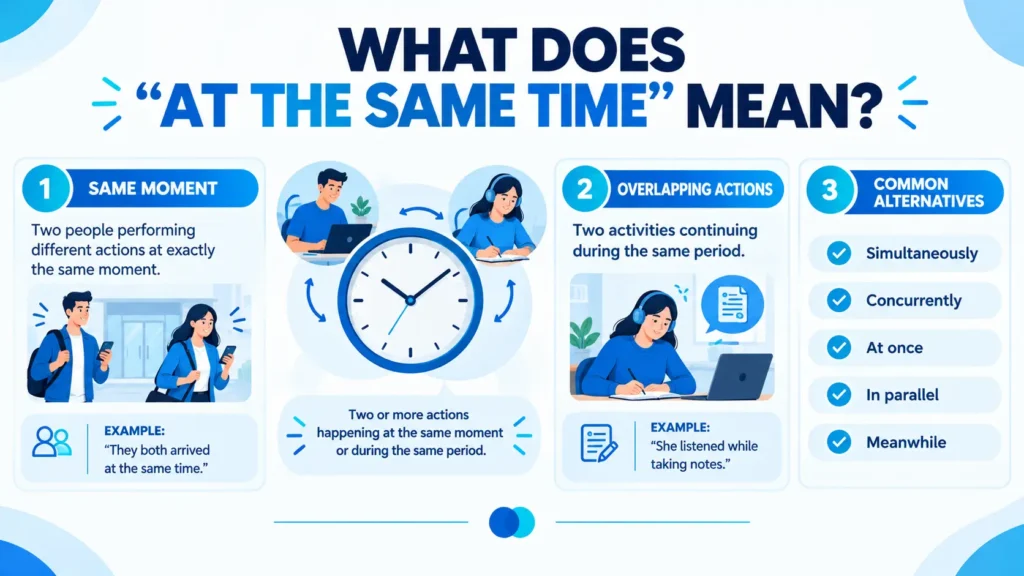
The phrase “at the same time” describes two or more things happening during the same moment or period. It can refer to actions, events, thoughts, conditions, or situations that overlap.
For example, you might say, “She was taking notes and listening at the same time.” In this sentence, both actions happen together.
People often look for alternatives to “at the same time” when they want to avoid repetition, improve sentence flow, or choose language that better fits a specific situation. You will commonly see these alternatives in everyday conversations, business writing, academic work, storytelling, and professional communication.
Why Use Other Ways to Say “At the Same Time”?
Using different expressions gives your writing more variety and lets you communicate the exact relationship between two actions.
Consider using an alternative when you want to:
- Avoid repeating the same phrase.
- Make a sentence sound more natural.
- Create a more formal or professional tone.
- Explain multiple events clearly.
- Make academic or technical writing more precise.
- Match your wording to the situation.
The key is not to replace “at the same time” automatically. Instead, choose an expression that accurately describes how the events or actions overlap.
10 Best Other Ways to Say “At the Same Time”
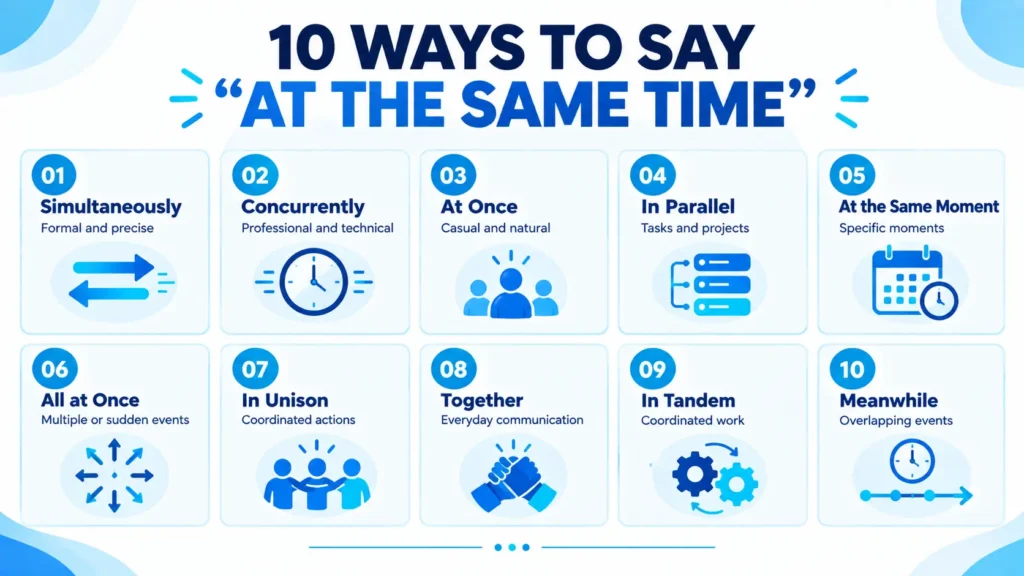
1. Simultaneously
Meaning
“Simultaneously” means that two or more things happen at exactly or nearly the same time. It is one of the clearest and most direct alternatives to “at the same time.”
Best For
- Professional
- Formal
- Academic
Example 1
The two teams simultaneously began working on their assigned projects.
Example 2
She answered the question while simultaneously checking the report.
Quick Tip
Use “simultaneously” when you want a concise, polished replacement in formal writing.
2. Concurrently
Meaning
“Concurrently” describes activities or events that occur during the same period. It is especially useful when the actions overlap but do not necessarily happen at the exact same second.
Best For
- Professional
- Formal
- Academic
Example 1
The company is concurrently developing its new website and mobile application.
Example 2
Students may enroll in both courses concurrently if they meet the requirements.
Quick Tip
Choose “concurrently” when discussing multiple ongoing activities in professional, academic, or technical contexts.
3. At Once
Meaning
“At once” can mean that something happens immediately, but it can also mean that several things happen together. Because of this double meaning, context matters.
Best For
- Casual
- Friendly
- Polite
Example 1
The children started laughing and talking at once.
Example 2
Several questions came to her mind at once.
Quick Tip
Use “at once” when the surrounding sentence clearly shows that you mean “together,” not “immediately.”
4. In Parallel
Meaning
“In parallel” means that two or more activities are carried out during the same period rather than one after another. It is common when describing projects, processes, and work.
Best For
- Professional
- Formal
Example 1
The design and engineering teams worked in parallel to meet the deadline.
Example 2
We can review the proposal and prepare the presentation in parallel.
Quick Tip
This phrase is particularly effective when explaining multiple tasks happening alongside each other.
5. At the Same Moment
Meaning
“At the same moment” directly emphasizes that two events occur during one particular point in time. It is similar to “at the same time,” but it can sound slightly more descriptive.
Best For
- Formal
- Friendly
- Warm
Example 1
At the same moment, the lights went out across the entire building.
Example 2
They both realized at the same moment that something was wrong.
Quick Tip
Use this expression when you want to emphasize a specific moment rather than a longer period.
6. All at Once
Meaning
“All at once” describes several things happening together or suddenly within the same period. It often adds a sense of intensity or surprise.
Best For
- Casual
- Friendly
- Warm
Example 1
The phones began ringing all at once.
Example 2
She suddenly remembered all the details all at once.
Quick Tip
Use “all at once” when multiple events happen together and you want the sentence to feel more vivid.
7. In Unison
Meaning
“In unison” means that people or things perform an action together, often in exactly the same way or at the same moment. It is especially natural for coordinated actions.
Best For
- Formal
- Friendly
- Warm
Example 1
The audience stood in unison when the speaker entered the room.
Example 2
The dancers moved in unison throughout the final performance.
Quick Tip
Use “in unison” when the actions are coordinated or synchronized, not simply occurring during the same general period.
8. Together
Meaning
“Together” can express actions or events that occur at the same time, especially when people perform something jointly. It is simple, natural, and widely used.
Best For
- Casual
- Friendly
- Warm
Example 1
We worked together to finish the presentation before lunch.
Example 2
The two speakers answered the audience’s questions together.
Quick Tip
Use “together” when the emphasis is on people or actions happening jointly rather than precise timing.
9. In Tandem
Meaning
“In tandem” describes two or more things working or developing together. It often suggests coordination as well as overlapping activity.
Best For
- Professional
- Formal
Example 1
The marketing and sales departments worked in tandem during the product launch.
Example 2
The two programs operate in tandem to improve customer service.
Quick Tip
Choose “in tandem” when you want to emphasize that activities are working together toward a related goal.
10. Meanwhile
Meaning
“Meanwhile” refers to something happening during the same general period as another event. It is often used to shift attention from one action or situation to another.
Best For
- Professional
- Casual
- Friendly
Example 1
The manager spoke with the client. Meanwhile, the team prepared the final documents.
Example 2
I was finishing the report; meanwhile, my colleague organized the meeting.
Quick Tip
Use “meanwhile” when you are moving from one event or situation to another that is happening during the same period.
Comparison Table
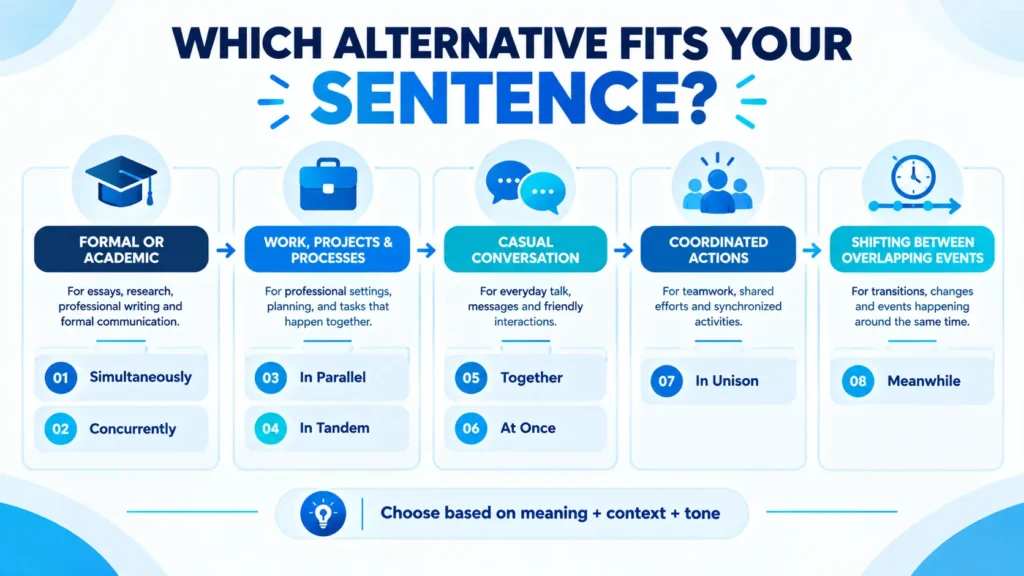
| Alternative | Best Used In | Tone |
| Simultaneously | Formal and academic writing | Professional |
| Concurrently | Business and technical writing | Formal |
| At once | Everyday conversations | Casual |
| In parallel | Projects and processes | Professional |
| At the same moment | Specific events | Neutral |
| All at once | Multiple or sudden events | Casual |
| In unison | Coordinated actions | Formal |
| Together | Everyday communication | Friendly |
| In tandem | Coordinated work or processes | Professional |
| Meanwhile | Connecting overlapping events | Neutral |
Common Mistakes
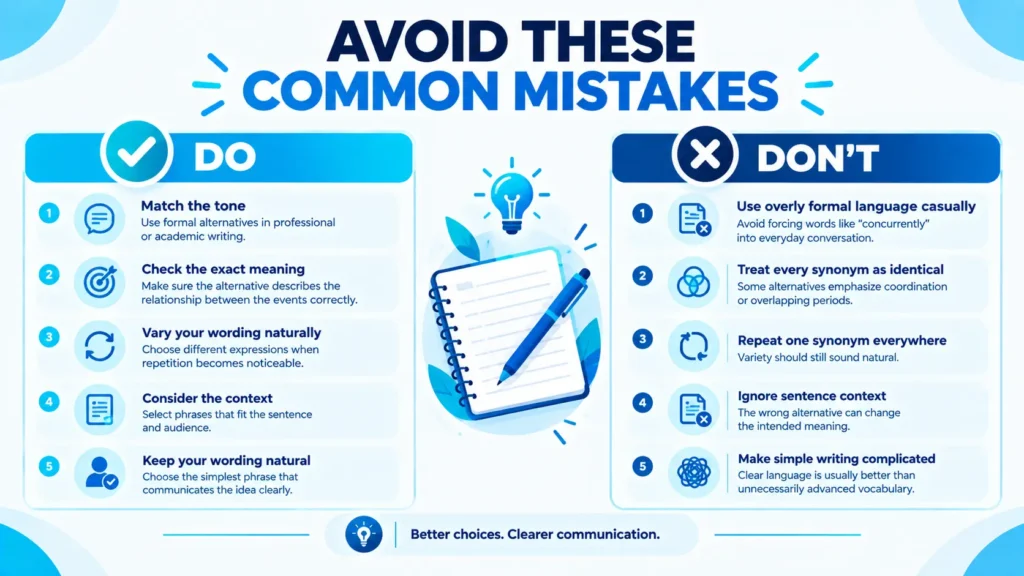
1. Using a casual phrase in professional writing
Words such as “together” or “all at once” can sound less precise in some business or academic contexts. Consider “simultaneously,” “concurrently,” or “in parallel” when greater precision is needed.
2. Choosing a phrase with a different meaning
Not every synonym works in every sentence. For example, “at once” can also mean “immediately,” while “meanwhile” usually refers to an overlapping period rather than one exact moment.
3. Replacing the phrase without considering context
A word may be technically similar but still sound unnatural. “In unison” suggests coordinated action, so it would not be the best choice for two unrelated events that simply happen at the same time.
4. Making simple writing too formal
Using “concurrently” in a casual text message can sound unnecessarily formal. Sometimes the most natural choice is simply “together” or “at once.”
5. Repeating the same alternative
Replacing “at the same time” with “simultaneously” throughout an entire article does not solve the repetition problem. Vary your wording naturally while making sure each phrase fits its context.
Frequently Asked Questions
What is the best formal way to say “at the same time”?
“Simultaneously” is usually the best formal alternative to “at the same time.” It is concise, clear, and widely accepted in professional and academic writing. “Concurrently” is another strong option when you are describing activities that happen during the same period.
What is a casual way to say “at the same time”?
For casual American English, “together” and “at once” can work well, depending on the sentence. “Together” is especially natural when people perform an activity jointly, while “at once” works when several events happen at the same moment.
Is “simultaneously” the same as “at the same time”?
Yes, “simultaneously” generally means that two or more events happen at the same time. It is a more concise and somewhat more formal alternative, so it often works well in academic papers, professional documents, and polished writing.
Can I use “concurrently” instead of “at the same time”?
Yes. “Concurrently” means that activities occur during the same period. However, it often sounds more technical or formal than “at the same time,” making it particularly suitable for business, academic, legal, or technical writing.
What is another way to say “at the same time” in an essay?
For an essay, “simultaneously,” “concurrently,” and “in parallel” are useful choices. The best option depends on your meaning. Use “simultaneously” for events occurring together, “concurrently” for overlapping activities, and “in parallel” for separate processes progressing during the same period.
What is another way to say “at the same time” in an email?
In a professional email, “simultaneously,” “concurrently,” or “in parallel” can sound polished. For example, you could say that two teams are “working in parallel” when both are handling different parts of the same project.
Is “meanwhile” a synonym for “at the same time”?
“Meanwhile” can communicate a similar idea, but it is not always a direct replacement. It usually introduces an event or situation happening during the same period as another event, often while shifting the reader’s attention from one subject to another.
Which alternative to “at the same time” sounds the most natural?
The most natural choice depends on your sentence. “Simultaneously” is versatile and precise, “together” sounds conversational, “at once” feels casual, and “in parallel” works especially well for tasks and projects.
Conclusion
There are many useful ways to say “at the same time,” and the right choice depends on your audience and purpose. “Simultaneously” is a strong all-purpose option for formal and professional writing, while “together” works naturally in everyday conversation. For more context, you can explore the meaning and usage of “at the same time” in the Cambridge Dictionary.
For business, academic, or technical contexts, “concurrently” and “in parallel” can provide greater precision. If several events happen suddenly, “all at once” may sound more natural, while “in unison” is best for coordinated actions.
The goal is not to replace the original phrase every time. Instead, choose the alternative that matches the exact meaning and tone of your sentence. A simple change in wording can make your communication clearer, more natural, and less repetitive.

Melody Schaefer is the Founder and Editor-in-Chief of FrontiersPost, where she oversees the publication of clear, useful, and thoughtfully researched content for modern readers. Her editorial focus includes language, communication, vocabulary, writing, and practical topics that help readers understand information with greater clarity and confidence.
At FrontiersPost, Melody works with writers and editors to maintain consistent editorial standards, improve content quality, and ensure that published articles are useful, accessible, and easy to understand. She is particularly interested in clear communication and presenting complex or easily confused topics in a straightforward way.
As Editor-in-Chief, she is also responsible for guiding the site’s editorial direction, reviewing content standards, and helping ensure that articles are regularly maintained and improved as information evolves.