

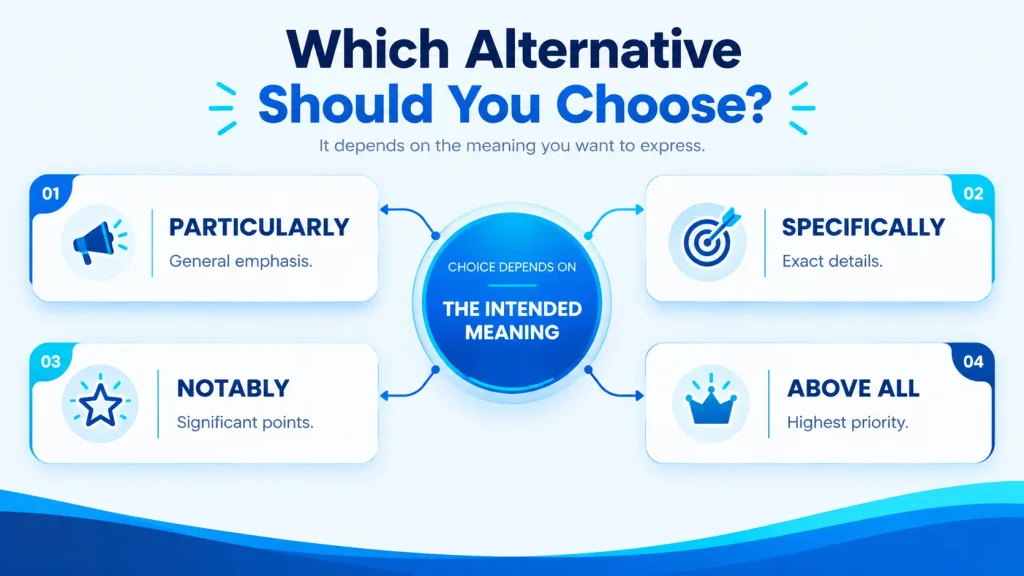
Another way to say especially is particularly, in particular, notably, specifically, or above all. These alternatives help you emphasize important details, people, ideas, or situations. Use particularly in everyday and professional writing, specifically when identifying something exact, and above all when highlighting the most important point.
Key Takeaways
- Particularly is a versatile alternative for everyday and professional English.
- In particular highlights a specific person, thing, or detail.
- Notably emphasizes something worth noticing or remembering.
- Specifically introduces precise information or a clear example.
- Choose alternatives based on context, tone, and the level of emphasis you want.
Finding another way to say especially can make your writing more natural, precise, and engaging. Whether you’re writing an academic essay, sending a professional email, or having a casual conversation, the right alternative helps you emphasize important information without repeating the same word.
Below are 10 useful alternatives, with meanings, examples, and tips to help you choose the best expression for your situation.
What Does “Another Way to Say Especially” Mean?

The phrase another way to say especially refers to alternative words or expressions that emphasize a particular person, thing, detail, or situation.
The word especially means particularly or more than usual. People use it to draw attention to something important, explain a preference, or show that a statement applies more strongly to one specific case.
For example, instead of saying, “I enjoy outdoor activities, especially hiking,” you could write, “I enjoy outdoor activities, particularly hiking.”
You can use these alternatives in academic writing, workplace communication, everyday conversations, presentations, and personal messages.
Why Use Other Ways to Say “Especially”?
Choosing a suitable alternative helps you communicate your ideas clearly while keeping your writing varied. It also allows you to adjust your tone to fit the audience and situation.
Consider using alternatives to:
- Avoid repetition: Keep paragraphs and conversations from sounding repetitive.
- Improve clarity: Highlight the exact detail you want readers to notice.
- Sound professional: Choose words that fit reports, emails, and formal documents.
- Strengthen emphasis: Make important ideas stand out.
- Improve academic writing: Express comparisons and specific points more precisely.
10 Best Other Ways to Say “Especially”
1. Particularly
Meaning
Particularly means especially or to a greater degree than usual. It is one of the closest alternatives to especially and works naturally in both spoken and written English.
Best For
Professional, Formal, Casual, Polite
Example 1
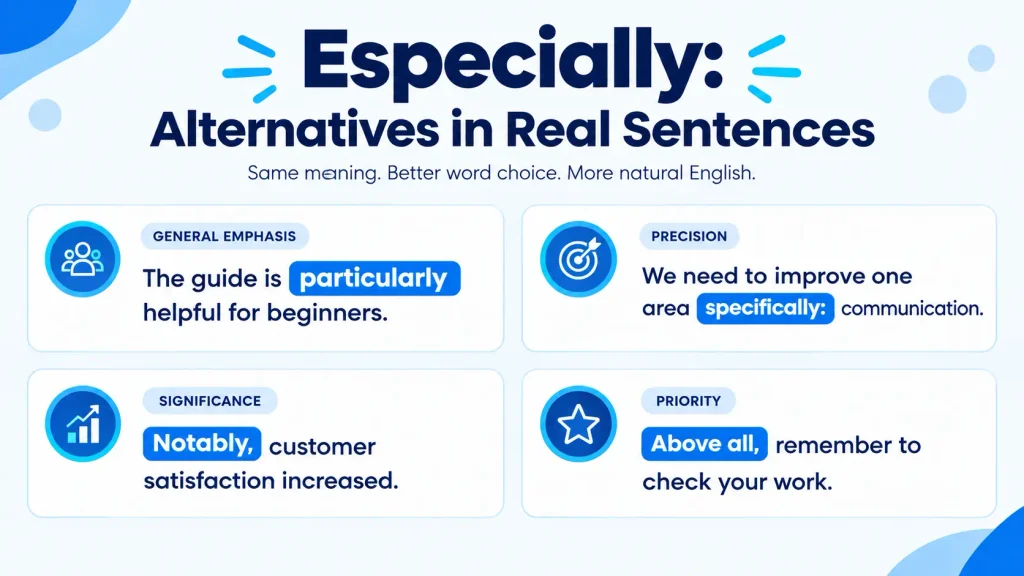
The new scheduling system is particularly useful for remote employees.
Example 2
I particularly enjoyed the final chapter of the book.
Quick Tip
Use particularly when you want a versatile replacement that fits most situations without changing the sentence’s meaning.
2. In Particular
Meaning
In particular draws attention to one specific person, thing, or detail within a larger group. It often appears at the end of a sentence or after a general statement.
Best For
Professional, Formal, Friendly
Example 1
Several departments contributed to the project, with the design team standing out in particular.
Example 2
I enjoy visiting national parks, Yellowstone in particular.
Quick Tip
Use in particular when you want to narrow a broad statement to one specific example.
3. Notably
Meaning
Notably emphasizes something that deserves attention because it is important, unusual, or significant. It is common in professional reports, academic writing, and analytical discussions.
Best For
Professional, Formal
Example 1
The company improved several services, notably its customer support system.
Example 2
Notably, attendance increased after the school introduced flexible class schedules.
Quick Tip
Choose notably when the detail you’re emphasizing is significant or worth pointing out to your reader.
4. Specifically
Meaning
Specifically identifies something precisely rather than discussing it in general terms. Although it can replace especially in some sentences, it works best when introducing exact details or clarifying what you mean.
Best For
Professional, Formal, Polite
Example 1
We need to improve our communication, specifically how we share project updates.
Example 2
The scholarship supports students, specifically those studying environmental science.
Quick Tip
Use specifically to clarify an exact point, not simply to add emphasis to an ordinary statement.
5. Above All
Meaning
Above all emphasizes the most important thing among several possibilities. Unlike especially, it often establishes a clear priority or ranking.
Best For
Professional, Formal, Warm
Example 1
A strong team needs technical skills and, above all, mutual trust.
Example 2
When preparing for the interview, above all, remember to be yourself.
Quick Tip
Use above all when you want to communicate that one point matters more than the others.
6. Primarily
Meaning
Primarily means mainly or chiefly. It emphasizes the principal purpose, reason, audience, or focus of something rather than simply highlighting one detail.
Best For
Professional, Formal
Example 1
The training program is primarily designed for new managers.
Example 2
Our newsletter focuses primarily on practical writing advice.
Quick Tip
Choose primarily when describing the main purpose or focus of a project, activity, or statement.
7. Chiefly
Meaning
Chiefly means mainly or above all in terms of importance. It sounds somewhat more formal than particularly and often appears in reports, explanations, and descriptive writing.
Best For
Formal, Professional
Example 1
The delay was caused chiefly by a shortage of materials.
Example 2
Her presentation focused chiefly on the long-term effects of climate change.
Quick Tip
Use chiefly to identify the main cause, reason, or subject rather than a minor detail.
8. Mainly
Meaning
Mainly means mostly or for the most part. It is a straightforward alternative when you want to explain what something generally consists of or what it focuses on most.
Best For
Casual, Friendly, Professional
Example 1
The workshop attracts mainly college students and recent graduates.
Example 2
I use this notebook mainly for planning my weekly tasks.
Quick Tip
Choose mainly for simple, direct sentences. In formal academic writing, primarily may sound more appropriate.
9. Most of All
Meaning
Most of all emphasizes the person, thing, or quality that matters more than the others. It often expresses a strong preference, personal feeling, or clear priority.
Best For
Casual, Friendly, Warm
Example 1
I enjoyed the food, the music, and most of all, the company.
Example 2
She wanted to succeed, but most of all, she wanted her family to feel proud.
Quick Tip
Use most of all when expressing personal priorities or emotions rather than presenting technical information.
10. More Than Anything
Meaning
More than anything emphasizes a strong desire, preference, or feeling. It is more emotional and conversational than many alternatives, so it does not fit every formal or factual sentence.
Best For
Casual, Friendly, Warm
Example 1
More than anything, I want our team to feel supported.
Example 2
He loves traveling, but more than anything, he enjoys spending time with his children.
Quick Tip
Use this expression to communicate strong personal feelings or priorities. For neutral factual writing, consider particularly or primarily instead.
Comparison Table
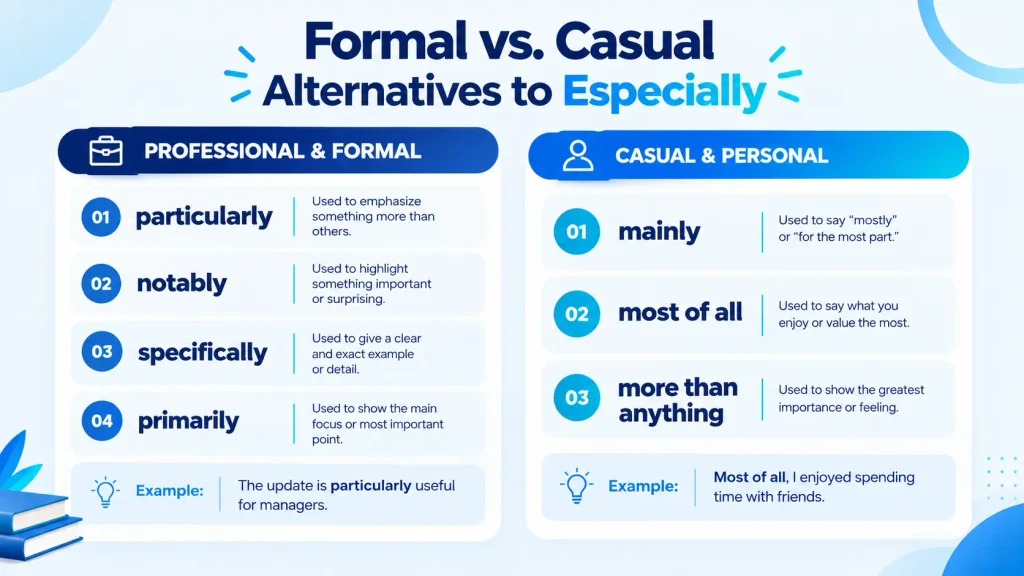
| Alternative | Best Used In | Tone |
|---|---|---|
| Particularly | Everyday and professional writing | Neutral |
| In particular | Specific examples and details | Clear |
| Notably | Reports and significant findings | Formal |
| Specifically | Precise details and clarification | Direct |
| Above all | Main priorities | Emphatic |
| Primarily | Purpose and main focus | Professional |
| Chiefly | Main causes or subjects | Formal |
| Mainly | General explanations | Conversational |
| Most of all | Personal preferences | Warm |
| More than anything | Strong feelings and desires | Emotional |
Common Mistakes When Replacing “Especially”
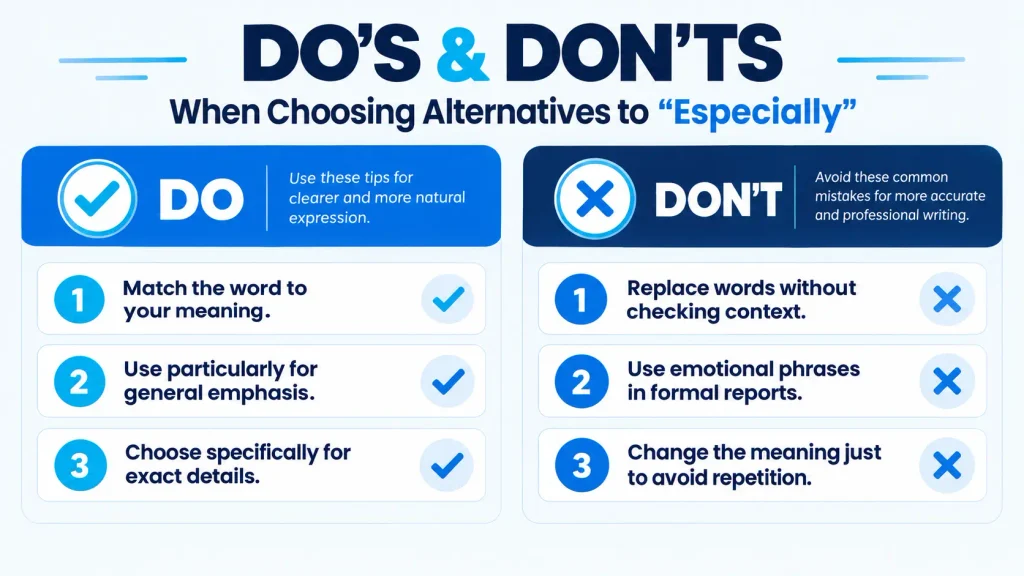
1. Using an Alternative That Changes the Meaning
Especially and primarily are not always interchangeable. The first highlights something, while the second identifies the main focus.
Better approach: Check whether you want to emphasize a detail or describe the main purpose.
2. Using Casual Expressions in Formal Writing
Phrases such as more than anything can sound too emotional in a research paper or business report.
Better approach: Choose particularly, notably, or specifically when the context requires a professional tone.
3. Choosing Overly Formal Language
Using chiefly in every casual conversation can make your speech sound unnatural.
Better approach: Match the expression to your audience and the way people normally speak in that setting.
4. Repeating the Same Alternative
Replacing every instance of especially with particularly may solve one problem but create another.
Better approach: Vary your wording only when another expression fits the meaning. Clarity matters more than variety.
5. Ignoring Sentence Structure
Some alternatives need a different sentence structure. For example, specifically often introduces precise details, while above all signals priority.
Better approach: Read the full sentence after making a substitution to ensure the grammar and meaning remain natural.
Frequently Asked Questions
1. What is the best synonym for especially?
Particularly is one of the best general synonyms for especially because it works in formal, professional, and casual contexts. However, the best choice depends on your meaning. Use specifically for precise details, notably for significant points, and above all to emphasize the highest priority.
2. What is a more formal word for especially?
Particularly, notably, specifically, and primarily can all work in formal writing. Choose notably when highlighting a significant finding and specifically when clarifying an exact point. For academic writing, the most appropriate word is the one that preserves your intended meaning and fits the sentence.
3. How can I say especially in an academic essay?
In an academic essay, consider particularly, notably, specifically, or primarily. For example, “This issue is particularly relevant to first-year students” sounds natural and clear. Use specifically when identifying a precise group or detail, and avoid choosing a synonym merely to make your writing sound more complicated.
4. Is particularly the same as especially?
Particularly and especially often have the same meaning and can replace each other in many sentences. For example, “The course is especially useful for beginners” can become “The course is particularly useful for beginners.” However, context matters because some expressions, such as above all, place greater emphasis on priority.
5. Can I use notably instead of especially?
Yes, when you want to draw attention to something significant or worth noticing. For example, “The policy especially helped small businesses” could become “The policy notably helped small businesses.” The second version emphasizes the significance of the result, so it may not fit every sentence where especially appears.
6. What is another way to say especially in a professional email?
Particularly, specifically, and in particular are useful in professional emails. You might write, “I particularly appreciate your feedback” or “I’d like to discuss one issue in particular.” These phrases sound natural while keeping your message focused and respectful.
7. What can I use instead of especially in a sentence?
You can use particularly, in particular, notably, specifically, above all, primarily, chiefly, mainly, most of all, or more than anything. Before choosing one, identify whether the sentence expresses emphasis, precision, a main purpose, or a personal priority.
8. Is especially appropriate for formal writing?
Yes. Especially is perfectly acceptable in formal writing, including academic papers, business reports, and professional correspondence. You do not need to replace it every time it appears. Use an alternative only when it improves clarity, reduces unnecessary repetition, or communicates your intended emphasis more accurately.
Readers who used this guide also looked at Another Way to Say Finally, Another Way to Say Finally in an Essay and Another Way to Say “For Example” in an Essay.
Conclusion
Finding another way to say especially can help you write with greater clarity, confidence, and variety. Particularly is an excellent all-purpose choice, while in particular highlights a specific detail and notably draws attention to something significant. When precision matters, choose specifically; when you want to identify a main purpose, consider primarily or chiefly.
Your audience and purpose should guide your choice. In professional emails and academic essays, prioritize clear, precise language. In casual conversations or personal messages, expressions such as most of all and more than anything can communicate stronger feelings.
Remember that especially is already a correct and natural word. You don’t need to replace it simply to avoid repetition. For a clearer understanding of its meaning and usage, consult the definition of especially. Choose an alternative when it better expresses your meaning, suits your tone, or helps readers understand the point you want to emphasize.

The FrontiersPost editorial team writes and reviews every guide to word and phrase alternatives, with clear meanings, tone notes and example sentences for everyday, academic and professional English.




