

If you’re looking for another way to say finally, useful alternatives include ultimately, eventually, in the end, at last, lastly, to conclude, in conclusion, after all, at long last, and when all is said and done. Each expression has a slightly different meaning and tone, making some better for professional emails, academic writing, and everyday conversations than others.
Key Takeaways
- Ultimately works well when expressing a final result or conclusion.
- Eventually describes something that happens after some time or delay.
- In the end is a natural choice for summarizing an outcome.
- Lastly and to conclude work well when organizing written information.
- At last and at long last express relief when something finally happens.
The word finally is useful in everyday conversations, professional emails, and academic writing. However, using it repeatedly can make your writing sound predictable. Choosing a more specific expression can help you communicate your message more naturally.
For example, you might use ultimately when explaining the result of a decision, eventually when describing something that happens after a delay, or lastly when introducing your final point in a list.
The best alternative depends on what you want to express. Below are 10 useful expressions, along with their meanings, appropriate situations, and examples.
What Does Finally Mean?
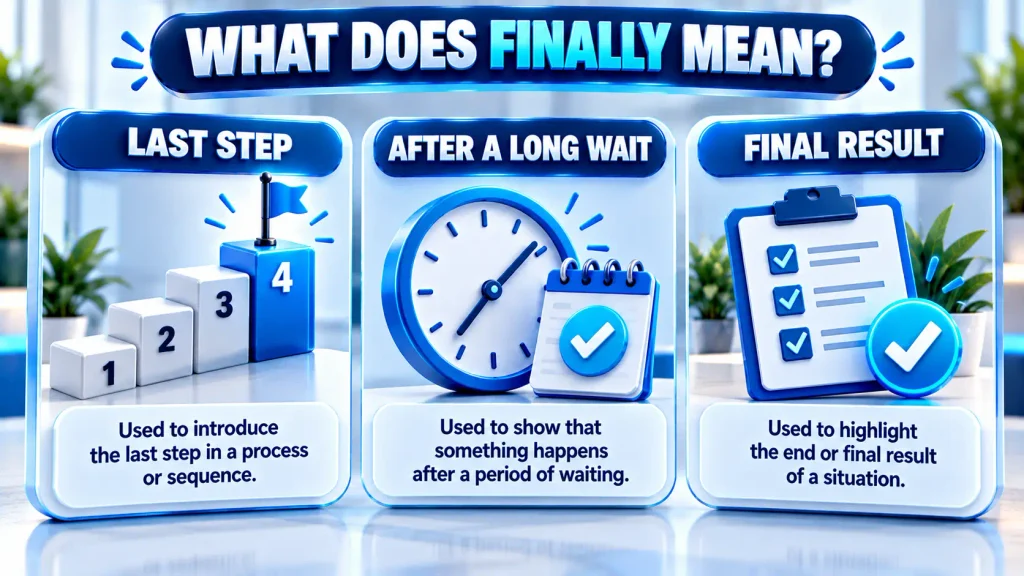
The word finally has several meanings depending on the context. It can introduce the last point in a discussion, describe something that happens after a long wait, or explain the final result of a situation.
For example:
- Last point: Finally, let’s discuss the importance of clear communication.
- After a delay: She finally received the job offer.
- Final result: Finally, we decided to move forward with the project.
Understanding these different uses is important because not every alternative works in every situation. For instance, lastly can introduce the final item in a list, but it does not always communicate the same sense of relief as at last.
Why Use Alternatives to Finally?
Using different expressions can make your writing clearer, more engaging, and less repetitive. The right alternative also helps communicate your intended meaning more accurately.
Here are some situations where alternatives are useful:
- Professional emails: Expressions such as ultimately and in the end can communicate decisions and outcomes clearly.
- Academic writing: Phrases such as to conclude and in conclusion help introduce final thoughts.
- Everyday conversations: Words such as eventually and at last sound natural when discussing something that happened after a delay.
- Presentations: Lastly helps introduce your final point without repeating the same transition.
- Personal messages: At long last can express excitement or relief about something you’ve been waiting for.
10 Best Alternatives to Finally

The following expressions provide natural alternatives for different situations. Choose one based on whether you’re introducing a final point, describing a delayed event, or explaining an outcome.
1. Ultimately
Meaning and Usage
Ultimately describes the final result of a situation, decision, or process. It is particularly useful when explaining what something leads to after considering different possibilities.
It sounds professional and works well in business communication and academic writing.
Best For
- Professional emails and reports
- Academic essays
- Business discussions
- Explaining decisions and outcomes
Example Sentences
- Ultimately, the team decided to launch the project next month.
- Your success ultimately depends on your commitment and consistent effort.
- Ultimately, clear communication helps prevent workplace misunderstandings.
Quick Tip
Use ultimately when emphasizing the final result rather than simply introducing the last item in a list.
2. Eventually
Meaning and Usage
Eventually means something happens after a period of time, a delay, or several attempts. It emphasizes the passage of time before an outcome occurs.
It is a natural choice for both professional and casual communication.
Best For
- Everyday conversations
- Personal stories
- Workplace updates
- Describing delayed results
Example Sentences
- We eventually found a solution to the technical problem.
- She eventually received a response from the hiring manager.
- After several interviews, he eventually secured the position.
Quick Tip
Use eventually when time or delay matters. It is not usually the best replacement when introducing the last point in an essay or presentation.
3. In the End
Meaning and Usage
In the end refers to the final outcome of a situation after different experiences, decisions, or possibilities.
It has a conversational, natural tone and works in both spoken and written English.
Best For
- Everyday conversations
- Personal experiences
- Informal professional communication
- Explaining final decisions
Example Sentences
- In the end, we chose the option that offered the best value.
- In the end, everything worked out better than expected.
- She considered several career paths, but in the end, she followed her passion.
Quick Tip
Choose in the end when discussing the final outcome of a situation. For more formal writing, ultimately may be a better choice.
4. At Last
Meaning and Usage
At last means something has happened after a long wait, delay, or period of difficulty. It often communicates happiness, relief, or satisfaction.
This expression is especially common in everyday English.
Best For
- Friendly conversations
- Personal messages
- Celebrating achievements
- Describing long-awaited events
Example Sentences
- At last, we have finished the renovation.
- The results are here at last!
- After months of preparation, she received her acceptance letter at last.
Quick Tip
Use at last when you want to emphasize relief or satisfaction. It is less suitable for introducing the final point in an academic discussion.
5. Lastly
Meaning and Usage
Lastly introduces the final item in a sequence, list, presentation, or discussion. It helps readers and listeners understand that you are moving toward the end of your explanation.
It is a particularly useful alternative when organizing information.
Best For
- Academic writing
- Business presentations
- Reports
- Instructions and organized lists
Example Sentences
- Lastly, remember to review your application before submitting it.
- Lastly, we need to discuss the project’s expected costs.
- The report examines customer satisfaction, product quality, and lastly, overall performance.
Quick Tip
Use lastly when introducing your final point. Avoid using it to describe something that happened after a long delay.
6. To Conclude
Meaning and Usage
To conclude is a formal transition that introduces the final thoughts or summary of a discussion. It signals that the main explanation is complete and you are about to wrap up.
It is particularly effective in academic and professional settings.
Best For
- Academic essays
- Presentations
- Professional reports
- Formal discussions
Example Sentences
- To conclude, effective teamwork requires trust and clear communication.
- To conclude, the proposed strategy offers several practical benefits.
- To conclude, students should focus on building strong research and writing skills.
Quick Tip
Use to conclude when introducing a closing statement or summary. It is more formal than simply saying in the end.
7. In Conclusion
Meaning and Usage
In conclusion introduces the final section or summary of a written or spoken discussion. It brings the main ideas together and helps readers understand the overall message.
It is commonly used in academic and professional writing.
Best For
- Essays
- Research papers
- Formal presentations
- Business reports
Example Sentences
- In conclusion, education plays an important role in personal development.
- In conclusion, the findings support the need for better workplace communication.
- In conclusion, both approaches offer valuable benefits, depending on the situation.
Quick Tip
Use in conclusion when presenting your final thoughts. Avoid repeating it several times within the same piece of writing.
8. After All
Meaning and Usage
After all provides a final reminder, explanation, or reason that supports what you are saying. Depending on the context, it can emphasize an important consideration or reinforce an argument.
It is more conversational than in conclusion.
Best For
- Everyday conversations
- Friendly messages
- Persuasive writing
- Explaining or reinforcing a point
Example Sentences
- We should give her another opportunity; after all, everyone makes mistakes.
- After all, the goal is to find a solution that works for everyone.
- He decided to accept the offer. After all, it was a great opportunity.
Quick Tip
After all is not a direct replacement for every use of finally. Use it when adding a reason or reinforcing a point rather than simply introducing your last idea.
9. At Long Last
Meaning and Usage
At long last means something has happened after an especially long or difficult wait. It expresses strong relief, excitement, or satisfaction.
It has a more expressive tone than at last.
Best For
- Personal messages
- Celebratory announcements
- Informal conversations
- Describing long-awaited achievements
Example Sentences
- At long last, we have completed the project.
- At long last, she is moving into her new home.
- The company has announced the results at long last.
Quick Tip
Use at long last when you want to emphasize how long someone has waited. It may sound too emotional for routine business reports.
10. When All Is Said and Done
Meaning and Usage
When all is said and done means after everything has been considered or completed. It emphasizes the overall result or the most important point in a situation.
This expression has a conversational and slightly reflective tone.
Best For
- Everyday conversations
- Personal reflections
- Informal professional communication
- Discussing long-term outcomes
Example Sentences
- When all is said and done, your happiness matters most.
- When all is said and done, teamwork makes the biggest difference.
- When all is said and done, we made the right decision.
Quick Tip
Use this expression when reflecting on the overall outcome of a situation. It is relatively long, so choose ultimately when you need a more concise alternative.
Comparison Table: 10 Alternatives to Finally
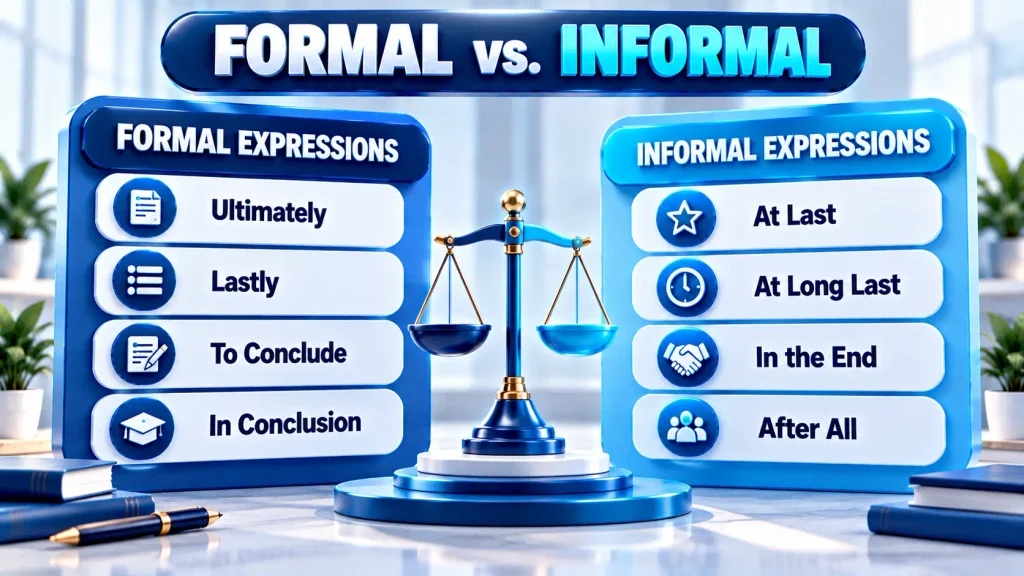
Not every alternative communicates the same meaning. This comparison makes it easier to choose the right expression for your writing or conversation.
| Alternative Phrase | Tone | Best Use | Formality |
|---|---|---|---|
| Ultimately | Professional | Final results and decisions | Formal |
| Eventually | Neutral | Events after a delay | Neutral |
| In the End | Conversational | Final outcomes | Neutral |
| At Last | Expressive | Long-awaited events | Informal |
| Lastly | Neutral | Final points in a list | Formal |
| To Conclude | Professional | Summaries and presentations | Formal |
| In Conclusion | Academic | Essays and reports | Formal |
| After All | Conversational | Supporting a reason | Neutral |
| At Long Last | Expressive | Long waits and achievements | Informal |
| When All Is Said and Done | Reflective | Overall results | Informal |
Common Mistakes to Avoid
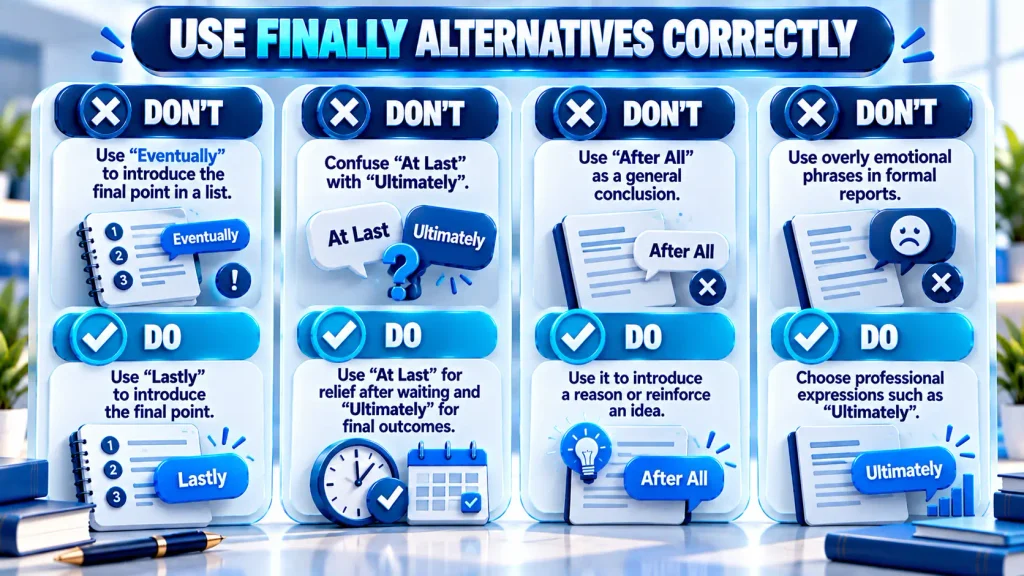
Although these alternatives can make your writing more interesting, using them incorrectly can change the meaning of your message.
Here are some common mistakes to watch for:
1. Using eventually to introduce a final point
Incorrect: Eventually, the report will discuss three important findings.
Better: Lastly, the report will discuss three important findings.
Eventually describes something that happens after time passes, while lastly introduces the final item in a sequence.
2. Confusing at last with ultimately
These expressions have different purposes.
- At last, we received the confirmation. (Emphasizes relief after waiting.)
- Ultimately, we received confirmation and moved forward. (Emphasizes the final outcome.)
3. Overusing formal transitions
Using to conclude and in conclusion repeatedly can make academic writing sound repetitive. Choose one appropriate transition and let your final paragraph communicate the main message naturally.
4. Using after all as a general closing phrase
After all usually introduces a reason or reinforces an idea. It does not automatically mean that something is happening last.
5. Choosing an expression without considering tone
At long last may sound too emotional in a formal business report, while in conclusion may sound unnecessarily formal in a friendly text message. Match the expression to your audience and purpose.
Frequently Asked Questions

1. What is the most professional way to say finally?
Ultimately is one of the most professional alternatives when discussing a final result or decision. For presentations and formal reports, to conclude and in conclusion are also appropriate. The best choice depends on whether you are explaining an outcome or introducing your final point.
2. What is another word for finally in an essay?
Useful alternatives include ultimately, lastly, to conclude, and in conclusion. Use lastly to introduce your final supporting point and in conclusion to begin your closing paragraph. Choose the expression that best fits the structure of your argument.
3. Can I use eventually instead of finally?
Yes, but only when describing something that happens after a period of time or delay. For example, “She eventually completed her degree” sounds natural. However, “Eventually, let’s discuss the final topic” is incorrect because you need a transition such as lastly.
4. What is a more formal way to say finally?
Ultimately, to conclude, and in conclusion are useful formal alternatives. Ultimately emphasizes the final result, while the other two introduce closing thoughts. In professional writing, select the expression that communicates your intended meaning without making the sentence unnecessarily complicated.
5. What is a casual way to say finally?
At last, in the end, and eventually are natural choices in everyday conversations. Use at last to express relief, in the end to discuss an outcome, and eventually when something happens after a delay.
6. Is lastly the same as finally?
Not exactly. Lastly specifically introduces the final item in a sequence or list. Finally has broader uses, including describing a long-awaited event or a final result. Therefore, lastly is appropriate when organizing information, but it cannot replace every use of finally.
7. What is another way to say finally in an email?
In professional emails, you can use ultimately, in the end, or lastly, depending on your message. For example, use ultimately when explaining a decision and lastly when adding your final request or point. These expressions help keep your communication clear and professional.
8. What is a stronger expression than finally?
At long last is more expressive when describing something that happens after a lengthy wait. Ultimately can sound stronger when emphasizing an important final result. The right choice depends on whether you want to communicate relief, importance, or a concluding idea.
Readers who used this guide also looked at Another Way to Say Finally in an Essay, Another Way to Say “For Example” in an Essay and Another Way to Say Hands On.
Conclusion
Choosing another way to say finally can make your writing more natural, precise, and engaging. Expressions such as ultimately, eventually, and in the end work well when discussing results or decisions, while lastly, to conclude, and in conclusion help organize essays, reports, and presentations.
For everyday conversations, at last and at long last communicate relief when something happens after a long wait. Meanwhile, after all and when all is said and done are useful when reinforcing a point or reflecting on an overall outcome.
The key is to consider your audience, tone, and intended meaning before choosing an alternative. Understanding the differences between finally and its alternatives can help you choose more precise expressions. Rather than replacing finally with the same expression every time, select the phrase that makes your message easiest to understand.

The FrontiersPost editorial team writes and reviews every guide to word and phrase alternatives, with clear meanings, tone notes and example sentences for everyday, academic and professional English.




