

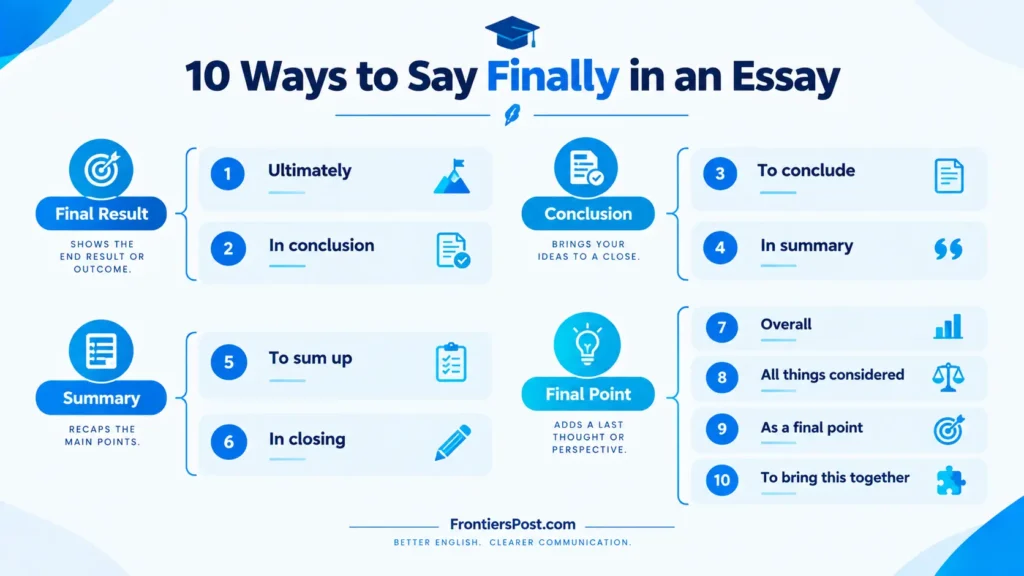
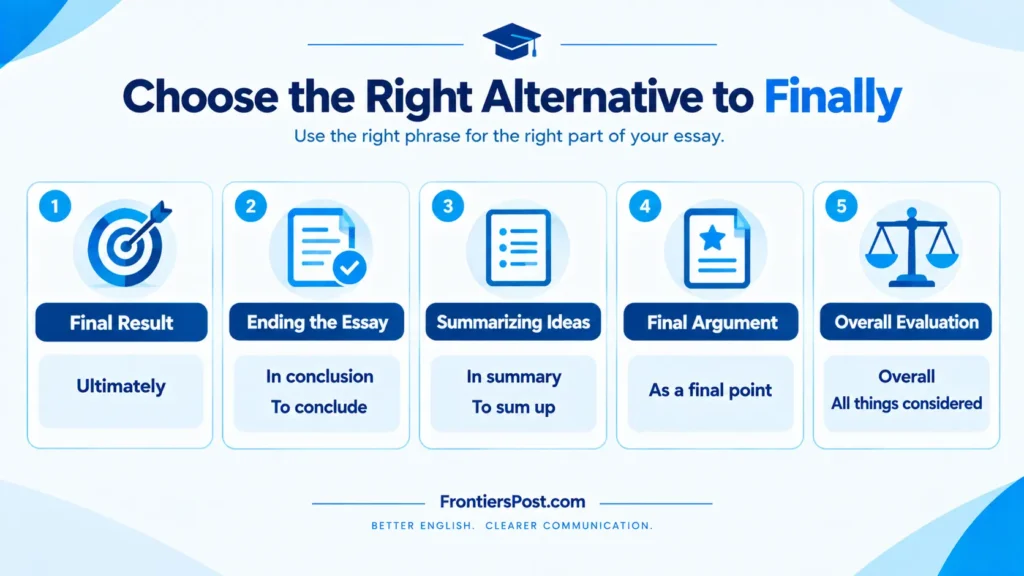
If you need another way to say finally in an essay, try ultimately, in conclusion, to conclude, in summary, to sum up, in closing, overall, all things considered, as a final point, or to bring this together. The best choice depends on whether you are introducing a final idea, summarizing your argument, or ending your essay.
Key Takeaways
- Ultimately works well when showing the final result or judgment of an argument.
- In conclusion and to conclude clearly signal the end of an essay.
- In summary and to sum up are useful when briefly reviewing key points.
- Overall and all things considered work well for a final evaluation.
- Choose the transition based on your essay’s purpose, tone, and relationship between ideas.
What Does “Another Way to Say Finally in an Essay” Mean?
The phrase “another way to say finally in an essay” refers to alternative transition words or phrases that can replace finally when introducing a final point, summarizing an argument, or bringing an essay to a close.
Writers often use finally to signal that they are discussing the last point in a series. However, repeating it throughout academic writing can make an essay sound predictable or mechanical.
Depending on the context, you can use expressions such as ultimately, in conclusion, to conclude, in summary, or overall. Each one has a slightly different purpose, so the strongest replacement depends on what you want the reader to understand.
Why Use Other Ways to Say “Finally in an Essay”?
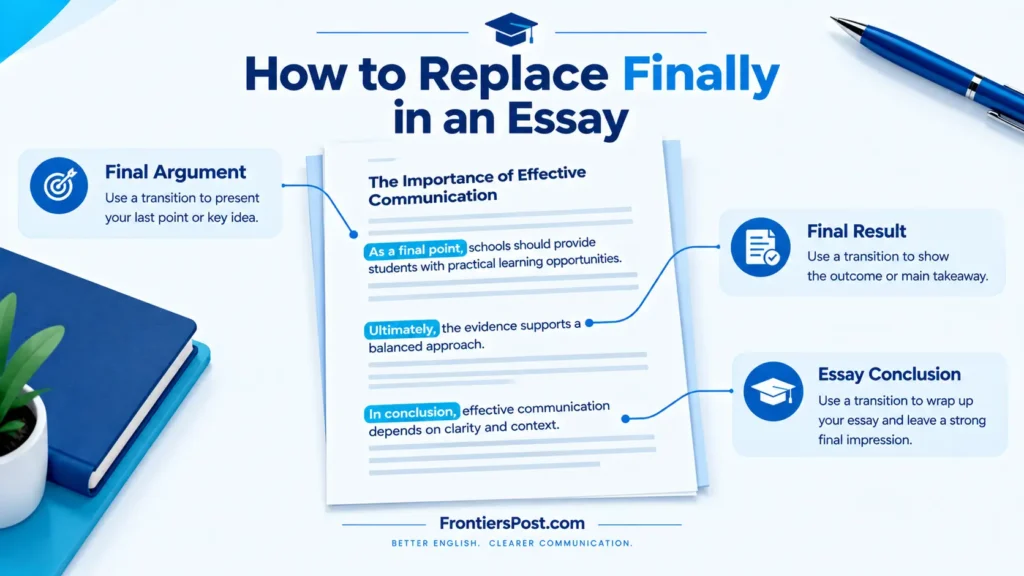
Using different transitions can make academic writing more precise and natural. Instead of relying on finally every time you introduce a final idea, choose a phrase that accurately describes the function of the sentence.
Other useful options can help you:
- Avoid repeating the same transition.
- Make your essay flow more naturally.
- Signal a conclusion or final point clearly.
- Match the formality of academic writing.
- Show whether you are summarizing, evaluating, or concluding.
- Create smoother connections between paragraphs.
The key is not to replace finally simply for the sake of variety. Select a transition that fits the relationship between your ideas.
10 Best Other Ways to Say “Finally in an Essay”
1. Ultimately
Meaning
Ultimately refers to the final result, conclusion, or judgment reached after considering the relevant information. It is especially useful when your final point represents the overall outcome of your discussion.
Best For
- Formal
- Academic
- Professional
Example 1
Ultimately, access to quality education can influence both individual success and economic growth.
Example 2
The evidence suggests that ultimately, long-term planning produces more reliable results than short-term solutions.
Quick Tip
Use ultimately when you want to emphasize the final result rather than simply announce the last item in a list.
2. In Conclusion
Meaning
In conclusion is a direct way to introduce the final section of an essay. It tells the reader that you are bringing your discussion or argument to an end.
Best For
- Formal
- Academic
- Professional
Example 1
In conclusion, renewable energy can provide significant environmental and economic benefits.
Example 2
In conclusion, the research demonstrates that regular reading can strengthen students’ vocabulary and comprehension skills.
Quick Tip
Use in conclusion primarily when you are actually concluding your essay, rather than introducing one more supporting detail.
3. To Conclude
Meaning
To conclude serves a similar purpose to in conclusion but often creates a slightly more concise transition. It works particularly well when introducing a final paragraph or final statement.
Best For
- Formal
- Academic
- Professional
Example 1
To conclude, effective communication requires both clear language and careful listening.
Example 2
To conclude, the benefits of public transportation extend beyond reducing traffic congestion.
Quick Tip
Use to conclude when you want a clear, concise signal that your argument is ending.
4. In Summary
Meaning
In summary introduces a brief review of the main ideas discussed earlier. It is useful when your final paragraph brings several arguments together before presenting the overall conclusion.
Best For
- Formal
- Academic
- Professional
Example 1
In summary, the study identifies three major factors that influence employee satisfaction.
Example 2
In summary, healthy communities depend on access to education, healthcare, and safe public spaces.
Quick Tip
Choose in summary when the main purpose of the sentence is to review information rather than introduce a completely new idea.
5. To Sum Up
Meaning
To sum up means to give a brief summary of the main points. It is natural and easy to understand, although it is slightly less formal than some traditional academic transitions.
Best For
- Academic
- Friendly
- Formal
Example 1
To sum up, the proposed policy could reduce costs while improving access to essential services.
Example 2
To sum up, each approach has strengths, but the second method offers the most practical solution.
Quick Tip
Use to sum up when your writing allows a straightforward and conversational academic style.
6. In Closing
Meaning
In closing signals that you are moving toward the final statement or thought. It can create a polished ending without sounding as repetitive as finally.
Best For
- Formal
- Professional
- Warm
Example 1
In closing, communities can make meaningful progress when residents work together toward shared goals.
Example 2
In closing, the discussion shows why responsible technology use should remain a priority in education.
Quick Tip
Use in closing for a final thought, especially when you want the ending to sound deliberate and polished.
7. Overall
Meaning
Overall introduces a broad assessment based on the information discussed throughout the essay. It does not necessarily mean “the last point,” so it works best when your final sentence gives an overall judgment.
Best For
- Academic
- Formal
- Professional
Example 1
Overall, the advantages of the program outweigh its limitations.
Example 2
Overall, the findings indicate that early intervention can produce better long-term outcomes.
Quick Tip
Do not use overall simply because an idea comes last. Use it when the statement evaluates or summarizes the bigger picture.
8. All Things Considered
Meaning
All things considered introduces a final judgment after examining different factors, perspectives, or pieces of evidence. It is particularly effective when your essay presents both advantages and disadvantages.
Best For
- Formal
- Academic
- Professional
Example 1
All things considered, the environmental benefits of the proposal justify its initial implementation costs.
Example 2
All things considered, online learning can be effective when students receive adequate support and guidance.
Quick Tip
Use this phrase when your conclusion reflects a balanced evaluation rather than a simple summary.
9. As a Final Point
Meaning
As a final point clearly introduces the last idea in a sequence of arguments. Unlike in conclusion, it does not necessarily mean that the entire essay is ending.
Best For
- Academic
- Formal
- Professional
Example 1
As a final point, policymakers should consider how the proposed changes could affect low-income families.
Example 2
As a final point, schools should provide students with practical opportunities to apply what they learn.
Quick Tip
Use as a final point when you are presenting your last supporting argument before writing the actual conclusion.
10. To Bring This Together
Meaning
To bring this together signals that you are connecting the major ideas discussed throughout the essay. It is useful when the conclusion synthesizes several points into one broader message.
Best For
- Academic
- Formal
- Professional
Example 1
To bring this together, the evidence shows that successful teams depend on trust, communication, and shared responsibility.
Example 2
To bring this together, each factor contributes to the larger challenge of creating sustainable urban communities.
Quick Tip
Use this phrase when your final paragraph combines several ideas rather than merely repeating your previous points.
Comparison Table
| Alternative | Best Used In | Tone |
| Ultimately | Arguments and final judgments | Formal |
| In conclusion | Final essay conclusion | Formal |
| To conclude | Final paragraph or statement | Formal |
| In summary | Reviewing main ideas | Formal |
| To sum up | Brief summary | Conversational/Formal |
| In closing | Final thought | Polished |
| Overall | Broad evaluation | Neutral/Formal |
| All things considered | Balanced final judgment | Formal |
| As a final point | Last supporting argument | Academic |
| To bring this together | Synthesizing ideas | Academic/Formal |
Common Mistakes
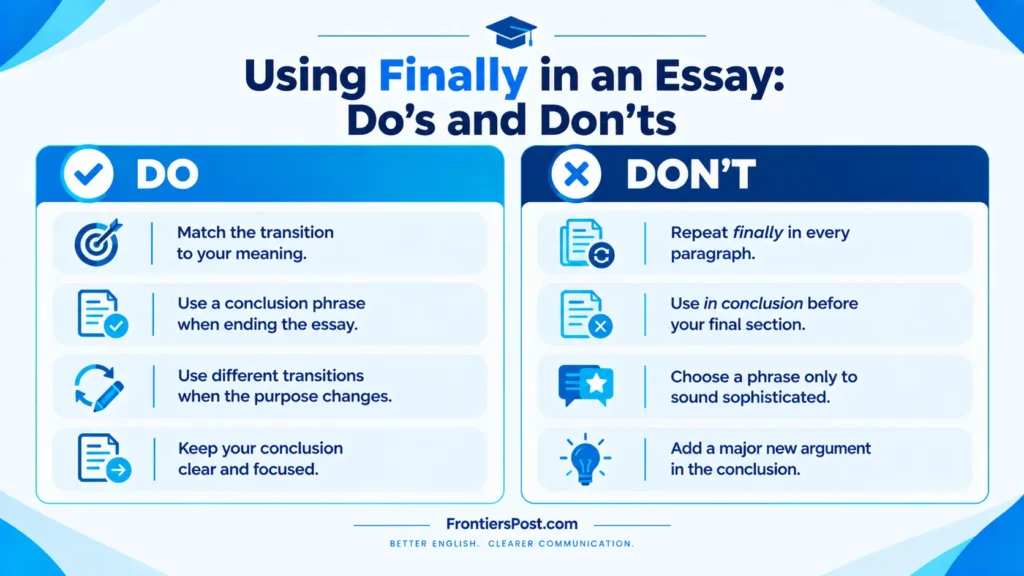
1. Using “finally” in every essay
Using finally repeatedly can make your writing sound formulaic. Vary your transitions when different phrases accurately describe the purpose of each paragraph.
2. Using “in conclusion” before the conclusion
In conclusion normally signals that you are wrapping up the essay. Avoid using it when you still have several major arguments to discuss.
3. Choosing an overly formal phrase
Not every essay needs sophisticated transitional language. A simple option such as overall may communicate your idea more clearly than a complicated expression.
4. Ignoring context
The alternatives are not completely interchangeable. As a final point introduces the last argument, while in summary focuses on reviewing earlier information.
5. Adding a new major argument at the end
A conclusion should normally bring your discussion together rather than introduce an unexpected central argument. Use your final paragraph to reinforce your main message and leave the reader with a clear understanding of your position.
Frequently Asked Questions
What is another way to say “finally” in an essay?
Common alternatives include ultimately, in conclusion, to conclude, in summary, to sum up, in closing, overall, and all things considered. The best choice depends on your sentence. For example, use ultimately for a final result and in conclusion when you are formally ending the essay.
What is the most formal way to say “finally” in an essay?
Ultimately, in conclusion, and to conclude are among the strongest formal alternatives. However, they serve different purposes. Ultimately emphasizes a final result or judgment, while in conclusion and to conclude clearly signal that the essay or discussion is ending.
Can I use “ultimately” instead of “finally”?
Yes, but the two words are not always exact substitutes. Ultimately usually emphasizes the final outcome, judgment, or result of a situation. Finally can simply indicate the last item in a sequence. Choose ultimately when you want to stress what the evidence or discussion leads to.
Is “in conclusion” better than “finally” in an essay?
In conclusion can be better when you are introducing the final paragraph of an essay. It directly tells the reader that you are concluding your discussion. However, finally may be more appropriate when you are simply presenting the last argument in a series.
What can I use instead of “finally” in an academic paragraph?
For an academic paragraph, consider ultimately, as a final point, overall, in summary, or all things considered. Your choice should depend on the purpose of the sentence. For example, as a final point introduces the last argument, while overall provides a broader evaluation.
Is “to sum up” appropriate for academic writing?
Yes. To sum up is understandable and acceptable in many forms of academic writing, although it has a slightly more conversational tone than in summary or in conclusion. If your instructor expects a highly formal style, in summary may be a stronger choice.
How can I avoid repeating “finally” in an essay?
First, identify what finally is doing in each sentence. If it introduces your last argument, try as a final point; if it summarizes your discussion, use in summary; if it gives an overall judgment, overall or ultimately may work better.
Should I use “finally” in the conclusion of an essay?
You can, but you do not have to. Finally is useful for signaling the last item in a sequence, while in conclusion or to conclude more clearly marks the end of the entire discussion. Always choose the transition based on the idea you are expressing.
Conclusion
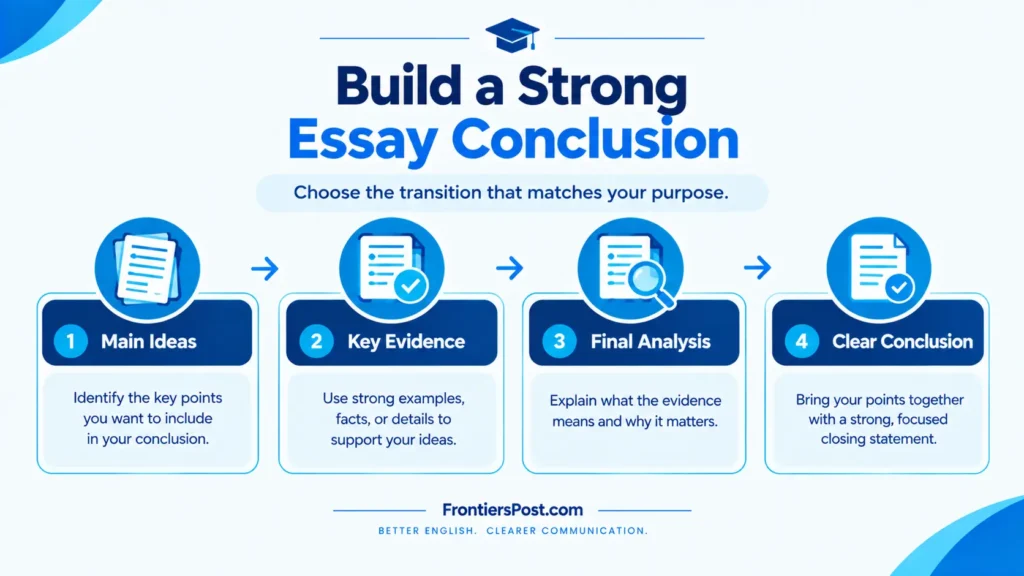
There are many effective ways to replace finally in an essay, but the best alternative depends on your purpose. Ultimately works well for a final result or judgment, while in conclusion and to conclude clearly signal the end of an essay. If you are reviewing your main ideas, in summary or to sum up may be more appropriate. For a deeper understanding of [the different uses of “finally”], Cambridge Dictionary provides a useful reference.
For a final supporting argument, as a final point is a clear choice. Meanwhile, overall and all things considered are useful when presenting a broader evaluation. The most effective approach is to choose a transition that matches your meaning instead of changing words simply to avoid repetition. A precise transition makes your argument easier to follow and gives your essay a more polished, natural flow.

Sarah Mitchell is a writer and editor specializing in English usage, professional communication, vocabulary, and natural word choice. At FrontiersPost, she helps readers understand how words and phrases differ across professional, academic, and everyday contexts.