

Another way to say “I hope you” depends on what you want to express. Natural alternatives include “I trust you,” “I wish you,” “I’m hoping you,” “Wishing you,” and “I sincerely hope you.” The best choice depends on whether you are writing a professional email, friendly message, formal note, or personal greeting.
Key Takeaways
- “I hope you” usually needs more words to form a complete thought.
- “I trust you” works well in formal and professional communication.
- “I wish you” is useful for expressing positive wishes or good outcomes.
- “Wishing you” creates a warm and friendly tone in messages and emails.
- The best alternative depends on your audience, purpose, and relationship.
“I hope you” is a common opening in English, but it is usually not a complete phrase by itself. Writers typically follow it with an idea such as “I hope you are doing well,” “I hope you have a great day,” or “I hope you understand.”
If you use the same opening repeatedly, your emails and messages can start to sound predictable. Fortunately, several natural alternatives can help you express the same general idea while making your writing more specific and appropriate for the situation.
What Does “I Hope You” Mean?
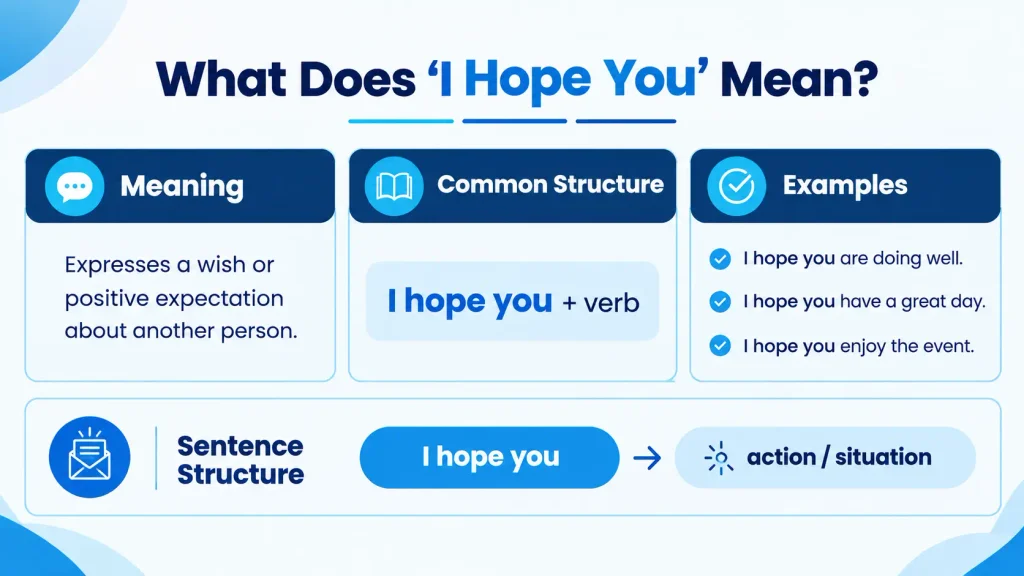
“I hope you” introduces a positive wish, expectation, or desire concerning another person. The phrase shows that you want something good for the reader or that you expect a particular outcome for them.
For example, you might write:
- “I hope you are doing well.”
- “I hope you have a wonderful weekend.”
- “I hope you enjoy your vacation.”
- “I hope you understand my decision.”
The expression is common in emails, letters, texts, workplace communication, and personal messages. Its exact meaning changes depending on the words that follow it.
Because “I hope you” is normally an incomplete opening, replacing it often means choosing a different structure for the entire sentence rather than simply changing two or three words.
Why Use Other Ways to Say “I Hope You”?
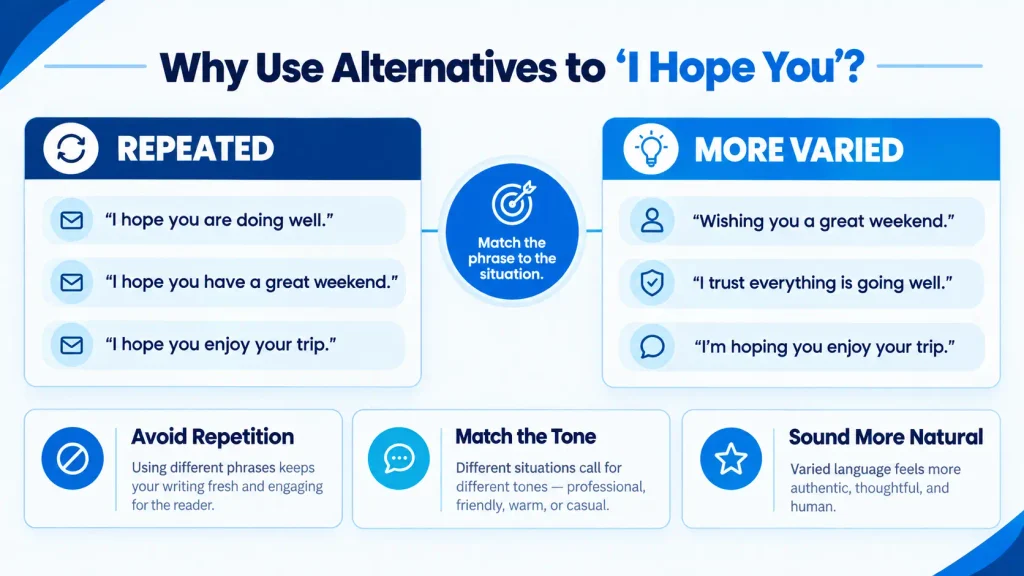
Using different expressions can make your communication sound more natural and intentional. This is especially helpful when you write emails frequently or communicate with the same people regularly.
Other expressions can help you:
- Avoid repeating the same opening.
- Make your message sound more personal.
- Match the tone to your relationship.
- Sound more professional in workplace communication.
- Express warmth, goodwill, or sincerity.
- Make a specific wish without relying on a standard phrase.
The goal is not to avoid “I hope you” completely. It is to choose language that fits the situation instead of using the same expression automatically.
10 Best Other Ways to Say “I Hope You”
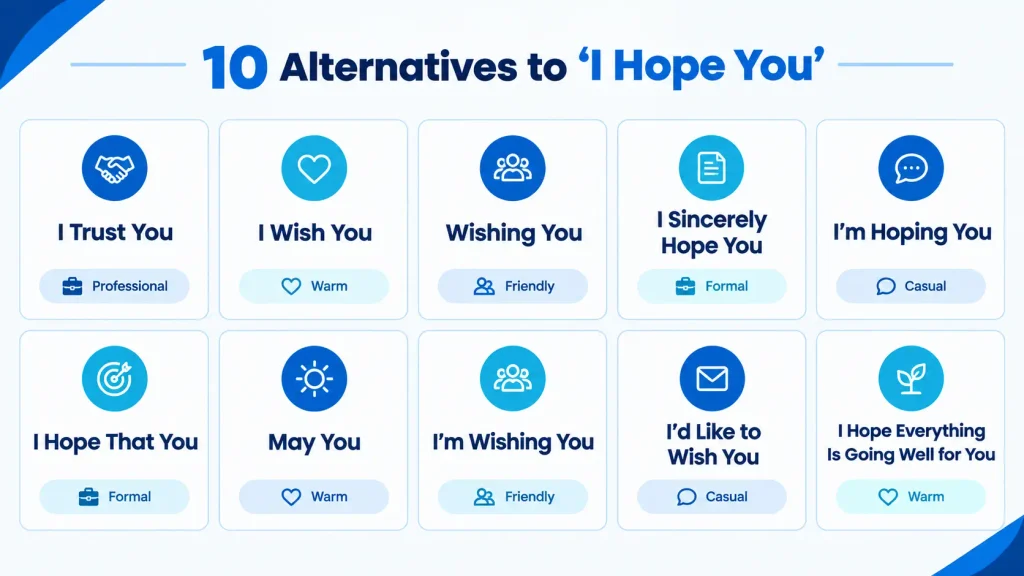
1. I Trust You
Meaning
“I trust you” expresses confidence in another person’s judgment, actions, or ability. Unlike “I hope you,” it suggests a stronger sense of confidence rather than simply expressing a wish.
Best For
- Professional
- Formal
- Polite
Example 1
“I trust you will review the proposal before Friday’s meeting.”
Example 2
“I trust you’ll make the decision that works best for the team.”
Quick Tip
Use “I trust you” when you want to communicate confidence rather than simply offer a good wish.
2. I Wish You
Meaning
“I wish you” is a direct way to express a positive desire for someone. It works particularly well when you are wishing someone success, happiness, good health, or a pleasant experience.
Best For
- Formal
- Friendly
- Warm
- Polite
Example 1
“I wish you every success in your new position.”
Example 2
“I wish you a relaxing and enjoyable weekend.”
Quick Tip
Follow “I wish you” with a positive noun phrase such as “success,” “happiness,” or “a wonderful day.”
3. Wishing You
Meaning
“Wishing you” is a warm and concise alternative that works well when you want to send someone a positive thought. It is especially common in greetings, cards, emails, and short messages.
Best For
- Friendly
- Warm
- Polite
Example 1
“Wishing you a wonderful birthday filled with good memories.”
Example 2
“Wishing you all the best as you begin your new role.”
Quick Tip
This expression is especially useful when you want a short, pleasant closing or greeting.
4. I Sincerely Hope You
Meaning
“I sincerely hope you” adds emphasis and makes your good wishes sound more heartfelt. It is useful when the situation deserves a little more warmth or seriousness than a routine “I hope you.”
Best For
- Formal
- Warm
- Polite
Example 1
“I sincerely hope you find the support you need during this difficult time.”
Example 2
“I sincerely hope you enjoy this new chapter in your career.”
Quick Tip
Use “sincerely” sparingly because it adds emotional weight and can sound excessive in casual messages.
5. I’m Hoping You
Meaning
“I’m hoping you” sounds conversational and natural. It communicates a current expectation or personal wish and is often more relaxed than the standard “I hope you.”
Best For
- Casual
- Friendly
- Warm
Example 1
“I’m hoping you can join us for dinner on Saturday.”
Example 2
“I’m hoping you get some time to relax this weekend.”
Quick Tip
This phrase works particularly well in everyday conversations and friendly workplace messages.
6. I Hope That You
Meaning
“I hope that you” has essentially the same meaning as “I hope you,” but adding “that” can make the sentence feel slightly more deliberate or complete.
Best For
- Professional
- Formal
- Polite
Example 1
“I hope that you find the information helpful.”
Example 2
“I hope that you have a safe trip home.”
Quick Tip
Do not add “that” to every sentence. In natural American English, “I hope you” is often shorter and smoother.
7. May You
Meaning
“May you” expresses a sincere wish or blessing for another person. It has a more elevated or formal feel than everyday alternatives, so it is best reserved for appropriate occasions.
Best For
- Formal
- Warm
- Friendly
Example 1
“May you find happiness and fulfillment in your new home.”
Example 2
“May you have many wonderful opportunities in the years ahead.”
Quick Tip
Use “may you” for heartfelt messages, special occasions, and meaningful wishes rather than routine business emails.
8. I’m Wishing You
Meaning
“I’m wishing you” is a personal and warm expression of goodwill. It emphasizes that the speaker is actively sending positive thoughts or wishes to the other person.
Best For
- Casual
- Friendly
- Warm
Example 1
“I’m wishing you a smooth recovery and plenty of rest.”
Example 2
“I’m wishing you a fantastic start to the new year.”
Quick Tip
This phrase works best when you genuinely want to make your message sound personal and caring.
9. I’d Like to Wish You
Meaning
“I’d like to wish you” is a polite and slightly formal way to introduce a good wish. It can sound polished without being as personal as “I’m wishing you.”
Best For
- Professional
- Formal
- Polite
Example 1
“I’d like to wish you continued success with your business.”
Example 2
“I’d like to wish you and your family a happy holiday season.”
Quick Tip
Choose this option when you want to sound courteous and polished in a formal message or announcement.
10. I Hope Everything Is Going Well for You
Meaning
This phrase broadens the focus from one specific wish to the person’s overall situation. It is a natural alternative when you want to check on someone without sounding overly formal.
Best For
- Friendly
- Warm
- Polite
- Professional
Example 1
“I hope everything is going well for you at your new job.”
Example 2
“I hope everything is going well for you and that you’re settling into your new home.”
Quick Tip
This option is especially useful when reconnecting with someone you have not spoken to recently.
Comparison Table
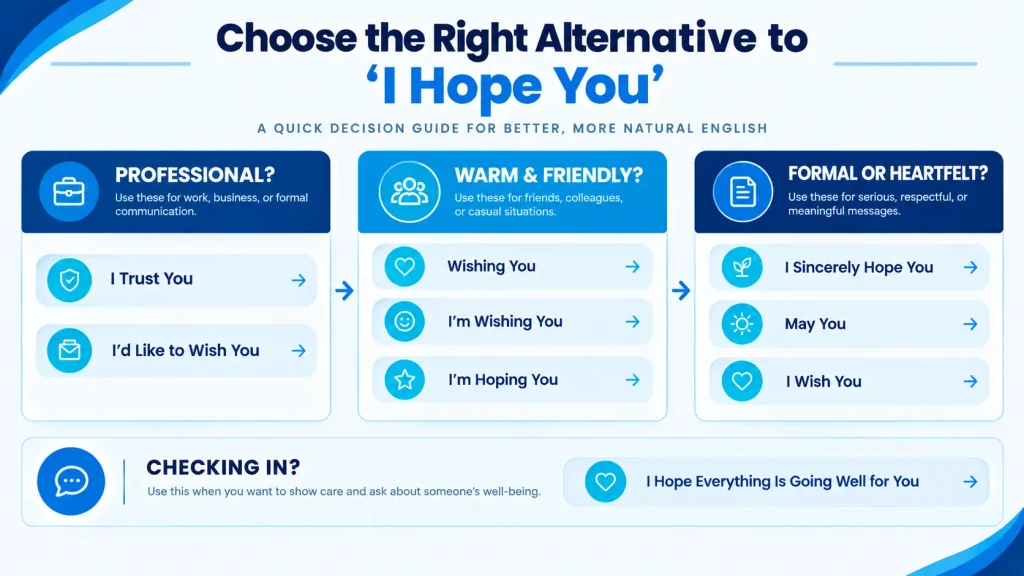
| Alternative | Best Used In | Tone |
| I Trust You | Professional emails, workplace communication | Formal, confident |
| I Wish You | Good wishes, congratulations, farewells | Warm, polite |
| Wishing You | Cards, messages, email closings | Friendly, warm |
| I Sincerely Hope You | Serious or heartfelt messages | Formal, sincere |
| I’m Hoping You | Everyday conversations, casual emails | Casual, friendly |
| I Hope That You | Professional and formal writing | Polite, neutral |
| May You | Special occasions and heartfelt messages | Formal, warm |
| I’m Wishing You | Personal messages and supportive notes | Warm, friendly |
| I’d Like to Wish You | Formal announcements and correspondence | Polite, formal |
| I Hope Everything Is Going Well for You | Reconnecting and checking in | Friendly, warm |
Common Mistakes
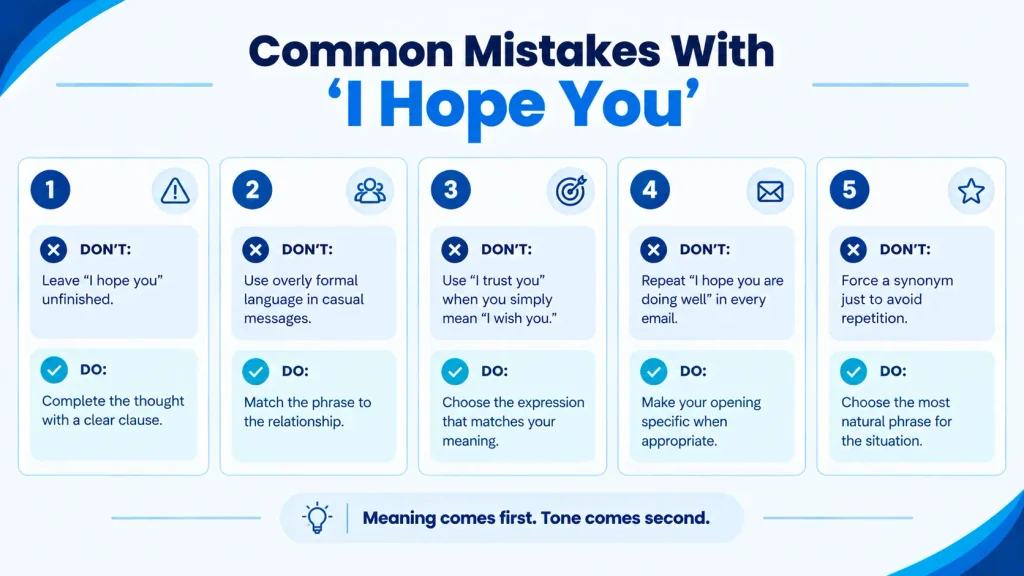
1. Using “I hope you” without finishing the thought
“I hope you” normally needs a complement to complete the idea. Avoid leaving the phrase unfinished unless it is immediately followed by more text.
2. Choosing a phrase that is too formal
Expressions such as “May you” can sound unnatural in a casual text to a close friend. Match the wording to the relationship.
3. Repeating the same opening in every email
Using “I hope you are doing well” in every message can make your writing feel routine. When appropriate, make your opening more specific to the recipient or situation.
4. Using “I trust you” when you mean “I wish you”
“I trust you” communicates confidence, not simply goodwill. Saying “I trust you have a wonderful vacation,” for example, can sound different from “I hope you have a wonderful vacation.”
5. Making a warm message sound mechanical
A phrase can be grammatically correct but still feel impersonal. Add a specific detail when possible, especially when reconnecting with someone or offering support.
Frequently Asked Questions
What is another way to say “I hope you”?
Depending on the sentence, you can use “I trust you,” “I wish you,” “Wishing you,” “I’m hoping you,” or “I sincerely hope you.” The right choice depends on what follows the phrase and whether you want your message to sound formal, professional, casual, friendly, or heartfelt.
What is a professional alternative to “I hope you”?
“I trust you” and “I’d like to wish you” can work well in professional settings, depending on the meaning of the sentence. If you are checking on someone’s well-being, a more specific opening can often sound more natural than replacing “I hope you” word for word.
Is “I hope you” grammatically correct?
Yes, but “I hope you” by itself is usually incomplete because the reader expects additional information. For example, “I hope you are well” and “I hope you have a great day” are complete sentences. The phrase becomes complete when followed by the relevant clause or idea.
What is a warm way to say “I hope you”?
“Wishing you” and “I’m wishing you” are warm alternatives. You can also use “I sincerely hope you” when you want to show stronger personal feeling. The best choice depends on the occasion and how close you are to the person receiving the message.
What can I say instead of “I hope you are doing well”?
You can say “I hope everything is going well for you,” “I hope you’re having a good week,” or “How are you doing?” If the message is professional, you can also begin with something specific to the purpose of your email rather than using a general well-being greeting.
Is “I trust you” the same as “I hope you”?
No. “I trust you” expresses confidence in someone, while “I hope you” usually expresses a wish or positive expectation. For example, “I trust you’ll handle the project well” shows confidence, while “I hope you enjoy the project” expresses a good wish.
Can I use “Wishing you” in a professional email?
Yes. “Wishing you” can sound professional when the situation calls for a positive closing or good wish. For example, “Wishing you continued success” works well in business correspondence. However, it may sound less natural as the opening of a routine email.
How do I avoid sounding repetitive when using “I hope you”?
Make the opening specific to the situation. Instead of repeatedly writing “I hope you are doing well,” mention something relevant, such as a recent meeting, upcoming event, project, or personal milestone. Specific language usually makes a message feel more thoughtful and less formulaic.
Conclusion
“I hope you” is a useful English expression for introducing a wish, greeting, or positive thought, but it usually needs additional words to complete the meaning. If you want more variety, alternatives such as “I wish you,” “Wishing you,” “I trust you,” and “I’m hoping you” can help you match your message to the situation.
For professional communication, choose wording that sounds polished without becoming overly formal. For friends and personal messages, warmer expressions often feel more natural. Most importantly, do not replace “I hope you” simply for the sake of using a synonym. Choose an expression that accurately reflects what you want to communicate and how you want the reader to feel.

Sarah Mitchell is a writer and editor specializing in English usage, professional communication, vocabulary, and natural word choice. At FrontiersPost, she helps readers understand how words and phrases differ across professional, academic, and everyday contexts.