

Another way to say “for example” in an essay is “for instance,” “such as,” “to illustrate,” “as an illustration,” or “by way of example.” The best choice depends on the sentence and level of formality. In academic writing, “for instance” and “such as” are natural, while “to illustrate” works well when introducing supporting evidence.
Key Takeaways
- “For instance” is the closest natural alternative to “for example.”
- “Such as” works best when introducing examples within a sentence.
- “To illustrate” is useful when explaining how an example supports an idea.
- Formal phrases such as “by way of example” suit academic or formal writing.
- Choose an alternative based on sentence structure, context, and the level of formality required.
What Does “Another Way to Say For Example in an Essay” Mean?
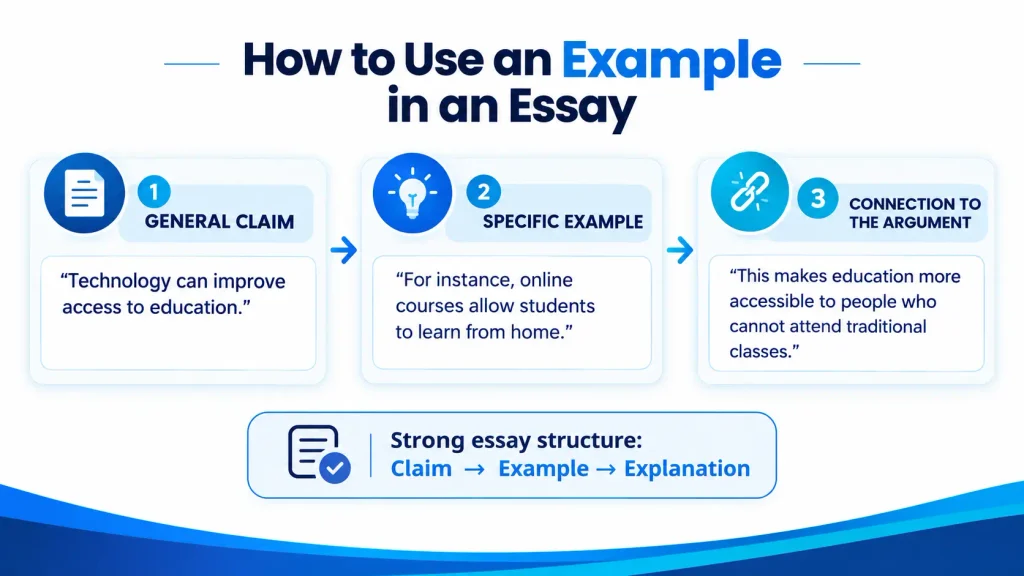
The phrase “for example” introduces a specific person, fact, situation, study, or idea that supports a broader statement. In an essay, writers use it to make abstract points clearer and provide evidence for an argument.
For instance, instead of writing, “Many students use technology to study. For example, they watch educational videos,” you can write, “Many students use technology to study. For instance, they watch educational videos.”
Finding alternatives to “for example” is useful because academic writing can sound repetitive when the same transition appears throughout an essay. Different expressions can also help you connect examples to your argument more naturally.
Why Use Other Ways to Say “For Example” in an Essay?
Using different expressions can make an essay smoother and more precise. However, the goal is not simply to replace every “for example” with a longer phrase.
Consider these benefits:
- Avoid repetition: Prevent the same transition from appearing repeatedly.
- Improve flow: Create smoother connections between ideas and evidence.
- Match academic tone: Choose wording appropriate for formal essays.
- Clarify relationships: Show whether an example illustrates, supports, or specifies an idea.
- Strengthen writing: Make supporting evidence feel more naturally connected to your argument.
The strongest academic writing uses these alternatives selectively rather than forcing a synonym into every sentence.
10 Best Other Ways to Say “For Example” in an Essay

1. For Instance
Meaning
“For instance” has almost the same meaning as “for example.” It introduces a specific case that helps explain or support a general statement.
It is one of the safest replacements because it sounds natural in both academic and general writing.
Best For
- Professional
- Formal
- Polite
Example 1
Students can improve their research skills in several ways. For instance, they can compare information from multiple academic sources.
Example 2
Some forms of exercise can improve concentration. For instance, a short walk may help students return to their work with greater focus.
Quick Tip
Use “for instance” when you could replace it with “for example” without changing the sentence structure.
2. Such As
Meaning
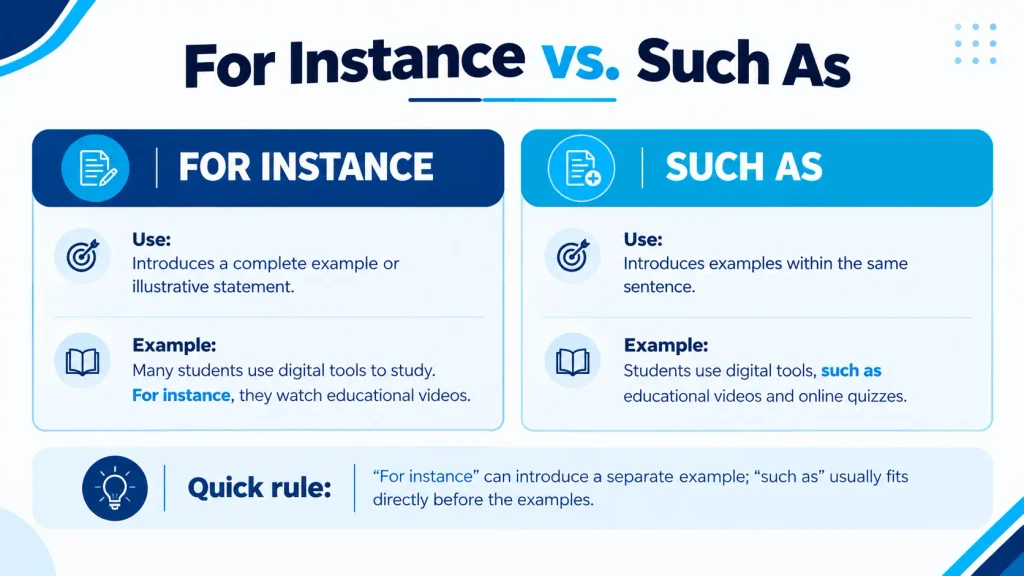
“Such as” introduces specific examples that belong to a larger category. Unlike “for instance,” it usually appears directly before the examples rather than beginning a separate sentence.
Best For
- Formal
- Professional
- Polite
Example 1
Students can use several research methods, such as interviews, surveys, and case studies.
Example 2
Many renewable energy sources, such as solar and wind power, can reduce dependence on fossil fuels.
Quick Tip
Use “such as” when examples are part of the same sentence rather than when you want to introduce a complete illustrative statement.
3. To Illustrate
Meaning
“To illustrate” signals that the information that follows will make an idea easier to understand. It works particularly well when the example demonstrates a concept rather than simply listing one.
Best For
- Formal
- Professional
- Academic
Example 1
Social media can influence how people receive news. To illustrate, a widely shared post can reach thousands of users within a short period.
Example 2
Small changes can have significant effects on productivity. To illustrate, organizing frequently used materials can reduce time spent searching for them.
Quick Tip
Choose “to illustrate” when you want to emphasize that the example helps explain or demonstrate your main point.
4. As an Illustration
Meaning
“As an illustration” introduces a specific situation or piece of information that makes a previous statement more concrete. It has a formal academic tone.
Best For
- Formal
- Academic
- Professional
Example 1
Economic conditions can affect household spending. As an illustration, families may reduce nonessential purchases when prices increase.
Example 2
Language changes as society changes. As an illustration, new words often emerge to describe developing technologies.
Quick Tip
Use this expression sparingly because it is more formal than the everyday “for example.”
5. By Way of Example
Meaning
“By way of example” introduces an example intended to explain or support a previous point. It has a distinctly formal tone and is more common in academic, legal, or highly formal writing.
Best For
- Formal
- Academic
- Professional
Example 1
Environmental policies can influence consumer behavior. By way of example, recycling incentives may encourage households to separate their waste.
Example 2
Historical events can shape national identity. By way of example, major conflicts are often remembered through public monuments and commemorations.
Quick Tip
Use this phrase when your essay has a formal tone, but avoid using it repeatedly because it can sound overly stiff.
6. One Example Is
Meaning
“One example is” directly identifies a particular case that supports the statement before it. It is clear and straightforward, making it useful when you want to highlight one especially relevant example.
Best For
- Formal
- Professional
- Friendly
Example 1
Technology has changed the way people communicate. One example is the widespread use of video conferencing for remote meetings.
Example 2
Several factors can affect academic performance. One example is the amount of sleep a student gets each night.
Quick Tip
Use this phrase when you want to draw attention to one specific example rather than introduce a long list.
7. Consider
Meaning
“Consider” invites the reader to examine a particular case as evidence for your broader point. It can make an essay sound more analytical and direct.
Best For
- Formal
- Academic
- Professional
Example 1
Public transportation can reduce traffic congestion. Consider a city where more residents choose buses instead of driving alone.
Example 2
Reading habits can affect vocabulary development. Consider how frequently students encounter unfamiliar words when they read challenging books.
Quick Tip
Use “consider” when you want the reader to think about an example rather than simply receive it as information.
8. Specifically
Meaning
“Specifically” narrows a broad statement by identifying the exact person, fact, action, or situation being discussed. It is not a perfect synonym for “for example,” but it can replace it when the purpose is to make a general point more precise.
Best For
- Formal
- Academic
- Professional
Example 1
Certain study techniques can improve memory. Specifically, reviewing information at spaced intervals can help students retain it.
Example 2
Some workplace policies benefit employees. Specifically, flexible scheduling can give workers greater control over their daily routines.
Quick Tip
Do not use “specifically” merely because you need a synonym for “for example.” Use it when you are narrowing or clarifying the point.
9. This Is Evident in
Meaning
“This is evident in” connects a general claim to evidence that demonstrates it. It is especially useful in analytical essays because it creates a stronger link between an argument and supporting evidence.
Best For
- Formal
- Academic
- Professional
Example 1
Economic inequality can influence educational opportunities. This is evident in communities where schools have significantly different levels of funding.
Example 2
Technology has transformed modern workplaces. This is evident in the growing use of digital platforms for communication and collaboration.
Quick Tip
Use this phrase when the following information provides evidence for the claim, rather than simply being an unrelated example.
10. As Demonstrated By
Meaning
“As demonstrated by” introduces evidence that shows or proves the point being discussed. It is particularly appropriate when referring to research findings, historical events, data, or observable results.
Best For
- Formal
- Academic
- Professional
Example 1
Regular practice can improve athletic performance, as demonstrated by studies examining the effects of consistent training.
Example 2
Urban development can affect local ecosystems, as demonstrated by changes in wildlife populations near expanding cities.
Quick Tip
Use “as demonstrated by” when the example provides evidence or proof, not merely an illustration.
Comparison Table
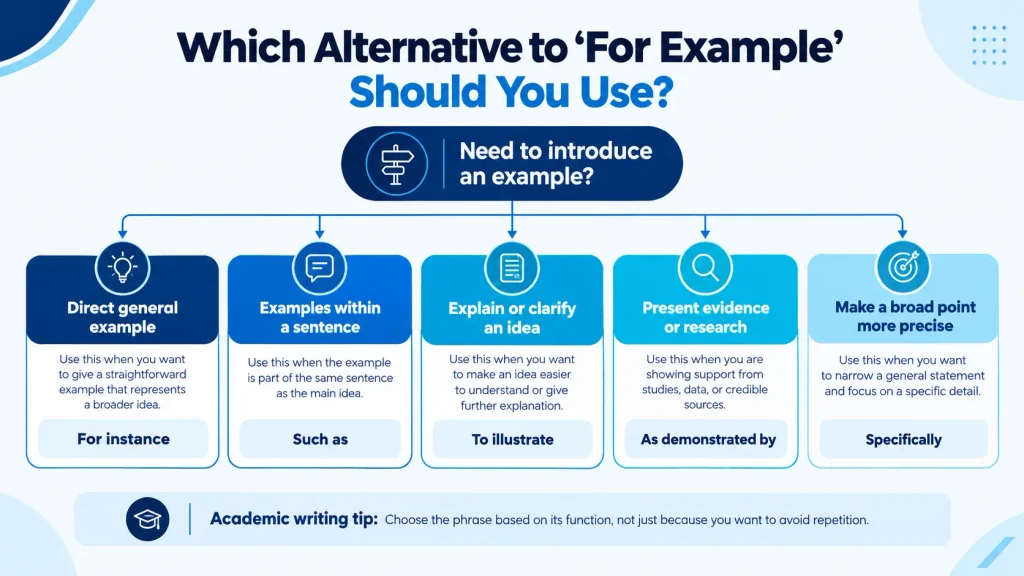
| Alternative | Best Used In | Tone |
|---|---|---|
| For instance | Essays, academic writing | Formal/Natural |
| Such as | Lists and sentence-level examples | Formal/Natural |
| To illustrate | Explanatory essays | Formal |
| As an illustration | Academic explanations | Formal |
| By way of example | Formal essays | Very Formal |
| One example is | Clear supporting points | Neutral/Formal |
| Consider | Analytical writing | Academic |
| Specifically | Clarification and detail | Formal |
| This is evident in | Evidence-based arguments | Academic |
| As demonstrated by | Research and evidence | Academic/Formal |
Common Mistakes
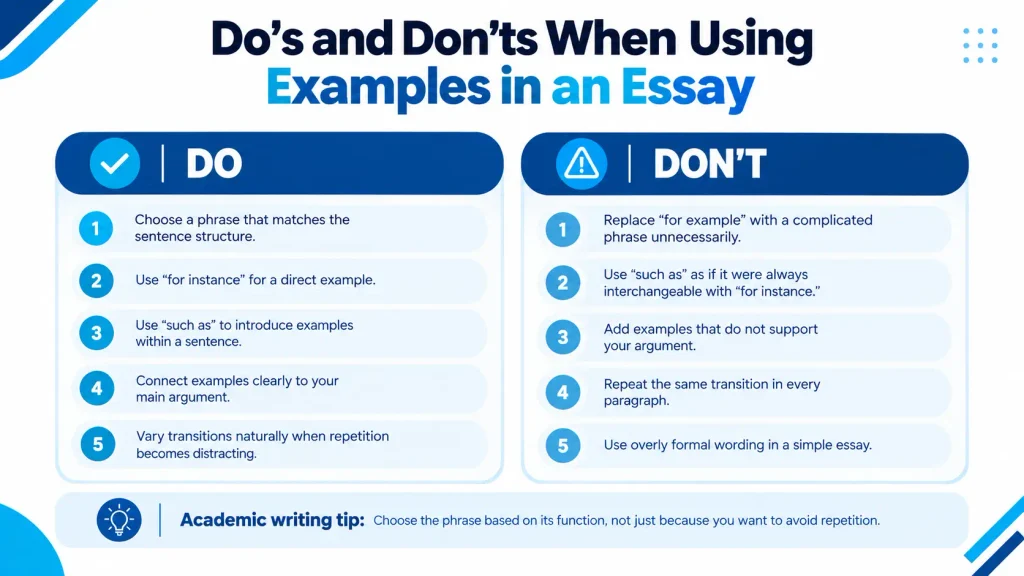
1. Repeating “For Example” Too Often
Using “for example” several times in every paragraph can make an essay sound repetitive. Vary your transitions when doing so improves readability, but do not replace the phrase simply for the sake of variety.
2. Treating Every Alternative as an Exact Synonym
Not every expression works in the same grammatical position. For example, “such as” usually introduces examples within a sentence, while “for instance” can introduce an independent sentence.
3. Using Overly Formal Language
Phrases such as “by way of example” may sound unnatural in a simple school essay. Choose language that matches your assignment and your overall writing style.
4. Using an Example Without Connecting It to the Argument
An example should support your main idea rather than appear randomly. After presenting important evidence, explain how it relates to the claim you are making.
5. Choosing a Phrase That Changes the Meaning
“Specifically” and “as demonstrated by” can perform different functions from “for example.” Make sure the replacement expresses the relationship you actually want to communicate.
Frequently Asked Questions
What is the best alternative to “for example” in an essay?
“For instance” is usually the best direct alternative because it has nearly the same meaning and works naturally in academic writing. However, “such as,” “to illustrate,” and “as demonstrated by” may be better choices depending on whether you are listing examples, explaining an idea, or presenting evidence.
Can I use “for instance” in an academic essay?
Yes. “For instance” is appropriate for most academic essays and is not considered too casual. It can introduce a specific example that supports a general claim. Still, strong academic writing should use transitions naturally rather than repeatedly replacing “for example” with “for instance.”
Is “such as” better than “for example” in an essay?
Neither is always better. “Such as” works especially well when examples are embedded within a sentence, while “for example” can introduce a complete example or separate sentence. Choose “such as” for concise lists and “for example” or “for instance” for broader illustrations.
What is a formal way to say “for example” in an essay?
Formal alternatives include “for instance,” “to illustrate,” “as an illustration,” “by way of example,” and “as demonstrated by.” The best choice depends on the purpose of the example. “As demonstrated by” is particularly useful when referring to research, data, or evidence.
How can I avoid saying “for example” repeatedly?
Use different transitions according to their function. Try “for instance” for a direct example, “such as” for a list, “to illustrate” for an explanation, and “as demonstrated by” for evidence. You can also restructure sentences so that an example is incorporated naturally without a transition.
Is “for instance” formal or informal?
“For instance” is generally neutral to formal and works well in academic, professional, and everyday writing. In an essay, it is a safe alternative to “for example.” It does not usually sound overly formal, so you can use it without making your writing seem unnecessarily complicated.
Can I start a sentence with “for example” in an essay?
Yes. Starting a sentence with “For example” is grammatically acceptable when the example clearly connects to the preceding idea. You can also use “For instance” or “To illustrate” to vary your transitions. Make sure the example contributes meaningful support instead of merely adding unnecessary detail.
What should I use instead of “for example” in a research paper?
For a research paper, choose a phrase based on the type of evidence you are introducing. “For instance” works for general examples, while “such as” works for categories or lists. When referring to findings or evidence, expressions such as “as demonstrated by” can create a more precise academic connection.
Writing something similar? Try Another Way to Say Hands On, 10 Natural Alternatives to Say “I Hope Everything Is Okay” or Different Ways to Say “In Contrast” Clearly and Naturally.
Conclusion
Knowing another way to say “for example” in an essay can make your writing more varied, precise, and natural. “For instance” is the closest general replacement, while “such as” works well for examples embedded in a sentence.
The key is to choose the expression based on its function rather than simply searching for a synonym. A strong essay does not need a different phrase every time it presents an example. Instead, use the transition that best fits your sentence, evidence, and level of formality.
The best alternative is the one that makes your example feel like a natural part of your argument.

The FrontiersPost editorial team writes and reviews every guide to word and phrase alternatives, with clear meanings, tone notes and example sentences for everyday, academic and professional English.




