

Another way to say “hands-on” depends on the context. Useful alternatives include practical, experiential, active, directly involved, applied, and on-the-job. For professional writing, “practical experience” or “direct involvement” often sounds more precise, while “learning by doing” works well in casual or educational contexts.
Key Takeaways
- “Hands-on” usually describes direct involvement or practical experience.
- Practical and applied are strong choices for professional writing.
- Experiential works well in education and formal contexts.
- Directly involved emphasizes personal participation.
- The best alternative depends on whether you are describing work, learning, training, or personal involvement.
What Does “Another Way to Say Hands On” Mean?
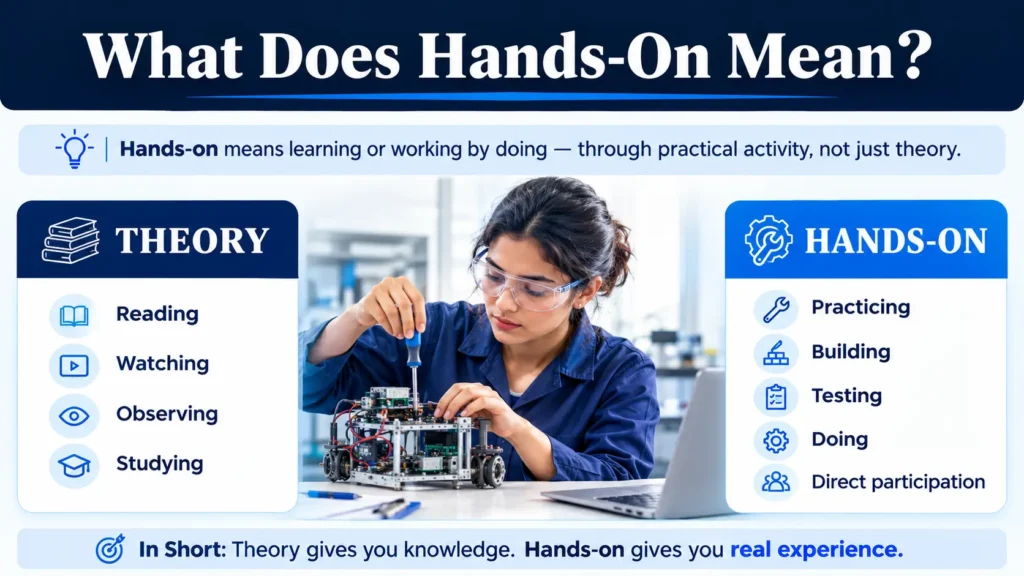
The phrase “hands-on” usually describes something that involves direct participation rather than simply watching, reading, or learning about something in theory.
For example, a hands-on training program gives people opportunities to practice a skill themselves. A hands-on manager, meanwhile, is closely involved in the day-to-day work of a team.
People often look for another way to say “hands-on” when writing a resume, professional email, academic assignment, job description, or website content. Choosing a more specific phrase can make the writing clearer and better suited to the situation.
Why Use Other Ways to Say “Hands On”?
Using alternatives can make your writing more precise and prevent the same phrase from appearing too often.
You might choose another expression to:
- Sound more professional on a resume
- Describe practical experience more clearly
- Match a formal or academic tone
- Emphasize active participation
- Explain learning through real-world practice
- Highlight direct involvement in a project
The key is to choose an alternative based on what “hands-on” actually means in your sentence.
10 Best Other Ways to Say “Hands On”
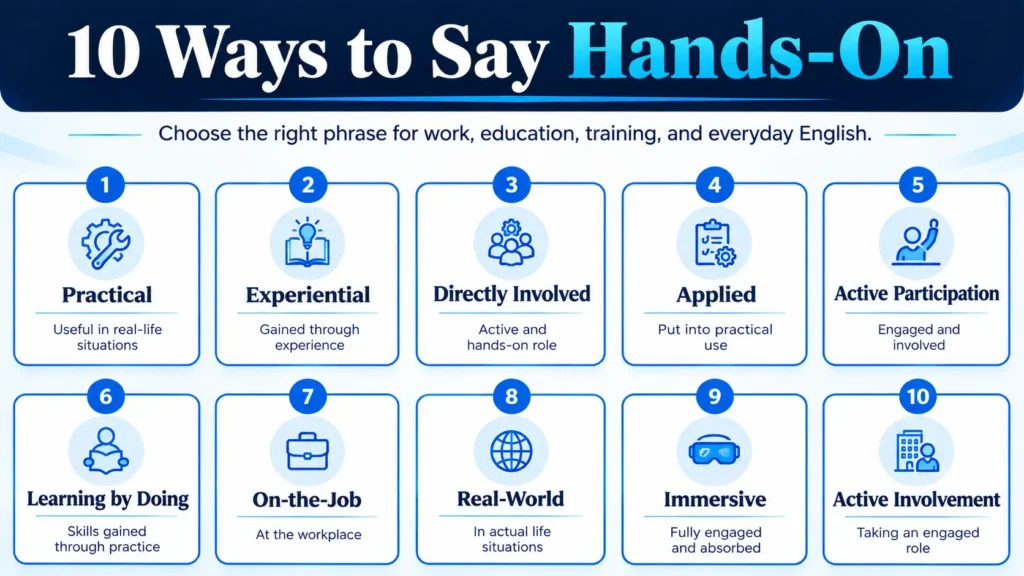
1. Practical
Meaning
Practical describes experience, knowledge, or activities that involve real-world use rather than theory alone. It is one of the most natural replacements for “hands-on,” especially when discussing skills and experience.
Best For
- Professional
- Formal
- Educational
- Resume writing
Example 1
She gained practical experience repairing commercial HVAC systems.
Example 2
The course provides practical training in digital marketing.
Quick Tip
Use “practical experience” when you want to emphasize that someone has actually used a skill in a real situation.
2. Experiential
Meaning
Experiential refers to learning or development that happens through direct experience. It is especially common in education, training, and professional development.
Best For
- Formal
- Professional
- Educational
Example 1
Students benefit from experiential learning through community-based projects.
Example 2
The program combines classroom instruction with experiential training.
Quick Tip
“Experiential” sounds more formal than “hands-on,” so it works particularly well in academic or institutional writing.
3. Directly Involved
Meaning
Directly involved emphasizes personal participation in an activity, project, or process. Unlike “practical,” it focuses more on someone’s active role than on skill development.
Best For
- Professional
- Formal
- Polite
Example 1
Our project manager was directly involved in every stage of the renovation.
Example 2
I was directly involved in developing and testing the new website.
Quick Tip
Choose this phrase when “hands-on” means someone personally took part rather than simply supervised from a distance.
4. Applied
Meaning
Applied describes knowledge or skills that are put into actual use. It is a strong choice when contrasting real-world practice with theoretical knowledge.
Best For
- Professional
- Formal
- Educational
Example 1
The workshop focuses on applied communication skills for the workplace.
Example 2
Employees receive training in applied problem-solving techniques.
Quick Tip
“Applied” works best with words such as knowledge, skills, learning, research, and training.
5. Active Participation
Meaning
Active participation means taking an active role instead of remaining an observer. It highlights engagement and involvement in a process.
Best For
- Formal
- Professional
- Educational
Example 1
The workshop encourages active participation through group exercises.
Example 2
Successful training requires active participation from every team member.
Quick Tip
Use this alternative when you want to emphasize engagement rather than physical practice.
6. Learning by Doing
Meaning
Learning by doing describes gaining knowledge or skills through practice and experience. It has a friendly, conversational tone and is easy for most readers to understand.
Best For
- Casual
- Friendly
- Educational
Example 1
The apprenticeship is built around learning by doing.
Example 2
Children often develop problem-solving skills through learning by doing.
Quick Tip
This phrase is excellent for blogs, educational content, and informal explanations, but it may sound too conversational for a formal resume.
7. On-the-Job
Meaning
On-the-job refers to learning or gaining experience while performing actual work. It is particularly useful when discussing employee training and workplace development.
Best For
- Professional
- Casual
- Workplace
Example 1
New technicians receive on-the-job training from experienced employees.
Example 2
She developed her customer service skills through on-the-job experience.
Quick Tip
Use “on-the-job” when the practical experience specifically happens in a workplace.
8. Real-World
Meaning
Real-world describes experience, skills, or knowledge connected to actual situations outside of theory or classroom exercises. It is common in career and educational writing.
Best For
- Professional
- Friendly
- Educational
Example 1
The internship gives students real-world experience in healthcare administration.
Example 2
Employers value candidates who can demonstrate real-world problem-solving skills.
Quick Tip
“Real-world experience” is a strong phrase when discussing internships, careers, education, and job qualifications.
9. Immersive
Meaning
Immersive describes an experience that deeply engages someone in an activity or environment. It can suggest more than simple participation because the person becomes actively involved in the experience.
Best For
- Professional
- Formal
- Educational
Example 1
The training provides an immersive introduction to emergency response procedures.
Example 2
Students participate in an immersive simulation of a business negotiation.
Quick Tip
Use “immersive” when the experience is designed to fully engage the participant rather than simply provide practice.
10. Active Involvement
Meaning
Active involvement highlights a person’s meaningful participation in a task, project, or organization. It is useful when “hands-on” refers to responsibility or engagement rather than physical work.
Best For
- Professional
- Formal
- Polite
Example 1
Her active involvement helped the team complete the project ahead of schedule.
Example 2
The position requires active involvement in daily operations and client communication.
Quick Tip
Use “active involvement” when describing a person’s role in a project, team, or business process.
Comparison Table
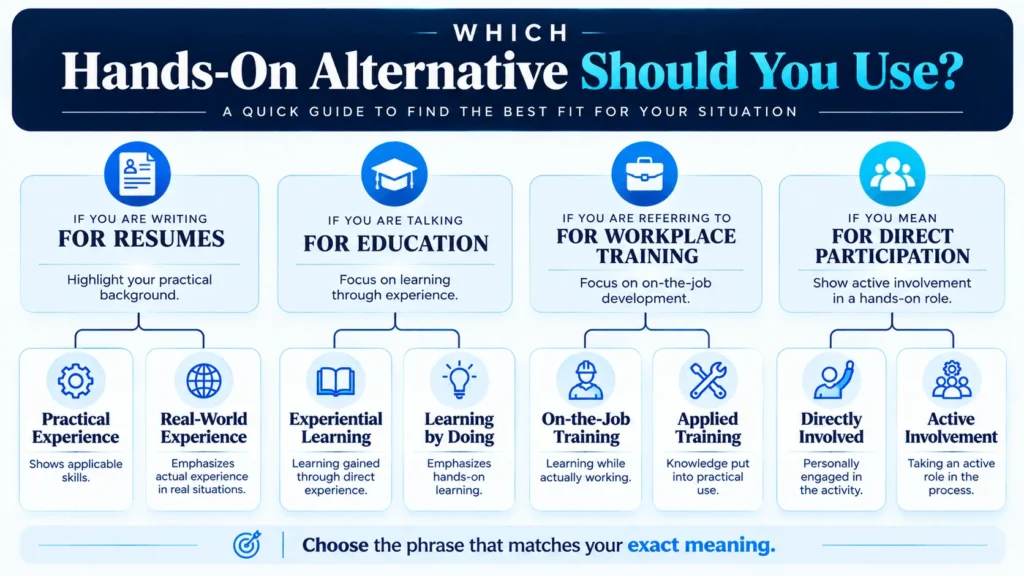
| Alternative | Best Used In | Tone |
| Practical | Resumes, training, professional writing | Professional |
| Experiential | Education, formal training | Formal |
| Directly involved | Projects, management, work | Professional |
| Applied | Skills, knowledge, education | Formal |
| Active participation | Classes, workshops, organizations | Formal |
| Learning by doing | Education, blogs, casual writing | Friendly |
| On-the-job | Workplace training | Professional |
| Real-world | Careers, education, experience | Conversational |
| Immersive | Training, simulations, education | Professional |
| Active involvement | Projects, business, teamwork | Formal |
Common Mistakes When Replacing “Hands On”
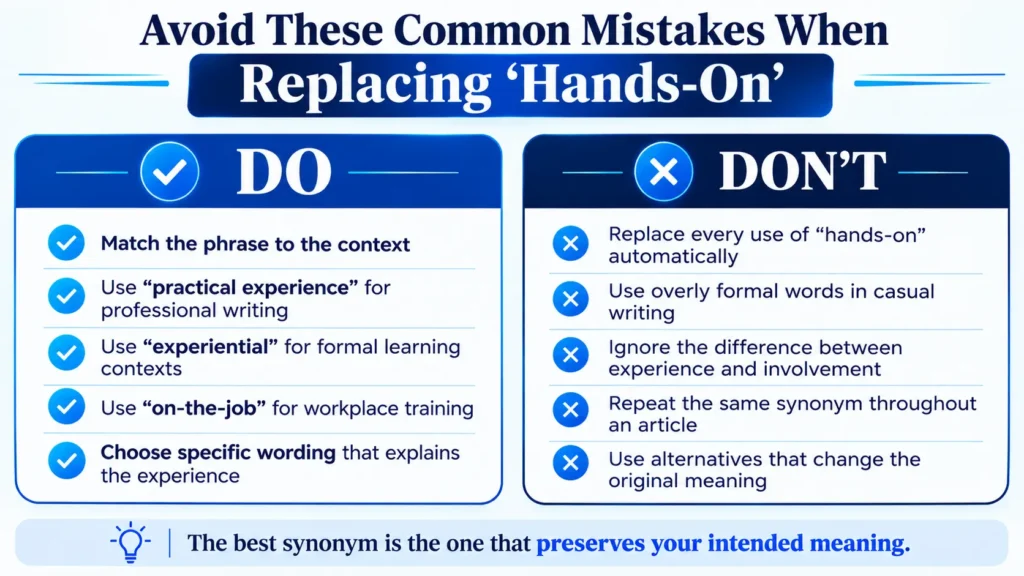
1. Using a phrase that changes the meaning
Not every synonym means exactly the same thing. “Practical” emphasizes real-world use, while “directly involved” emphasizes participation.
2. Choosing overly formal language
Words such as “experiential” may sound unnatural in a casual conversation. Pick language that matches your audience.
3. Using casual phrases in professional writing
“Learning by doing” is clear and natural, but “practical experience” may be a better choice for a resume or cover letter.
4. Ignoring the context
“Hands-on training,” “hands-on experience,” and “hands-on management” describe different ideas. The best replacement can change with each phrase.
5. Replacing the phrase just to avoid repetition
There is nothing wrong with “hands-on” when it is the clearest option. Use an alternative when it improves precision, tone, or readability—not simply because you want every sentence to sound different.
Frequently Asked Questions
What is a professional way to say “hands-on”?
Practical experience is one of the strongest professional alternatives to “hands-on.” Depending on the context, you can also use “direct involvement,” “applied experience,” or “active participation.” For a resume, choose the phrase that clearly explains what you actually did rather than using a vague synonym.
What is another way to say “hands-on experience”?
You can say practical experience, real-world experience, applied experience, direct experience, or on-the-job experience. “Practical experience” is usually the safest choice for professional writing because it clearly suggests that you have used your knowledge or skills in real situations.
What is another way to say “hands-on training”?
Good alternatives include practical training, experiential training, applied training, and on-the-job training. The best choice depends on how the training works. If employees practice skills while working, “on-the-job training” is especially precise.
How do you say “hands-on” on a resume?
On a resume, replace “hands-on” with a specific description whenever possible. For example, instead of saying “hands-on experience with WordPress,” you could write “practical experience developing and maintaining WordPress websites.” Specific wording shows what you can actually do.
Is “practical” the same as “hands-on”?
“Practical” and “hands-on” are closely related, but they are not always identical. “Hands-on” strongly suggests direct participation, while “practical” can simply mean useful or connected to real-world application. Context determines whether they can be used interchangeably.
What is a formal word for “hands-on”?
Experiential is a formal alternative, especially when discussing learning or training. Applied can also work when you are talking about putting knowledge or skills into practice. However, a simple phrase such as “practical experience” is often clearer than using a more sophisticated word.
What is another way to say “hands-on learning”?
You can use experiential learning, practical learning, active learning, learning by doing, or applied learning. “Experiential learning” is common in formal educational contexts, while “learning by doing” is more conversational and immediately understandable.
What is another way to say “hands-on approach”?
Depending on the meaning, you could say practical approach, active approach, directly involved approach, or participatory approach. If you are describing a manager, “closely involved approach” may communicate the idea more naturally than a direct synonym.
Conclusion
There are many useful ways to say “hands-on,” but the best choice depends on what you want to emphasize. Practical is a strong all-purpose option, while experiential works well for formal education and training. Directly involved and active involvement are better when you want to highlight personal participation.
For workplace writing, practical experience, real-world experience, and on-the-job training are especially natural. In casual or educational content, learning by doing can feel more approachable.
The most effective alternative is not always the closest synonym. Choose the phrase that tells readers exactly what kind of experience, participation, or learning you mean. For a clearer understanding of the phrase itself, see [Cambridge Dictionary’s definition of hands-on.

Sarah Mitchell is a writer and editor specializing in English usage, professional communication, vocabulary, and natural word choice. At FrontiersPost, she helps readers understand how words and phrases differ across professional, academic, and everyday contexts.