

Another way to say “in light of” includes considering, given, because of, taking into account, in view of, and based on. These alternatives help you explain how new information, circumstances, or evidence affect a decision or conclusion. The best choice depends on whether you want to express a reason, acknowledge evidence, or introduce relevant circumstances.
Key Takeaways
- “In light of” means considering information or circumstances when making a decision or judgment.
- “Considering” and “given” are natural alternatives for everyday and professional communication.
- “In view of” and “taking into account” work well in formal writing.
- “Because of” emphasizes a reason or cause rather than simply acknowledging information.
- Choose an alternative that fits your sentence, audience, and intended meaning.
“In light of” is a useful English expression for explaining how information, evidence, or circumstances influence a decision. You will often see it in professional emails, academic essays, business reports, and formal announcements.
However, repeating this phrase can make your writing sound stiff. Choosing another way to say “in light of” can help you communicate more naturally while keeping your original meaning clear.
Whether you are writing an email to your manager, discussing research findings, or explaining a change in plans, the following alternatives can help you find the right words.
What Does “In Light Of” Mean?

The phrase “in light of” means considering something or taking information into account when making a decision, forming an opinion, or explaining a situation.
People commonly use it when new facts, recent developments, or existing circumstances affect what happens next.
For example:
“In light of the recent changes, we have decided to update our project timeline.”
This sentence means the recent changes influenced the decision to update the timeline.
The expression is especially common in formal and professional communication. However, simpler alternatives often work better in casual conversations and everyday emails.
Why Use Other Ways to Say “In Light Of”?

Although “in light of” is grammatically correct, using the same expression repeatedly can make your writing sound unnecessarily formal. Alternatives help you communicate your point with greater precision.
Consider using another expression to:
- Avoid repetition: Keep essays, reports, and emails engaging.
- Improve clarity: Explain reasons and decisions in simpler language.
- Match the tone: Choose wording suitable for professional, academic, or casual situations.
- Express cause and effect: Show whether information influenced a decision or directly caused an outcome.
- Improve readability: Make complex sentences easier to understand.
The key is to choose an alternative that preserves the meaning of your original sentence.
10 Best Other Ways to Say “In Light Of”

1. Considering
Meaning
“Considering” means taking a particular fact, situation, or piece of information into account. It is a natural, flexible alternative that works in both professional and everyday English.
Best For
Professional, Formal, Casual, Polite
Example 1
Considering the limited budget, we should focus on the most important project requirements.
Example 2
Considering her experience, she is a strong candidate for the position.
Quick Tip
Use “considering” when you want to acknowledge a relevant circumstance without making your sentence sound overly formal.
2. Given
Meaning
“Given” introduces a fact or condition that helps explain a decision, recommendation, or conclusion. It is concise and particularly useful in business communication and academic writing.
Best For
Professional, Formal, Polite
Example 1
Given the current workload, we may need another week to complete the report.
Example 2
Given the available evidence, the researchers recommend further testing.
Quick Tip
Place “given” at the beginning of a sentence when you want to present an important fact before explaining its implications.
3. Because Of
Meaning
“Because of” identifies the reason something happened or a decision was made. Unlike some alternatives, it emphasizes cause and effect rather than simply asking the reader to consider relevant information.
Best For
Professional, Casual, Polite
Example 1
Because of the unexpected delay, the team rescheduled the client presentation.
Example 2
Because of recent customer feedback, the company revised its return policy.
Quick Tip
Use “because of” when the relationship between a circumstance and its outcome is causal. It is not always interchangeable with “in light of.”
4. In View Of
Meaning
“In view of” means considering a particular fact or situation. It is close in meaning to “in light of” and works especially well in formal documents, workplace announcements, and official correspondence.
Best For
Formal, Professional, Polite
Example 1
In view of the safety concerns, the organizers moved the event indoors.
Example 2
In view of your recent progress, we would like to discuss your professional development.
Quick Tip
Choose “in view of” when you need a formal tone. For a casual message, “given” or “considering” may sound more natural.
5. Taking Into Account
Meaning
“Taking into account” emphasizes that you have considered relevant facts, needs, limitations, or opinions before reaching a decision. It is especially useful when several factors influence the outcome.
Best For
Professional, Formal, Polite
Example 1
Taking into account everyone’s availability, we scheduled the meeting for Thursday afternoon.
Example 2
The committee revised the proposal, taking into account the concerns raised by local residents.
Quick Tip
Use this phrase when you want to emphasize a thoughtful decision-making process rather than simply state a reason.
6. Based On
Meaning
“Based on” shows that a decision, opinion, or conclusion relies on particular information, evidence, or experience. It is direct and common in reports, research papers, and workplace communication.
Best For
Professional, Formal, Casual
Example 1
Based on the latest sales figures, we should increase inventory before the holiday season.
Example 2
Based on the survey results, students prefer shorter and more interactive lessons.
Quick Tip
Use “based on” when you want to identify the foundation for a conclusion. Make sure the information you mention genuinely supports that conclusion.
7. With This In Mind
Meaning
“With this in mind” introduces a decision, suggestion, or next step that follows from information already discussed. It helps connect an earlier point with a practical response.
Best For
Professional, Friendly, Polite
Example 1
With this in mind, I recommend moving the training session to next week.
Example 2
With this in mind, let’s develop a study schedule that allows more time for revision.
Quick Tip
Use this phrase to create a smooth transition between an explanation and your recommendation. It is especially helpful in presentations and longer emails.
8. In Consideration Of
Meaning
“In consideration of” means taking a particular factor into account. It can sound formal and is useful when discussing circumstances, requests, or decisions that require careful attention.
Best For
Formal, Professional, Polite
Example 1
In consideration of the team’s additional responsibilities, management extended the project deadline.
Example 2
The scholarship committee reviewed each application in consideration of the applicant’s financial circumstances.
Quick Tip
Use this expression sparingly. In many sentences, “considering” or “taking into account” communicates the same idea more naturally.
9. In Response To
Meaning
“In response to” describes an action taken because of a request, event, concern, or development. It emphasizes a reaction to something rather than the general consideration of information.
Best For
Professional, Formal, Polite
Example 1
In response to employee feedback, the company introduced flexible working hours.
Example 2
In response to the customer’s concerns, our support team provided a detailed explanation.
Quick Tip
Choose “in response to” when someone takes action after a specific event or communication. Do not use it when you only mean that information influenced your thinking.
10. Given The Circumstances
Meaning
“Given the circumstances” means considering the situation as a whole, particularly when challenges, limitations, or unexpected events affect what is reasonable or possible.
Best For
Professional, Casual, Polite, Friendly
Example 1
Given the circumstances, postponing the launch was the most responsible decision.
Example 2
Given the circumstances, you handled the difficult conversation very well.
Quick Tip
Use this expression when the overall situation matters more than one individual fact. It works well when explaining or evaluating a decision.
Comparison Table

| Alternative | Best Used In | Tone |
|---|---|---|
| Considering | Emails and everyday writing | Natural, neutral |
| Given | Reports and business emails | Concise, professional |
| Because of | Explaining causes | Direct, clear |
| In view of | Official documents | Formal |
| Taking into account | Decisions involving several factors | Thoughtful, professional |
| Based on | Research and recommendations | Direct, analytical |
| With this in mind | Transitions and suggestions | Friendly, professional |
| In consideration of | Formal decisions and requests | Formal |
| In response to | Reactions and corrective actions | Professional, direct |
| Given the circumstances | Difficult or changing situations | Understanding, neutral |
Common Mistakes
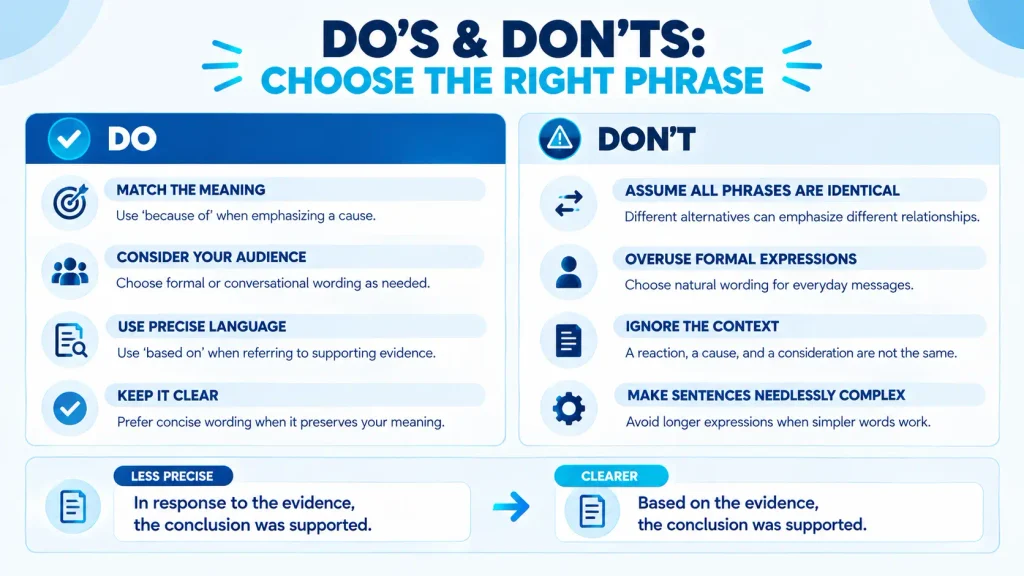
1. Using “Because Of” When You Only Mean “Considering”
“Because of” emphasizes a cause, while “in light of” can indicate that information influenced a decision without directly causing it.
Incorrect fit: “In light of the new evidence, the committee will review the case” becomes “Because of the new evidence, the committee will review the case” when the writer does not intend to emphasize direct causation.
Both sentences can be correct, but they place slightly different emphasis on the relationship.
2. Choosing Overly Formal Language
Expressions such as “in consideration of” may sound unnatural in a simple email.
Better: Write “Considering your schedule, we can meet tomorrow” instead of “In consideration of your schedule, we can meet tomorrow.”
3. Repeating the Same Expression
Using “in light of” several times in one paragraph can make your writing repetitive.
Better: Alternate between suitable expressions such as “given,” “considering,” and “based on,” depending on the intended meaning.
4. Ignoring the Context
Not every alternative fits every sentence. “In response to” describes a reaction, while “based on” identifies the information supporting a conclusion.
Better: Identify whether you are explaining a cause, considering circumstances, or responding to an event before selecting an alternative.
5. Making a Sentence Needlessly Complicated
Long phrases can obscure a simple point.
Better: Prefer “Given the delay, we changed the schedule” over a lengthy explanation when the shorter version communicates the same meaning.
Frequently Asked Questions
1. What is the best alternative to “in light of”?
“Considering” is one of the most versatile alternatives because it works in professional, academic, and everyday writing. “Given” is another strong choice when introducing a relevant fact or condition. The best option depends on whether you want to emphasize circumstances, evidence, or a direct cause.
2. Is “given” the same as “in light of”?
The expressions often have similar meanings, but their usage can differ slightly. Both can introduce information that affects a decision. “Given” is usually more concise, while “in light of” can sound more formal and may emphasize how new information changes the way a situation should be understood.
3. How can I use “in light of” in a professional email?
You can use “in light of” to explain a change, recommendation, or decision. For example, write, “In light of the updated requirements, we have revised the project timeline.” You can also choose “given the updated requirements” for a shorter, more direct alternative.
4. What is a formal synonym for “in light of”?
“In view of,” “taking into account,” and “in consideration of” are formal alternatives. “In view of” is especially close in meaning, while “taking into account” emphasizes careful consideration. Choose the phrase that fits your sentence rather than selecting the most formal expression automatically.
5. Can I use “because of” instead of “in light of”?
Yes, when you want to emphasize that something happened because of a particular reason. However, the phrases are not always interchangeable. “In light of the findings, the team reconsidered its approach” emphasizes the influence of the findings, whereas “because of the findings” emphasizes causation.
6. What is a simple way to say “in light of”?
“Considering” and “given” are simple, natural alternatives. For example, “In light of the weather, we canceled the picnic” could become “Given the weather, we canceled the picnic.” These expressions communicate the same general idea without making the sentence sound unnecessarily formal.
7. Is “in view of” grammatically correct?
Yes. “In view of” is a standard English expression meaning “considering” or “because of a particular situation,” depending on context. For example, “In view of the new information, we decided to postpone the decision.” It is particularly appropriate in formal writing and professional communication.
8. How do I avoid repeating “in light of” in an essay?
Use alternatives that reflect the exact relationship between your evidence and your argument. Try “considering” when acknowledging circumstances, “based on” when presenting evidence, and “given” when introducing a relevant fact. Vary your sentence structure as well, so your essay remains clear and natural.
Readers who used this guide also looked at “In Other Words” Synonyms, Another Way to Say In This Case and Another Way to Say Is About.
Conclusion
Choosing another way to say “in light of” can make your writing clearer, more natural, and better suited to your audience. Expressions such as “considering,” “given,” and “in view of” work well when acknowledging relevant circumstances, while “because of” emphasizes a cause and “based on” highlights supporting evidence.
For professional emails, choose concise alternatives that communicate your point directly. In academic essays and reports, use expressions that accurately describe how evidence or circumstances support your conclusions. For everyday conversations, simpler wording often sounds more natural.
Remember that these expressions are not always interchangeable. Before replacing “in light of,” consider what you want to emphasize: a reason, a piece of evidence, a response, or the broader situation. For a clearer understanding of the phrase, explore the meaning of “in light of”. The best alternative is the one that preserves your meaning while helping readers understand your message easily.

The FrontiersPost editorial team writes and reviews every guide to word and phrase alternatives, with clear meanings, tone notes and example sentences for everyday, academic and professional English.




