

Another way to say “in other words” includes phrases such as “to put it another way,” “that is to say,” “put simply,” and “to rephrase.” These expressions help clarify, restate, or simplify an idea without changing its meaning. The best choice depends on your tone, audience, and context.
Key Takeaways
- “In other words” is used to restate an idea more clearly or simply.
- “To put it another way” is a natural choice for everyday and professional writing.
- “That is to say” works well in formal and academic contexts.
- “Put simply” is useful when you want to make a complex idea easier to understand.
- Choose your alternative based on the audience, tone, and purpose of your message.
What Does “In Other Words” Mean?
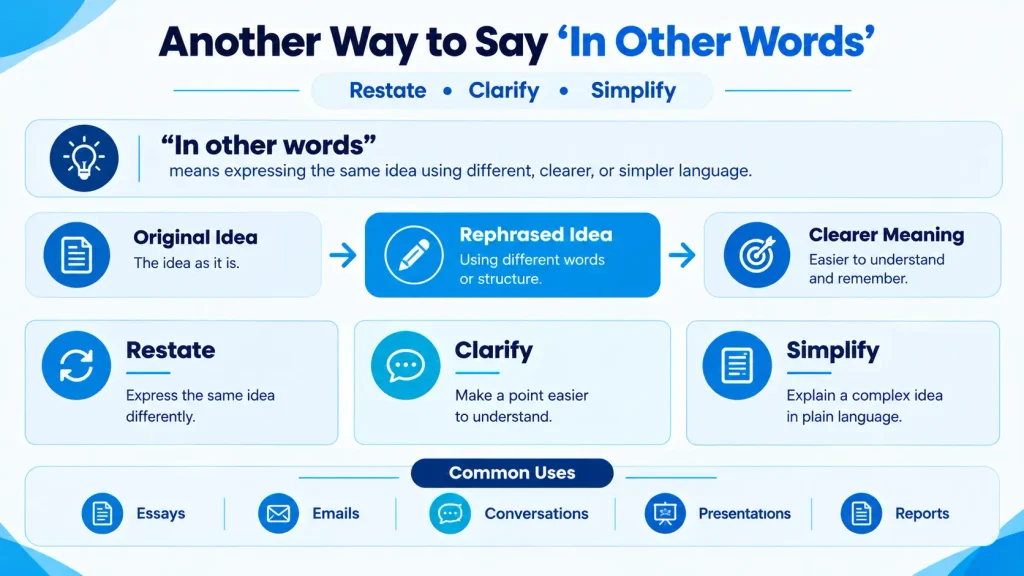
“In other words” is a phrase used to explain the same idea using different language. People often use it when they want to clarify a statement, simplify a complicated point, or make sure the reader understands what they mean.
For example, you might say, “The project needs more funding. In other words, we need additional money to finish it.” The second statement restates the first one in a more direct way.
The phrase is common in conversations, emails, essays, presentations, reports, and professional communication. However, repeating it too often can make your writing sound predictable.
Why Use Other Ways to Say “In Other Words”?
Using different expressions can make your writing more natural and precise. It also lets you adjust your language to fit the situation.
You may want an alternative to:
- Avoid repeating the same phrase.
- Make a complicated idea easier to understand.
- Sound more polished in professional writing.
- Create variety in essays and reports.
- Match a formal, casual, or conversational tone.
- Restate an important point without sounding repetitive.
The key is to choose a phrase that preserves your intended meaning while fitting the context.
10 Best Other Ways to Say “In Other Words”
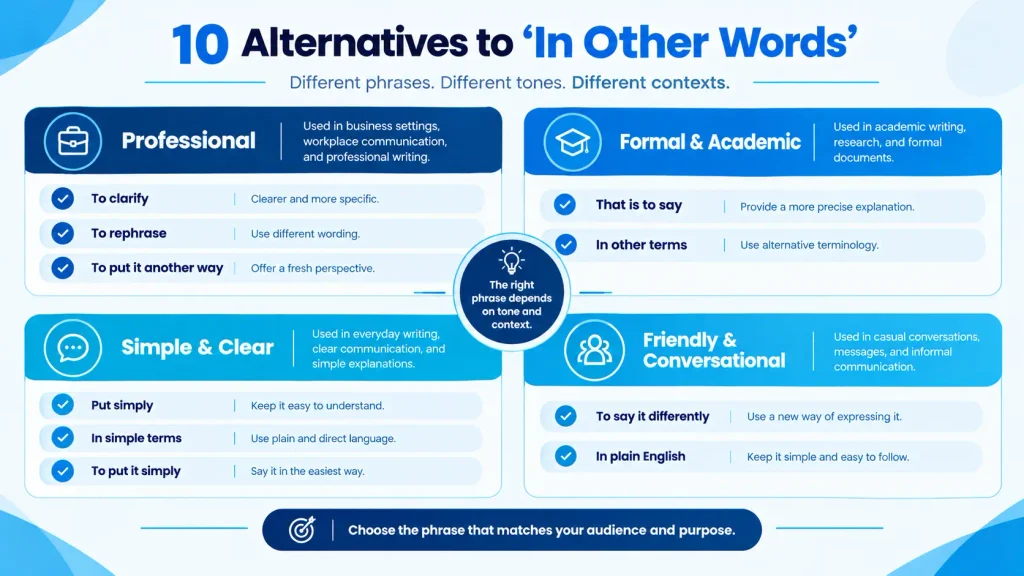
1. To Put It Another Way
Meaning
“To put it another way” means to express the same idea using different words. It is one of the most natural alternatives because it sounds clear without being overly formal.
Best For
- Professional
- Formal
- Friendly
- Casual
Example 1
The deadline cannot be extended. To put it another way, we need to submit everything by Friday.
Example 2
She wants more flexibility in her schedule. To put it another way, she would prefer fewer fixed hours.
Quick Tip
Use this phrase when you want to restate an idea naturally in both conversation and writing.
2. To Rephrase
Meaning
“To rephrase” means to express an idea differently while keeping its original meaning. It is especially useful when explaining something that could be misunderstood.
Best For
- Professional
- Formal
- Polite
Example 1
To rephrase the manager’s comment, the team needs to focus on quality before increasing production.
Example 2
Let me rephrase that so my point is clearer: We need more time to review the proposal.
Quick Tip
Use “to rephrase” when correcting, clarifying, or improving the wording of something you just said.
3. Put Simply
Meaning
“Put simply” signals that you are about to explain something in easier or more direct language. It works particularly well when the original idea is technical or complicated.
Best For
- Professional
- Friendly
- Formal
- Polite
Example 1
The software reduces unnecessary processing. Put simply, it helps the computer work faster.
Example 2
The policy limits access after business hours. Put simply, employees cannot use the facility at night.
Quick Tip
Choose “put simply” when your main goal is to make information easier for the reader to understand.
4. That Is to Say
Meaning
“That is to say” introduces a clarification or more exact explanation of a previous statement. It has a more formal tone than many everyday alternatives.
Best For
- Formal
- Professional
- Academic
Example 1
The agreement applies only to permanent employees, that is to say, temporary workers are excluded.
Example 2
The results were inconclusive, that is to say, they did not provide enough evidence to support the theory.
Quick Tip
Use this expression sparingly in formal writing because frequent repetition can make your prose sound stiff.
5. In Simple Terms
Meaning
“In simple terms” tells the reader that you are about to explain an idea in a more understandable way. It is helpful when your audience may not be familiar with specialized language.
Best For
- Professional
- Friendly
- Polite
- Formal
Example 1
In simple terms, the contract allows either party to end the agreement with proper notice.
Example 2
In simple terms, the experiment shows that temperature affects how quickly the material changes.
Quick Tip
This is a strong choice for educational content, workplace explanations, and technical subjects.
6. To Clarify
Meaning
“To clarify” introduces information that makes a previous statement more precise or less confusing. It focuses on clearing up possible misunderstandings.
Best For
- Professional
- Formal
- Polite
Example 1
To clarify, the meeting will begin at 10 a.m., not 11 a.m. as originally planned.
Example 2
To clarify, the discount applies to new customers only.
Quick Tip
Use this phrase when your purpose is clarification rather than simply repeating an idea.
7. In Other Terms
Meaning
“In other terms” means expressing an idea using different language. It can work when explaining an abstract concept, although it is less common than “in other words.”
Best For
- Formal
- Academic
- Professional
Example 1
In other terms, the company is shifting its resources toward long-term growth.
Example 2
In other terms, the new system gives employees greater control over their schedules.
Quick Tip
Use this expression when you want to emphasize a change in terminology or perspective.
8. To Say It Differently
Meaning
“To say it differently” introduces another way of expressing the same thought. It sounds conversational while still being appropriate for many professional situations.
Best For
- Casual
- Friendly
- Professional
- Polite
Example 1
To say it differently, we need to solve the underlying problem instead of treating the symptoms.
Example 2
To say it differently, the customer wants a faster and simpler checkout process.
Quick Tip
This phrase works well when you want your writing to sound natural and conversational.
9. In Plain English
Meaning
“In plain English” means explaining something without complicated terminology or unnecessary technical language. It is especially useful when translating specialized information for a general audience.
Best For
- Casual
- Friendly
- Professional
- Polite
Example 1
In plain English, the company is asking employees to reduce unnecessary expenses.
Example 2
In plain English, the warranty covers repairs but not accidental damage.
Quick Tip
Use “in plain English” when your goal is to make specialized or complicated information accessible to ordinary readers.
10. To Put It Simply
Meaning
“To put it simply” introduces a shorter or easier explanation of an idea. It emphasizes clarity and works well when the original statement contains several details.
Best For
- Professional
- Friendly
- Formal
- Casual
Example 1
To put it simply, the project needs a stronger plan before the team can move forward.
Example 2
The product has several advanced features. To put it simply, it does more while requiring less effort from the user.
Quick Tip
Use this phrase when you want to reduce a complicated explanation to its main point.
Comparison Table
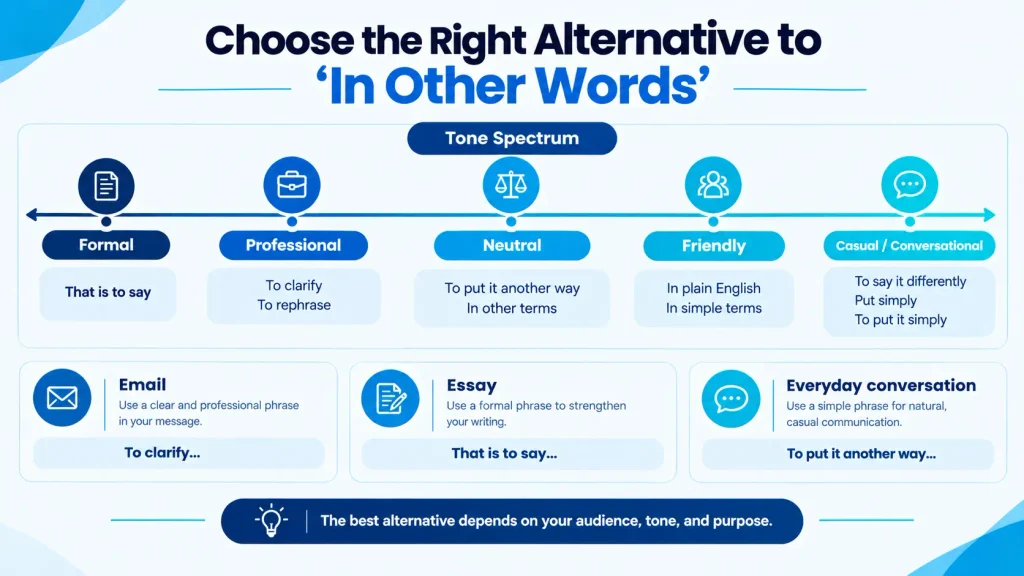
| Alternative | Best Used In | Tone |
| To Put It Another Way | Everyday and professional communication | Natural |
| To Rephrase | Clarifications and professional writing | Polite |
| Put Simply | Explanations and educational content | Clear |
| That Is to Say | Academic and formal writing | Formal |
| In Simple Terms | Technical or complicated subjects | Accessible |
| To Clarify | Emails and professional communication | Professional |
| In Other Terms | Academic and professional contexts | Formal |
| To Say It Differently | Conversations and workplace writing | Conversational |
| In Plain English | General-audience explanations | Friendly |
| To Put It Simply | Clear explanations and summaries | Natural |
Common Mistakes
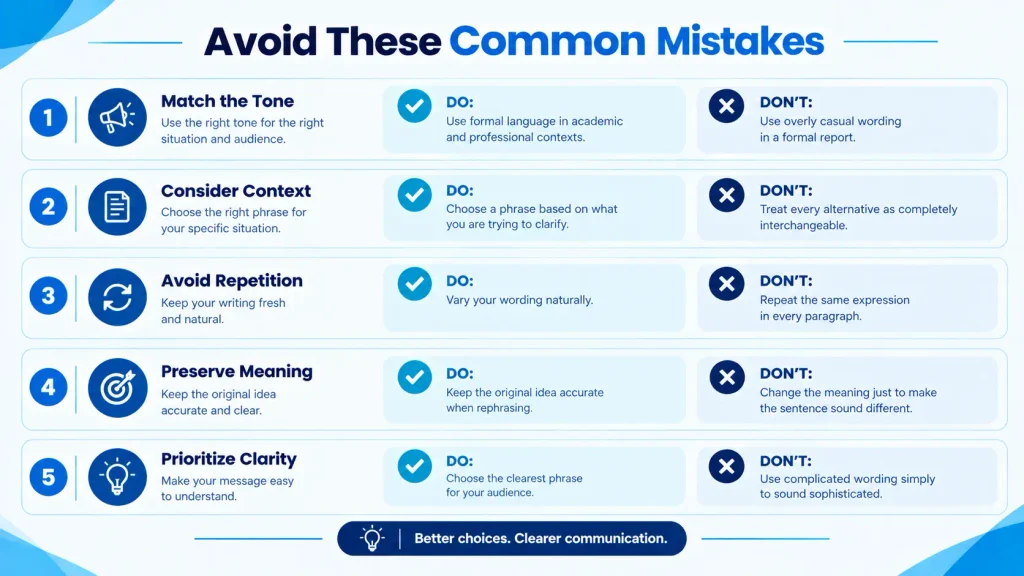
1. Using Casual Phrases in Professional Emails
Some alternatives may sound too conversational in a formal email or business report. Choose language that matches your relationship with the reader and the purpose of your message.
2. Choosing Overly Formal Language
Expressions such as “that is to say” can sound unnecessarily formal in casual conversation. A simpler phrase like “to put it another way” may sound more natural.
3. Repeating the Same Alternative
Replacing “in other words” with another phrase does not help if you use the new phrase in every paragraph. Vary your wording based on the context.
4. Forgetting the Original Meaning
A restatement should preserve the main idea of the original sentence. Avoid changing important details merely to make the wording sound different.
5. Using a Clarification Phrase Without Clarifying
Phrases such as “to clarify” should introduce useful information. If the next sentence simply repeats the previous sentence without adding clarity, the expression becomes unnecessary.
Frequently Asked Questions
What is another way to say “in other words”?
Common alternatives include “to put it another way,” “to rephrase,” “put simply,” “that is to say,” and “in simple terms.” The best choice depends on the context. For everyday communication, “to put it another way” sounds natural, while “that is to say” is more appropriate for formal or academic writing.
What is a professional way to say “in other words”?
“To put it another way,” “to clarify,” and “to rephrase” are useful professional alternatives. They work well in emails, reports, meetings, and workplace discussions. “To clarify” is especially appropriate when you want to correct or explain a possible misunderstanding rather than simply repeat the same information.
What is a formal way to say “in other words”?
“That is to say” is a traditional formal alternative to “in other words.” “In other terms” can also work in certain academic or professional contexts. However, formal writing should still prioritize clarity, so a straightforward phrase such as “to rephrase” may be a better choice in many situations.
What is a simple way to say “in other words”?
“Put simply,” “in simple terms,” and “to put it simply” are excellent choices when you want to make an idea easier to understand. These phrases tell the reader that you are about to explain the same concept using clearer, more accessible language.
Can I use “to put it another way” in an essay?
Yes. “To put it another way” can work well in an essay when you need to restate an idea for clarity. However, academic writing often benefits from precise wording, so use the phrase only when the restatement adds clarity or helps explain an important concept.
Is “in plain English” professional?
Yes, “in plain English” can be professional, particularly when explaining technical, legal, financial, or specialized information to a general audience. It emphasizes accessibility rather than simplicity for its own sake. In a highly formal academic paper, however, “in simple terms” may fit the tone better.
Is “to rephrase” the same as “in other words”?
They have very similar purposes, but they are not always interchangeable. “To rephrase” focuses on expressing something differently, while “in other words” usually introduces a restatement or clarification. Both can help prevent repetition and make a message easier to understand.
Which alternative should I use in a professional email?
For most professional emails, “to clarify,” “to rephrase,” or “to put it another way” are safe choices. Select “to clarify” when correcting confusion, “to rephrase” when changing the wording, and “to put it another way” when explaining the same point from a different angle.
Conclusion
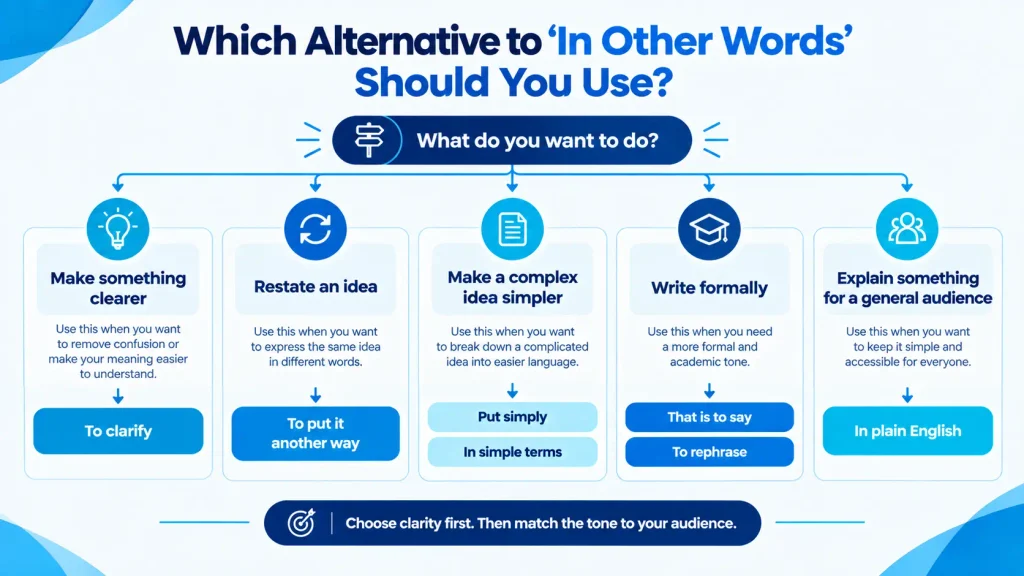
There are many useful alternatives to “in other words,” and each one creates a slightly different effect. “To put it another way” is a versatile choice for everyday and professional communication, while “to clarify” works especially well when you need to prevent confusion. For simpler explanations, “put simply,” “in simple terms,” and “in plain English” are effective options.
If you are writing an academic or formal document, “that is to say” or “to rephrase” may fit better. The most important thing is to consider your audience and purpose before choosing a replacement. A good alternative should make your message clearer without changing its meaning.
When in doubt, choose the phrase that sounds natural for the situation. Clear, direct language is usually more effective than unnecessarily complicated wording.

Sarah Mitchell is a writer and editor specializing in English usage, professional communication, vocabulary, and natural word choice. At FrontiersPost, she helps readers understand how words and phrases differ across professional, academic, and everyday contexts.