

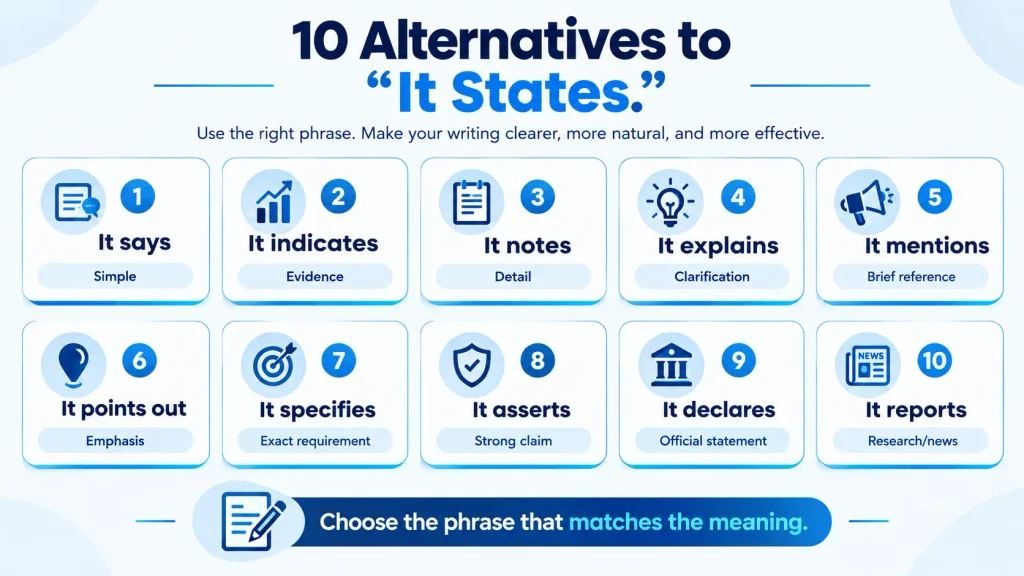
Another way to say “it states” includes it says, it indicates, it notes, it explains, it mentions, it points out, it specifies, it asserts, it declares, and it reports. The best choice depends on context. For formal writing, “it indicates” or “it specifies” may sound more precise, while “it says” works well in everyday English.
Key Takeaways
- “It states” means that a source clearly expresses or presents information.
- “It says” is the simplest and most natural everyday alternative.
- “It indicates” works well when information suggests a conclusion or meaning.
- “It specifies” is useful when a source gives exact details or requirements.
- Choose your wording based on the source, context, tone, and level of certainty.
What Does “Another Way to Say It States” Mean?
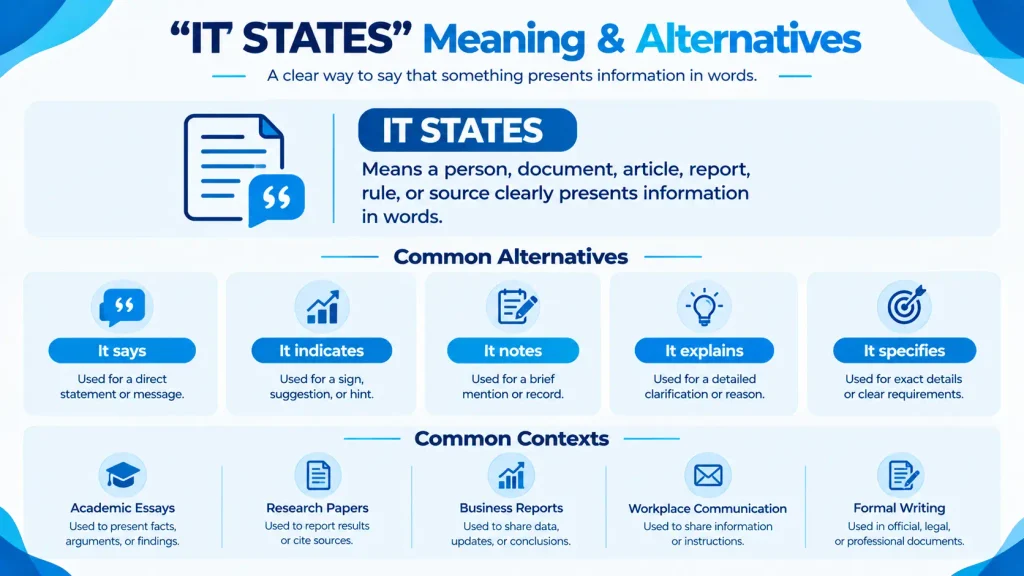
The phrase “it states” means that a person, document, article, report, rule, or other source clearly presents information in words. For example, you might write, “The policy states that employees must submit the form by Friday.”
People often search for another way to say “it states” because repeating the same phrase can make academic, professional, or formal writing feel monotonous. Using alternatives can make your writing more precise while keeping the original meaning.
The phrase is especially common in academic essays, research papers, business reports, legal documents, workplace communication, and formal explanations.
Why Use Other Ways to Say “It States”?
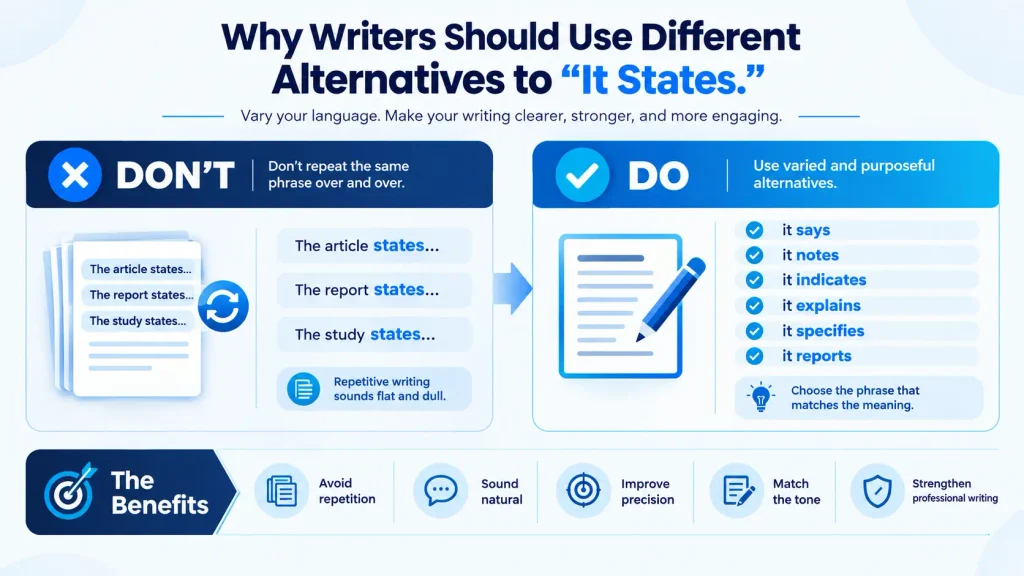
Replacing “it states” can make your writing more natural and help you show exactly how a source communicates information.
Other expressions can help you:
- Avoid repeating the same phrase.
- Make academic writing more varied.
- Match the tone of your audience.
- Show whether a source gives, suggests, or emphasizes information.
- Make professional writing more precise.
- Describe different types of statements accurately.
The key is to choose an alternative that fits the source and meaning instead of changing the phrase simply for variety.
10 Best Other Ways to Say “It States”
1. It Says
Meaning
“It says” is the most straightforward alternative to “it states.” It simply tells the reader that a person, document, or source contains or expresses particular information.
Best For
- Casual
- Friendly
- Professional
- Polite
Example 1
The email says that the meeting has been moved to Thursday.
Example 2
The article says that regular practice can improve writing skills.
Quick Tip
Use “it says” when you want simple, natural English rather than highly formal wording.
2. It Indicates
Meaning
“It indicates” suggests that a source provides information that points toward a particular fact, conclusion, or interpretation. It is especially useful when the source does not make the idea completely explicit.
Best For
- Professional
- Formal
Example 1
The survey indicates that most customers prefer online support.
Example 2
The data indicates a gradual increase in workplace communication skills.
Quick Tip
Use “it indicates” when the information provides evidence or suggests something rather than directly declaring it.
3. It Notes
Meaning
“It notes” means that a source specifically mentions or draws attention to a particular fact. It is common in academic, professional, and analytical writing.
Best For
- Professional
- Formal
Example 1
The report notes that employee training improved after the new program began.
Example 2
The study notes several differences between written and spoken communication.
Quick Tip
Choose “it notes” when the source highlights a detail that is relevant to the discussion.
4. It Explains
Meaning
“It explains” is appropriate when a source provides information that helps the reader understand a process, reason, idea, or situation. It emphasizes understanding rather than simply presenting a statement.
Best For
- Professional
- Formal
- Friendly
Example 1
The guide explains how students can organize their research papers.
Example 2
The report explains why clear instructions can reduce workplace mistakes.
Quick Tip
Use “it explains” when the source gives reasoning, background, or clarification.
5. It Mentions
Meaning
“It mentions” means that a source refers to something without necessarily focusing on it in detail. This makes it useful when discussing a minor point within a larger document.
Best For
- Casual
- Professional
- Friendly
Example 1
The article mentions several useful strategies for improving vocabulary.
Example 2
The handbook mentions flexible scheduling as one possible workplace benefit.
Quick Tip
Use “it mentions” when the source refers to an idea briefly rather than developing it fully.
6. It Points Out
Meaning
“It points out” means that a source draws attention to a particular fact, problem, or observation. It can make writing sound more conversational while remaining appropriate in many professional contexts.
Best For
- Professional
- Friendly
- Casual
Example 1
The report points out that many customers prefer shorter response times.
Example 2
The teacher points out that the introduction needs stronger supporting evidence.
Quick Tip
Use this phrase when you want to emphasize that someone or something draws attention to an important detail.
7. It Specifies
Meaning
“It specifies” is useful when a source provides exact details, conditions, instructions, or requirements. It is more precise than the general phrase “it states.”
Best For
- Formal
- Professional
Example 1
The contract specifies the deadline for submitting the completed documents.
Example 2
The application instructions specify which documents applicants must provide.
Quick Tip
Use “it specifies” when the source gives a particular requirement, number, condition, or detail.
8. It Asserts
Meaning
“It asserts” means that a person or source presents something as true or makes a strong claim. The word can sound more forceful than “it states.”
Best For
- Formal
- Professional
Example 1
The author asserts that early feedback improves student performance.
Example 2
The paper asserts that communication plays a central role in effective teamwork.
Quick Tip
Use “it asserts” when the source makes a definite claim, especially in academic or analytical writing.
9. It Declares
Meaning
“It declares” describes a clear or emphatic statement. It is often used when someone formally announces a position, decision, intention, or fact.
Best For
- Formal
- Professional
Example 1
The organization declares its commitment to improving workplace safety.
Example 2
The announcement declares that the new policy will take effect next month.
Quick Tip
Because “declares” can sound strong, use it when the statement is formal, official, or emphatic.
10. It Reports
Meaning
“It reports” means that a source provides information about an event, finding, result, or situation. It is particularly common when referring to news articles, studies, surveys, and research.
Best For
- Professional
- Formal
Example 1
The study reports higher satisfaction among employees who received additional training.
Example 2
The newspaper reports that the company plans to expand its operations.
Quick Tip
Use “it reports” when a source presents findings, observations, events, or information gathered from research or investigation.
Comparison Table
| Alternative | Best Used In | Tone |
| It says | Everyday writing, emails, general communication | Natural |
| It indicates | Research, analysis, professional writing | Precise |
| It notes | Academic and professional writing | Formal |
| It explains | Guides, reports, educational writing | Clear |
| It mentions | General and professional writing | Neutral |
| It points out | Explanations, discussions, workplace writing | Conversational |
| It specifies | Instructions, contracts, policies | Precise |
| It asserts | Essays, research, analytical writing | Strong |
| It declares | Official statements and announcements | Formal |
| It reports | Research, news, studies, reports | Professional |
Common Mistakes
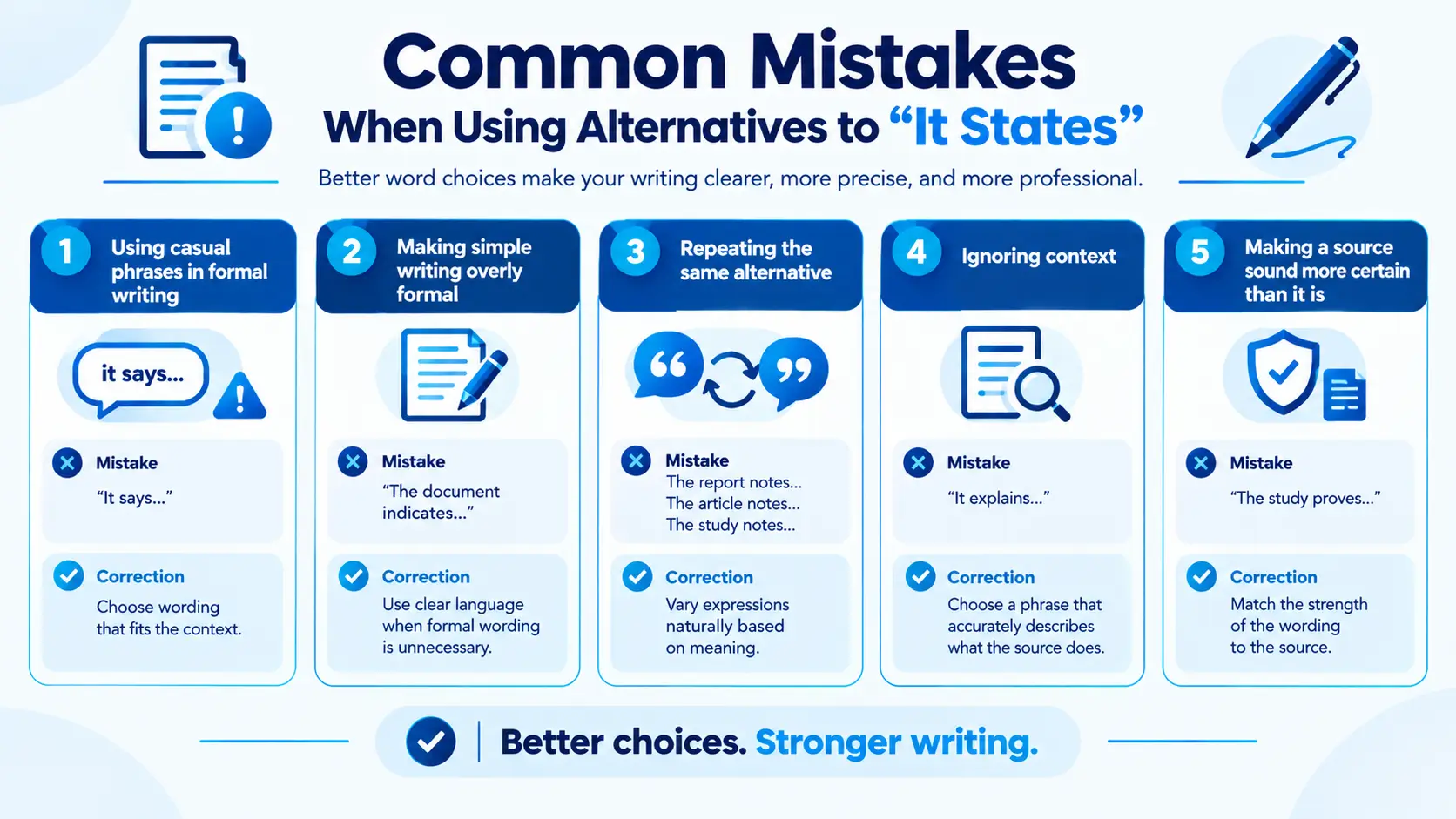
1. Using Casual Phrases in Formal Writing
Phrases such as “it says” are grammatically correct, but they may not always provide the precision expected in academic or highly formal writing. Consider “it indicates,” “it notes,” or “it specifies” when the context calls for more exact language.
2. Choosing an Overly Formal Alternative
Not every sentence needs sophisticated wording. Replacing every instance of “it states” with “it asserts” or “it declares” can make simple writing sound unnecessarily heavy.
3. Repeating the Same Alternative
Changing “it states” to “it says” does not solve the problem if “it says” appears repeatedly throughout the same paragraph. Vary your wording according to the actual meaning of each sentence.
4. Forgetting Context
Not all alternatives have exactly the same meaning. “It mentions” suggests a brief reference, while “it specifies” suggests exact information. Choose the phrase that accurately describes the source.
5. Making a Source Sound More Certain Than It Is
Words such as “asserts” and “declares” can sound stronger than “indicates” or “mentions.” Do not use a forceful expression if the source merely suggests an idea or reports an observation.
Frequently Asked Questions
What is a simple way to say “it states”?
A simple way to say “it states” is “it says.” This is the most natural choice for everyday communication and works in many professional situations as well. However, academic or formal writing may benefit from more specific alternatives such as “it indicates,” “it notes,” or “it specifies,” depending on the source and meaning.
What is a formal way to say “it states”?
Formal alternatives include “it indicates,” “it notes,” “it specifies,” “it asserts,” and “it declares.” The right option depends on what the source actually does. For example, “it specifies” works well for exact requirements, while “it indicates” is useful when evidence points toward a conclusion.
Can I use “it says” in an academic essay?
Yes, but use it thoughtfully. “It says” is grammatically correct and easy to understand, although some academic contexts may call for more precise wording. Depending on the source, “it notes,” “it indicates,” “it explains,” or “it reports” can provide a clearer description of how the information is presented.
Is “it indicates” the same as “it states”?
Not exactly. “It states” usually means that a source directly presents information, while “it indicates” often means that the information points toward a conclusion or suggests something. Because of this distinction, “it indicates” should not replace “it states” when the source makes a direct and explicit statement.
What can I say instead of “the article states”?
You can write “the article says,” “the article notes,” “the article explains,” “the article indicates,” or “the article reports.” Choose based on the article’s purpose. For example, use “reports” for research findings, “explains” for clarification, and “notes” when the article highlights a particular detail.
What is another way to say “the author states”?
Depending on the context, you can say “the author argues,” “the author notes,” “the author explains,” “the author asserts,” or “the author points out.” These expressions are not perfect substitutes in every situation. “Argues” suggests a position or reasoning, while “notes” usually refers to an observation or detail.
What is a professional alternative to “it states”?
Professional alternatives include “it indicates,” “it notes,” “it specifies,” and “it reports.” These expressions are especially useful in business reports, research, workplace documents, and formal correspondence. Choose the option that matches the information rather than selecting a formal-sounding phrase simply for variety.
How do I avoid repeating “it states” in an essay?
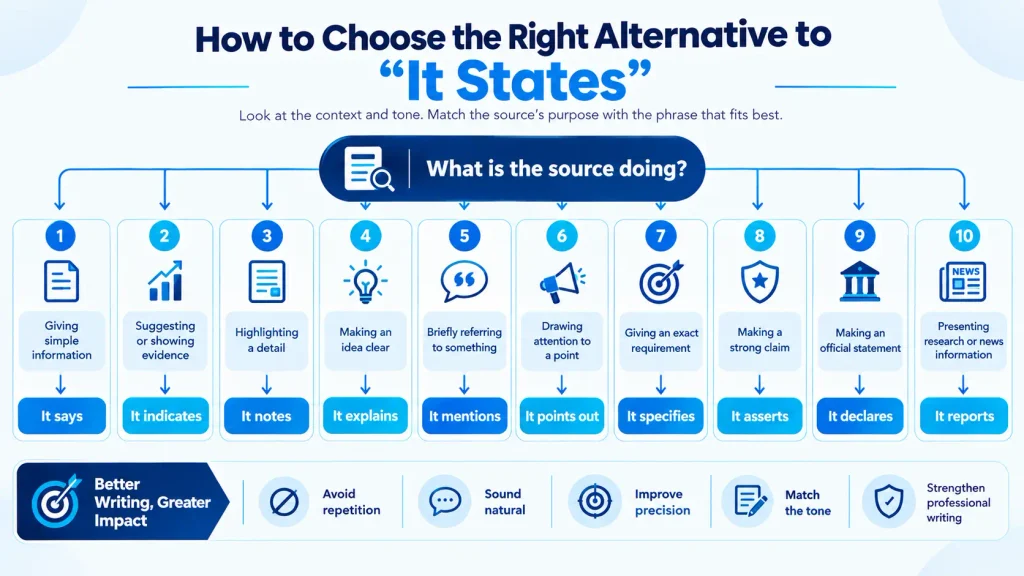
First, identify what the source is doing in each sentence. If it gives exact requirements, use “it specifies”; if it highlights a point, use “it notes”; if it provides evidence, use “it indicates”; and if it presents research findings, use “it reports.” This creates natural variety without changing the meaning.
Conclusion
There are many useful alternatives to “it states,” but the best choice depends on the context. For simple, natural English, “it says” is usually the easiest option. In academic and professional writing, “it indicates,” “it notes,” “it explains,” “it specifies,” and “it reports” can provide greater precision.
Pay attention to the exact meaning before replacing the phrase. Use “it mentions” for a brief reference, “it specifies” for exact details, and “it asserts” when a source makes a strong claim. By choosing alternatives based on meaning and tone, you can avoid repetition while making your writing clearer, more natural, and more professional. For simple, natural English, “it says” is usually the easiest option.

Melody Schaefer is the Founder and Editor-in-Chief of FrontiersPost, where she oversees the publication of clear, useful, and thoughtfully researched content for modern readers. Her editorial focus includes language, communication, vocabulary, writing, and practical topics that help readers understand information with greater clarity and confidence.
At FrontiersPost, Melody works with writers and editors to maintain consistent editorial standards, improve content quality, and ensure that published articles are useful, accessible, and easy to understand. She is particularly interested in clear communication and presenting complex or easily confused topics in a straightforward way.
As Editor-in-Chief, she is also responsible for guiding the site’s editorial direction, reviewing content standards, and helping ensure that articles are regularly maintained and improved as information evolves.