

Another way to say “main idea” is central idea, main point, core idea, key point, primary idea, central point, core message, thesis, central theme, or gist. The best choice depends on context, such as academic writing, professional communication, reading comprehension, or everyday conversation.
Key Takeaways
- “Central idea” is one of the closest alternatives to “main idea.”
- “Main point” works well in everyday and professional communication.
- “Core idea” emphasizes the most important concept or thought.
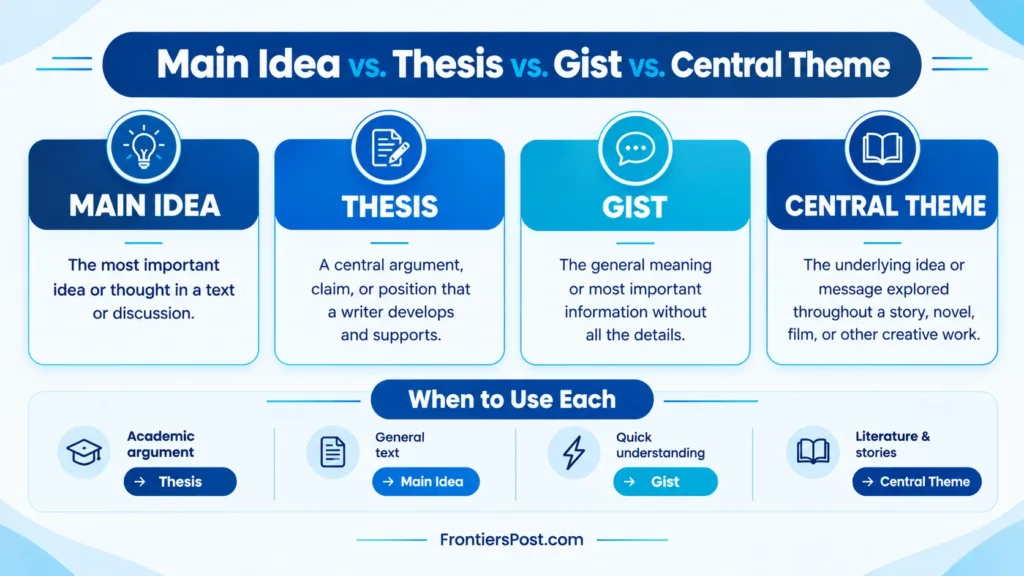
- “Thesis” is best when referring to the central argument of an essay or paper.
- Choose an alternative based on the context, tone, and type of information you are describing.
What Is Another Way to Say “Main Idea”?
There are several natural ways to say “main idea.” The phrase refers to the most important thought, message, argument, or concept that a piece of writing, speech, discussion, or presentation communicates.
Depending on the situation, you can say “central idea,” “main point,” “core idea,” “key point,” or “core message.” In academic writing, “thesis” may be more appropriate when you mean the central argument of an essay or paper.
What Does “What Is Another Way to Say “Main Idea”?” Mean?
The question “what is another way to say ‘main idea’?” asks for a different word or phrase with a similar meaning. People commonly search for alternatives when they want to avoid repetition, improve their writing, or choose language that better fits a specific context.
“Main idea” is frequently used when discussing reading comprehension, essays, articles, presentations, speeches, meetings, and explanations. For example, a teacher might ask students to identify the main idea of a passage, while a manager might ask an employee to summarize the main point of a proposal.
The phrase is broad, so the best replacement depends on what you mean. “Central idea” closely matches the original meaning, while “thesis” is more specific to an argument or position.
Why Use Other Ways to Say “Main Idea”?
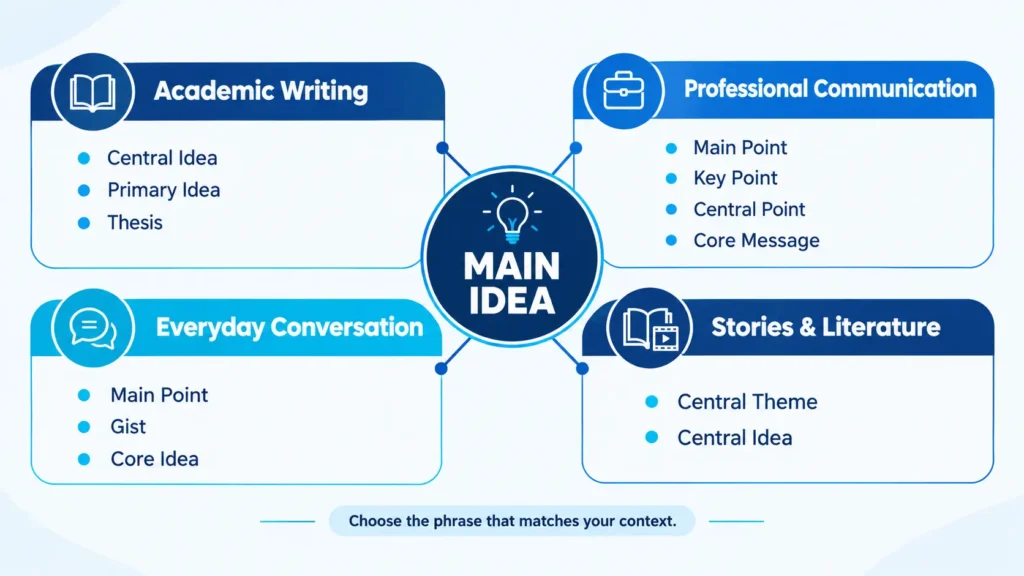
Using alternatives can make your writing clearer and more precise. Repeating “main idea” several times in the same paragraph can also make otherwise good writing feel repetitive.
Consider another phrase when you want to:
- Avoid using the same wording repeatedly.
- Make your meaning more specific.
- Sound more natural in conversation.
- Improve professional or academic writing.
- Match the tone of your audience.
- Describe an argument, message, theme, or concept more accurately.
10 Best Other Ways to Say “Main Idea”
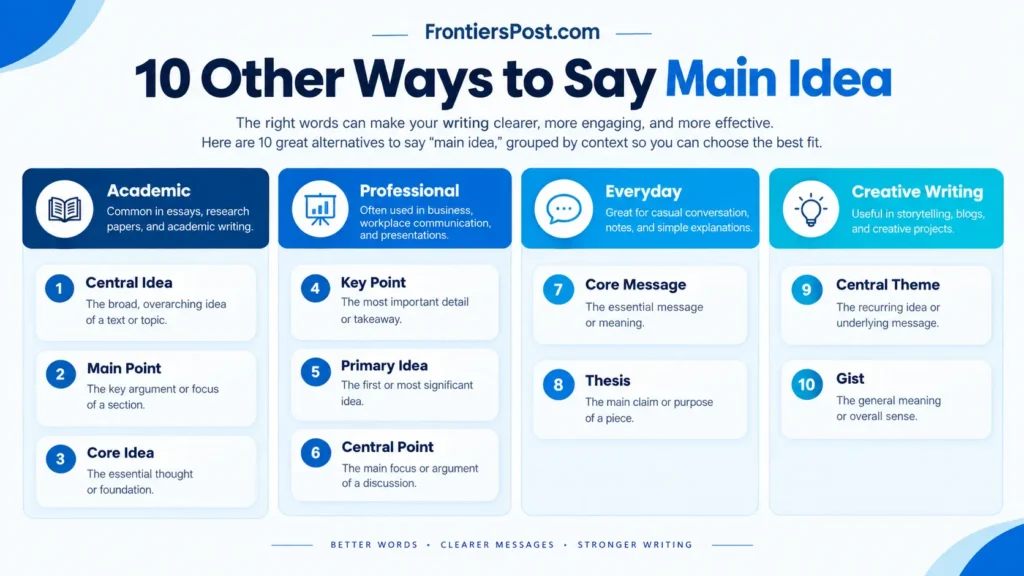
1. Central Idea
Meaning
“Central idea” refers to the most important thought or concept around which a piece of writing or discussion is organized. It is one of the closest and most interchangeable alternatives to “main idea.”
Best For
- Academic
- Formal
- Professional
Example 1
The central idea of the article is that small changes can improve workplace communication.
Example 2
Students should identify the central idea before analyzing the author’s supporting details.
Quick Tip
Use “central idea” when you want a polished alternative that works naturally in academic and professional contexts.
2. Main Point
Meaning
“Main point” describes the most important piece of information someone wants you to understand. It sounds slightly more conversational than “central idea.”
Best For
- Professional
- Casual
- Friendly
- Polite
Example 1
The main point of her presentation was to explain why the deadline needed to change.
Example 2
Can you tell me the main point of the meeting before I join?
Quick Tip
Choose “main point” when talking about discussions, meetings, presentations, or explanations.
3. Core Idea
Meaning
“Core idea” refers to the fundamental thought or concept at the heart of a subject. It emphasizes what everything else is built around.
Best For
- Professional
- Academic
- Formal
Example 1
The core idea behind the program is to make education more accessible.
Example 2
Once you understand the core idea, the rest of the chapter becomes easier to follow.
Quick Tip
Use “core idea” when you want to emphasize the foundation of a concept rather than simply its most noticeable point.
4. Key Point
Meaning
A “key point” is an important piece of information that helps explain or support a larger subject. Unlike “main idea,” it can refer to one important detail rather than the overall message.
Best For
- Professional
- Formal
- Casual
Example 1
One key point from the report is that customer demand has increased significantly.
Example 2
Before we finish, let me review the key points from today’s discussion.
Quick Tip
Use “key point” when referring to an important takeaway, especially in presentations, meetings, and summaries.
5. Primary Idea
Meaning
“Primary idea” means the most important idea in relation to other ideas. It has a more formal tone and is useful when distinguishing the central concept from secondary information.
Best For
- Formal
- Academic
- Professional
Example 1
The primary idea of the research is that early intervention can improve long-term outcomes.
Example 2
The writer introduces the primary idea before presenting several supporting examples.
Quick Tip
Use “primary idea” when your writing needs a formal, structured tone.
6. Central Point
Meaning
“Central point” refers to the most important point a writer or speaker is trying to communicate. It works especially well when discussing an argument, explanation, or presentation.
Best For
- Professional
- Formal
- Academic
Example 1
The central point of the proposal is to reduce unnecessary operating costs.
Example 2
The speaker returned to the central point several times during the interview.
Quick Tip
Choose “central point” when the subject involves a clear argument or message.
7. Core Message
Meaning
“Core message” describes the primary message that a person, organization, article, advertisement, or presentation wants the audience to understand. It focuses more on communication than on an abstract idea.
Best For
- Professional
- Formal
- Friendly
- Warm
Example 1
The campaign’s core message is that every customer deserves dependable service.
Example 2
Before designing the presentation, we need to agree on its core message.
Quick Tip
Use “core message” when discussing communication, branding, presentations, speeches, or public-facing content.
8. Thesis
Meaning
A “thesis” is the central claim, argument, or position that an essay or research paper develops and supports. It is not a universal replacement for “main idea,” but it is highly appropriate when discussing academic arguments.
Best For
- Academic
- Formal
Example 1
The essay’s thesis argues that public transportation can reduce traffic congestion in major cities.
Example 2
Every supporting paragraph should connect clearly to the paper’s thesis.
Quick Tip
Use “thesis” only when you mean the central argument or claim, not simply the general topic of a passage.
9. Central Theme
Meaning
“Central theme” refers to the main underlying subject, message, or idea explored throughout a work. It is especially common when discussing literature, stories, films, and creative writing.
Best For
- Formal
- Academic
Example 1
Trust is the central theme of the novel.
Example 2
The film explores the central theme of finding purpose after a major life change.
Quick Tip
Use “central theme” for literature and other creative works when the main idea develops throughout the entire work.
10. Gist
Meaning
“Gist” means the general meaning or most important part of something. It is more informal than “central idea” and is useful when you want to describe the basic message without discussing every detail.
Best For
- Casual
- Friendly
- Polite
Example 1
I didn’t have time to read the entire report, but I understand the gist.
Example 2
She gave me the gist of the conversation while we waited for the meeting to start.
Quick Tip
Use “gist” in casual or conversational situations when you mean the overall meaning rather than a precise central argument.
Comparison Table
| Alternative | Best Used In | Tone |
| Central idea | Essays, articles, academic writing | Formal |
| Main point | Conversations, meetings, explanations | Casual/Professional |
| Core idea | Concepts, explanations, research | Formal |
| Key point | Reports, presentations, discussions | Professional |
| Primary idea | Academic and structured writing | Formal |
| Central point | Arguments, proposals, discussions | Professional |
| Core message | Speeches, campaigns, presentations | Professional/Warm |
| Thesis | Essays, research papers, arguments | Academic |
| Central theme | Literature, films, stories | Formal |
| Gist | Conversations and summaries | Casual |
Common Mistakes
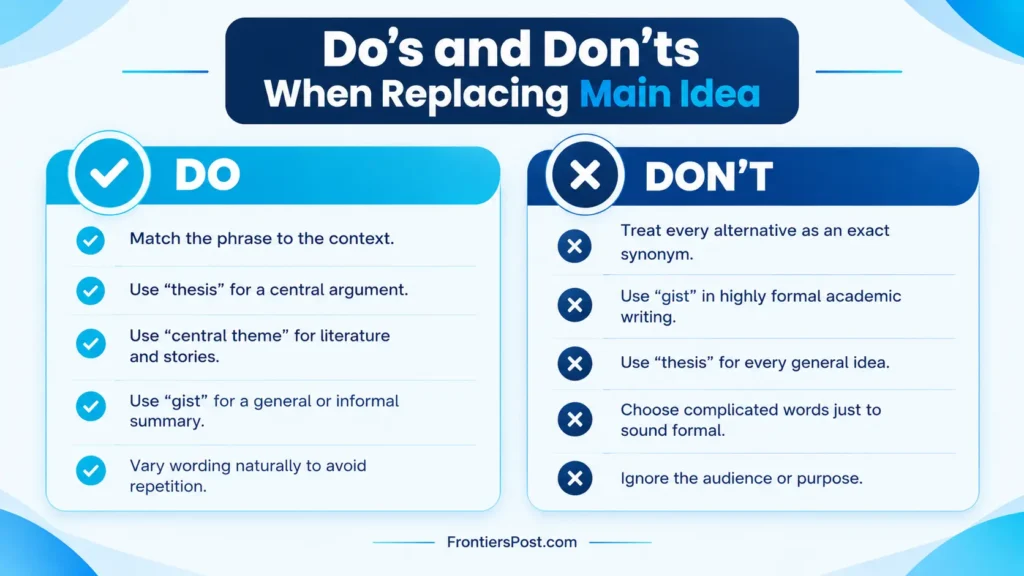
1. Using a casual phrase in formal writing
Words such as “gist” can sound too conversational in an academic essay. For formal writing, “central idea,” “central point,” or “primary idea” may be a better choice.
2. Treating every alternative as an exact synonym
Not every option has exactly the same meaning. For example, “thesis” specifically refers to a central argument, while “central theme” usually describes an idea developed throughout a creative work.
3. Choosing an overly formal expression
Using “primary idea” in a casual conversation can sound unnatural. If you’re talking with friends or coworkers, “main point” or “gist” may sound more natural.
4. Ignoring the context
The subject matters when choosing an alternative. A literary analysis may call for “central theme,” while a business presentation may work better with “key point” or “core message.”
5. Repeating the same alternative
Replacing “main idea” with “central idea” every time does not solve repetition. Vary your wording naturally when the meaning and context allow it.
Frequently Asked Questions
What is the best synonym for “main idea”?
The best synonym for “main idea” is usually “central idea.” It has nearly the same meaning and works well in academic, professional, and general writing. If you’re referring to an argument, “thesis” may be more precise, while “gist” works better for casual conversations.
What is another way to say “main idea” in an essay?
In an essay, you can use “central idea,” “central point,” “core idea,” “primary idea,” or “thesis.” However, “thesis” is most appropriate when you mean the main argument or claim that the essay presents and supports.
What is a more formal word for “main idea”?
“Central idea,” “primary idea,” and “central point” are formal alternatives. “Central idea” is usually the safest choice because it sounds natural without being unnecessarily complicated. “Thesis” is also formal but should be used when referring specifically to an argument or claim.
What is another way to say “main idea” in reading?
For reading comprehension, “central idea” is one of the best alternatives. You can also use “main point” or “core idea,” depending on the passage. “Central idea” is particularly useful when identifying the primary message of an article, paragraph, or nonfiction passage.
Is “gist” the same as “main idea”?
“Gist” and “main idea” are similar, but they are not always exact synonyms. “Gist” usually means the general meaning or basic point, while “main idea” can refer to a specific central concept that the writer develops with supporting details.
Can I use “thesis” instead of “main idea”?
You can use “thesis” when the main idea is a central argument or claim. For example, an academic essay has a thesis that states the position the writer intends to support. You should not use “thesis” simply to describe the general subject or message of every passage.
What is another way to say “main idea” professionally?
Professional alternatives include “key point,” “central point,” “core idea,” “central idea,” and “core message.” “Key point” works especially well in meetings and presentations, while “core message” is useful when discussing communication, branding, or organizational goals.
How do I choose the right alternative to “main idea”?
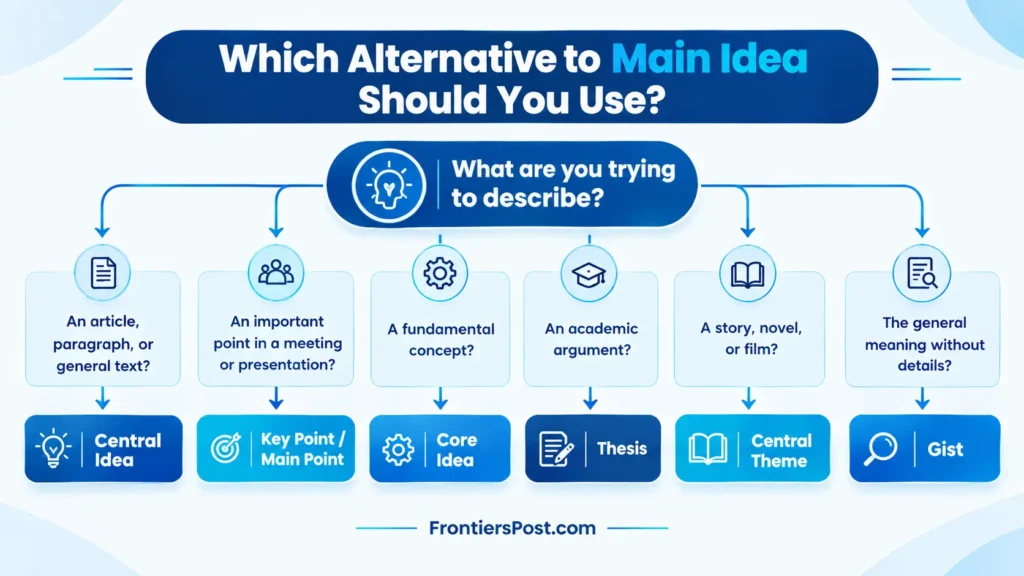
Consider what you are describing and who will read or hear it. Use “central idea” for a general-purpose option, “thesis” for an academic argument, “central theme” for creative works, “key point” for important information, and “gist” for casual summaries.
Conclusion
For academic writing, “primary idea,” “central point,” or “thesis” can provide greater precision. For a clear definition of “thesis,” see Cambridge Dictionary. When discussing stories, novels, or films, “central theme” may be more appropriate.
For academic writing, “primary idea,” “central point,” or “thesis” can provide greater precision. When discussing stories, novels, or films, “central theme” may be more appropriate. Meanwhile, “gist” works well when you simply want to describe the general meaning.
The key is to choose a phrase that matches your meaning instead of replacing “main idea” automatically. A precise alternative can make your writing clearer, more natural, and better suited to your audience.

Sarah Mitchell is a Senior English Editor at FrontiersPost, specializing in English usage, vocabulary, word choice, grammar, and effective communication. She focuses on helping readers understand subtle differences between commonly confused words, phrases, and expressions and use them naturally in everyday, professional, and academic writing.
At FrontiersPost, Sarah researches, writes, and edits educational content with an emphasis on clarity, accuracy, and practical examples. She works closely with the editorial team to ensure that articles are easy to understand while maintaining appropriate context, meaning, and usage.
Her editorial interests include English vocabulary, synonyms, phrasing, professional communication, and the practical nuances that can make written communication more precise and effective.