

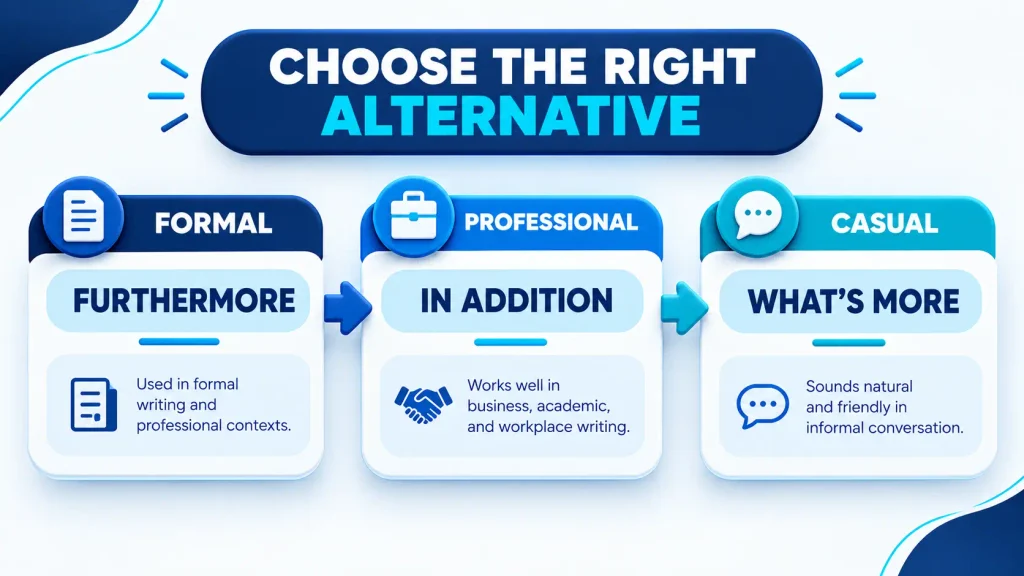
Another way to say moreover includes furthermore, in addition, additionally, besides, and what’s more. These expressions help you add information without repeating the same transition word. Use furthermore in formal writing, in addition in professional emails, and what’s more in conversational writing. Choose a phrase that fits your tone and the relationship between your ideas.
Key Takeaways
- Furthermore and additionally work well in formal and professional writing.
- In addition is a clear choice for essays, reports, and emails.
- Besides often sounds more conversational and can introduce an extra reason.
- What’s more adds emphasis to an important point.
- Choose transitions based on context, tone, and the connection between your ideas.
What Does “Another Way to Say Moreover” Mean?
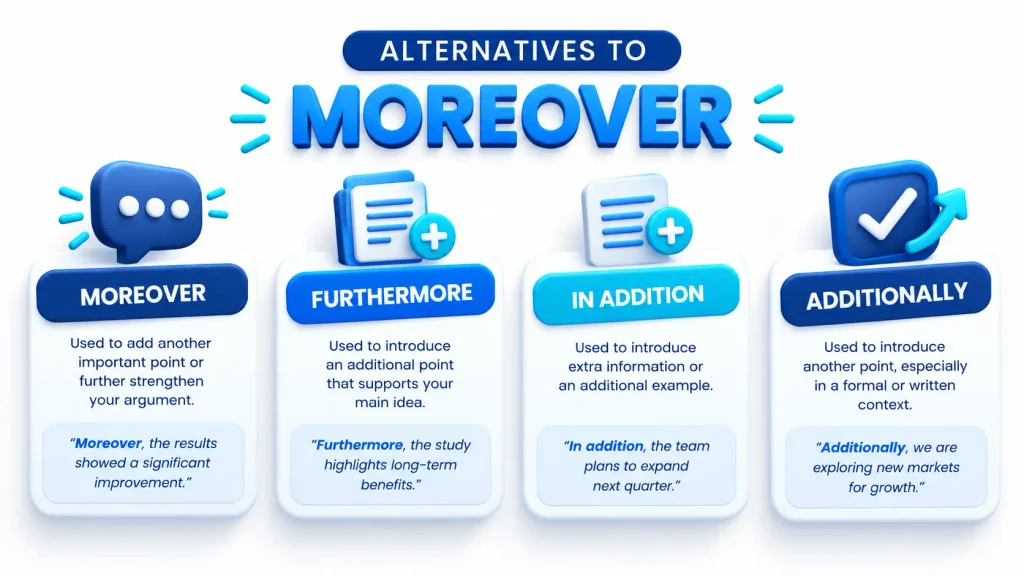
The phrase “another way to say moreover” refers to alternative expressions that help you add information to a sentence, paragraph, or conversation. These expressions connect ideas and show readers that you are introducing an additional point.
The word moreover is commonly used in essays, research papers, business reports, and formal presentations. It signals that the next statement adds information that supports or expands on the previous one.
For example:
- Original: The proposal reduces costs. Moreover, it improves efficiency.
- Revised: The proposal reduces costs. Furthermore, it improves efficiency.
Both versions communicate the same basic idea. However, choosing different transitions can make your writing sound more natural and prevent repetition.
Why Use Other Ways to Say “Moreover”?
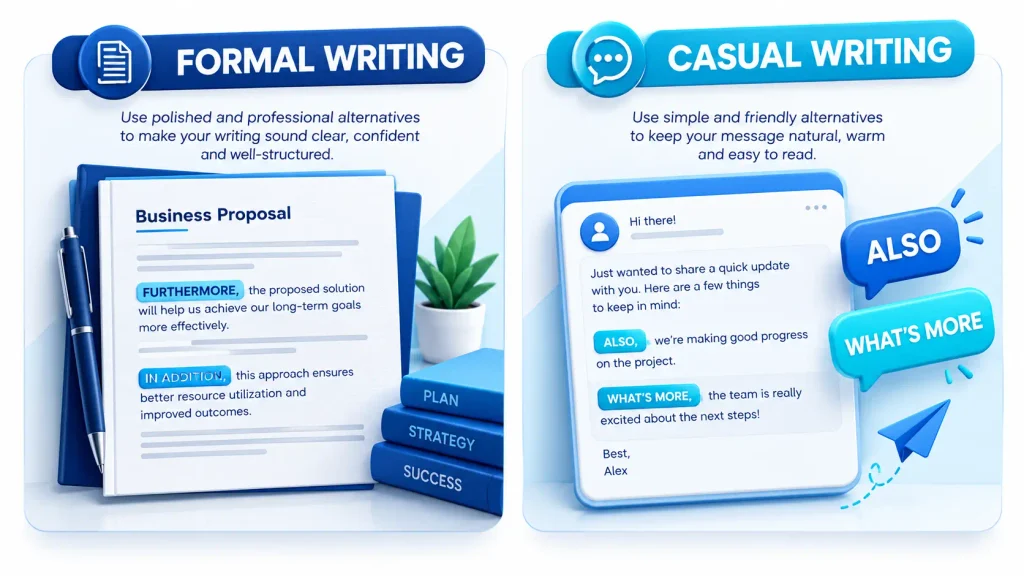
Although moreover is useful, repeating it throughout an article or email can make your writing sound mechanical. Alternative expressions help you maintain a natural flow while making the relationship between your ideas clear.
Consider using another transition when you want to:
- Avoid repetition: Keep your paragraphs varied and engaging.
- Improve clarity: Show how one point connects to another.
- Match the tone: Choose language that suits an academic paper or casual conversation.
- Strengthen an argument: Introduce additional evidence or supporting reasons.
- Improve professional communication: Make reports, presentations, and emails easier to read.
The best alternative depends on what you want to communicate. Some phrases sound formal, while others add emphasis or create a more conversational tone.
10 Best Other Ways to Say “Moreover”

1. Furthermore
Meaning
Furthermore introduces additional information that supports or develops a previous point. It is a strong alternative to moreover in formal and academic writing.
Best For
Formal, Professional
Example 1
The updated software improves data security. Furthermore, it makes routine tasks easier to manage.
Example 2
The study identifies several causes of poor sleep. Furthermore, it suggests practical ways to improve sleep quality.
Quick Tip
Use furthermore when your next point adds meaningful support to an argument or explanation.
2. In Addition
Meaning
In addition introduces another fact, benefit, or point. It is clear and versatile, making it suitable for both professional communication and academic writing.
Best For
Professional, Formal, Polite
Example 1
In addition, the training program includes one-on-one coaching sessions.
Example 2
The apartment has a spacious kitchen. In addition, residents have access to a shared fitness center.
Quick Tip
Use in addition when you want to introduce extra information without sounding overly formal.
3. Additionally
Meaning
Additionally signals that you are adding another detail to the information already provided. It is common in reports, workplace emails, proposals, and research-based writing.
Best For
Professional, Formal
Example 1
Additionally, all employees must complete the annual safety course by December.
Example 2
The new policy clarifies payment deadlines. Additionally, it explains how employees can request reimbursement.
Quick Tip
Use additionally to introduce a new item in a list of points, especially in structured business writing.
4. Also
Meaning
Also is a simple, natural way to add information. Unlike moreover, it works comfortably in everyday conversations as well as professional writing.
Best For
Casual, Friendly, Professional
Example 1
The course covers grammar and punctuation. It also teaches students how to organize their ideas.
Example 2
I sent you the meeting notes. I also included the updated project schedule.
Quick Tip
Place also before the main verb in many sentences, but after the verb be. For example, write “She also works remotely” and “She is also available.”
5. Besides
Meaning
Besides introduces an additional reason, fact, or consideration. It often sounds more conversational than furthermore, particularly when you want to explain why something makes sense.
Best For
Casual, Friendly, Persuasive
Example 1
We should leave early. Besides, traffic usually gets heavy after five.
Example 2
The online course is affordable. Besides, you can complete the lessons on your own schedule.
Quick Tip
Use besides when adding a supporting reason in conversation. In formal academic writing, in addition may be a safer choice.
6. What’s More
Meaning
What’s more introduces another point that strengthens the previous statement. It can add emphasis and make a sentence feel more engaging.
Best For
Casual, Friendly, Persuasive
Example 1
The hotel is close to the beach. What’s more, breakfast is included in the room rate.
Example 2
Her presentation was clear and informative. What’s more, she answered every question with confidence.
Quick Tip
Use what’s more when the additional information makes your point more convincing or impressive.
7. On Top of That
Meaning
On top of that adds another fact or circumstance, often one that makes a situation even better or worse. It has a conversational tone and is less formal than moreover.
Best For
Casual, Friendly
Example 1
The restaurant had excellent food. On top of that, the staff were exceptionally welcoming.
Example 2
I had three assignments due on Friday. On top of that, I needed to prepare for a presentation.
Quick Tip
Reserve this expression for informal writing and conversation. Choose furthermore or additionally for most formal reports.
8. As Well
Meaning
As well adds another person, thing, or action to a statement. It is especially natural in everyday English and friendly professional messages.
Best For
Casual, Friendly, Polite
Example 1
Please send the final report and the presentation slides as well.
Example 2
Maya will attend the workshop, and her supervisor will join as well.
Quick Tip
Place as well near the end of a sentence in most cases. It usually sounds more natural there than at the beginning.
9. Not Only That
Meaning
Not only that introduces an additional point with extra emphasis. It suggests that the new information strengthens what you have already said.
Best For
Casual, Friendly, Persuasive
Example 1
The library offers free tutoring. Not only that, it provides access to online research databases.
Example 2
The jacket is lightweight and comfortable. Not only that, it is waterproof.
Quick Tip
Use this phrase when you want readers or listeners to notice an extra benefit or important detail.
10. Equally Important
Meaning
Equally important introduces another point that deserves the same level of attention as the previous one. It is especially useful when discussing several priorities or parts of an argument.
Best For
Formal, Professional
Example 1
The team must meet its sales targets. Equally important, it must maintain strong customer relationships.
Example 2
Students need time to practice new skills. Equally important, they need feedback to understand their progress.
Quick Tip
Choose equally important when the next point has comparable significance. Do not use it for a minor or unrelated detail.
Comparison Table
| Alternative | Best Used In | Tone |
|---|---|---|
| Furthermore | Essays and reports | Formal |
| In addition | Emails and academic writing | Neutral, professional |
| Additionally | Business documents | Formal |
| Also | Everyday and workplace writing | Natural, neutral |
| Besides | Conversations and informal arguments | Casual |
| What’s more | Persuasive writing and conversation | Emphatic |
| On top of that | Informal conversations | Casual |
| As well | Friendly messages | Natural, polite |
| Not only that | Persuasive explanations | Emphatic |
| Equally important | Reports and structured arguments | Formal |
Common Mistakes When Replacing Moreover
1. Using Casual Phrases in Formal Writing
Expressions such as on top of that can sound too informal in academic papers or official reports. Choose furthermore or in addition when you need a more professional tone.
2. Choosing a Transition That Does Not Fit
Not every alternative works in every sentence. For example, equally important suggests that two points have similar importance, while also simply adds information.
3. Repeating the Same Alternative
Replacing every instance of moreover with furthermore does not solve the problem of repetition. Vary your transitions naturally and use them only when they improve the connection between ideas.
4. Adding Unnecessary Transitions
A transition word is not required between every sentence. If the relationship between two statements is already clear, removing the extra phrase may improve readability.
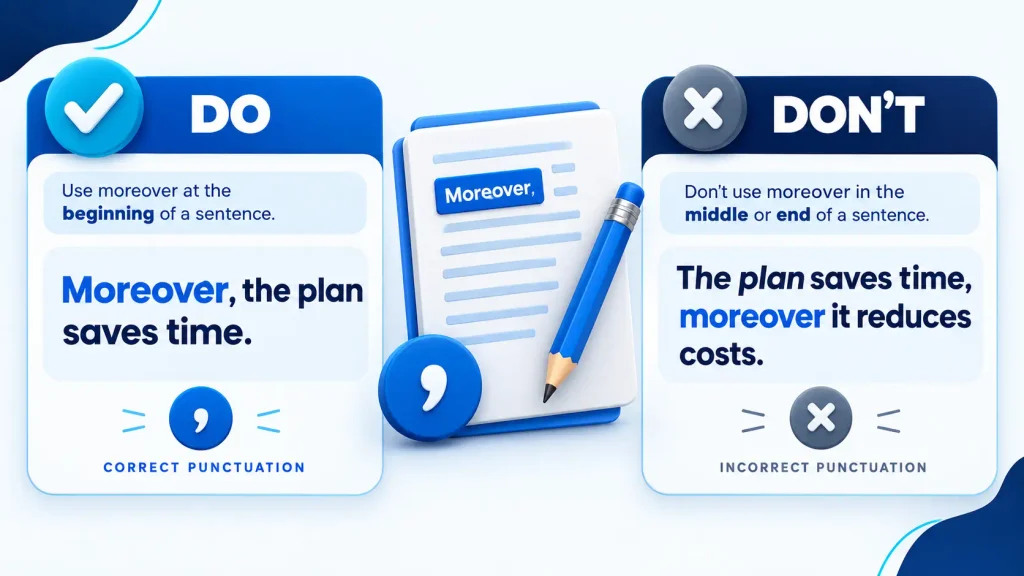
5. Using Incorrect Punctuation
When moreover or furthermore begins an independent clause, a comma usually follows the introductory word.
Correct: The plan is affordable. Furthermore, it is easy to implement.
Incorrect: The plan is affordable, furthermore it is easy to implement.
Avoid joining two complete sentences with only a comma. Use a period or a semicolon with the appropriate punctuation.
Frequently Asked Questions
1. What is the best alternative to moreover?
Furthermore is one of the closest alternatives to moreover, especially in formal and academic writing. Both expressions introduce additional information that supports a previous point. However, in addition and additionally may sound more natural in business emails and reports, depending on the sentence.
2. What is a formal way to say moreover?
You can use furthermore, additionally, in addition, or equally important in formal writing. The best choice depends on your meaning. Use furthermore to develop an argument, in addition to introduce another detail, and equally important to emphasize a point with similar significance.
3. What can I use instead of moreover in an essay?
For an essay, consider furthermore, in addition, and additionally. These transitions help connect supporting evidence, explanations, and arguments. However, avoid inserting a transition into every paragraph. Use one when it clarifies the relationship between your ideas and helps readers follow your reasoning.
4. Can I use also instead of moreover?
Yes. Also can replace moreover when you simply want to add information. It is more conversational and often makes sentences easier to read. For example, “The program teaches writing. It also develops critical-thinking skills.” In a highly formal argument, furthermore may be more suitable.
5. Is furthermore the same as moreover?
Furthermore and moreover have very similar meanings. Both introduce additional information that supports or expands on a previous statement. In many sentences, you can use either word without changing the main meaning. The choice usually comes down to writing style, sentence flow, and personal preference.
6. How do I avoid repeating moreover in an essay?
Use a mix of suitable transitions, such as furthermore, in addition, and additionally. You can also connect ideas through sentence structure rather than adding a transition every time. Focus on the logical relationship between your points instead of replacing one repeated word with another repeated word.
7. Is besides a professional alternative to moreover?
Besides can work in professional communication when the tone is conversational, but it may sound too informal in academic papers or highly formal reports. In those settings, in addition or furthermore is usually a better choice. Always consider the audience and purpose of your writing.
8. Should I put a comma after moreover?
Yes. When moreover appears at the beginning of a sentence, it is normally followed by a comma. For example: “Moreover, the revised plan reduces operating costs.” When using it between independent clauses, follow the appropriate punctuation rules rather than joining complete sentences with a comma alone.
You may also find these guides useful: Another Way to Say Overall in an Essay, “Provide” Synonyms for Better Writing and How to Say “Results” in a More Precise Way.
Conclusion
Choosing another way to say moreover can make your writing clearer, more natural, and easier to follow. Understanding the meaning and usage of moreover can also help you choose the right transition for your audience, purpose, and the connection between your ideas.
For academic essays and formal reports, furthermore and additionally are reliable choices. In professional emails, in addition often provides a clear and polished transition. For everyday conversations, also, besides, and what’s more can sound more natural.
Remember that these expressions are not always interchangeable. Equally important emphasizes the significance of another point, while on top of that adds a more conversational touch. Choose the phrase that communicates your meaning accurately rather than selecting a transition just to sound formal.

The FrontiersPost editorial team writes and reviews every guide to word and phrase alternatives, with clear meanings, tone notes and example sentences for everyday, academic and professional English.




