

If you need another way to say results, useful alternatives include outcomes, findings, conclusions, effects, consequences, achievements, performance, returns, scores, and data. The best choice depends on context. For research, “findings” works well; for goals, “outcomes” or “achievements” may sound more natural; for money, “returns” is often more precise.
Key Takeaways
- “Results” can describe outcomes, findings, achievements, scores, or data.
- Outcomes is a strong general alternative for the effects of an action or decision.
- Findings works best for research, studies, reports, and investigations.
- Achievements emphasizes successful accomplishments rather than simple outcomes.
- Choose the replacement based on the meaning and tone you want to convey.
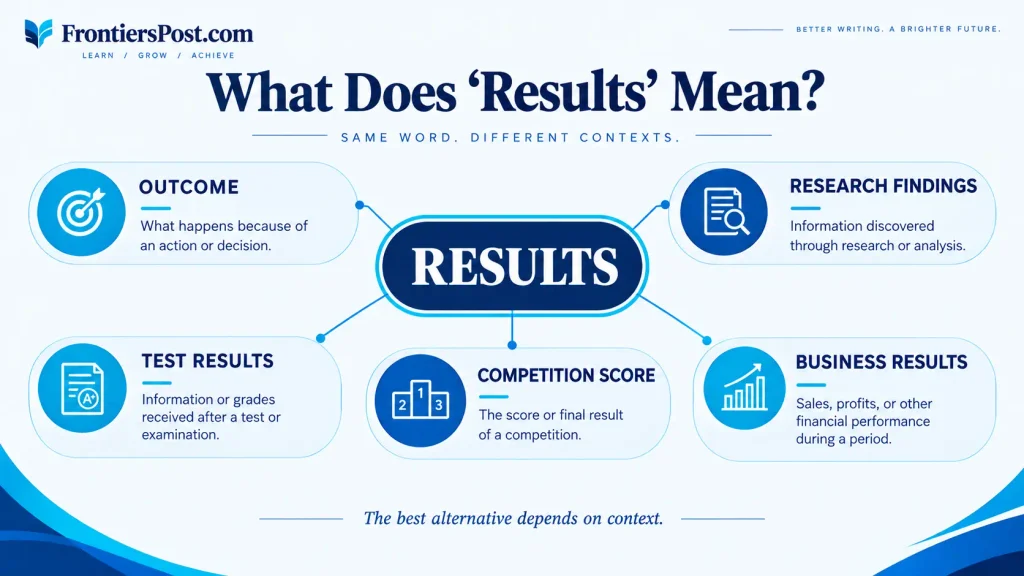
The word “results” is common in everyday, academic, professional, and business writing. It can refer to what happened after an action, what a study discovered, how well someone performed, or the final score of an event.
Because “results” has several meanings, the best alternative depends on the situation. Choosing a more specific word can make your writing clearer, more natural, and more precise.
What Does “Another Way to Say Results” Mean?
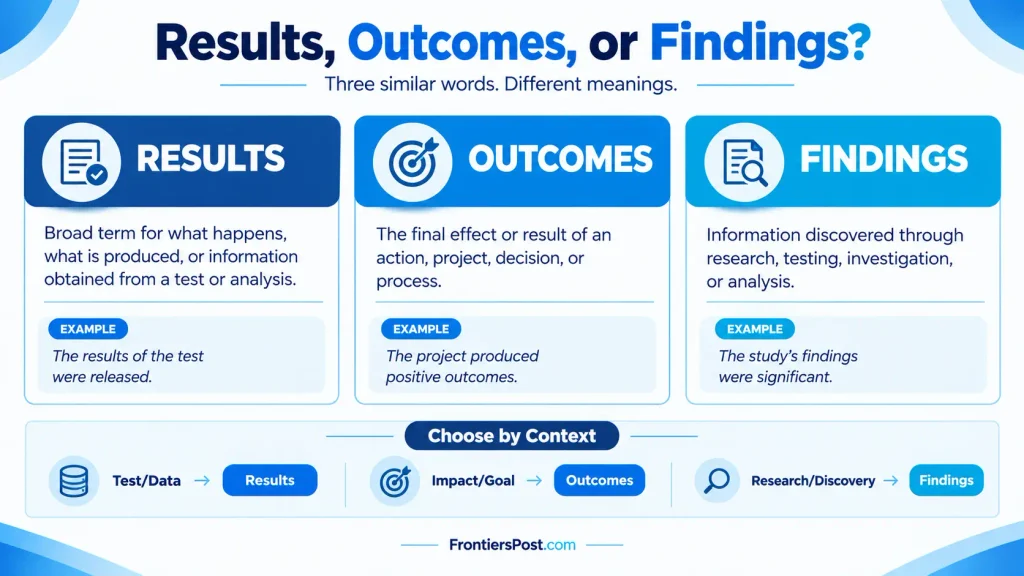
The phrase “another way to say results” refers to alternative words or phrases that communicate the same or a closely related idea as “results.”
For example, you might use “outcomes” when discussing the effects of a project, “findings” when discussing research, or “scores” when referring to an exam or competition.
“Results” is commonly used in academic papers, business reports, workplace conversations, sports, education, and everyday English.
Why Use Other Ways to Say “Results”?
Using the same word repeatedly can make writing feel flat or imprecise. A more specific alternative can tell readers exactly what kind of results you mean.
Consider these benefits:
- Avoid repetition: Replace “results” when it appears too often.
- Improve precision: Choose a word that describes the exact type of result.
- Match the context: Academic, professional, casual, and financial situations may require different wording.
- Sound more natural: Some alternatives fit particular sentences better.
- Strengthen your writing: Specific vocabulary can make reports, essays, and presentations clearer.
10 Best Other Ways to Say “Results”

1. Outcomes
Meaning
Outcomes refers to what happens as a consequence of an action, decision, project, or situation. It is one of the most versatile alternatives to “results,” especially when discussing goals or the impact of an activity.
Best For
- Professional
- Formal
- Academic
Example 1
The training program produced positive outcomes for new employees.
Example 2
We will review the outcomes of the policy change after six months.
Quick Tip
Use outcomes when you want to emphasize what happened as a result of a particular action or process.
2. Findings
Meaning
Findings refers to information or facts discovered through research, analysis, testing, or investigation. It is especially common in academic papers, scientific studies, surveys, and professional reports.
Best For
- Professional
- Formal
- Academic
Example 1
The study’s findings support the need for additional research.
Example 2
Researchers presented their findings at the annual conference.
Quick Tip
Choose findings when “results” refers to information discovered during research rather than a general outcome.
3. Conclusions
Meaning
Conclusions are judgments or ideas reached after examining evidence, information, or results. The word focuses on what you determine from the available evidence rather than the raw information itself.
Best For
- Formal
- Academic
- Professional
Example 1
The researchers reached several important conclusions after analyzing the survey.
Example 2
Our conclusions are based on three years of customer data.
Quick Tip
Do not use conclusions when you simply mean numerical or experimental results. It usually refers to an interpretation drawn from evidence.
4. Effects
Meaning
Effects describe the changes or impacts caused by an action, event, decision, or condition. This word works well when you want to focus on how something influenced people, systems, or situations.
Best For
- Formal
- Academic
- Professional
Example 1
The new schedule had positive effects on employee productivity.
Example 2
The report examines the long-term effects of the environmental policy.
Quick Tip
Use effects when your main focus is the impact something had on another person, group, or situation.
5. Consequences
Meaning
Consequences are the effects that follow an action or decision. The word can describe either positive or negative outcomes, although it often carries a serious or negative tone depending on context.
Best For
- Formal
- Professional
- Academic
Example 1
The team considered the possible consequences before changing the procedure.
Example 2
Poor planning can have serious consequences for a small business.
Quick Tip
Use consequences when you want to emphasize what follows from a particular choice or action, especially when the impact is significant.
6. Achievements
Meaning
Achievements refers to successful results that demonstrate progress, ability, effort, or accomplishment. Unlike the neutral word “results,” it usually has a positive meaning.
Best For
- Professional
- Formal
- Friendly
- Warm
Example 1
Her achievements during the first year impressed the entire management team.
Example 2
The annual report highlights the company’s major achievements.
Quick Tip
Choose achievements when the results represent something successfully accomplished rather than simply something that happened.
7. Performance
Meaning
Performance describes how well a person, team, product, system, or organization operates or accomplishes a task. It is particularly useful in business, education, sports, and workplace settings.
Best For
- Professional
- Formal
- Academic
Example 1
The manager reviewed the team’s performance during the quarterly meeting.
Example 2
The updated software improved the device’s overall performance.
Quick Tip
Use performance when “results” is really about how well something or someone performed.
8. Returns
Meaning
Returns refers to the money or profit generated by an investment or financial activity. It is more specific than “results” and should generally be reserved for financial contexts.
Best For
- Professional
- Formal
Example 1
The investment generated strong returns over the past year.
Example 2
Investors are closely monitoring returns from the new fund.
Quick Tip
Use returns when discussing financial gains, investment performance, or money earned from an asset.
9. Scores
Meaning
Scores refers to numerical results used to measure performance in tests, games, competitions, assessments, or evaluations. It is more precise than “results” when a number represents the outcome.
Best For
- Casual
- Professional
- Academic
- Friendly
Example 1
Students received their exam scores on Friday afternoon.
Example 2
The final scores showed a close competition between the two teams.
Quick Tip
Use scores when the result is represented by a numerical rating, grade, or competitive total.
10. Data
Meaning
Data refers to facts, measurements, numbers, observations, or other information collected for analysis. It can sometimes replace “results,” but only when the sentence is referring to the information itself rather than the interpretation of that information.
Best For
- Professional
- Formal
- Academic
Example 1
The researchers collected data from more than 500 participants.
Example 2
The team used customer data to identify changes in buying behavior.
Quick Tip
Use data for collected information. If you mean what the data shows or proves, findings or conclusions may be more accurate.
Comparison Table

| Alternative | Best Used In | Tone |
| Outcomes | Projects, decisions, programs | Professional |
| Findings | Research, studies, investigations | Formal |
| Conclusions | Analysis, essays, research | Formal |
| Effects | Impacts and changes | Professional |
| Consequences | Actions and decisions | Serious |
| Achievements | Successes and accomplishments | Positive |
| Performance | Work, sports, business | Professional |
| Returns | Investments and finance | Formal |
| Scores | Tests, games, competitions | Neutral |
| Data | Research, analysis, statistics | Formal |
Common Mistakes
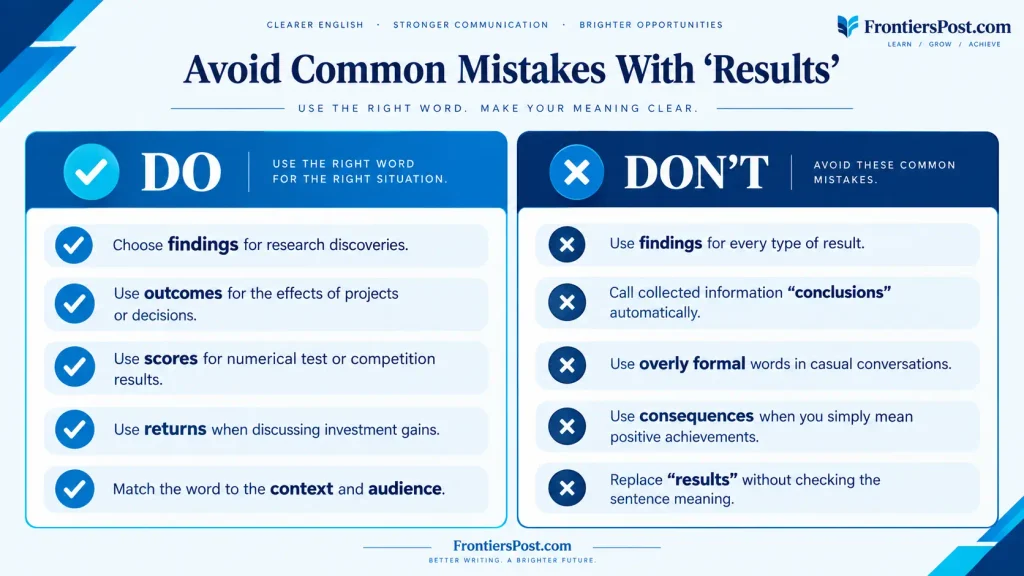
1. Using “Findings” for Every Type of Result
“Findings” specifically suggests information discovered through research or investigation. It may sound unnatural when describing a business project, sports match, or personal accomplishment.
2. Using “Consequences” When You Mean Positive Results
Although consequences can be neutral, the word often suggests serious or negative effects. For positive achievements, outcomes or achievements may communicate the intended meaning more clearly.
3. Confusing Data With Findings
Data is the information collected during research, while findings are what researchers discover after examining that information. The two terms are related but not interchangeable in every sentence.
4. Choosing a Word That Is Too Formal
Words such as conclusions and findings work well in academic writing but may sound unnecessarily formal in casual conversation. Match your vocabulary to your audience.
5. Ignoring the Specific Meaning of “Results”
Before replacing “results,” ask what the word means in your sentence. Are you talking about an outcome, research discovery, financial gain, achievement, or numerical score? The answer determines the best alternative.
Frequently Asked Questions
What is the best synonym for “results”?
Outcomes is one of the most useful general alternatives to “results” when you mean what happened after an action, decision, or process. However, there is no single replacement that works in every situation. Use findings for research, scores for tests or competitions, and returns for financial gains.
What is another way to say “results” in an essay?
In an essay, findings, outcomes, conclusions, effects, or evidence may work depending on the sentence. For example, “The study’s findings demonstrate…” is appropriate when discussing research. If you are explaining what happened because of an action, “outcomes” may be a better choice.
What is another word for “results” in research?
Findings is usually the most natural alternative when referring to discoveries made through research. For example, “The study’s findings indicate a relationship between sleep and academic performance.” Data refers to the collected information, while conclusions refer to interpretations based on the evidence.
What is another way to say “positive results”?
You can say positive outcomes, successful outcomes, favorable results, achievements, or strong performance, depending on the context. “Positive outcomes” works well for projects and decisions, while “achievements” is better when emphasizing something accomplished successfully.
What is another word for “results” in business?
Common choices include outcomes, performance, achievements, effects, and returns. The right word depends on the subject. Use “performance” for how well a company or team is doing, “returns” for investment gains, and “outcomes” for the effects of a business initiative.
Can “outcomes” replace “results”?
Yes, outcomes can replace “results” in many professional, academic, and everyday contexts. The two words are closely related when discussing what happens after an action or process. However, “outcomes” often emphasizes the eventual effects or consequences, while “results” can have a broader meaning.
What is a professional way to say “results”?
Outcomes, findings, performance, achievements, or conclusions can sound more precise and professional than “results,” depending on the context. For example, “We reviewed the project outcomes” is appropriate for a workplace report, while “The research findings were significant” fits an academic or scientific setting.
What is the difference between results and outcomes?
Results is a broad term for what happens or is produced by an action, process, test, or event. Outcomes usually focuses on the eventual effects or consequences of that action. In many professional contexts, the words can be used interchangeably, but “outcomes” can sound more specific when discussing goals and impact.
You may also find these guides useful: Another Way to Say Similarly, Another Way to Say “Since” and “Talks About” Alternatives.
Conclusion
Choosing another way to say results can make your writing more precise and natural. The best alternative depends on what you actually mean. Use outcomes for the effects of projects or decisions, findings for research discoveries, and conclusions for judgments based on evidence.
For successful accomplishments, achievements is a stronger choice, while performance works well when discussing how effectively someone or something operates. In financial contexts, returns is more precise, and scores fits tests and competitions.
The key is to consider the meaning before replacing the word. Instead of searching for a synonym that simply sounds different, choose the word that tells your reader exactly what kind of results you mean.

The FrontiersPost editorial team writes and reviews every guide to word and phrase alternatives, with clear meanings, tone notes and example sentences for everyday, academic and professional English.