
If you’re looking for another way to say similarly, several expressions can help you connect ideas without repeating the same word. Good alternatives include likewise, in the same way, correspondingly, equally, in a similar manner, and along the same lines. The best choice depends on whether you’re writing an academic essay, a professional email, or having an everyday conversation.
Key Takeaways
- Likewise is a natural alternative for both professional and everyday writing.
- In the same way works well when explaining similarities between actions or ideas.
- Correspondingly is useful when two things have a related or matching relationship.
- Along the same lines sounds natural in informal conversations and discussions.
- Choose alternatives based on context, tone, and the relationship between your ideas.
The word “similarly” helps connect two ideas that share something in common. It makes writing smoother by showing readers that another point, situation, or example has a comparable quality.
However, using the same transition repeatedly can make your writing sound predictable. Whether you’re writing an academic essay, preparing a business report, or sending a professional email, choosing different expressions can make your communication more engaging.
Fortunately, there are several natural alternatives to “similarly” that work in different situations. Below are 10 useful options, along with their meanings, examples, and tips to help you choose the right expression.
What Does Similarly Mean?
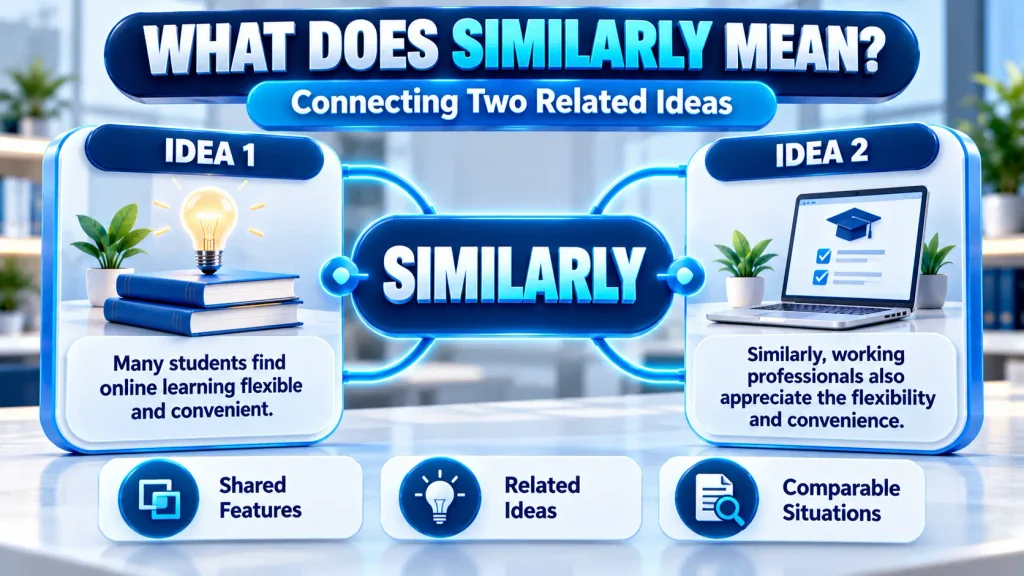
“Similarly” is an adverb used to show that two or more things share comparable features, qualities, actions, or circumstances.
It helps readers understand that a new point relates to something mentioned earlier. Writers often use it to introduce a supporting argument, compare situations, or connect related observations.
For example:
- Sarah enjoys reading historical novels. Similarly, her brother prefers books about the past.
- The first company improved customer service. Similarly, the second company introduced better support options.
In both examples, “similarly” connects two related ideas and makes the relationship between them clear.
Why Use Alternatives to Similarly?

Although “similarly” is useful, repeating it throughout an article, essay, or email can make your writing feel monotonous.
Using alternative expressions gives you more flexibility and helps communicate the exact relationship between ideas.
Here are some reasons to consider different wording:
- Improve academic writing: Different transitions help connect arguments and supporting evidence.
- Avoid repetition: Varying your vocabulary makes paragraphs more interesting.
- Sound more professional: Certain alternatives work particularly well in reports, presentations, and business communication.
- Improve clarity: Some expressions explain the relationship between two ideas more precisely.
- Match your tone: You can choose formal, neutral, or conversational wording depending on your audience.
The key is to select an expression that accurately connects your ideas rather than replacing “similarly” with a word that only sounds different.
10 Best Alternatives to Similarly

The following expressions are useful in academic writing, professional communication, and everyday conversations. Each has a slightly different meaning and tone.
1. Likewise
Meaning and Usage
“Likewise” is one of the closest and most natural alternatives to “similarly.” It indicates that another person, situation, or idea shares a comparable quality or experience.
It works in both formal and informal communication, making it a versatile choice.
Best For
- Professional emails
- Academic writing
- Everyday conversations
- Business reports
Example Sentences
- The marketing team values creativity. Likewise, the design team encourages fresh ideas.
- Emma enjoys working independently. Likewise, her colleague prefers managing projects alone.
- Our customers appreciate quick responses. Likewise, they value friendly service.
Quick Tip
Use “likewise” when you want a short, natural transition between two related statements. It can also mean “the same to you” in everyday conversations.
2. In the Same Way
Meaning and Usage
“In the same way” explains that something happens or works through a method or process comparable to another.
It is slightly more explanatory than “similarly” and helps readers understand how two situations are connected.
Best For
- Academic essays
- Explanatory writing
- Instructions
- Professional presentations
Example Sentences
- Students learn vocabulary through regular practice. In the same way, they improve their writing through consistent effort.
- The first department handles customer requests. In the same way, the second department manages incoming inquiries.
- Exercise improves physical health. In the same way, regular reading supports mental development.
Quick Tip
Use this expression when comparing methods, processes, or actions. It is particularly helpful when explaining how one situation resembles another.
3. In a Similar Manner
Meaning and Usage
“In a similar manner” is a more formal expression that describes two actions or processes that happen in comparable ways.
It is especially useful when discussing methods, procedures, or professional practices.
Best For
- Academic papers
- Research discussions
- Formal reports
- Business documents
Example Sentences
- The researchers examined the first group. In a similar manner, they evaluated the second group.
- The company improved its online services. In a similar manner, it upgraded its mobile platform.
- The first experiment measured temperature changes. In a similar manner, the second experiment recorded variations in pressure.
Quick Tip
Choose this expression for formal explanations. In casual conversations, “in the same way” usually sounds more natural.
4. Along the Same Lines
Meaning and Usage
“Along the same lines” means that something follows a similar idea, approach, or direction.
It is a conversational expression that works particularly well when introducing a related thought or suggestion.
Best For
- Team discussions
- Friendly emails
- Meetings
- Everyday conversations
Example Sentences
- We should focus on improving customer satisfaction. Along the same lines, we need to make our support process faster.
- I prefer simple website designs. Along the same lines, I think we should avoid unnecessary features.
- Your suggestion makes sense. Along the same lines, I would recommend updating the training materials.
Quick Tip
Use this expression when connecting related opinions, suggestions, or approaches. It sounds natural in discussions but may be too conversational for some academic papers.
5. Correspondingly
Meaning and Usage
“Correspondingly” describes something that changes, develops, or happens in a way that matches another situation.
Unlike “similarly,” it often emphasizes a direct relationship between two related changes or outcomes.
Best For
- Academic writing
- Business reports
- Data analysis
- Formal explanations
Example Sentences
- Customer demand increased during the summer. Correspondingly, the company expanded its production.
- The first department received additional funding. Correspondingly, its operational capacity improved.
- As employee responsibilities increased, compensation levels rose correspondingly.
Quick Tip
Use “correspondingly” when two developments are connected or one reflects another. Avoid using it simply because two unrelated things share a general similarity.
6. Equally
Meaning and Usage
“Equally” can show that two things are comparable in importance, value, or relevance.
It is useful when emphasizing that another point deserves the same attention as the first.
Best For
- Professional communication
- Academic discussions
- Presentations
- Persuasive writing
Example Sentences
- Experience is important when hiring employees. Equally, strong communication skills can make a difference.
- Students need access to good learning materials. Equally, they benefit from supportive teachers.
- Product quality matters to customers. Equally, reliable customer service influences their decisions.
Quick Tip
Use “equally” when you want to emphasize comparable importance. Remember that it does not always mean two things are identical.
7. By the Same Token
Meaning and Usage
“By the same token” introduces another point based on similar reasoning or a comparable principle.
It is slightly more formal than everyday conversational expressions and works well when developing an argument.
Best For
- Opinion writing
- Academic discussions
- Professional arguments
- Formal conversations
Example Sentences
- Employees should respect their managers. By the same token, managers should treat employees fairly.
- Customers expect high-quality products. By the same token, businesses should provide dependable customer support.
- Students must complete their assignments on time. By the same token, instructors should return feedback promptly.
Quick Tip
Use this phrase when the second statement follows the same reasoning as the first. It is especially effective when discussing responsibilities, expectations, or shared principles.
8. Comparably
Meaning and Usage
“Comparably” means in a way that can be compared with something else, particularly in terms of quality, size, performance, or degree.
It is useful when discussing measurable similarities or comparable characteristics.
Best For
- Business reports
- Performance reviews
- Research writing
- Product comparisons
Example Sentences
- The new software performs well. Comparably, the previous version offers reliable features.
- Both departments achieved strong results, with comparably high levels of customer satisfaction.
- The two candidates demonstrated comparably strong communication skills.
Quick Tip
Use “comparably” when discussing qualities or results that can reasonably be compared. It is not always interchangeable with “likewise.”
9. In Like Manner
Meaning and Usage
“In like manner” is a formal expression meaning in a similar way or using a comparable approach.
It is less common in everyday American English but can work in formal or carefully structured writing.
Best For
- Formal documents
- Academic discussions
- Traditional written communication
- Detailed explanations
Example Sentences
- The first group completed the assessment successfully. In like manner, the second group achieved the required results.
- The organization supports local schools. In like manner, it contributes to community development programs.
- The first policy protects employee rights. In like manner, the second policy promotes workplace safety.
Quick Tip
Use this expression sparingly. “In the same way” is generally more natural and easier to understand for modern readers.
10. Similarly to That
Meaning and Usage
“Similarly to that” can be used conversationally to refer to something that resembles a previously mentioned idea or situation. However, it is less natural as a standalone transition than most alternatives on this list.
In many situations, “in a similar way” or “along the same lines” is a better choice.
Best For
- Informal explanations
- Conversational comparisons
- Simple discussions
Example Sentences
- The first program helps students improve their writing. In a similar way, the second program develops their reading skills.
- Our previous campaign focused on customer engagement. Along the same lines, the new campaign encourages stronger customer relationships.
Quick Tip
Avoid using “similarly to that” when a simpler expression works better. Choose “in a similar way” for clearer and more natural writing.
Comparison Table: 10 Alternatives to Similarly
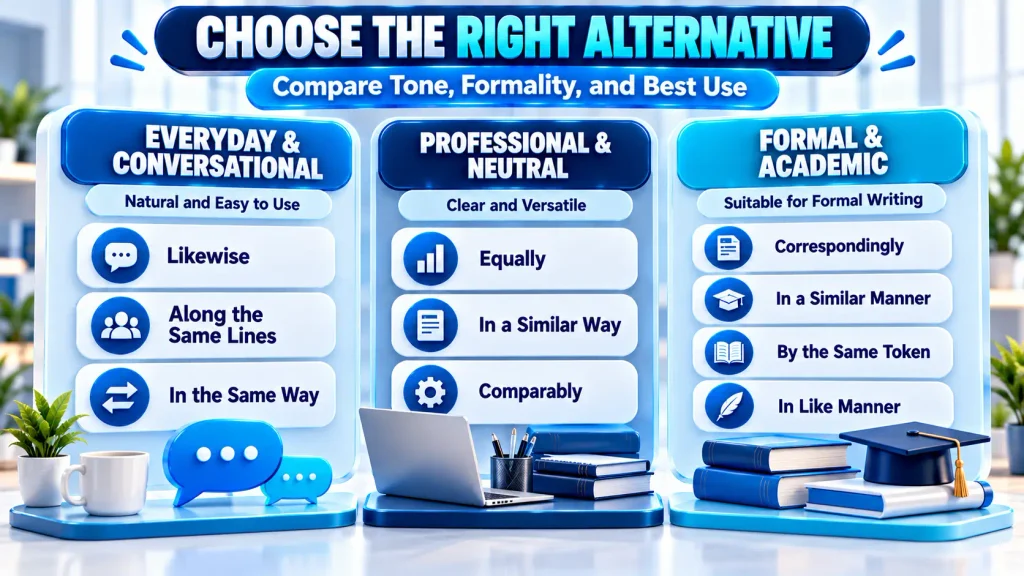
Choosing the right alternative depends on your intended meaning and audience. This table makes it easier to compare the expressions.
| Alternative Phrase | Tone | Best Use | Formality |
|---|---|---|---|
| Likewise | Neutral | Emails and essays | Medium |
| In the same way | Neutral | Explanations | Medium |
| In a similar manner | Formal | Academic writing | High |
| Along the same lines | Conversational | Discussions | Low |
| Correspondingly | Formal | Reports and analysis | High |
| Equally | Neutral | Arguments and presentations | Medium |
| By the same token | Formal | Logical arguments | High |
| Comparably | Formal | Comparisons and reports | High |
| In like manner | Very formal | Formal documents | High |
| In a similar way | Neutral | Everyday and academic writing | Medium |
Common Mistakes to Avoid
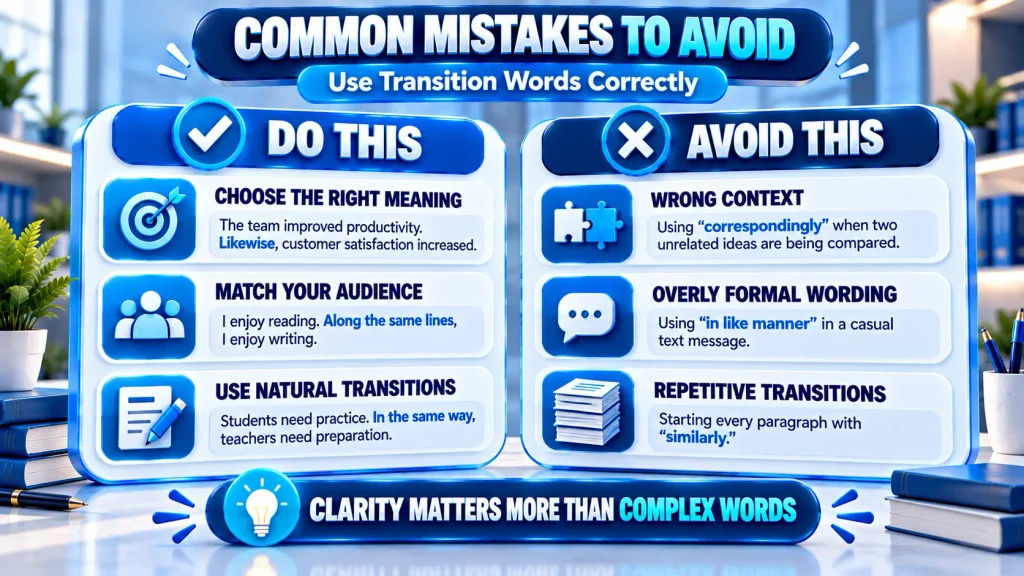
Although these alternatives can improve your writing, using them incorrectly can create confusion. Watch out for these common mistakes.
1. Using alternatives without checking their meaning
Not every alternative communicates exactly the same relationship.
For example:
Incorrect: “Sales increased. Likewise, customer complaints decreased.”
Better: “Sales increased. Meanwhile, customer complaints decreased.”
The second example shows a change happening at the same time rather than necessarily describing a similar development.
2. Using overly formal expressions in casual conversations
Phrases such as “in like manner” and “in a similar manner” can sound unnatural in everyday messages.
Instead of saying:
“She enjoys traveling. In like manner, I enjoy exploring new places.”
Try:
“She enjoys traveling. I do, too.”
3. Repeating the same transition throughout an essay
Using “likewise” in every paragraph does not improve vocabulary variety.
Instead, choose transitions based on the relationship between your ideas.
4. Confusing similarity with cause and effect
“Correspondingly” often suggests a relationship between developments. It should not automatically replace “similarly” when two unrelated observations are being compared.
5. Forgetting punctuation
When expressions such as “likewise,” “similarly,” and “correspondingly” introduce independent clauses, a comma generally follows the introductory transition.
Example:
“Likewise, the second team completed the project successfully.”
Frequently Asked Questions
1. What is the best alternative to similarly?
“Likewise” is one of the best general alternatives because it works in academic writing, professional communication, and everyday conversations. Other useful choices include “in the same way,” “equally,” and “along the same lines.” Your choice should depend on the relationship between the ideas.
2. What is a more professional way to say similarly?
For professional communication, consider “likewise,” “correspondingly,” “in a similar manner,” and “equally.” These expressions work well in business reports, presentations, and formal emails. Choose the one that best explains how the two points are connected.
3. What is another word for similarly in an essay?
Good alternatives for academic essays include “likewise,” “in the same way,” “in a similar manner,” and “correspondingly.” These transitions help connect supporting arguments and related observations without repeating the same expression throughout your writing.
4. Can I use likewise instead of similarly?
Yes. “Likewise” is a natural substitute for “similarly” in many situations. Both expressions connect related ideas. For example, “The first student enjoys science. Likewise, the second student loves mathematics.” However, check the context to ensure the relationship between the statements remains clear.
5. Is similarly a formal or informal word?
“Similarly” is a neutral transition that works in both formal and informal communication. You can use it in academic essays, business reports, professional emails, and everyday conversations. Its suitability depends more on the sentence and context than on the word itself.
6. What can I use instead of similarly in academic writing?
In academic writing, useful alternatives include “likewise,” “correspondingly,” “in a similar manner,” and “in the same way.” These expressions help connect research findings, arguments, and explanations while maintaining a clear and appropriate tone.
7. What is the difference between similarly and likewise?
Both words introduce a related idea, but “likewise” can also express agreement or return a sentiment. For example, “I enjoyed meeting you” can be answered with “Likewise.” “Similarly” is generally used to compare situations, actions, or characteristics.
8. How can I avoid repeating similarly in writing?
Use a variety of transitions that accurately reflect your intended meaning. Consider “likewise” for related statements, “in the same way” for comparable actions, and “equally” for points of similar importance. You can also restructure sentences to make comparisons without adding another transition.
Writing something similar? Try Another Way to Say “Since”, “Talks About” Alternatives or Another Way to Say “The Fact That” in Clear and Natural English.
Conclusion
Choosing another way to say similarly can make your writing clearer, more natural, and less repetitive. Expressions such as likewise, in the same way, in a similar manner, and along the same lines are useful for connecting related ideas. For more formal communication, correspondingly and by the same token can help express relationships between arguments or developments.
However, the best alternative depends on what you want to communicate. Use “likewise” for general comparisons, “equally” when emphasizing importance, and “in the same way” when explaining similar actions or processes. By selecting transitions that match your meaning and audience, you can improve your essays, professional emails, reports, and everyday conversations.
“By selecting transitions that match your meaning and audience, you can improve your essays, professional emails, reports, and everyday conversations with a better understanding of transition words and phrases for clearer writing.”

The FrontiersPost editorial team writes and reviews every guide to word and phrase alternatives, with clear meanings, tone notes and example sentences for everyday, academic and professional English.




