

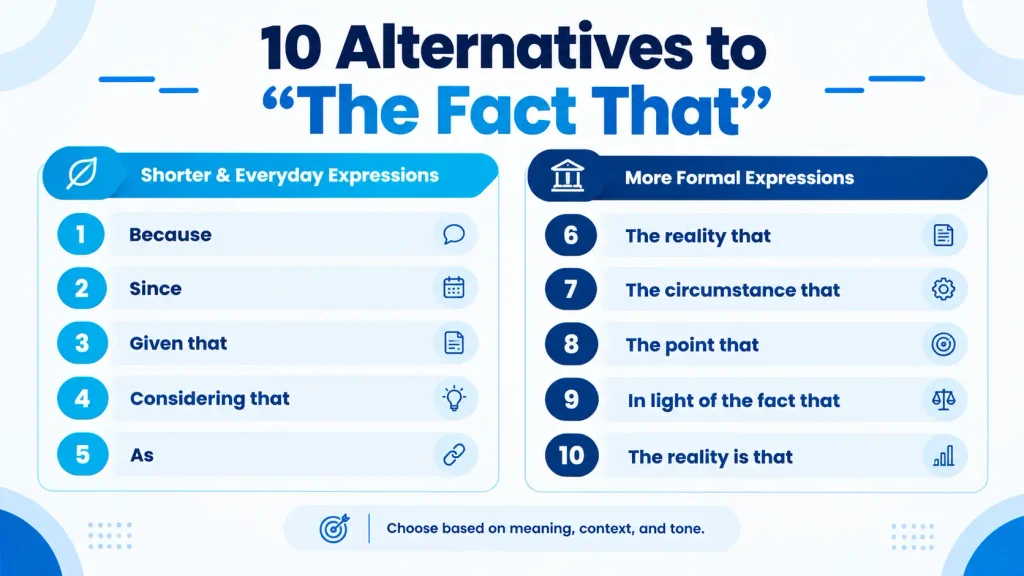
Another way to say “the fact that” includes “because,” “given that,” “considering that,” “since,” “as,” “in light of the fact that,” “the reality that,” “the circumstance that,” “the point that,” and “the reality is that.” The best choice depends on whether you want your writing to sound casual, professional, formal, or more direct.
Key Takeaways
- “The fact that” is useful, but it can sound wordy when repeated.
- “Because” and “since” often make everyday writing clearer and more direct.
- “Given that” and “considering that” work well in professional communication.
- “In light of the fact that” is appropriate for formal writing but can feel lengthy.
- Choose an alternative based on your sentence, tone, and intended meaning.
What Does “Another Way to Say the Fact That” Mean?

“The fact that” is a phrase used to introduce a true, known, or accepted situation that supports the rest of a sentence.
For example, you might write, “The fact that she arrived early helped us start the meeting on time.” Here, “the fact that” introduces the situation that she arrived early.
People often search for another way to say the fact that because the phrase can become repetitive or unnecessarily wordy. Replacing it with a more direct expression can make emails, essays, reports, and everyday conversations sound smoother.
Common alternatives include “because,” “since,” “given that,” and “considering that.” The right option depends on what you want the sentence to communicate.
Why Use Other Ways to Say “The Fact That”?

Using alternatives can make your writing more natural and precise. In many cases, you can remove unnecessary words without changing the meaning.
Here are some reasons to choose a different phrase:
- Avoid repetition: Prevent the same expression from appearing several times.
- Improve clarity: Make your sentence easier to understand.
- Sound more natural: Use wording that fits everyday American English.
- Match the situation: Choose language appropriate for casual, professional, or formal writing.
- Be more concise: Replace a longer construction with a shorter one.
10 Best Other Ways to Say “The Fact That”
1. Because
Meaning
“Because” directly explains the reason for something. It is one of the simplest and most natural replacements when “the fact that” introduces a reason or cause.
Best For
- Casual
- Professional
- Friendly
Example 1
We canceled the outdoor event because the forecast called for heavy rain.
Example 2
She was able to finish early because the team provided the information she needed.
Quick Tip
Use “because” when the original phrase is explaining why something happened.
2. Since
Meaning
“Since” can introduce a reason in much the same way as “because.” It sounds natural in both everyday and professional writing, although context should make the meaning clear.
Best For
- Casual
- Professional
- Friendly
Example 1
Since the office was closed, we completed the meeting online.
Example 2
I decided to call you since I had a few questions about the project.
Quick Tip
Use “since” when the reason is already clear from the surrounding context.
3. Given That
Meaning
“Given that” acknowledges a known condition or circumstance before presenting a conclusion. It is especially useful when discussing decisions, plans, or practical situations.
Best For
- Professional
- Formal
- Polite
Example 1
Given that the deadline is tomorrow, we should review the final draft today.
Example 2
Given that several employees work remotely, the company added virtual meeting options.
Quick Tip
Choose “given that” when you want to show that a known circumstance influenced a decision.
4. Considering That
Meaning
“Considering that” draws attention to a particular circumstance when explaining a conclusion or reaction. It can sound thoughtful and balanced without being overly formal.
Best For
- Professional
- Formal
- Polite
Example 1
Considering that the store opened only last month, its sales numbers are impressive.
Example 2
Considering that he had never used the software before, he learned it remarkably quickly.
Quick Tip
Use this phrase when the circumstance you mention helps explain why something seems reasonable or surprising.
5. As
Meaning
“As” can introduce a reason or cause in a concise way. It is often more polished than repeating “the fact that,” particularly in written communication.
Best For
- Professional
- Formal
- Polite
Example 1
As the meeting had already started, we joined without further delay.
Example 2
As the road was closed, the driver chose a different route.
Quick Tip
Make sure the sentence clearly shows that “as” means because, rather than referring to time or comparison.
6. The Reality That
Meaning
“The reality that” emphasizes that a situation is real or unavoidable. It can be useful when discussing circumstances that have an important effect on a decision or argument.
Best For
- Formal
- Professional
Example 1
The reality that housing costs continue to rise has affected many families.
Example 2
The reality that customers expect faster service has changed how businesses operate.
Quick Tip
Use this phrase when you specifically want to emphasize the real-world situation, rather than simply give a reason.
7. The Circumstance That
Meaning
“The circumstance that” highlights a particular condition or situation. It is more formal than everyday alternatives and is most useful when discussing specific circumstances.
Best For
- Formal
- Professional
Example 1
The circumstance that several roads were closed delayed emergency services.
Example 2
The circumstance that the contract had expired required both parties to renegotiate.
Quick Tip
Reserve this phrase for formal or technical contexts where discussing a specific circumstance is important.
8. The Point That
Meaning
“The point that” can introduce an important detail, observation, or argument. It works best when the information that follows is relevant to a broader discussion.
Best For
- Professional
- Formal
- Friendly
Example 1
The point that she raised several concerns deserves further discussion.
Example 2
The point that customers prefer online support should influence our next strategy.
Quick Tip
Use this expression when you want to emphasize a particular point or consideration, not simply state a cause.
9. In Light of the Fact That
Meaning
“In light of the fact that” introduces information that should be considered when making a decision or reaching a conclusion. It is common in formal and professional writing.
Best For
- Formal
- Professional
- Polite
Example 1
In light of the fact that costs have increased, we need to review the current budget.
Example 2
In light of the fact that the policy has changed, all employees should read the updated guidelines.
Quick Tip
Although useful, this phrase is long. Use a shorter alternative when the same meaning can be expressed more clearly.
10. The Reality Is That
Meaning
“The reality is that” introduces a statement about an actual condition or situation. It can add emphasis when the writer wants readers to recognize something that may be overlooked.
Best For
- Professional
- Formal
- Warm
Example 1
The reality is that small changes can make a significant difference over time.
Example 2
The reality is that not every project will follow the original schedule.
Quick Tip
Use this phrase sparingly because it adds emphasis. For simple cause-and-effect sentences, “because” may be more direct.
Comparison Table

| Alternative | Best Used In | Tone |
| Because | Everyday and professional writing | Direct |
| Since | Conversations and emails | Natural |
| Given that | Business and workplace writing | Professional |
| Considering that | Explanations and discussions | Thoughtful |
| As | Formal and professional writing | Concise |
| The reality that | Reports and analytical writing | Serious |
| The circumstance that | Formal or technical writing | Formal |
| The point that | Discussions and arguments | Emphatic |
| In light of the fact that | Formal documents | Formal |
| The reality is that | Essays and professional communication | Emphatic |
Common Mistakes

1. Using Casual Phrases in Professional Emails
Not every alternative has the same level of formality. “Because” is perfectly acceptable in most professional emails, while some longer expressions may sound unnecessarily formal.
2. Choosing Overly Formal Language
Phrases such as “in light of the fact that” can make simple ideas harder to read. If “because” communicates the same idea, the shorter option is often clearer.
3. Repeating “The Fact That”
Using the phrase several times in one paragraph can make your writing feel repetitive. Look for opportunities to replace it with a direct conjunction or a more precise expression.
4. Forgetting Context
Not every alternative has exactly the same function. “Because” usually explains a reason, while “the reality that” emphasizes an existing situation.
5. Adding Words Without Adding Meaning
Longer does not always mean more professional. Strong writing communicates the intended idea with the fewest words necessary.
Frequently Asked Questions
1. What is another way to say “the fact that”?
Common alternatives include “because,” “since,” “given that,” “considering that,” and “as.” The best choice depends on the sentence. For everyday writing, “because” is often the clearest option, while “given that” can work well in professional communication.
2. What is a more professional way to say “the fact that”?
“Given that,” “considering that,” and “in light of the fact that” can sound professional. However, professional writing does not always require longer wording. In many business contexts, a simple phrase such as “because” is clearer and more efficient.
3. Can I replace “the fact that” with “because”?
Yes, when “the fact that” introduces a reason or cause. For example, “The event was canceled due to the fact that it rained” can become “The event was canceled because it rained.” The second version is shorter and more direct.
4. Is “since” a synonym for “the fact that”?
“Since” can replace “the fact that” when the phrase introduces a reason. For example, “Since the store was closed, we went home” communicates the same basic cause-and-effect relationship as a longer sentence using “the fact that.”
5. Is “given that” formal?
“Given that” is generally more polished and professional than casual expressions such as “because” or “since,” although it is still common in normal business writing. It works particularly well when a known circumstance leads to a decision or conclusion.
6. What is the best alternative to “the fact that” in an essay?
The best choice depends on the sentence. “Because,” “since,” “given that,” and “considering that” can all work well. Academic writing usually benefits from precise and concise wording rather than automatically choosing the longest or most formal expression.
7. Is “in light of the fact that” too formal?
It can be too formal for casual conversation or a short email. The phrase is useful when writing formal notices, reports, or official communications, but “because,” “given that,” or “considering that” may communicate the same idea more naturally.
8. How can I avoid repeating “the fact that”?
First, identify what the phrase is doing in your sentence. If it introduces a reason, try “because” or “since.” If it introduces a condition that affects a decision, “given that” may work better. In some cases, you can simply rewrite the sentence and remove the phrase entirely.
You may also find these guides useful: Another Way to Say “Therefore”, Another Way to Say This in Emails, Essays, and Everyday English and Another Way to Say “Too Much”.
Conclusion
Finding another way to say “the fact that” can make your writing clearer, shorter, and more natural. The best replacement depends on the role the phrase plays in your sentence.
For everyday and professional communication, “because” and “since” are often strong choices. If you are explaining a decision based on a known circumstance, “given that” or “considering that” may fit better. For formal writing, options such as “in light of the fact that” or “the circumstance that” can be appropriate, although they should not be used simply to make a sentence sound more sophisticated.
The key is to focus on meaning first and tone second. Choose the shortest phrase that accurately expresses your idea and fits your audience. Clear and concise writing is usually more effective than unnecessarily complicated wording.

The FrontiersPost editorial team writes and reviews every guide to word and phrase alternatives, with clear meanings, tone notes and example sentences for everyday, academic and professional English.




