

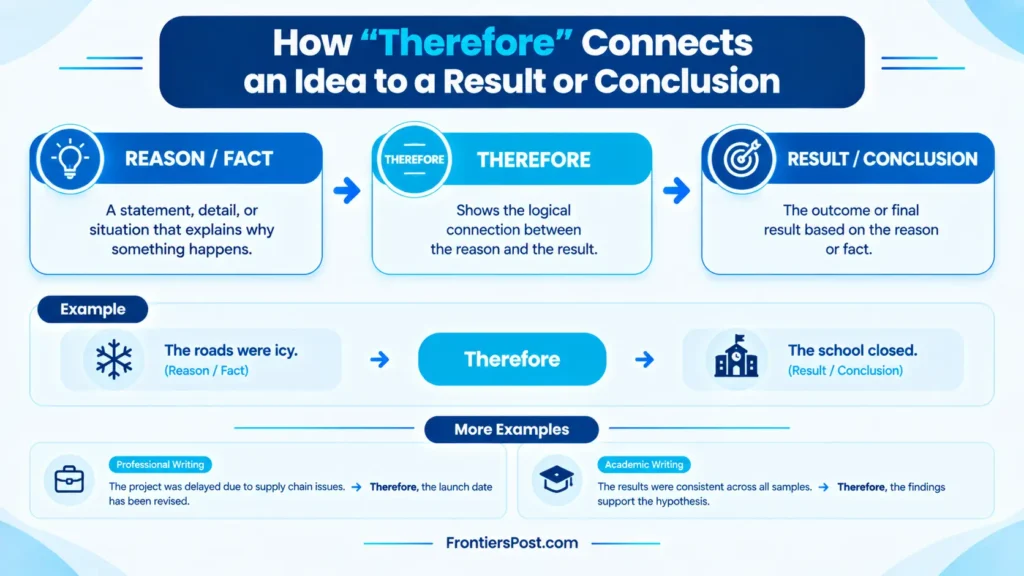
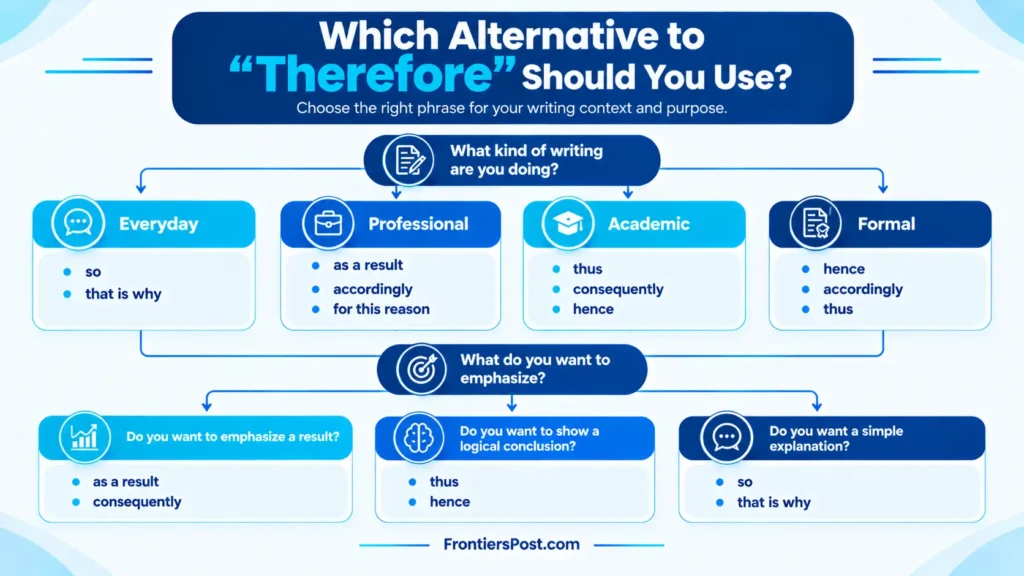
If you need another way to say “therefore,” try “thus,” “consequently,” “as a result,” “for this reason,” or “accordingly.” For casual conversation, “so” sounds more natural. In academic and professional writing, “consequently,” “thus,” and “accordingly” are strong choices.
Key Takeaways
- “Thus” is a concise choice for formal and academic writing.
- “Consequently” clearly shows that one event or fact leads to another.
- “As a result” works well in professional, academic, and everyday contexts.
- “So” is the most natural choice for casual conversations.
- The best alternative depends on your tone, audience, and context.
What Does “Another Way to Say Therefore” Mean?
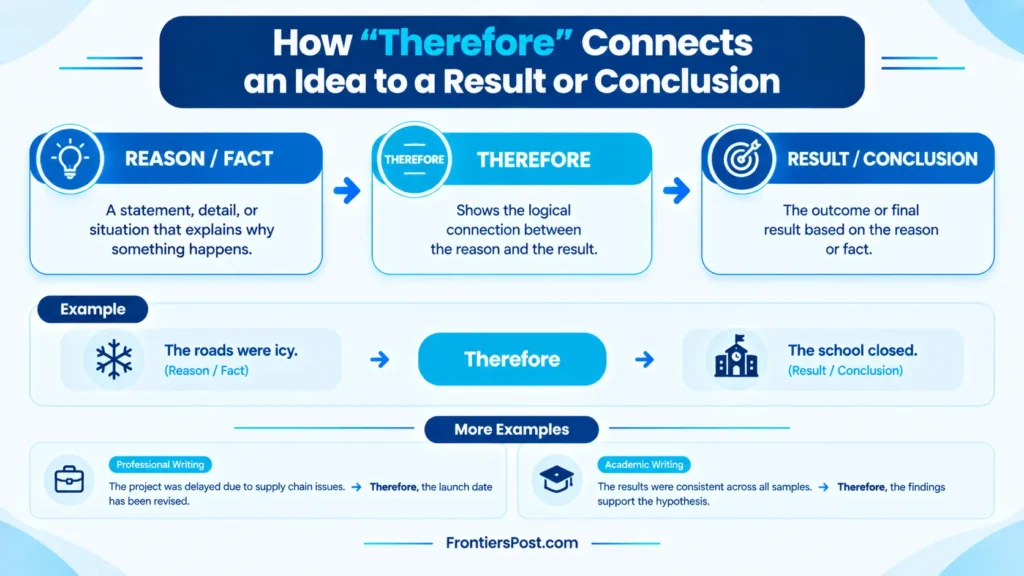
The phrase “another way to say therefore” refers to different words or expressions that can replace “therefore” while keeping the same basic meaning.
Therefore introduces a conclusion, result, or logical consequence. For example, “The roads were icy; therefore, the school closed” means that the icy roads caused the school to close.
People often look for alternatives to avoid repetition, improve sentence flow, or match a specific level of formality. You may need a different expression in an academic essay than you would use in a text message or casual conversation.
Why Use Other Ways to Say “Therefore”?
Using different expressions can make your writing sound more natural and precise. Although “therefore” is useful, repeating it too often can make your sentences feel predictable.
Other options can help you:
- Avoid repeating the same transition word.
- Create smoother connections between ideas.
- Match formal, professional, or casual situations.
- Make cause-and-effect relationships clearer.
- Improve the flow of essays, reports, emails, and conversations.
The key is not simply to replace “therefore” with another word. Choose an expression that fits the meaning and tone of the sentence.
10 Best Other Ways to Say “Therefore”
1. Thus
Meaning
“Thus” means “in this way” or “as a result.” It often introduces a conclusion that logically follows from the information before it.
This is a concise and polished alternative that works especially well in academic and formal writing.
Best For
- Formal
- Professional
- Academic
Example 1
The research sample was too small; thus, the findings should be interpreted with caution.
Example 2
She completed all the required training and thus qualified for the position.
Quick Tip
Use “thus” when you want a concise, formal transition without adding unnecessary words.
2. Consequently
Meaning
“Consequently” means “as a consequence” or “as a result.” It emphasizes that something happened because of a previous event, decision, or condition.
It is particularly useful when you want to make a clear cause-and-effect relationship.
Best For
- Formal
- Professional
- Academic
Example 1
The company missed its sales target; consequently, management revised the marketing strategy.
Example 2
The storm damaged several power lines, and consequently, thousands of residents lost electricity.
Quick Tip
Choose “consequently” when the result is a direct and important consequence of what came before.
3. As a Result
Meaning
“As a result” introduces an outcome caused by something previously mentioned. It is one of the most versatile alternatives to “therefore.”
Unlike some highly formal transitions, it sounds natural in both professional writing and everyday communication.
Best For
- Professional
- Formal
- Casual
- Academic
Example 1
The team improved its customer service process. As a result, customer satisfaction increased.
Example 2
He forgot to set an alarm; as a result, he arrived late for the meeting.
Quick Tip
Use “as a result” when you want to clearly connect a cause with its outcome without sounding overly formal.
4. For This Reason
Meaning
“For this reason” means that the information just mentioned provides the reason for a conclusion or decision.
It is especially helpful when you want to explain why someone made a particular choice.
Best For
- Formal
- Professional
- Polite
Example 1
The instructions were unclear. For this reason, we requested additional guidance from the supervisor.
Example 2
The museum is closed for renovations. For this reason, visitors should plan an alternative activity.
Quick Tip
Use this phrase when your main goal is to emphasize the reason behind a decision or conclusion.
5. Hence
Meaning
“Hence” is a formal word meaning “for this reason” or “as a result.” It is commonly found in academic, technical, legal, and professional writing.
It can sound more sophisticated than everyday alternatives, so it is less common in casual speech.
Best For
- Formal
- Academic
- Professional
Example 1
The data showed a consistent pattern, hence the researchers accepted the original hypothesis.
Example 2
The equipment requires specialized maintenance, hence the need for trained technicians.
Quick Tip
Use “hence” when the surrounding writing already has a formal or technical tone.
6. Accordingly
Meaning
“Accordingly” means “in a way that is appropriate to the situation” or “as a result of what has been stated.” It often connects information with a resulting action or decision.
It is common in business communication, reports, and formal announcements.
Best For
- Professional
- Formal
- Polite
Example 1
The project deadline has been moved forward; accordingly, all team members must adjust their schedules.
Example 2
The client requested several changes, and we accordingly updated the proposal.
Quick Tip
Use “accordingly” when an action or decision follows logically from new information.
7. So
Meaning
“So” is a simple and natural alternative to “therefore.” It commonly connects a reason with its result in everyday English.
Although it can be used in many situations, it generally sounds less formal than “therefore,” “thus,” or “consequently.”
Best For
- Casual
- Friendly
- Everyday
Example 1
I had an early appointment, so I left the house before sunrise.
Example 2
The restaurant was completely booked, so we decided to try the place next door.
Quick Tip
Use “so” in conversations, texts, and informal writing, but consider a more formal alternative for academic papers.
8. Because of This
Meaning
“Because of this” directly explains that something happened as a result of a previously mentioned situation.
It has a conversational quality and can make cause-and-effect relationships easy to understand.
Best For
- Casual
- Friendly
- Professional
Example 1
The instructions changed at the last minute. Because of this, we had to update the presentation.
Example 2
The neighborhood received heavy snowfall. Because of this, several local roads remained closed.
Quick Tip
Choose “because of this” when you want the cause-and-effect connection to feel straightforward and easy to follow.
9. That Is Why
Meaning
“That is why” explains the reason for a result, decision, or situation. It is especially common in spoken English and conversational writing.
It sounds more personal and direct than formal transitions such as “hence” or “consequently.”
Best For
- Casual
- Friendly
- Warm
- Polite
Example 1
I knew the traffic would be heavy. That is why I left thirty minutes early.
Example 2
She wanted to make sure everyone understood the plan. That is why she explained it again.
Quick Tip
Use “that is why” when speaking naturally or explaining a reason to someone in a direct, conversational way.
10. It Follows That
Meaning
“It follows that” introduces a conclusion that logically comes from the facts or ideas already presented.
It has a distinctly formal tone and works best when discussing reasoning, evidence, arguments, or conclusions.
Best For
- Formal
- Academic
- Professional
Example 1
The policy applies to all full-time employees. It follows that the new requirement applies to every department.
Example 2
The evidence supports the proposed explanation. It follows that further investigation should focus on the remaining variables.
Quick Tip
Use “it follows that” when you want to highlight a logical conclusion rather than simply describe an ordinary result.
Comparison Table
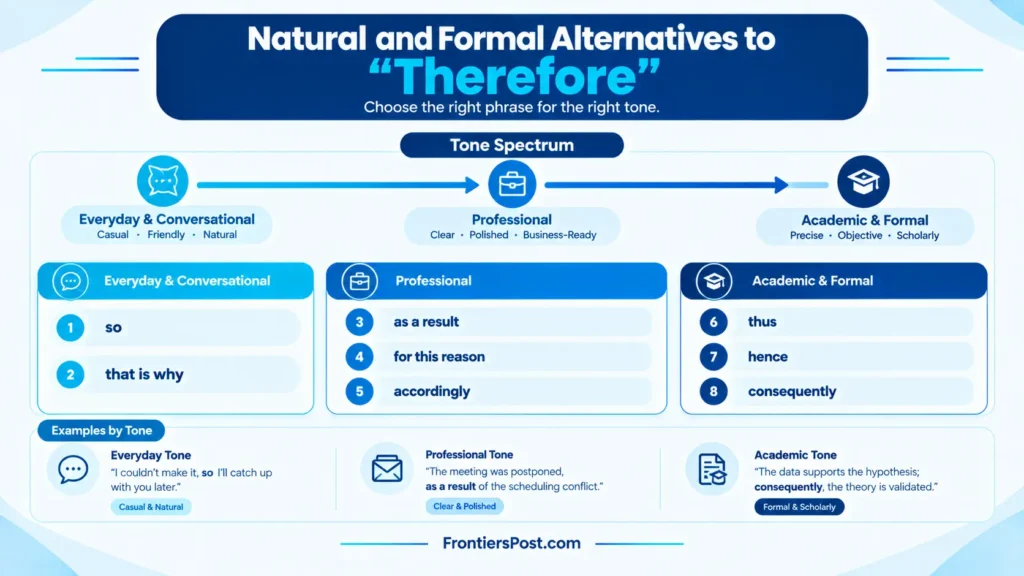
| Alternative | Best Used In | Tone |
| Thus | Academic writing, formal reports | Formal |
| Consequently | Essays, reports, professional writing | Formal |
| As a Result | Professional, academic, everyday writing | Neutral |
| For This Reason | Explanations, business writing | Formal/Polite |
| Hence | Academic, technical, formal writing | Formal |
| Accordingly | Business communication, formal writing | Professional |
| So | Conversation, texts, informal writing | Casual |
| Because of This | Everyday explanations, informal writing | Neutral |
| That Is Why | Conversation and personal communication | Friendly |
| It Follows That | Academic arguments and logical conclusions | Very Formal |
Common Mistakes
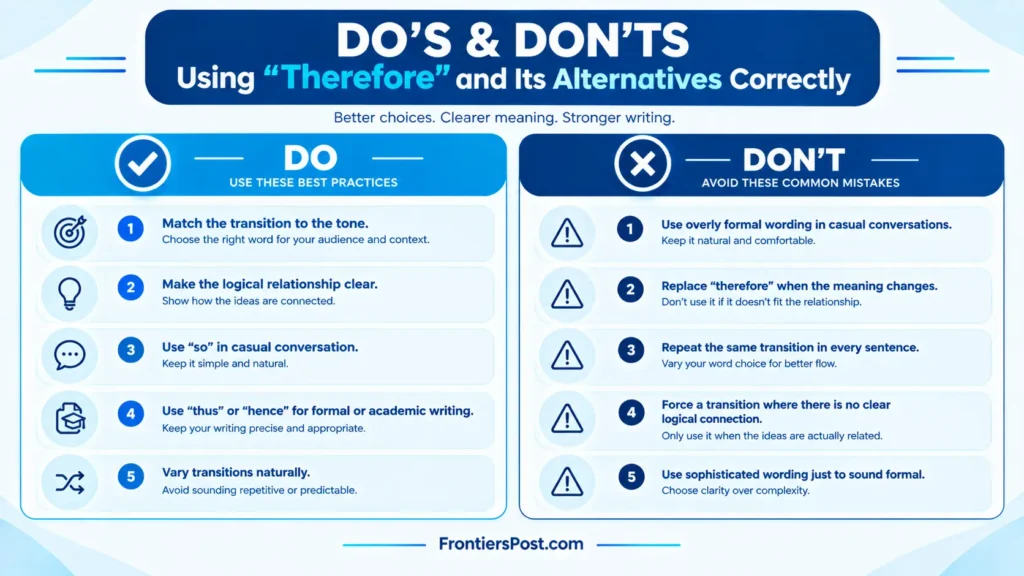
1. Using Casual Phrases in Professional Emails
Words such as “so” may be perfectly natural in conversation but can sound less polished in a formal business email. Consider “accordingly,” “as a result,” or “consequently” when the situation calls for a professional tone.
2. Choosing Overly Formal Language
Not every sentence needs “hence” or “it follows that.” Using formal transitions in a casual conversation can make your writing sound stiff or unnatural.
3. Repeating the Same Phrase
Using “therefore” in every paragraph can make an essay or report repetitive. Varying your transitions can improve readability while still preserving clear logical connections.
4. Forgetting Context
Not every alternative has exactly the same tone. “That is why” works naturally in conversation, while “it follows that” is much better suited to formal reasoning.
5. Forcing a Cause-and-Effect Connection
A transition should accurately represent the relationship between your ideas. Don’t use “consequently” unless the second statement actually follows from the first.
Frequently Asked Questions
1. What is another way to say “therefore” in an essay?
Some strong alternatives to “therefore” in an essay include “thus,” “consequently,” “as a result,” “hence,” and “for this reason.” The best choice depends on your sentence. For academic writing, “thus” and “consequently” are especially useful because they clearly connect evidence, reasoning, and conclusions.
2. What is a professional way to say “therefore”?
Professional alternatives include “consequently,” “accordingly,” “as a result,” and “for this reason.” These expressions work well in business emails, reports, presentations, and workplace documents. “Accordingly” is particularly useful when you are describing an action or decision that follows from new information.
3. What is a casual way to say “therefore”?
The most natural casual alternative is “so.” You can also use “that is why” or “because of this,” depending on the sentence. These expressions are common in everyday American English and usually sound more relaxed than “therefore” or “consequently.”
4. Can I use “thus” instead of “therefore”?
Yes. “Thus” can replace “therefore” when you are introducing a conclusion or result. For example, “The evidence was incomplete; thus, the researchers continued their investigation.” Keep in mind that “thus” generally has a formal or academic tone.
5. Is “hence” the same as “therefore”?
“Hence” and “therefore” often have similar meanings because both can introduce a conclusion or result. However, “hence” tends to sound more formal and is less common in everyday American conversation. It is often better suited to academic, technical, or formal writing.
6. What can I say instead of “therefore” in a sentence?
You can use “thus,” “consequently,” “as a result,” “accordingly,” “for this reason,” or “so.” Choose based on the relationship between your ideas. For a simple result, “as a result” works well, while “it follows that” is better for a logical conclusion.
7. What is another way to say “therefore” in academic writing?
For academic writing, consider “thus,” “consequently,” “hence,” “as a result,” or “it follows that.” These transitions can help connect evidence to conclusions. However, clarity should come first. A simpler phrase such as “as a result” may be better than a highly formal word if it makes the sentence easier to understand.
8. Is “so” too informal for “therefore”?
“So” is usually more conversational than “therefore,” but that does not make it incorrect. It is an excellent choice for everyday speech and informal writing. In formal academic papers, business reports, or professional documents, a more precise transition such as “consequently” or “thus” may fit better.
Conclusion
There are many useful alternatives to “therefore,” and the best one depends on your audience and purpose. For a clearer understanding of the phrase, you can review the meaning and usage of “therefore.” “Thus” and “hence” are strong choices for formal or academic writing, while “consequently” clearly emphasizes a result.
For professional communication, “accordingly,” “as a result,” and “for this reason” can make your message sound clear and polished. In everyday conversations, “so” and “that is why” usually feel more natural.
The important thing is to choose a transition that accurately connects your ideas. Instead of replacing “therefore” automatically, consider the tone and relationship between your sentences first. That small choice can make your writing clearer, smoother, and more natural.

Sarah Mitchell is a writer and editor specializing in English usage, professional communication, vocabulary, and natural word choice. At FrontiersPost, she helps readers understand how words and phrases differ across professional, academic, and everyday contexts.