
If you need another way to say “with this being said,” try “that said,” “having said that,” “however,” “nevertheless,” or “with that in mind.” These alternatives help you introduce a contrasting point, qualify an earlier statement, or smoothly shift the discussion while matching the tone of your writing.
Key Takeaways
- “That said” is a concise, natural choice for most situations.
- “Having said that” works well when acknowledging a previous point before adding a qualification.
- “However” is useful for formal, academic, and professional writing.
- “With that in mind” creates a smooth transition from an earlier idea to a related conclusion.
- Choose the alternative based on your tone, context, and relationship between ideas.
Finding the right transition can make your writing sound smoother and more intentional. If you often use “with this being said,” several alternatives can help you introduce a contrasting idea, add a qualification, or move naturally to your next point.
What Does “With This Being Said” Mean?
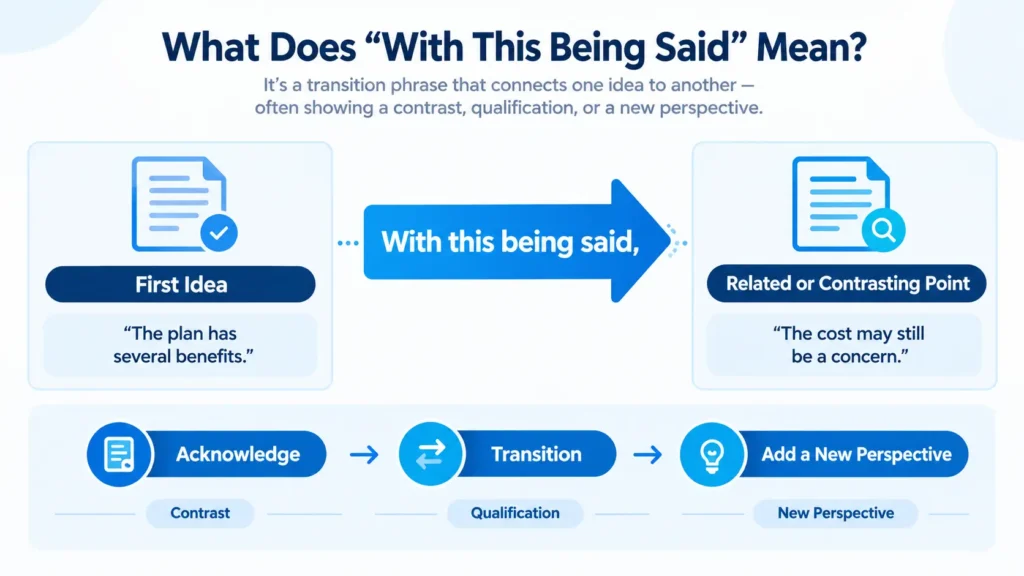
“With this being said” is a transition phrase used to connect one statement with another. It often signals that the writer or speaker is about to add a different perspective, limitation, clarification, or contrasting point.
For example, you might praise a product and then mention one drawback: “The laptop is affordable and reliable. With this being said, its battery life could be better.”
The phrase is common in conversations, essays, business writing, presentations, and online content. However, “with that being said” is generally more idiomatic than “with this being said.”
Why Use Other Ways to Say “With This Being Said”?
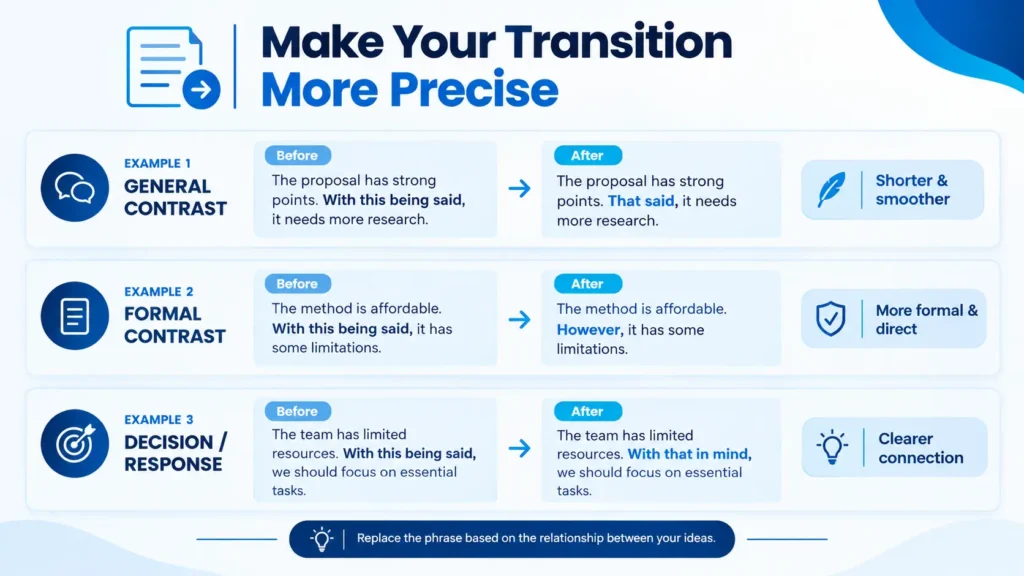
Using different transition phrases can make your writing clearer and prevent the same expression from appearing repeatedly.
Other benefits include:
- Avoiding repetition in longer articles or essays.
- Sounding more natural in everyday conversations.
- Matching the tone of professional or casual communication.
- Creating smoother transitions between ideas.
- Showing contrast or qualification more precisely.
- Making academic and business writing more polished.
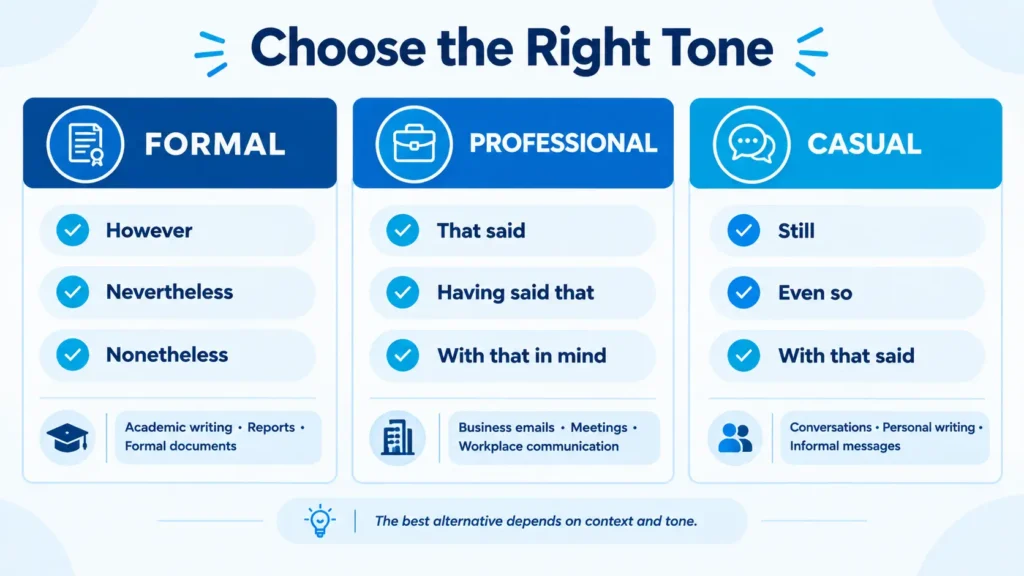
The best alternative depends on what you want the transition to accomplish.
10 Best Other Ways to Say “With This Being Said”
1. That Said
Meaning
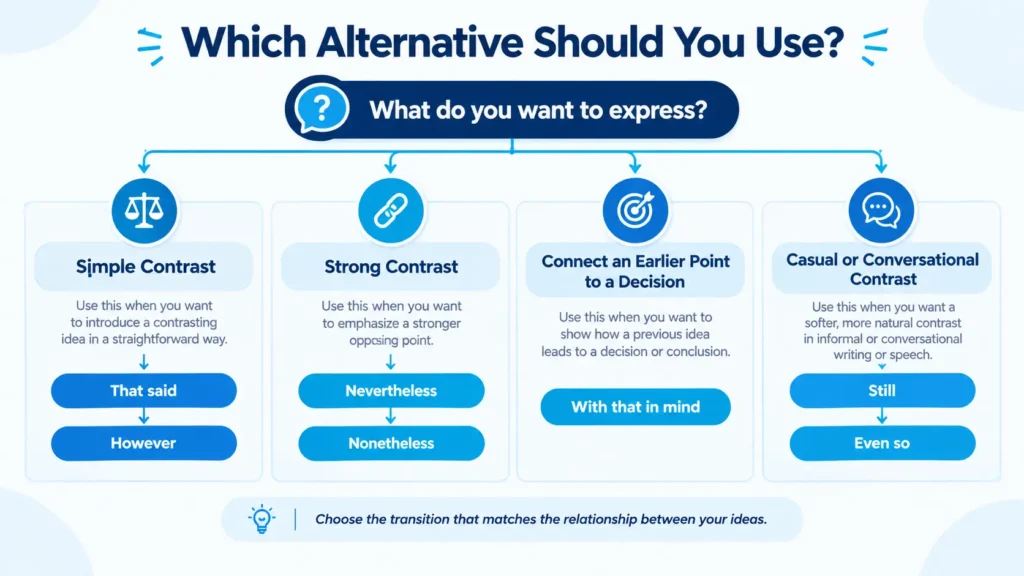
“That said” is one of the most natural and versatile alternatives. It acknowledges the previous statement while introducing a point that may qualify, balance, or contrast with it.
Best For
- Professional
- Formal
- Casual
- Friendly
Example 1
The restaurant has limited parking. That said, the food and service are excellent.
Example 2
The project will require additional time. That said, we can still meet the most important deadline.
Quick Tip
Use “that said” when you want a short, polished transition that works in both conversation and writing.
2. Having Said That
Meaning
“Having said that” means that you recognize or accept something you just mentioned, but you are about to add another thought. It is especially useful when you want to balance two sides of an issue.
Best For
- Professional
- Formal
- Friendly
- Polite
Example 1
The training session was challenging. Having said that, I learned several skills that I can use immediately.
Example 2
She has little experience with the software. Having said that, she picked it up surprisingly quickly.
Quick Tip
Choose this phrase when your second statement directly responds to or qualifies the first.
3. However
Meaning
“However” introduces a contrasting or opposing idea. It is more direct and formal than many conversational alternatives, making it a strong choice for professional and academic writing.
Best For
- Professional
- Formal
Example 1
The proposal offers several advantages. However, the current budget does not support the full plan.
Example 2
The instructions look simple. However, the final step requires careful attention.
Quick Tip
Use “however” when the relationship between your two ideas is clearly contrastive.
4. Nevertheless
Meaning
“Nevertheless” introduces a statement that remains true despite something previously mentioned. It often emphasizes that a situation or conclusion is not changed by the earlier point.
Best For
- Formal
- Professional
Example 1
The weather forecast predicted heavy rain. Nevertheless, the outdoor event continued as planned.
Example 2
The application process was demanding. Nevertheless, many students completed it successfully.
Quick Tip
Use “nevertheless” when you want to emphasize that the second point holds despite the first.
5. Nonetheless
Meaning
“Nonetheless” has a meaning similar to “nevertheless.” It introduces an idea that remains valid even after considering the previous statement.
Best For
- Formal
- Professional
Example 1
The apartment is farther from downtown than we expected. Nonetheless, the location is convenient for our daily commute.
Example 2
The experiment produced mixed results. Nonetheless, the findings provide useful information for future research.
Quick Tip
Use “nonetheless” when you want a polished alternative to “nevertheless” without changing the basic meaning.
6. With That in Mind
Meaning
“With that in mind” connects an earlier point to a decision, recommendation, or next step. Unlike a purely contrastive transition, it often shows that the previous information has influenced what comes next.
Best For
- Professional
- Formal
- Polite
Example 1
The team has a limited budget. With that in mind, we should focus on the highest-priority improvements.
Example 2
Customers value quick responses. With that in mind, the company plans to expand its support hours.
Quick Tip
Choose this phrase when your next idea is a direct response to information you just discussed.
7. Even So
Meaning
“Even so” introduces a statement that remains true despite the circumstances or information previously given. It sounds natural and conversational while still being suitable for many types of writing.
Best For
- Casual
- Friendly
- Professional
Example 1
The course requires a lot of reading. Even so, I would recommend it to anyone interested in the subject.
Example 2
We missed our first target. Even so, the team made significant progress this quarter.
Quick Tip
Use “even so” when you want a warmer, less formal contrast than “nevertheless.”
8. Still
Meaning
“Still” can introduce a contrasting thought while keeping the tone simple and conversational. It suggests that the second point remains true despite what was just said.
Best For
- Casual
- Friendly
- Warm
Example 1
The hotel room was smaller than expected. Still, it was clean and comfortable.
Example 2
I know the drive is long. Still, I think the trip will be worth it.
Quick Tip
Use “still” for natural everyday communication when a highly formal transition would sound unnecessary.
9. With That Said
Meaning
“With that said” is a widely used transition for moving from one point to another while acknowledging what came before. It can introduce a qualification, contrasting observation, or practical conclusion.
Best For
- Professional
- Formal
- Casual
- Polite
Example 1
The new system has a learning curve. With that said, most employees should become comfortable with it within a few weeks.
Example 2
The first draft needs several revisions. With that said, the main idea is strong.
Quick Tip
Use “with that said” when you want to preserve the conversational feel of the original phrase while making the wording more natural.
10. Despite That
Meaning
“Despite that” clearly shows that the next statement remains true even though the previous fact might suggest otherwise. It is useful when you want to emphasize a specific contrast.
Best For
- Formal
- Professional
- Polite
Example 1
The instructions were unclear. Despite that, the team completed the task correctly.
Example 2
The company faced several setbacks. Despite that, it continued investing in new products.
Quick Tip
Use “despite that” when you want the contrast itself to be the main focus of the transition.
Comparison Table
| Alternative | Best Used In | Tone |
| That said | Most situations | Natural, polished |
| Having said that | Balanced arguments | Thoughtful, conversational |
| However | Academic and professional writing | Formal, direct |
| Nevertheless | Formal writing | Strong, formal |
| Nonetheless | Professional and academic contexts | Formal, polished |
| With that in mind | Recommendations and decisions | Professional, practical |
| Even so | Everyday and professional communication | Natural, conversational |
| Still | Casual conversations | Friendly, simple |
| With that said | General communication | Conversational, polished |
| Despite that | Clear contrast | Direct, formal |
Common Mistakes
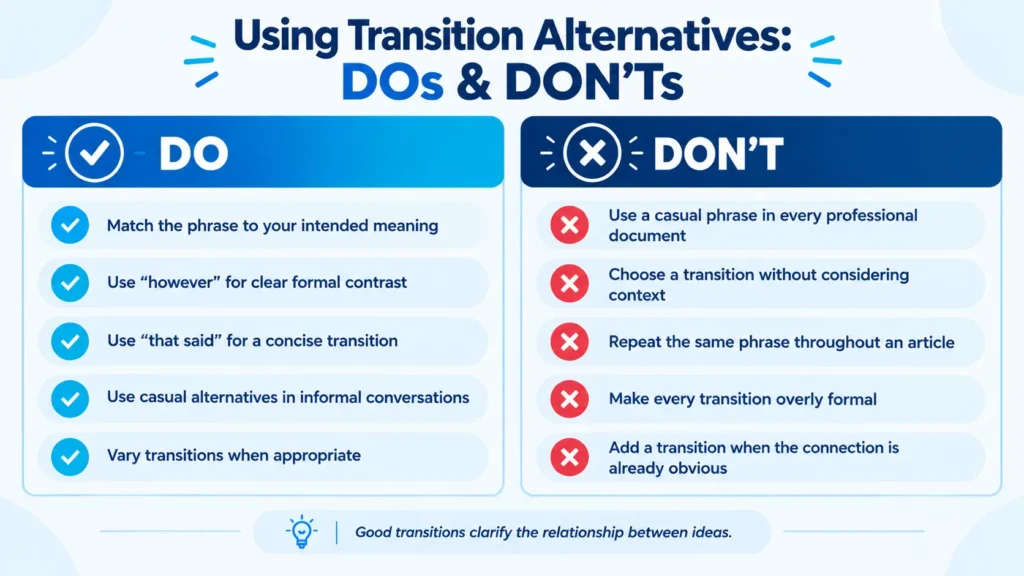
1. Using Casual Phrases in Professional Emails
Words such as “still” or “even so” can work professionally, but highly formal documents may benefit from “however,” “nevertheless,” or “nonetheless.” Always consider your audience.
2. Choosing an Overly Formal Alternative
Using “nevertheless” in a casual text message can sound stiff. A simpler choice such as “that said” or “still” may sound more natural.
3. Repeating the Same Transition
Using the same phrase in every paragraph can make your writing feel mechanical. Rotate between appropriate alternatives when the meaning remains accurate.
4. Ignoring the Relationship Between Ideas
Not every transition means exactly the same thing. “However” signals contrast, while “with that in mind” usually connects previous information to a decision or action.
5. Sounding Insincere
A transition should genuinely connect your ideas. If you praise something and immediately use a contrast phrase without a meaningful reason, the writing can feel forced.
Frequently Asked Questions
What is the most natural way to say “with this being said”?
“That said” is one of the most natural alternatives. It is concise, flexible, and works well in professional writing, essays, presentations, and everyday communication. If you want a more conversational option, “having said that” is also a strong choice.
Is “with that being said” grammatically correct?
Yes, “with that being said” is a commonly used English transition. However, it can often be shortened to “that said” or “having said that” without losing the intended meaning. Shorter alternatives may make your writing sound cleaner and more direct.
Is “with this being said” formal?
“With this being said” can appear in formal writing, but it is somewhat wordier than necessary. In academic or professional contexts, “however,” “nevertheless,” or “that said” may provide a more concise transition, depending on the relationship between the ideas.
What can I say instead of “with this being said” in an essay?
For an essay, consider “however,” “nevertheless,” “nonetheless,” or “having said that.” The best choice depends on the sentence. Use “however” for direct contrast and “nevertheless” or “nonetheless” when the second idea remains true despite the first.
Can I use “that said” in professional writing?
Yes. “That said” is widely suitable for professional communication because it is concise without sounding overly formal. You can use it in reports, emails, presentations, proposals, and workplace discussions when you want to qualify or balance a previous statement.
What is a casual alternative to “with this being said”?
“Still” and “even so” are natural casual alternatives. They work especially well in conversations, text messages, personal writing, and informal emails. For example, you can use “still” when you want to acknowledge a drawback but maintain a positive or opposing point.
What is the difference between “however” and “that said”?
Both can introduce contrast, but they have slightly different functions. “However” directly signals a contrast between ideas, while “that said” often acknowledges a previous statement before adding a qualification or different perspective.
Is “having said that” better than “with this being said”?
Often, yes. “Having said that” sounds natural and clearly signals that you are moving from one point to another after acknowledging what you just said. However, “that said” is usually shorter and more efficient, especially in polished professional writing.
Conclusion
There are many effective ways to say “with this being said,” and the best choice depends on the relationship between your ideas and the tone you want to create. “That said” is an excellent all-purpose option, while “however” fits formal and professional writing particularly well.
For a stronger contrast, try “nevertheless,” “nonetheless,” or “despite that.” If your next point follows logically from earlier information, “with that in mind” may be more precise. For casual communication, “still” and “even so” often sound more natural.
The key is not simply replacing one phrase with another. Choose the transition that accurately shows how your next idea connects to the one before it. A well-chosen phrase makes your writing clearer, smoother, and easier to follow.

Melody Schaefer is the Founder and Editor-in-Chief of FrontiersPost, where she oversees the publication of clear, useful, and thoughtfully researched content for modern readers. Her editorial focus includes language, communication, vocabulary, writing, and practical topics that help readers understand information with greater clarity and confidence.
At FrontiersPost, Melody works with writers and editors to maintain consistent editorial standards, improve content quality, and ensure that published articles are useful, accessible, and easy to understand. She is particularly interested in clear communication and presenting complex or easily confused topics in a straightforward way.
As Editor-in-Chief, she is also responsible for guiding the site’s editorial direction, reviewing content standards, and helping ensure that articles are regularly maintained and improved as information evolves.