
Another way to say “too much” depends on the context. You can say excessive, more than necessary, overdone, overwhelming, or a lot. For professional writing, “excessive” works well, while “a bit much,” “over the top,” and “more than I can handle” sound more natural in casual conversations.
Key Takeaways
- “Too much” can describe quantity, intensity, emotion, effort, or behavior.
- Excessive is a strong choice for professional and formal writing.
- More than necessary works well when you want to sound neutral and precise.
- Overwhelming is useful when something feels emotionally or mentally difficult.
- The best alternative depends on your audience, tone, and specific situation.
What Does “Another Way to Say Too Much” Mean?
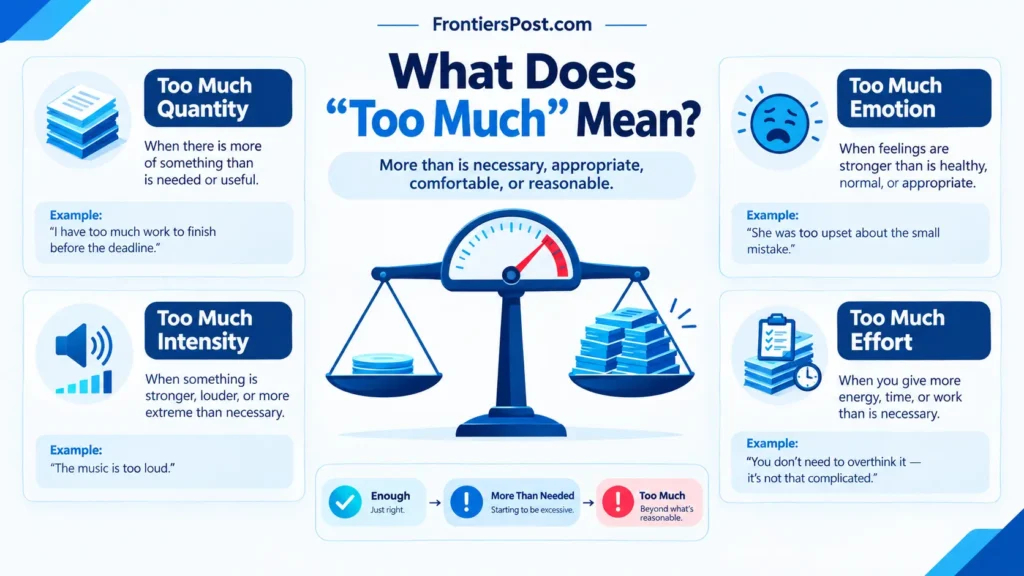
“Too much” means that something exceeds what is considered necessary, appropriate, comfortable, or reasonable. It can refer to quantity, intensity, frequency, emotion, effort, or behavior.
For example, you might say, “There is too much information in this report,” or “You are worrying too much.” The phrase is common in everyday American English because it is simple and flexible.
People often search for another way to say “too much” when they want to avoid repetition, sound more precise, or adjust their tone. The right replacement can make a sentence clearer and more appropriate for professional, academic, or casual communication.
Why Use Other Ways to Say “Too Much”?
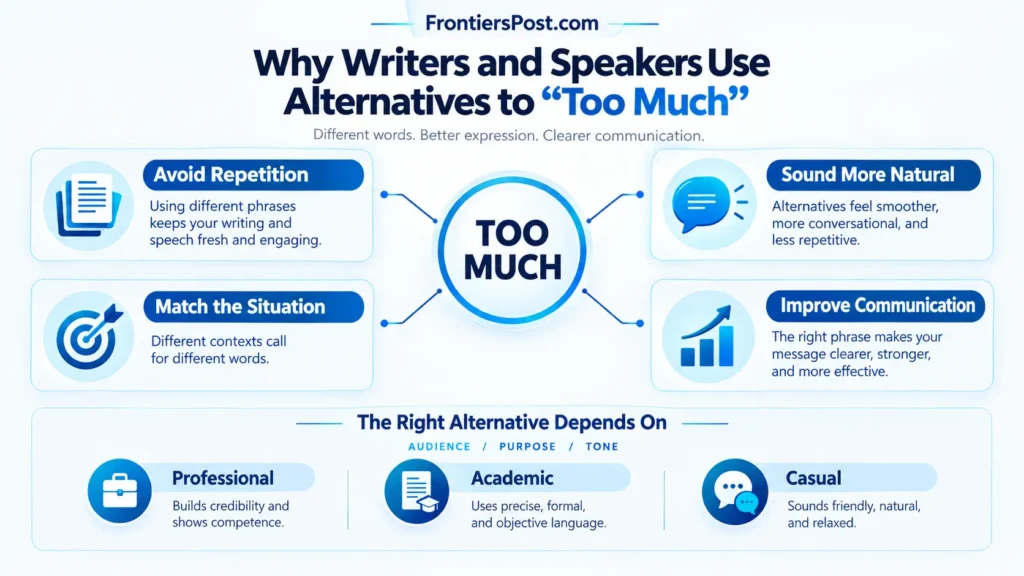
Using alternatives can make your writing and speech more specific and natural. Instead of relying on the same phrase repeatedly, you can choose wording that explains exactly what you mean.
Common reasons include:
- Avoiding repetition: Use different expressions throughout your writing.
- Sounding more precise: Choose a word that describes the problem more clearly.
- Matching the situation: Formal writing often requires different wording than casual speech.
- Improving professional communication: More precise language can make emails and reports sound polished.
- Expressing emotion: Words such as “overwhelming” can communicate how something feels, not just its quantity.
10 Best Other Ways to Say “Too Much”
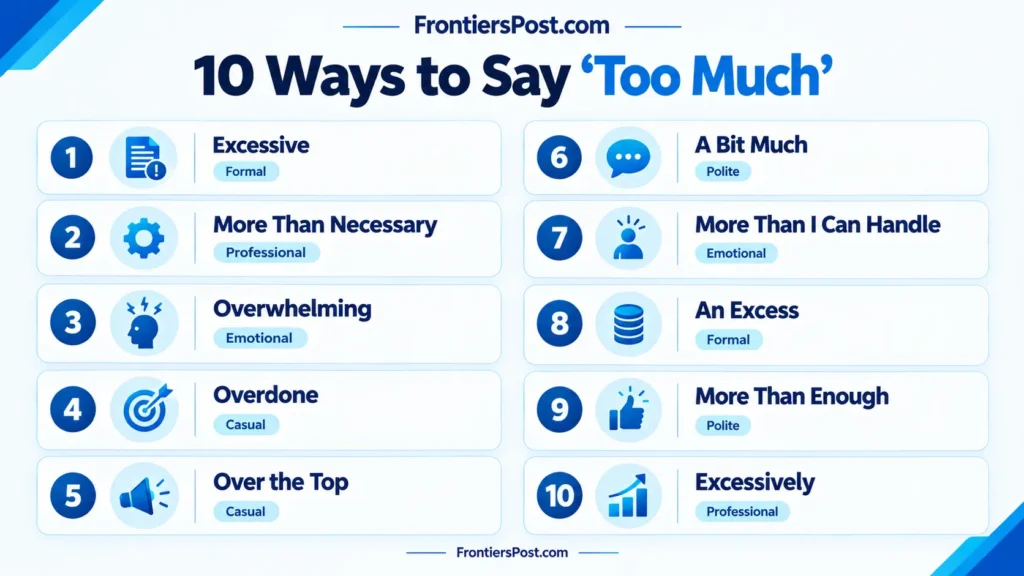
1. Excessive
Meaning
“Excessive” means more than what is reasonable, necessary, or appropriate. It is one of the best direct replacements for “too much” when you want concise, professional wording.
Best For
- Professional
- Formal
- Academic
Example 1
The company received criticism for its excessive use of promotional emails.
Example 2
Excessive screen time can make it harder to maintain a healthy work-life balance.
Quick Tip
Use “excessive” when you want to clearly communicate that something has gone beyond a reasonable limit.
2. More Than Necessary
Meaning
“More than necessary” means that something exceeds the amount, effort, or level actually needed. It sounds neutral and avoids the stronger judgment that can come with words like “excessive.”
Best For
- Professional
- Formal
- Polite
Example 1
The presentation included more information than necessary for a brief team meeting.
Example 2
You do not need to provide more details than necessary to answer the question.
Quick Tip
Choose this phrase when you want to point out excess without sounding overly critical.
3. Overwhelming
Meaning
“Overwhelming” describes something that feels difficult to manage because there is too much of it or because it creates a strong emotional response. It focuses more on the effect of excess than the amount itself.
Best For
- Friendly
- Warm
- Casual
Example 1
Starting a new job can feel overwhelming during the first few weeks.
Example 2
The number of choices on the menu was overwhelming for the group.
Quick Tip
Use “overwhelming” when the amount or intensity of something creates stress, pressure, confusion, or a strong emotional reaction.
4. Overdone
Meaning
“Overdone” means that something has been taken too far or used more than is effective or appropriate. It is especially useful when discussing style, decoration, humor, or creative choices.
Best For
- Casual
- Friendly
- Professional
Example 1
The decorations looked beautiful, but the extra lighting felt a little overdone.
Example 2
The joke was funny at first, but repeating it several times made it overdone.
Quick Tip
“Overdone” is a good choice when something is not necessarily harmful but has gone beyond what works well.
5. Over the Top
Meaning
“Over the top” means excessive, extreme, or more dramatic than a situation requires. It is informal and often carries a slightly humorous or conversational tone.
Best For
- Casual
- Friendly
Example 1
His reaction to the small mistake was completely over the top.
Example 2
The birthday party decorations were fun without being too over the top.
Quick Tip
Use “over the top” in conversations, texts, and informal writing rather than formal business documents.
6. A Bit Much
Meaning
“A bit much” is a polite, conversational way to say that something feels excessive or unreasonable. It can soften criticism while still making your opinion clear.
Best For
- Casual
- Friendly
- Polite
Example 1
Asking everyone to attend a three-hour meeting seems like a bit much.
Example 2
The extra service fee was a bit much considering the small order.
Quick Tip
This phrase works especially well when you want to express mild disagreement without sounding harsh.
7. More Than I Can Handle
Meaning
“More than I can handle” means that something has become too difficult, stressful, or demanding for you personally. It focuses on your ability to cope rather than simply describing the quantity.
Best For
- Casual
- Friendly
- Warm
Example 1
Working two jobs while taking evening classes is becoming more than I can handle.
Example 2
The constant messages from work were starting to feel like more than I could handle.
Quick Tip
Use this expression when the issue is personally overwhelming rather than simply larger than expected.
8. An Excess
Meaning
“An excess” refers to an amount that goes beyond what is needed or desirable. It is more formal and works particularly well when discussing resources, costs, materials, or quantities.
Best For
- Formal
- Professional
- Academic
Example 1
The audit revealed an excess of unused office supplies.
Example 2
An excess of information can make a simple decision more difficult.
Quick Tip
Use “an excess” when you are discussing a measurable or identifiable surplus.
9. More Than Enough
Meaning
“More than enough” means that there is already a sufficient amount, with additional quantity beyond what is required. Depending on context, it can be neutral, appreciative, or gently critical.
Best For
- Friendly
- Casual
- Polite
- Professional
Example 1
You have given me more than enough time to finish the project.
Example 2
We already have more than enough food for everyone at the event.
Quick Tip
Use this phrase when you want to emphasize that the amount exceeds what is needed without necessarily criticizing it.
10. Excessively
Meaning
“Excessively” is an adverb that describes an action or quality occurring to an unreasonable or unnecessary degree. It is useful when “too much” modifies a verb or adjective.
Best For
- Professional
- Formal
- Academic
Example 1
The manager was excessively focused on minor formatting issues.
Example 2
The product was excessively expensive compared with similar options.
Quick Tip
Use “excessively” when you need an adverb to describe how strongly, frequently, or intensely something happens.
Comparison Table
| Alternative | Best Used In | Tone |
| Excessive | Professional, academic, formal writing | Precise |
| More Than Necessary | Professional, formal communication | Neutral |
| Overwhelming | Personal and everyday situations | Emotional |
| Overdone | Style, behavior, creative situations | Conversational |
| Over the Top | Casual conversations | Informal |
| A Bit Much | Everyday conversations | Polite, mild |
| More Than I Can Handle | Personal situations | Emotional |
| An Excess | Formal and professional writing | Formal |
| More Than Enough | Everyday and professional contexts | Neutral |
| Excessively | Academic, formal, professional writing | Precise |
Common Mistakes
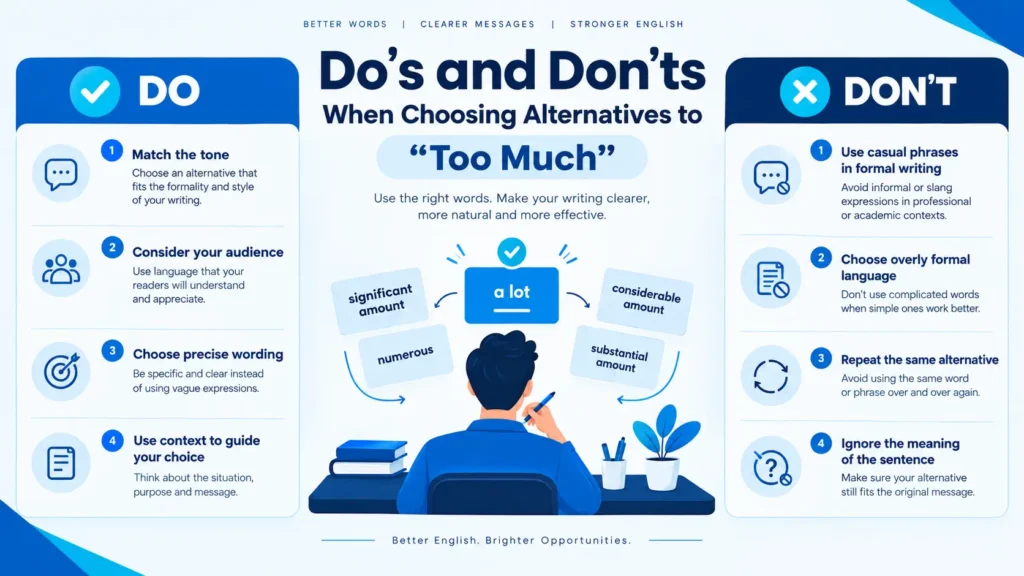
1. Using Casual Phrases in Professional Emails
Expressions such as “a bit much” and “over the top” can sound too informal in a business email. In professional settings, “excessive” or “more than necessary” is usually a better choice.
2. Choosing Overly Formal Language
Not every sentence needs a formal replacement. Saying “an excess” in a casual conversation may sound unnatural when “more than enough” would communicate the same idea more easily.
3. Repeating the Same Alternative
Replacing “too much” with “excessive” every time does not solve the problem of repetition. Select different alternatives based on what you actually want to express.
4. Forgetting Context
The meaning can change depending on the situation. “Overwhelming” describes the emotional effect of something, while “excessive” usually emphasizes that the amount or degree is unreasonable.
5. Sounding More Critical Than Intended
Some alternatives are stronger than “too much.” Words such as “excessive” and “overdone” can sound judgmental, so consider using “more than necessary” or “a bit much” when you want a softer tone.
Frequently Asked Questions
What is a professional way to say “too much”?
A professional way to say “too much” is “excessive.” For example, instead of saying, “There was too much spending,” you could write, “There was excessive spending.” “More than necessary” is another useful option when you want a neutral and measured tone.
What is a polite way to say “too much”?
A polite way to say “too much” is “a bit much” or “more than necessary.” These expressions communicate that something exceeds what you expected without making your criticism sound too strong. “More than necessary” is particularly useful in professional communication.
What is a casual way to say “too much”?
Casual alternatives include “a bit much,” “over the top,” and “more than enough,” depending on the meaning. “That’s a bit much” is common when expressing mild disagreement, while “over the top” suggests that something is unusually extreme or dramatic.
What is another word for “too much”?
Common single-word alternatives include excessive, overwhelming, and overdone. The best word depends on the context. “Excessive” describes an unreasonable amount, “overwhelming” focuses on the effect something has on you, and “overdone” suggests that something has gone beyond what works well.
How do you say “too much” in a formal way?
For formal writing, use terms such as “excessive,” “an excess,” or “more than necessary.” For example, “The report contains too much detail” can become “The report contains excessive detail.” This wording is clear and appropriate for academic, business, and formal contexts.
Can I say “overwhelming” instead of “too much”?
Yes, but the two phrases are not always interchangeable. “Overwhelming” describes something that feels difficult to manage, while “too much” simply indicates that an amount or degree is beyond what is appropriate or wanted.
Is “over the top” the same as “too much”?
“Over the top” can mean “too much,” especially when something is overly dramatic, elaborate, or extreme. However, it is informal. For professional or academic writing, “excessive” or “more than necessary” is usually more appropriate.
How do I choose the best alternative to “too much”?
Start by identifying what you mean. Use “excessive” for formal or professional contexts, “overwhelming” for emotional impact, “overdone” for style or behavior, and “a bit much” for mild criticism in casual conversation. Context should guide your choice.
Conclusion
Knowing another way to say “too much” can help you communicate with greater precision and avoid repetitive wording. The best alternative depends on what you are describing and how strongly you want to express your point.
For professional or academic writing, “excessive,” “excessively,” and “more than necessary” are reliable choices.
The key is to match your words to the situation rather than simply replacing one phrase with another. When you choose the alternative that fits your meaning, tone, and audience, your writing sounds clearer, more natural, and more confident.

Melody Schaefer is the Founder and Editor-in-Chief of FrontiersPost, where she oversees the publication of clear, useful, and thoughtfully researched content for modern readers. Her editorial focus includes language, communication, vocabulary, writing, and practical topics that help readers understand information with greater clarity and confidence.
At FrontiersPost, Melody works with writers and editors to maintain consistent editorial standards, improve content quality, and ensure that published articles are useful, accessible, and easy to understand. She is particularly interested in clear communication and presenting complex or easily confused topics in a straightforward way.
As Editor-in-Chief, she is also responsible for guiding the site’s editorial direction, reviewing content standards, and helping ensure that articles are regularly maintained and improved as information evolves.