
Looking for another way to say “since”? Depending on the context, you can use because, as, given that, considering that, from the time that, ever since, from then on, after, because of, or due to. The best choice depends on whether “since” means because or refers to time.
Key Takeaways
- “Since” has two main meanings: because and from a past time until now.
- Use because, as, or given that when “since” gives a reason.
- Use ever since, from the time that, or from then on for time-related meanings.
- Formal writing may benefit from alternatives such as given that or due to.
- Always choose an alternative based on the sentence’s meaning and tone.
What Does “Another Way to Say Since” Mean?
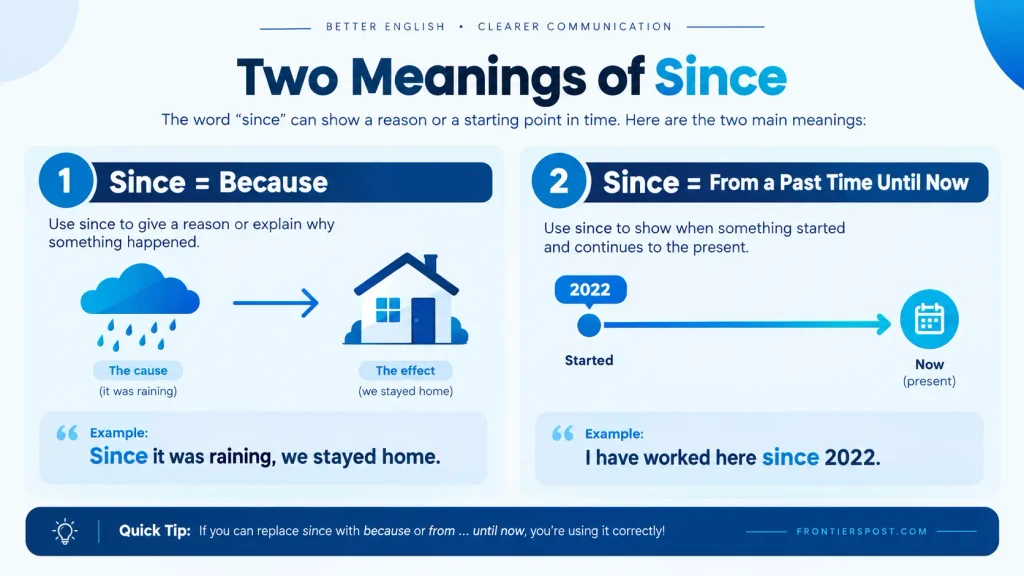
The phrase “another way to say since” refers to alternative words or phrases that can replace “since” without changing the intended meaning.
“Since” commonly has two uses. It can introduce a reason, as in “Since it was raining, we stayed home.” It can also describe time, as in “I have worked here since 2022.”
Because these meanings are different, the best replacement depends on context. Using a time-related alternative in a sentence about cause can make the meaning unclear, while a causal alternative may sound incorrect when discussing a starting point in time.
Why Use Other Ways to Say “Since”?
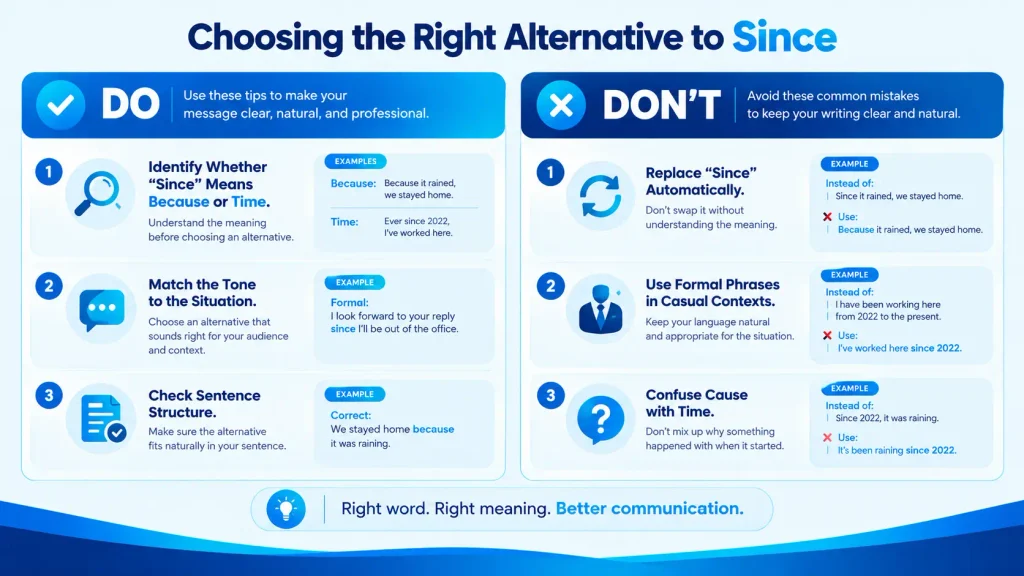
Although “since” is common and grammatically correct, repeating it too often can make your writing feel predictable. Choosing a suitable alternative can make your sentences more precise and natural.
Other reasons to use an alternative include:
- Avoiding repetition in essays or articles
- Making cause-and-effect relationships clearer
- Creating smoother professional writing
- Choosing a more formal or academic tone
- Making time references more specific
- Adjusting your language for casual or conversational situations
The key is not to replace “since” automatically. Instead, identify what “since” means in your sentence before choosing another expression.
10 Best Other Ways to Say “Since”
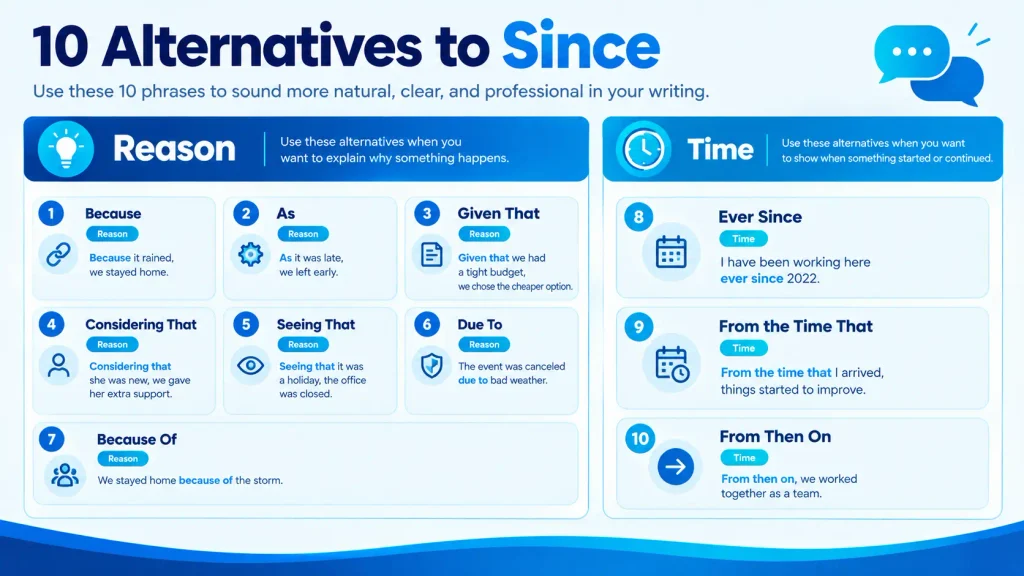
1. Because
Meaning
Because is one of the clearest alternatives when “since” introduces a reason. It directly explains why something happened or why someone made a particular decision.
Best For
- Professional
- Formal
- Casual
- Academic
Example 1
Because the meeting was moved, we had extra time to prepare the presentation.
Example 2
I took the earlier train because I wanted to avoid the evening rush.
Quick Tip
Use because when you want the reason to be unmistakable. It is often clearer than “since,” especially when a sentence could otherwise have a time-related meaning.
2. As
Meaning
As can replace “since” when it means because. It is concise and works especially well when the reason is already obvious from the surrounding context.
Best For
- Formal
- Professional
- Academic
- Polite
Example 1
As the deadline is approaching, we should review the final draft today.
Example 2
As everyone had arrived, the manager began the presentation.
Quick Tip
Place as before the reason you are giving. Avoid using it when the sentence could become confusing because “as” has several meanings.
3. Given That
Meaning
Given that introduces a fact or circumstance that provides a logical reason for something. It often sounds more deliberate and analytical than “since.”
Best For
- Formal
- Professional
- Academic
Example 1
Given that the budget has been reduced, we need to reconsider the project timeline.
Example 2
Given that several employees are working remotely, the company updated its communication policy.
Quick Tip
Use given that when you want to emphasize that a known fact supports a decision, conclusion, or recommendation.
4. Considering That
Meaning
Considering that means taking a particular fact into account. It works well when the reason is based on a circumstance that should be considered before reaching a conclusion.
Best For
- Professional
- Formal
- Conversational
- Friendly
Example 1
Considering that the store was closing soon, we decided to place the order online.
Example 2
Considering that she had never used the software before, she learned it remarkably quickly.
Quick Tip
Use this phrase when the reason involves weighing a situation or circumstance rather than simply stating a direct cause.
5. Seeing That
Meaning
Seeing that can mean because or in view of the fact that. It is more conversational than “given that” and often appears in everyday speech.
Best For
- Casual
- Friendly
- Conversational
Example 1
Seeing that you already finished the report, you can take the afternoon off.
Example 2
Seeing that the weather had improved, we decided to continue the outdoor event.
Quick Tip
Choose seeing that for relaxed communication. It may sound less appropriate in highly formal academic or business writing.
6. Due to
Meaning
Due to means because of and identifies a cause or contributing factor. Unlike “since,” it is normally followed by a noun or noun phrase rather than a complete clause.
Best For
- Formal
- Professional
- Academic
Example 1
The flight was delayed due to severe weather conditions.
Example 2
The event was postponed due to unexpected maintenance work.
Quick Tip
Do not use due to exactly like “since.” It usually needs a noun phrase, such as “due to heavy traffic,” rather than “due to traffic was heavy.”
7. Because of
Meaning
Because of directly expresses the reason for an action, event, or condition. It is straightforward and works in both everyday and professional communication.
Best For
- Professional
- Casual
- Formal
- Friendly
Example 1
We arrived late because of an accident on the highway.
Example 2
The outdoor class was canceled because of the extreme heat.
Quick Tip
Use because of before a noun or noun phrase. For a complete clause, use because instead.
8. Ever Since
Meaning
Ever since is a time-related alternative to “since.” It emphasizes that something started at a particular point in the past and has continued from that time.
Best For
- Casual
- Friendly
- Warm
- Professional
Example 1
She has been interested in photography ever since she received her first camera.
Example 2
We have stayed in touch ever since we graduated from college.
Quick Tip
Use ever since when you want to emphasize continuity from a past event to the present.
9. From the Time That
Meaning
From the time that identifies the exact period when something began. It is useful when you want to make the starting point clearer than simply using “since.”
Best For
- Formal
- Academic
- Professional
Example 1
From the time that the new policy took effect, employees have followed a different approval process.
Example 2
He has kept detailed records from the time that he started managing the department.
Quick Tip
Use this phrase when the starting point matters and you want to make the time relationship especially clear.
10. From Then On
Meaning
From then on means that something continued or happened repeatedly after a specific point in the past. Unlike “since,” it usually focuses on what happened after that moment rather than directly connecting the past to the present.
Best For
- Casual
- Friendly
- Professional
- Formal
Example 1
She received helpful feedback from her supervisor, and from then on, she reviewed every report twice.
Example 2
The team changed its process after the first mistake, and from then on, every file was carefully checked.
Quick Tip
Use from then on when you are describing what happened after a particular event. It works especially well in narratives and explanations.
Comparison Table
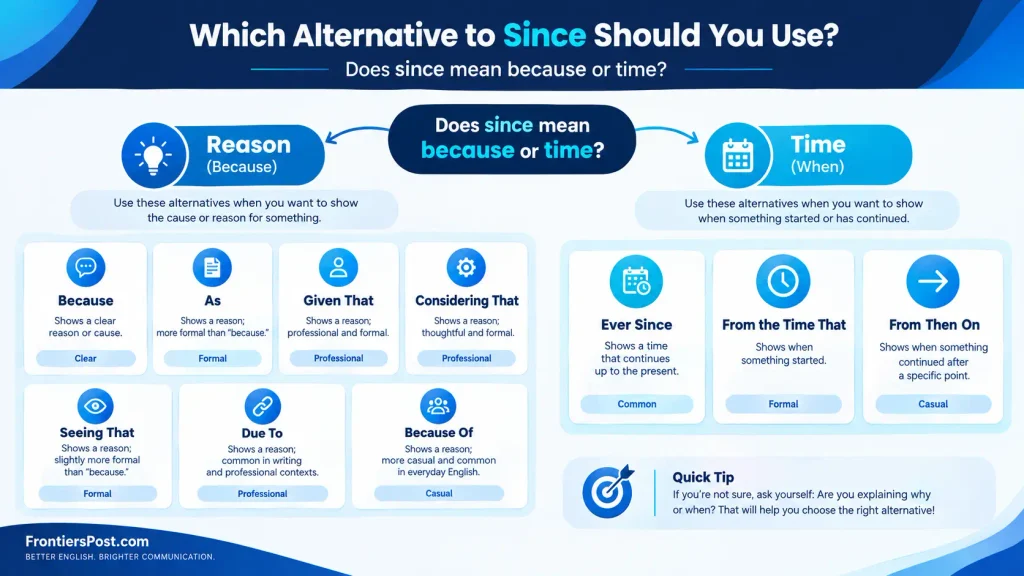
| Alternative | Best Used In | Tone |
| Because | Most situations | Clear and direct |
| As | Formal and academic writing | Concise |
| Given that | Professional and analytical writing | Formal |
| Considering that | Professional and conversational contexts | Thoughtful |
| Seeing that | Everyday conversation | Casual |
| Due to | Formal and professional writing | Formal |
| Because of | Everyday and professional writing | Direct |
| Ever since | Ongoing time references | Natural and warm |
| From the time that | Specific time references | Formal |
| From then on | Events continuing after a point | Narrative and natural |
Common Mistakes
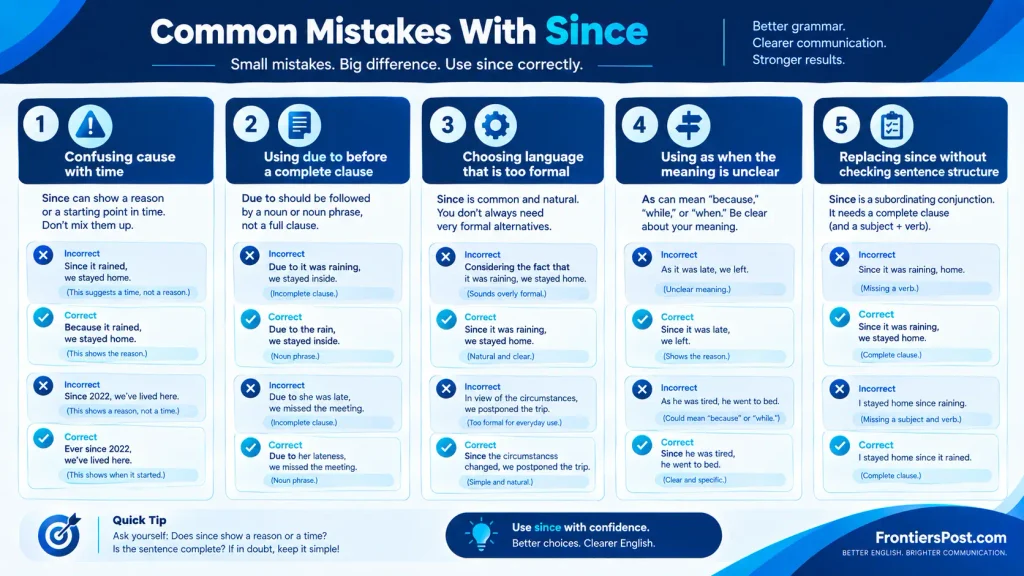
1. Confusing Cause With Time
The most common mistake is overlooking the two meanings of “since.” If “since” means because, use an alternative such as “because” or “given that.” If it refers to time, consider “ever since” or “from the time that.”
2. Using “Due To” Before a Complete Clause
“Due to” normally introduces a noun or noun phrase. For example, “The game was canceled due to rain” is correct, while a construction such as “due to it rained” is not.
3. Choosing an Overly Formal Alternative
Words such as “given that” and “from the time that” can sound unnecessarily formal in casual conversation. Match the phrase to your audience and purpose.
4. Using “As” When the Meaning Is Unclear
“As” has several meanings, including because, while, and in the role of. If readers could misunderstand the sentence, “because” is often the clearer choice.
5. Replacing “Since” Without Checking the Sentence
Not every alternative can grammatically replace “since” in the same position. Check whether the replacement requires a noun, noun phrase, or complete clause before changing the sentence.
Frequently Asked Questions
What is another way to say “since” in an essay?
In an essay, you can use because, as, given that, considering that, or due to, depending on the sentence. For example, “Given that the evidence is limited, the conclusion should be cautious” sounds appropriate in academic writing. Choose the alternative that makes the relationship between ideas most precise.
What is a formal way to say “since”?
Formal alternatives include given that, considering that, due to, and from the time that. The correct choice depends on whether “since” expresses a reason or a time period. “Given that” works particularly well when introducing a fact that supports a conclusion or decision.
What can I say instead of “since” to mean “because”?
When “since” means “because,” the clearest alternatives are because, as, given that, considering that, and seeing that. “Because” is usually the most direct choice, while “given that” sounds more analytical and “seeing that” is more conversational.
What is another way to say “since” in professional writing?
Professional alternatives include because, given that, considering that, due to, and because of. The best option depends on sentence structure. For example, “Given that the deadline has changed, we will update the schedule” is suitable for a workplace message.
What is another way to say “since” when talking about time?
For time-related meanings, you can use ever since, from the time that, or from then on. These phrases emphasize when something began or what happened after a particular event. The best option depends on whether the action continues to the present.
Is “as” a synonym for “since”?
Yes, as can be a synonym for “since” when “since” means “because.” For example, “As the roads were closed, we took another route” has the same basic meaning as “Since the roads were closed, we took another route.” However, “as” can have other meanings, so context matters.
Is “because of” the same as “since”?
They can express the same basic reason, but they are not always interchangeable grammatically. Because and since can introduce a complete clause, while because of is normally followed by a noun or noun phrase. For example, “because of heavy rain” is correct.
Which alternative to “since” is best for everyday English?
Because is usually the easiest and clearest choice when “since” means “because.” For time, ever since sounds natural when describing something that has continued from a past event. The best choice ultimately depends on the meaning, sentence structure, and tone.
Writing something similar? Try “Talks About” Alternatives, Another Way to Say “The Fact That” in Clear and Natural English or Another Way to Say “Therefore”.
Conclusion
There are several natural ways to say “since,” but the right alternative depends on what you mean. When “since” introduces a reason, because is usually the clearest choice, while as, given that, considering that, and seeing that provide different levels of formality. For causes expressed through nouns, because of and due to can work well.
When “since” refers to time, alternatives such as ever since and from the time that make the timeline clearer. From then on is useful when describing what happened after a particular point.
The most important rule is simple: identify whether “since” means because or refers to time before choosing a replacement. For a clearer understanding of its meanings and usage, see since meaning and usage.

The FrontiersPost editorial team writes and reviews every guide to word and phrase alternatives, with clear meanings, tone notes and example sentences for everyday, academic and professional English.




