
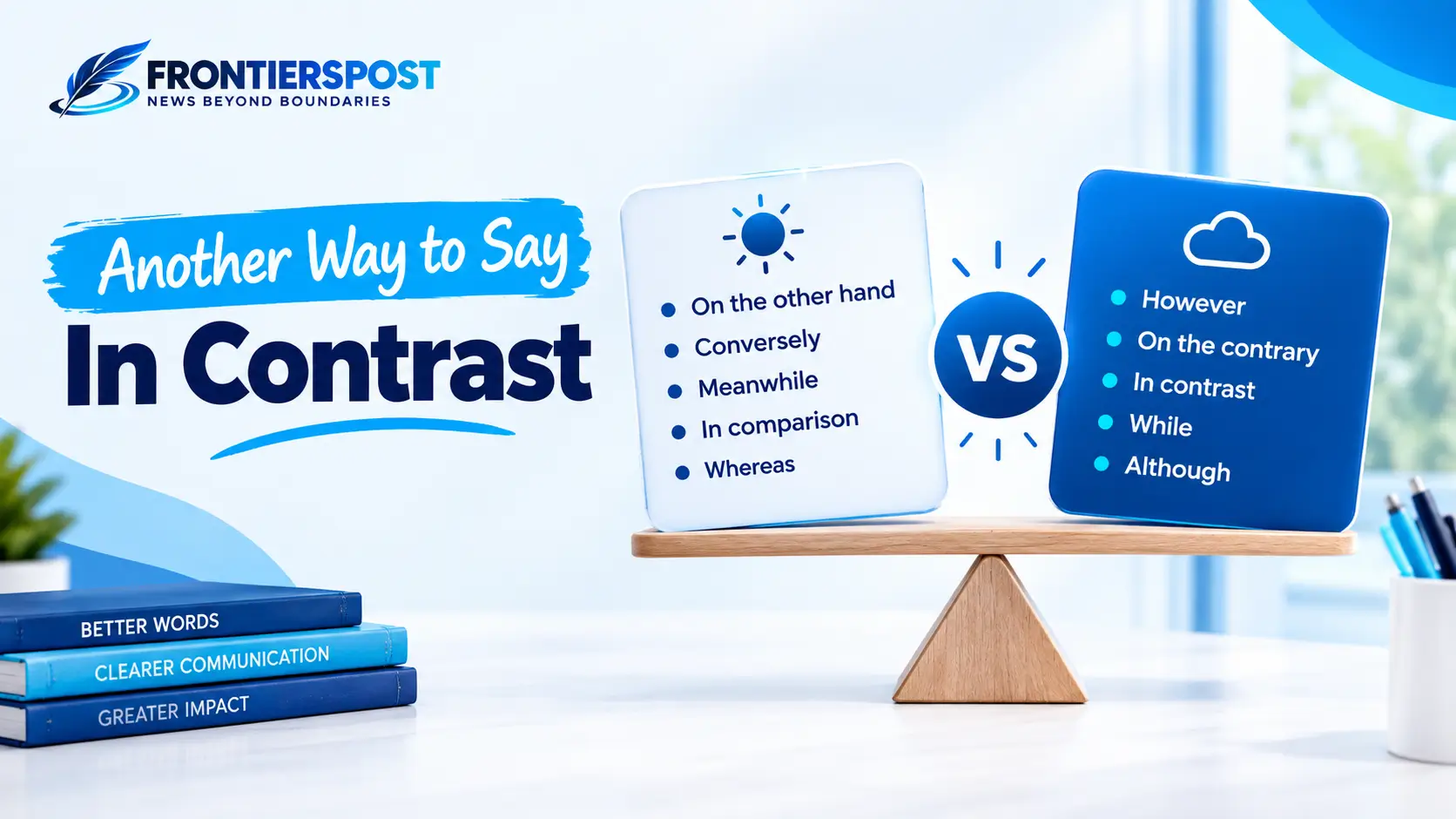
Another way to say “in contrast” includes on the other hand, by comparison, conversely, whereas, unlike, in comparison, alternatively, while, in opposition, and as opposed to. The best choice depends on context, tone, and whether you are comparing ideas, people, situations, or results.
Key Takeaways
- “In contrast” introduces a clear difference between two ideas, situations, or things.
- On the other hand is useful for balanced comparisons and everyday writing.
- Conversely and by comparison work well in formal or academic writing.
- Whereas and while are useful when comparing two statements in one sentence.
- Choose an alternative based on your audience, tone, and the strength of the comparison.
What Does “Another Way to Say in Contrast” Mean?
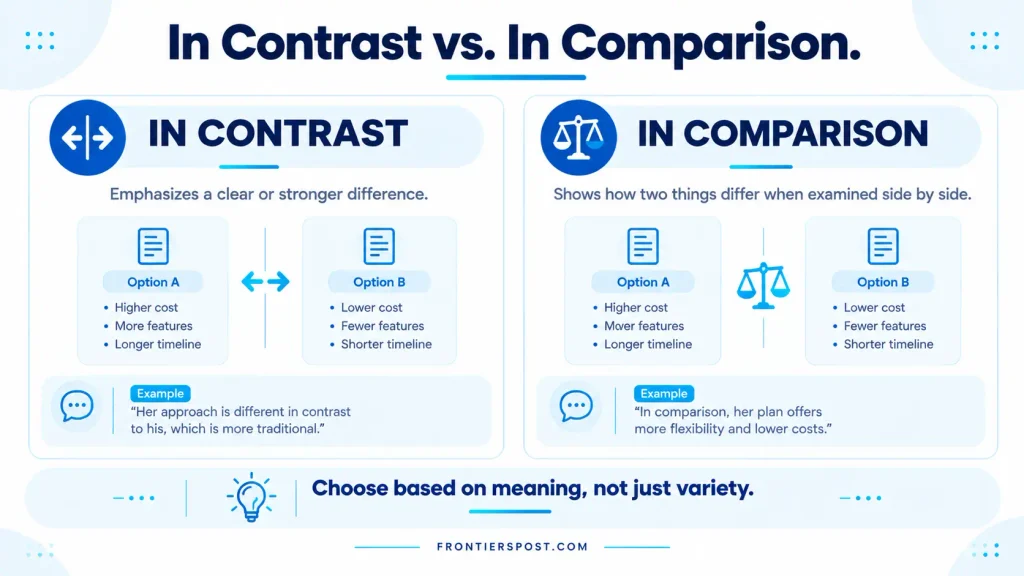
The phrase “in contrast” is used to show that two ideas, situations, or things are different. It signals a comparison and helps readers understand that the second point differs from the first.
For example, you might write, “The first study showed positive results. In contrast, the second study found little improvement.”
People often use “in contrast” in academic essays, reports, business writing, articles, and formal discussions. However, repeating the same transition can make writing feel predictable, so using a suitable alternative can make your sentences more varied and natural.
Why Use Other Ways to Say “In Contrast”?
Using different expressions can improve your writing without changing the meaning of your sentence. The right alternative can also make a comparison sound more precise or fit a particular tone.
Common reasons to use another expression include:
- Avoiding repetitive transition words.
- Making academic writing more varied.
- Creating smoother comparisons.
- Matching formal or conversational contexts.
- Showing differences more clearly.
- Connecting related ideas naturally.
10 Best Other Ways to Say “In Contrast”

1. On the Other Hand
Meaning
On the other hand introduces a different point, perspective, or result. It is especially useful when you want to present two sides of an issue without suggesting that one is necessarily wrong.
Best For
- Casual
- Friendly
- Professional
- Polite
Example 1
The downtown apartment is closer to work. On the other hand, the house in the suburbs offers more space.
Example 2
The first proposal would cost less. On the other hand, the second option could provide better long-term value.
Quick Tip
Use “on the other hand” when presenting a balanced alternative or a different perspective.
2. By Comparison
Meaning
By comparison highlights a difference by directly relating one subject to another. It works particularly well when discussing measurable differences in quality, size, performance, or results.
Best For
- Professional
- Formal
- Academic
Example 1
The previous model was difficult to operate. By comparison, the new version has a much simpler interface.
Example 2
The coastal region received heavy rainfall. By comparison, the inland areas remained relatively dry.
Quick Tip
Use “by comparison” when the difference becomes clearer after considering another subject.
3. Conversely
Meaning
Conversely introduces an idea that is opposite or significantly different from the statement before it. It is more formal than “on the other hand” and is common in academic and professional writing.
Best For
- Formal
- Professional
- Academic
Example 1
Higher temperatures increased water consumption. Conversely, cooler weather reduced household demand.
Example 2
Some employees prefer working independently. Conversely, others perform better when collaborating with a team.
Quick Tip
Use “conversely” when the second idea represents a clear reversal or opposite pattern.
4. Whereas
Meaning
Whereas connects two contrasting ideas within the same sentence. It is useful when you want to compare two people, objects, situations, or results directly.
Best For
- Formal
- Professional
- Academic
Example 1
The morning shift starts at 7 a.m., whereas the evening shift begins at 3 p.m.
Example 2
The original design focused on appearance, whereas the revised version emphasizes usability.
Quick Tip
“Whereas” usually works best inside a sentence rather than as a standalone transition.
5. Unlike
Meaning
Unlike directly points out how one person, thing, or situation differs from another. It is concise and natural, making it useful when you want to avoid a longer transition.
Best For
- Casual
- Professional
- Academic
- Friendly
Example 1
Unlike its predecessor, the new software requires very little training.
Example 2
Unlike traditional classrooms, the online course allows students to study at their own pace.
Quick Tip
Place “unlike” before the noun or noun phrase you are comparing.
6. In Comparison
Meaning
In comparison draws attention to a difference or similarity between two subjects. It is flexible enough for academic, professional, and general informational writing.
Best For
- Professional
- Formal
- Academic
Example 1
The first neighborhood has limited public transportation. In comparison, the second has several bus and train options.
Example 2
The basic plan includes essential features. In comparison, the premium plan provides several advanced tools.
Quick Tip
Use “in comparison” when you want the reader to evaluate one subject against another.
7. Alternatively
Meaning
Alternatively presents another option or possibility rather than simply pointing out a difference. It works best when the comparison involves choices or possible approaches.
Best For
- Professional
- Formal
- Polite
Example 1
You can submit the form online. Alternatively, you can deliver a printed copy to the office.
Example 2
The company could expand its current location. Alternatively, it could open a second branch.
Quick Tip
Use “alternatively” for different options, not every type of contrast.
8. While
Meaning
While can connect two contrasting ideas in the same sentence. It is a natural and concise option when the difference between two subjects needs to be stated directly.
Best For
- Casual
- Professional
- Academic
- Friendly
Example 1
While the first option is cheaper, the second provides more features.
Example 2
While some customers prefer digital receipts, others still request printed copies.
Quick Tip
Use “while” when you want to make a direct comparison without adding a separate transition sentence.
9. In Opposition
Meaning
In opposition emphasizes that two ideas, positions, forces, or actions are directly opposed to each other. It is stronger than a simple statement of difference.
Best For
- Formal
- Academic
- Professional
Example 1
The committee supported the proposal, while several community groups stood in opposition.
Example 2
The two theories offer explanations that are largely in opposition to each other.
Quick Tip
Reserve “in opposition” for situations involving a meaningful or direct conflict rather than a minor difference.
10. As Opposed To
Meaning
As opposed to clearly identifies one choice, idea, or situation as different from another. It is especially useful when emphasizing a specific comparison.
Best For
- Professional
- Formal
- Polite
- Academic
Example 1
The company chose a remote-first model as opposed to requiring employees to work in the office every day.
Example 2
We selected a simple layout as opposed to a design filled with unnecessary elements.
Quick Tip
Use “as opposed to” when you want to emphasize the difference between two specific choices or approaches.
Comparison Table
| Alternative | Best Used In | Tone |
| On the Other Hand | General comparisons, conversations, emails | Conversational |
| By Comparison | Reports, analysis, essays | Formal |
| Conversely | Academic and professional writing | Formal |
| Whereas | Direct sentence comparisons | Formal |
| Unlike | Concise comparisons | Neutral |
| In Comparison | Academic and professional writing | Formal |
| Alternatively | Choices and options | Professional |
| While | Direct comparisons | Neutral |
| In Opposition | Strong disagreements or opposing positions | Formal |
| As Opposed To | Comparing specific choices | Professional |
Common Mistakes

1. Using Casual Phrases in Professional Writing
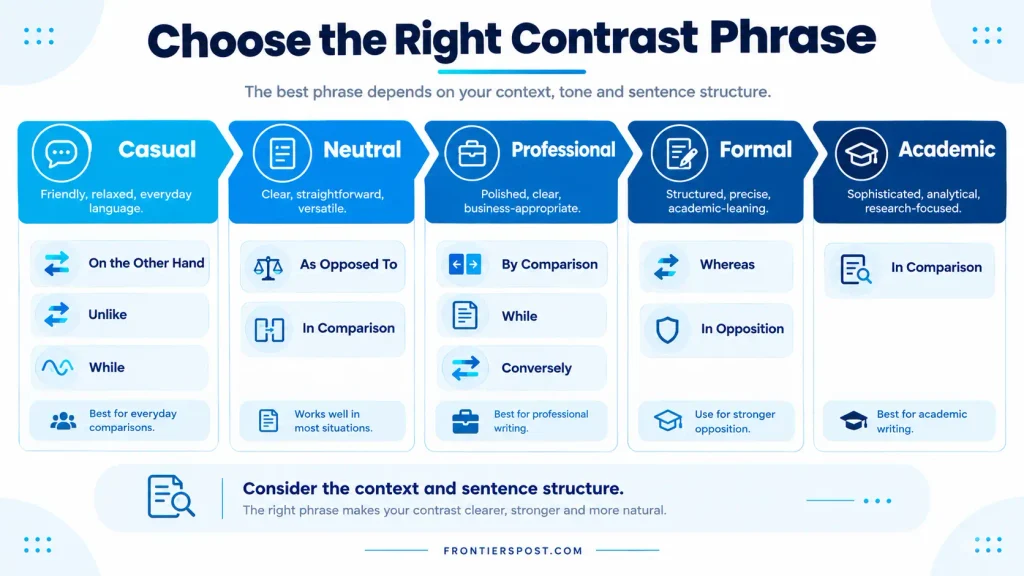
Expressions such as “on the other hand” can work in professional communication, but some contexts may require more precise wording. Consider “conversely,” “whereas,” or “by comparison” for formal reports and academic work.
2. Choosing an Alternative That Does Not Show Contrast
Not every transition means exactly the same thing. For example, “alternatively” usually introduces another option, while “conversely” signals a stronger reversal or opposite relationship.
3. Repeating the Same Transition
Using “in contrast” several times in one essay can make your writing sound repetitive. Rotate between appropriate alternatives when the meaning remains accurate.
4. Ignoring Sentence Structure
Some alternatives cannot simply replace “in contrast” word for word. “Whereas” and “while,” for example, usually connect clauses, while “unlike” normally comes before a noun or noun phrase.
5. Making the Contrast Sound Stronger Than It Is
Words such as “in opposition” can suggest direct conflict. If two ideas are simply different, choose a neutral expression such as “by comparison,” “unlike,” or “while.”
Frequently Asked Questions

What is another way to say “in contrast” in an essay?
Several alternatives work well in essays, including conversely, by comparison, in comparison, whereas, and on the other hand. The best choice depends on the sentence. “Conversely” is useful for a strong reversal, while “whereas” works well when comparing two ideas within one sentence.
What is a formal way to say “in contrast”?
Conversely, by comparison, in comparison, and whereas are formal alternatives to “in contrast.” They are common in academic papers, reports, analytical writing, and professional documents. Choose “conversely” when the second point reverses the first, and “by comparison” when you are directly evaluating two subjects.
What can I say instead of “in contrast” in academic writing?
In academic writing, you can use conversely, whereas, by comparison, in comparison, or unlike. The choice should match the relationship between your ideas. Avoid using a more formal transition simply to sound academic; accuracy and clarity are more important than complex wording.
Is “on the other hand” the same as “in contrast”?
“On the other hand” and “in contrast” can both introduce differences, but they are not always interchangeable. “On the other hand” often introduces another perspective or option, while “in contrast” more directly highlights a difference between two subjects or ideas.
What is another word for “in contrast” in a sentence?
Depending on the sentence, alternatives include whereas, while, unlike, conversely, and as opposed to. These expressions have different grammatical structures, so you may need to rewrite the sentence rather than simply replace “in contrast” with another phrase.
Can I use “whereas” instead of “in contrast”?
Yes, but the sentence structure usually needs to change. “Whereas” joins contrasting clauses within one sentence, while “in contrast” commonly works as a transition between sentences or ideas. For example, “The first plan is inexpensive, whereas the second offers more features.”
Is “conversely” a good alternative to “in contrast”?
“Conversely” is a good alternative when the second idea represents an opposite or reversed relationship. It is particularly useful in academic, analytical, and professional writing. However, it may sound too strong if the two ideas are simply different rather than opposite.
What is the best alternative to “in contrast” in professional writing?
There is no single best choice for every professional situation. By comparison works well for analytical writing, whereas fits direct comparisons, and on the other hand is natural when presenting another perspective. Choose the expression that accurately describes the relationship between your ideas.
You may also find these guides useful: Another Way to Say In Light Of, “In Other Words” Synonyms and Another Way to Say In This Case.
Conclusion
Using another way to say “in contrast” can make your writing clearer, smoother, and less repetitive. The best alternative depends on what kind of difference you want to show and how formal your writing needs to be.
For everyday and professional communication, on the other hand is a natural choice. In academic or formal writing, conversely, by comparison, and whereas can create a more precise comparison. If you are comparing specific choices, as opposed to may work better, while unlike provides a concise option.
Before choosing a replacement, consider the sentence structure as well as the meaning. A strong transition should make the relationship between your ideas easier—not harder—for the reader to understand.

The FrontiersPost editorial team writes and reviews every guide to word and phrase alternatives, with clear meanings, tone notes and example sentences for everyday, academic and professional English.




