

Another way to say “due to” includes because of, owing to, as a result of, on account of, as a consequence of, resulting from, caused by, and stemming from. The best choice depends on context and tone. For professional writing, “because of,” “owing to,” and “as a result of” are especially useful.
Key Takeaways
- “Due to” means because of or as a result of something.
- Because of is the most natural everyday alternative.
- Owing to and as a result of work well in formal and professional writing.
- Some alternatives, such as thanks to, are better when the result is positive.
- Always choose an alternative based on the sentence’s meaning, tone, and context.
What Does “Another Way to Say Due To” Mean?

The phrase “due to” means that something happened because of a particular reason or cause. It is commonly used to explain why an event, situation, change, or result occurred.
For example, you might say, “The flight was delayed due to bad weather.” Here, “due to” identifies bad weather as the reason for the delay.
The phrase is common in professional emails, academic writing, news reports, announcements, and everyday communication. However, repeating “due to” can make your writing feel predictable, so using alternatives can make your sentences more varied and natural.
Why Use Other Ways to Say “Due To”?
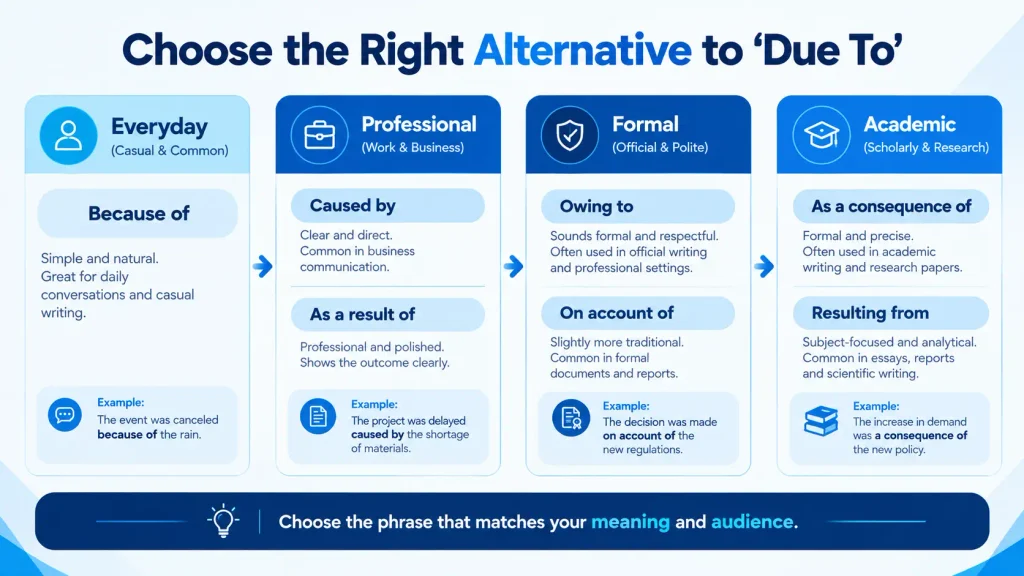
Choosing another way to say “due to” can help you make your writing clearer and better suited to your audience.
You may want an alternative to:
- Avoid repeating the same phrase.
- Make everyday writing sound more natural.
- Create a more formal or academic tone.
- Explain cause and effect more clearly.
- Match the emotional tone of the situation.
- Make professional emails and reports easier to read.
The key is not simply replacing “due to” with a synonym. The alternative should fit the meaning and grammar of the entire sentence.
10 Best Other Ways to Say “Due To”
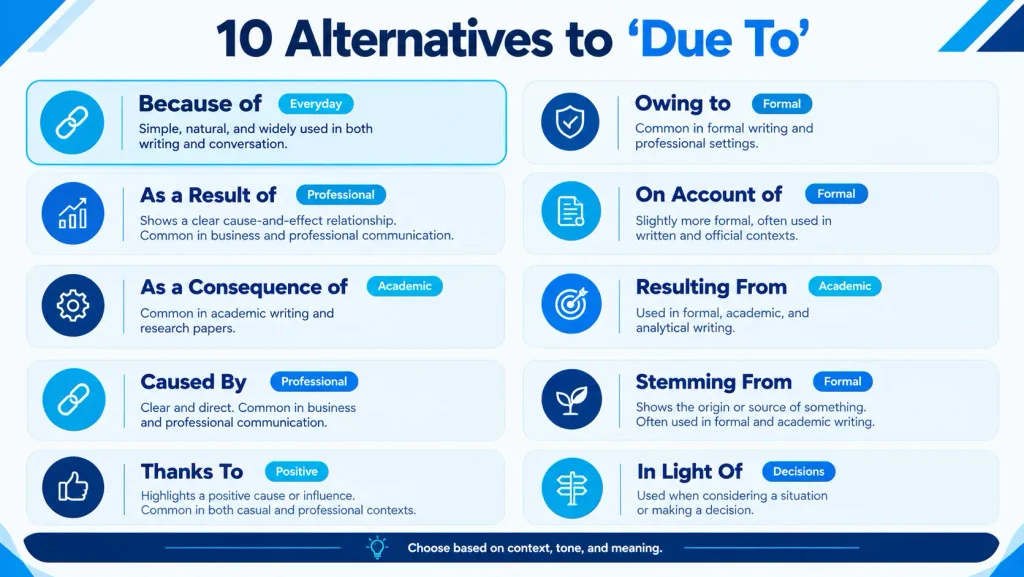
1. Because Of
Meaning
Because of means that something happened as a result of a particular person, event, condition, or circumstance. It is one of the most natural and widely used alternatives to “due to.”
Best For
- Casual
- Friendly
- Professional
- Polite
Example 1
The outdoor concert was canceled because of heavy rain.
Example 2
We arrived late because of unexpected traffic on the highway.
Quick Tip
Use “because of” when you want your sentence to sound direct, clear, and natural without being overly formal.
2. Owing To
Meaning
Owing to means “because of” and is often used when explaining the cause of a situation. It has a more formal tone than “because of.”
Best For
- Formal
- Professional
- Academic
Example 1
The museum will close early owing to a scheduled maintenance project.
Example 2
Several deliveries were delayed owing to severe winter weather.
Quick Tip
Choose “owing to” when you want a polished alternative for formal notices, reports, or professional writing.
3. As a Result Of
Meaning
As a result of explains that one event or condition produced a particular outcome. It emphasizes the relationship between a cause and its effect.
Best For
- Professional
- Formal
- Academic
Example 1
The company changed its schedule as a result of customer feedback.
Example 2
Several roads were closed as a result of flooding in the area.
Quick Tip
Use this phrase when you want to make the cause-and-effect relationship especially clear.
4. On Account Of
Meaning
On account of means “because of” or “for the reason that.” It can sound somewhat more formal than everyday alternatives and is useful when giving a specific reason.
Best For
- Formal
- Professional
- Polite
Example 1
The event was postponed on account of safety concerns.
Example 2
The employee requested additional time on account of an unexpected family matter.
Quick Tip
Use “on account of” when the reason is important enough to state explicitly, especially in formal communication.
5. As a Consequence Of
Meaning
As a consequence of indicates that something happened because another event or condition produced a particular effect. It strongly emphasizes the resulting consequence.
Best For
- Formal
- Academic
- Professional
Example 1
Production slowed as a consequence of the equipment failure.
Example 2
The organization revised its policies as a consequence of the new regulations.
Quick Tip
This phrase works particularly well when you are discussing significant outcomes in reports, essays, or analytical writing.
6. Resulting From
Meaning
Resulting from identifies the event, action, or condition that caused something else to happen. It is concise and especially useful when describing problems, changes, or outcomes.
Best For
- Professional
- Formal
- Academic
Example 1
The additional costs resulting from the delay were covered by the supplier.
Example 2
The changes resulting from the new policy affected several departments.
Quick Tip
Use “resulting from” when you want to describe the cause of an existing condition rather than simply explain why an event occurred.
7. Caused By
Meaning
Caused by directly identifies what produced an event, problem, or condition. It is straightforward and often more direct than “due to.”
Best For
- Professional
- Formal
- Casual
Example 1
The technical issue was caused by an outdated software version.
Example 2
The damage was caused by a pipe that burst overnight.
Quick Tip
“Caused by” is especially useful when the relationship between the cause and effect is direct and clear.
8. Stemming From
Meaning
Stemming from means originating from or developing because of something. It is useful when a situation has a deeper or ongoing cause.
Best For
- Professional
- Formal
- Academic
Example 1
The disagreement was stemming from a misunderstanding between the two teams.
Example 2
The company faced several challenges stemming from supply chain disruptions.
Quick Tip
Use “stemming from” when the cause is an underlying issue rather than a single immediate event.
9. Thanks To
Meaning
Thanks to means that something happened because of a particular person, action, or circumstance. Unlike many alternatives to “due to,” it usually suggests a positive or beneficial result.
Best For
- Casual
- Friendly
- Warm
- Polite
Example 1
Thanks to your quick response, we were able to finish the project on time.
Example 2
The team reached its goal thanks to months of careful preparation.
Quick Tip
Use “thanks to” when the cause contributed to a positive outcome. Avoid it when describing an unwanted event unless you are intentionally being sarcastic.
10. In Light Of
Meaning
In light of means considering or because of new information, circumstances, facts, or developments. It is not a direct synonym for every use of “due to,” but it works well when a decision or action changes because of new circumstances.
Best For
- Formal
- Professional
- Academic
- Polite
Example 1
In light of recent developments, the company decided to review its policy.
Example 2
The meeting format was changed in light of feedback from employees.
Quick Tip
Use “in light of” when the cause involves information or circumstances that influence a decision, rather than a simple physical cause.
Comparison Table
| Alternative | Best Used In | Tone |
| Because of | Everyday and professional writing | Neutral |
| Owing to | Formal writing and notices | Formal |
| As a result of | Reports and academic writing | Formal |
| On account of | Formal explanations | Polite/Formal |
| As a consequence of | Analytical and academic writing | Formal |
| Resulting from | Professional and academic writing | Formal |
| Caused by | Direct explanations | Neutral |
| Stemming from | Professional and analytical writing | Formal |
| Thanks to | Positive situations | Warm/Friendly |
| In light of | Decisions and new circumstances | Professional/Formal |
Common Mistakes
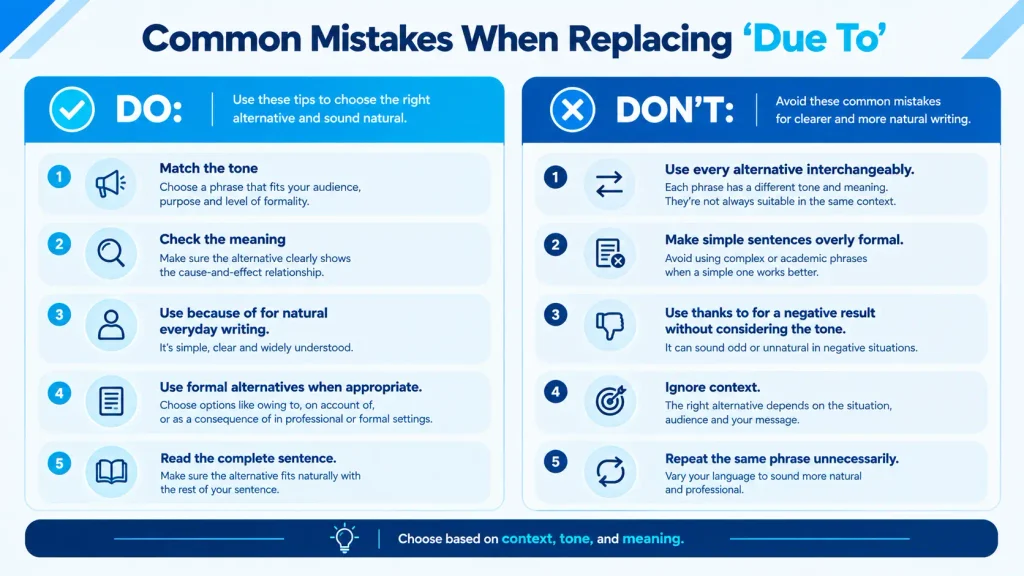
1. Using a Casual Phrase in a Formal Context
Some alternatives sound more conversational than others. For example, “thanks to” may not be appropriate when explaining a serious problem in a formal report.
2. Treating Every Alternative as an Exact Substitute
Not every phrase has exactly the same meaning. “In light of,” for example, usually refers to decisions made after considering information or circumstances, while “because of” directly states a cause.
3. Choosing Overly Formal Language
Phrases such as “as a consequence of” can sound unnecessarily formal in a simple conversation. In everyday communication, “because of” is often clearer.
4. Ignoring the Positive or Negative Meaning
“Thanks to” often suggests that the cause produced a favorable result. Using it for a negative situation can create an unintended tone.
5. Forgetting Sentence Structure
Some alternatives fit naturally into different grammatical structures. Always read the complete sentence after replacing “due to” to make sure the wording remains clear and grammatically correct.
Frequently Asked Questions
What is the most common alternative to “due to”?
The most common alternative to “due to” is “because of.” It is natural, clear, and appropriate for most everyday and professional situations. For example, “The meeting was canceled because of the storm” sounds straightforward and conversational while still being grammatically correct.
What is a formal way to say “due to”?
Formal alternatives include “owing to,” “as a result of,” “as a consequence of,” and “resulting from.” The best option depends on the sentence. “Owing to” is a close replacement, while “as a result of” is particularly useful when you want to emphasize cause and effect.
Can I use “because of” instead of “due to”?
Yes. “Because of” is often an excellent replacement for “due to,” especially in everyday and professional writing. It clearly identifies the reason something happened and generally sounds more natural than “due to” when used in conversational sentences.
Is “owing to” the same as “due to”?
“Owing to” and “due to” are very similar because both can introduce a cause or reason. However, “owing to” often sounds more formal. It is common in announcements, reports, academic writing, and other situations where a polished tone is appropriate.
What is another way to say “due to the fact that”?
A simpler alternative is usually “because.” For example, instead of saying “The event was delayed due to the fact that the speaker arrived late,” you can write, “The event was delayed because the speaker arrived late.” The shorter version is generally clearer and more direct.
Can I use “thanks to” instead of “due to”?
You can, but only when the context supports a positive or beneficial meaning. “Thanks to” often expresses appreciation for the cause of a good outcome. For example, “We finished early thanks to your help” sounds natural because the result is positive.
What is the best alternative to “due to” in academic writing?
“As a result of,” “owing to,” and “resulting from” can work well in academic writing. Your choice should depend on the sentence. “As a result of” is especially useful when explaining a clear relationship between a cause and its outcome.
Is “because of” more natural than “due to”?
In many everyday sentences, yes. “Because of” is direct and widely used in spoken and written American English. However, “due to” remains useful in professional, formal, and technical contexts, so the best choice depends on the tone and structure of your sentence.
You may also find these guides useful: Another Way to Say Especially, Another Way to Say Finally and Another Way to Say Finally in an Essay.
Conclusion
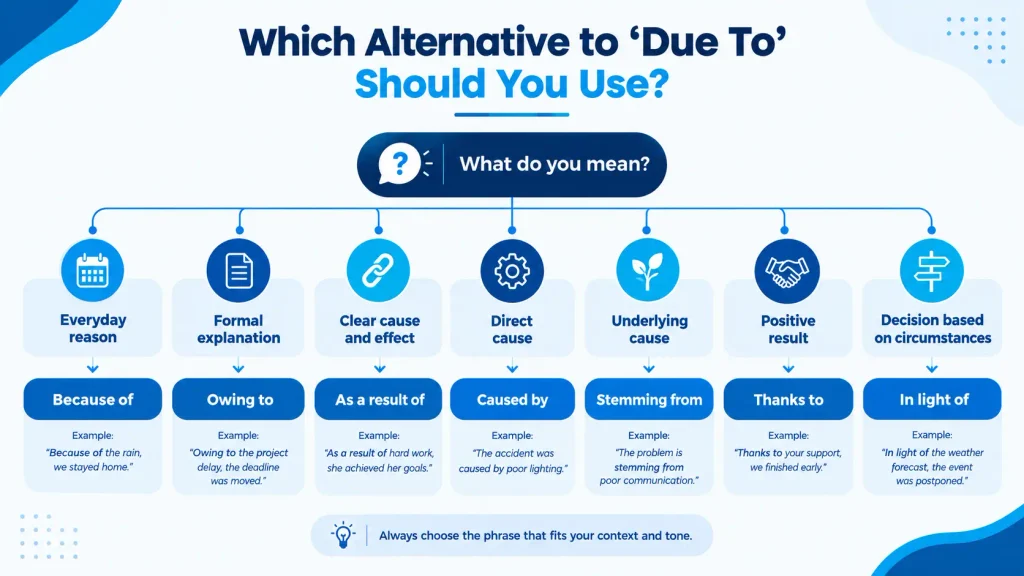
There are many natural ways to say “due to,” but the right alternative depends on your meaning and audience. Because of is the simplest choice for everyday communication, while owing to and as a result of work well in professional or formal writing.
For analytical writing, as a consequence of, resulting from, and stemming from can make cause-and-effect relationships more precise. When the outcome is positive, thanks to can add a warmer tone. In light of is useful when new information or circumstances influence a decision.
Instead of replacing “due to” automatically, consider what you want the sentence to communicate. A well-chosen alternative can make your writing clearer, more natural, and better suited to the situation. For a clearer understanding of the phrase, see the meaning and usage of due to.

The FrontiersPost editorial team writes and reviews every guide to word and phrase alternatives, with clear meanings, tone notes and example sentences for everyday, academic and professional English.




