

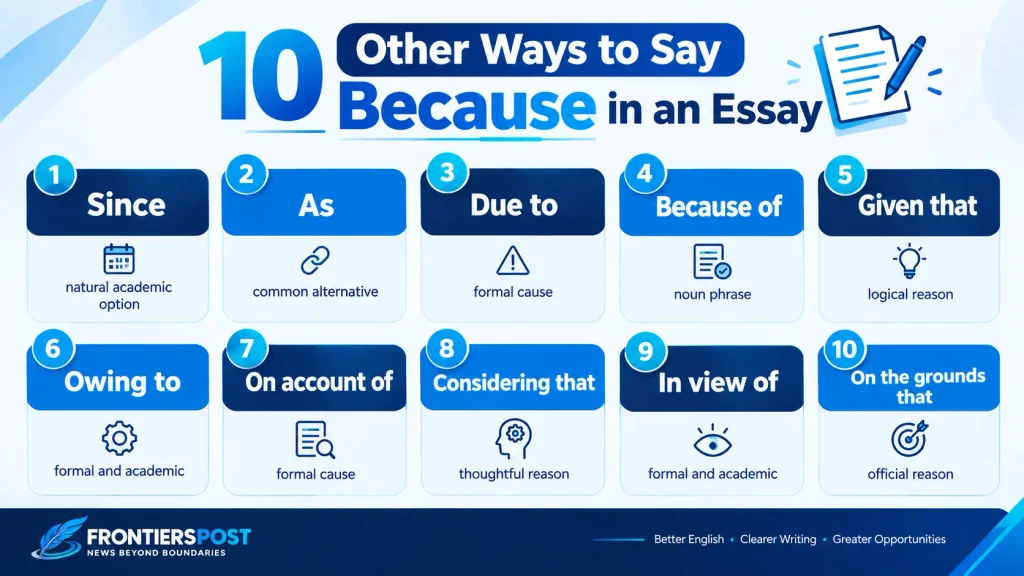
Another way to say because in an essay includes since, as, due to the fact that, owing to, because of, given that, as a result of, on account of, considering that, and in view of. The best choice depends on whether you need a formal, academic, concise, or cause-and-effect expression.
Key Takeaways
- Since and as are natural alternatives to “because” in academic writing.
- Due to and because of must be followed by a noun or noun phrase.
- Given that works well when introducing a known or accepted reason.
- Avoid replacing “because” with a more complicated phrase when a simple option is clearer.
- Choose an alternative based on grammar, tone, and the relationship between the ideas.
When writing an essay, using the same word repeatedly can make your sentences feel predictable. Although because is completely correct, choosing an appropriate alternative can make your academic writing more varied and precise.
The key is to choose a phrase that fits the sentence naturally. Some alternatives introduce a reason, while others emphasize a cause, explain circumstances, or connect an event with its result.
What Does “Another Way to Say Because in an Essay” Mean?
The phrase “another way to say because in an essay” refers to alternative words and expressions that explain why something happens or why a statement is true.
“Because” is commonly used to introduce a reason or cause. For example, “The students stayed inside because it was raining” explains the reason the students stayed inside.
In essays, writers may use alternatives such as since, as, due to, given that, or because of to avoid repetition and create smoother transitions. These expressions are especially useful in academic, argumentative, and explanatory writing.
Why Use Other Ways to Say “Because in an Essay”?
Using alternatives to “because” can improve your writing when the replacement fits the context. However, the goal is not to make every sentence sound more complicated.
Useful alternatives can help you:
- Avoid repeating “because” throughout an essay.
- Create more natural sentence variety.
- Match a formal or academic writing style.
- Make cause-and-effect relationships clearer.
- Connect ideas more smoothly.
- Choose between clauses and noun phrases correctly.
The strongest academic writing usually balances variety with clarity. A simple “because” is often better than an unnecessarily complicated expression.
10 Best Other Ways to Say “Because”
1. Since
Meaning
Since can introduce a reason or explanation, much like “because.” It is especially natural when the reason is already known, obvious, or closely connected to the main idea.
Best For
- Formal
- Professional
- Academic
Example 1
Since the evidence was limited, the researchers avoided making a definite conclusion.
Example 2
The experiment was repeated since the original results were inconsistent.
Quick Tip
Use “since” when the reason is secondary to the main point. If the reason needs strong emphasis, “because” may be clearer.
2. As
Meaning
As can introduce a reason and works well in formal and academic writing. It often creates a smooth connection between two related ideas without putting heavy emphasis on the cause.
Best For
- Formal
- Professional
- Academic
Example 1
As the deadline was approaching, the team prioritized the most important tasks.
Example 2
The proposal was revised as several sections needed additional evidence.
Quick Tip
Make sure “as” clearly means “because” in your sentence. It can also mean “while” or describe how something happens.
3. Due to
Meaning
Due to expresses a cause or reason, but it is normally followed by a noun or noun phrase rather than a complete clause. It is common in formal and academic writing.
Best For
- Formal
- Professional
Example 1
The outdoor event was canceled due to severe weather conditions.
Example 2
Due to limited funding, the organization postponed the project.
Quick Tip
Use due to + noun phrase, not due to + subject + verb. For example, “due to heavy rain” is correct, while “due to it was raining” is not.
4. Because of
Meaning
Because of gives a reason and is followed by a noun, pronoun, or noun phrase. It is one of the most direct alternatives to “because” and works in both formal and everyday writing.
Best For
- Professional
- Formal
- Casual
Example 1
The research was delayed because of unexpected technical problems.
Example 2
Several students missed the presentation because of transportation issues.
Quick Tip
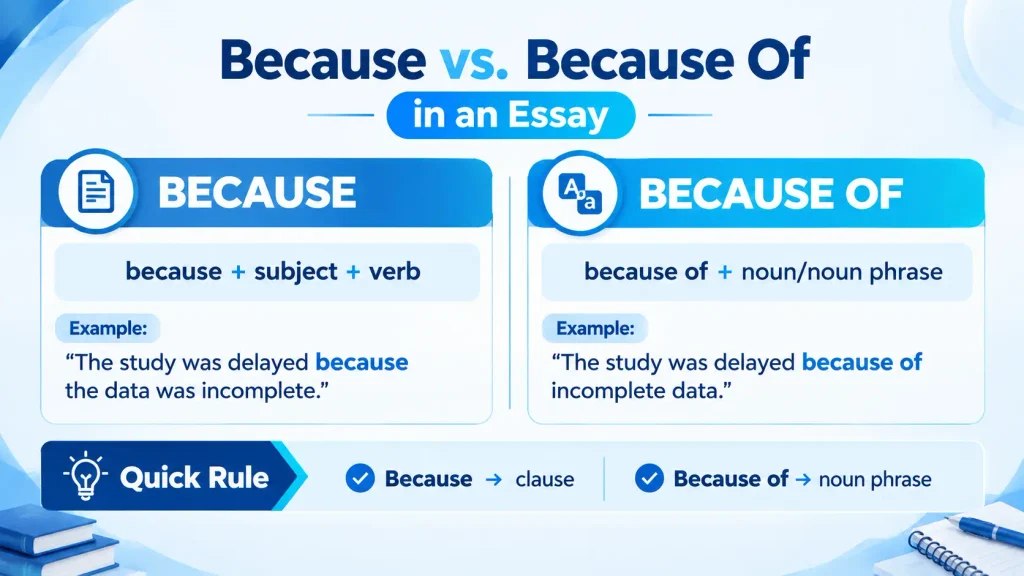
Remember the grammar difference: use because + clause, but because of + noun phrase.
5. Given That
Meaning
Given that introduces a reason based on a fact, condition, or situation that the reader can accept. It is particularly useful when building an argument or explaining a logical conclusion.
Best For
- Formal
- Academic
- Professional
Example 1
Given that the sample size was small, the findings should be interpreted carefully.
Example 2
Given that demand has increased, the company should consider expanding its services.
Quick Tip
Use “given that” when the information after it provides a reasonable basis for the conclusion that follows.
6. Owing To
Meaning
Owing to means “because of” and explains the cause of an event or situation. It has a formal tone and can work particularly well in academic or professional writing.
Best For
- Formal
- Professional
Example 1
Owing to a shortage of materials, construction was temporarily suspended.
Example 2
The publication date changed owing to unexpected editorial delays.
Quick Tip
Follow “owing to” with a noun or noun phrase, just as you would with “because of.”
7. On Account Of
Meaning
On account of means “because of” or “for the reason of.” It can explain why something happened, although it sounds more formal and somewhat less common than “because of.”
Best For
- Formal
- Professional
Example 1
The meeting was postponed on account of the director’s absence.
Example 2
The application was rejected on account of missing documentation.
Quick Tip
Use this expression sparingly in modern academic writing. “Because of” or “due to” is often more concise.
8. Considering That
Meaning
Considering that introduces a fact or circumstance that helps explain a conclusion. It is useful when the writer wants the reader to take a particular situation into account.
Best For
- Formal
- Academic
- Professional
Example 1
Considering that the program is still new, its early results are encouraging.
Example 2
Considering that the budget was reduced, the project achieved its goals efficiently.
Quick Tip
Use “considering that” when the reason involves a circumstance that should be weighed before reaching a conclusion.
9. In View Of
Meaning
In view of means “because of” or “considering.” It is a formal expression that works well when a decision or action is based on specific facts or circumstances.
Best For
- Formal
- Professional
Example 1
In view of the recent findings, the committee requested additional research.
Example 2
The policy was reviewed in view of changing industry standards.
Quick Tip
“In view of” is followed by a noun phrase. It is more formal than everyday alternatives such as “because of.”
10. On The Grounds That
Meaning
On the grounds that introduces a specific reason or justification for an argument, decision, or action. It is particularly useful when explaining why a position is supported or challenged.
Best For
- Formal
- Academic
- Professional
Example 1
The proposal was rejected on the grounds that it lacked sufficient supporting evidence.
Example 2
The researchers questioned the conclusion on the grounds that several variables had not been controlled.
Quick Tip
Use this expression when you want to emphasize the specific basis for a decision, argument, or judgment.
Comparison Table
| Alternative | Best Used In | Tone |
| Since | Academic essays, explanations | Formal, natural |
| As | Academic and professional writing | Formal, smooth |
| Due to | Formal essays, reports | Formal |
| Because of | General academic writing | Neutral |
| Given that | Arguments and analysis | Formal, logical |
| Owing to | Academic and professional writing | Formal |
| On account of | Formal explanations | Formal |
| Considering that | Analytical essays | Formal, thoughtful |
| In view of | Formal arguments and reports | Formal |
| On the grounds that | Arguments and justifications | Formal, authoritative |
Common Mistakes
1. Using Casual Phrases in Formal Essays
Some conversational expressions may sound too informal in academic writing. Choose alternatives that fit the level of formality required by your assignment.
2. Using the Wrong Grammar After “Due To”
“Due to” should generally be followed by a noun or noun phrase. Do not treat it as a direct replacement for “because” before a complete subject-and-verb clause.
3. Choosing an Overly Formal Expression
Not every sentence needs sophisticated wording. If “because” communicates the idea more clearly, there is no reason to replace it.
4. Ignoring Context
Different alternatives can emphasize slightly different relationships between ideas. Consider whether you are explaining a reason, identifying a cause, or supporting an argument.
5. Replacing Every “Because”
Variety is useful, but excessive variation can make writing feel unnatural. Keep “because” when it is the clearest and most direct choice.
Frequently Asked Questions
What is a formal way to say “because” in an essay?
Formal alternatives to “because” include since, as, given that, owing to, due to, in view of, and on the grounds that. The best option depends on sentence structure. For example, “given that” works before a complete clause, while “due to” normally introduces a noun phrase.
What is the best replacement for “because” in academic writing?
There is no single replacement that works best in every academic sentence. Since, as, given that, and because of are versatile choices. For formal arguments, expressions such as on the grounds that may be useful, but simple wording is usually preferable when it communicates the idea clearly.
Can I use “since” instead of “because” in an essay?
Yes. “Since” can introduce a reason in academic writing and is often a natural alternative to “because.” For example, “Since the evidence was incomplete, the researchers conducted another study.” However, make sure the context makes the causal meaning clear.
Is “due to” the same as “because”?
“Due to” and “because” can communicate a similar cause-and-effect relationship, but their grammar differs. “Because” normally introduces a clause, while “due to” is followed by a noun or noun phrase. For example, “The event was canceled because it rained” differs grammatically from “The event was canceled due to rain.”
Is “because of” formal enough for an essay?
Yes. Because of is acceptable in many academic essays and is not inherently informal. It is often a clear and natural choice when followed by a noun phrase, such as “because of limited resources.” You do not need to replace it simply to make your writing sound more academic.
What can I use instead of “because” to avoid repetition?
You can use since, as, given that, because of, due to, owing to, or other context-appropriate expressions. However, do not replace every occurrence automatically. A mix of direct and alternative phrasing usually creates more natural academic writing.
Can I start an essay sentence with “because”?
Yes. A sentence can begin with “because” when the dependent clause is connected to an independent clause. For example, “Because the evidence was incomplete, the researcher conducted further analysis.” Starting with “because” is grammatically correct when the sentence is complete.
Which alternative to “because” sounds most academic?
Expressions such as given that, in view of, and on the grounds that can have a distinctly formal tone. However, academic writing does not require complicated vocabulary. In many situations, because, since, or as is clearer and more effective.
Conclusion
There are many ways to say because in an essay, but the best choice depends on your sentence, purpose, and desired tone. Since and as are natural options for academic writing, while because of and due to work well when you need to introduce a noun phrase.
For more formal arguments, given that, considering that, in view of, and on the grounds that can help establish a clear logical connection. Still, variety should never come at the expense of clarity.
When revising an essay, look for repeated uses of “because” and consider whether another expression would make the sentence smoother or more precise. The goal is not to sound complicated—it is to communicate the relationship between your ideas clearly and confidently.

Sarah Mitchell is a Senior English Editor at FrontiersPost, specializing in English usage, vocabulary, word choice, grammar, and effective communication. She focuses on helping readers understand subtle differences between commonly confused words, phrases, and expressions and use them naturally in everyday, professional, and academic writing.
At FrontiersPost, Sarah researches, writes, and edits educational content with an emphasis on clarity, accuracy, and practical examples. She works closely with the editorial team to ensure that articles are easy to understand while maintaining appropriate context, meaning, and usage.
Her editorial interests include English vocabulary, synonyms, phrasing, professional communication, and the practical nuances that can make written communication more precise and effective.