

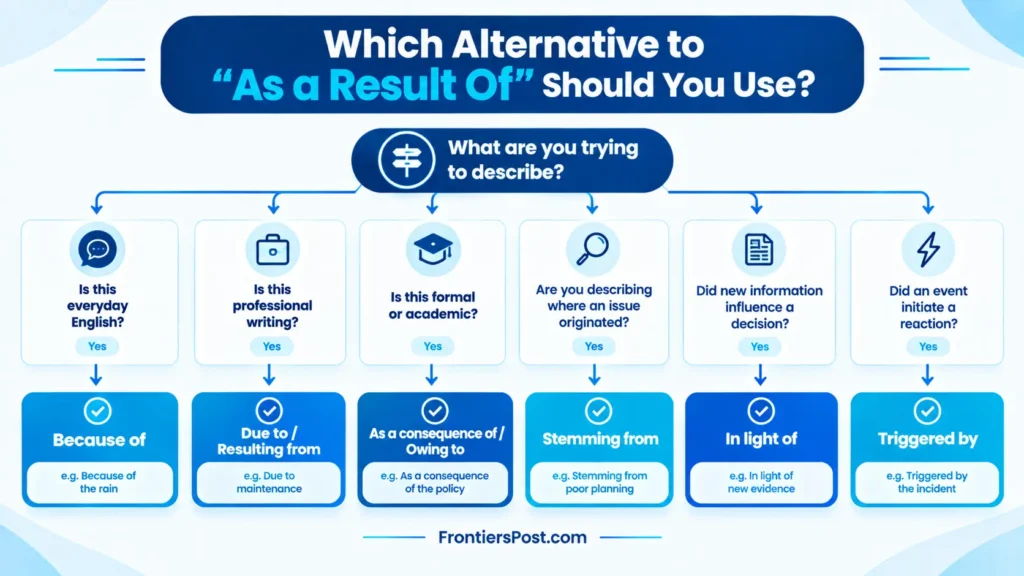
If you need another way to say “as a result of,” you can use phrases such as “because of,” “due to,” “as a consequence of,” “owing to,” or “stemming from.” The best choice depends on whether you want a casual, professional, academic, or more formal tone.
Key Takeaways
- “Because of” is the most natural everyday alternative to “as a result of.”
- “Due to” works well in professional and formal writing.
- “As a consequence of” emphasizes a clear cause-and-effect relationship.
- “Owing to” is useful when you want a polished, formal tone.
- Always choose an alternative based on the sentence, audience, and level of formality.
What Does “Another Way to Say As a Result Of” Mean?
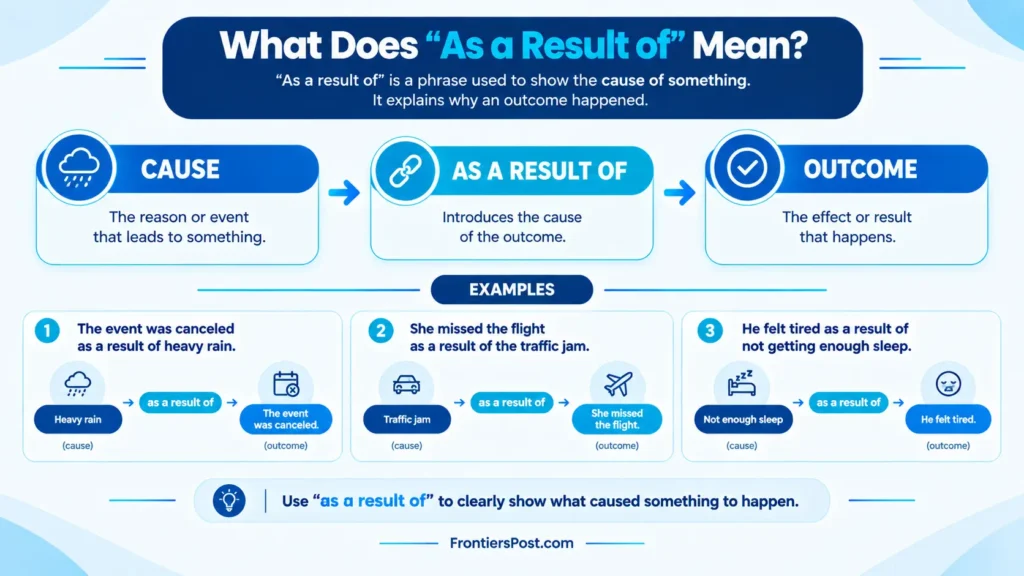
The phrase “as a result of” means that something happened because of a particular cause or situation. It introduces the reason or condition that led to an outcome.
For example, “The event was canceled as a result of severe weather” means that severe weather caused the cancellation. The phrase is common in academic writing, business communication, reports, news writing, and formal conversations.
People often search for another way to say “as a result of” because they want to avoid repetition or find wording that better matches their sentence.
Why Use Other Ways to Say “As a Result Of”?
Using different expressions can make your writing smoother and more precise. Although “as a result of” is correct, repeating it throughout an article, essay, or report can make your writing feel predictable.
Consider another expression when you want to:
- Avoid repeating the same phrase.
- Make a sentence sound more natural.
- Adjust your level of formality.
- Create stronger cause-and-effect connections.
- Improve professional or academic writing.
- Make everyday conversations sound less formal.
10 Best Other Ways to Say “As a Result Of”
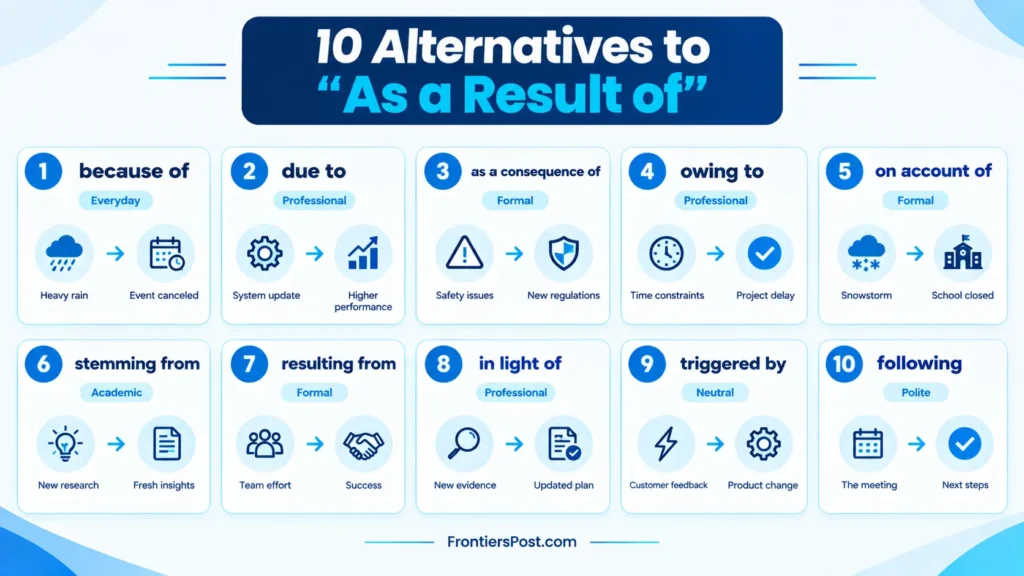
1. Because Of
Meaning
“Because of” directly explains why something happened. It is one of the most natural alternatives and works especially well in everyday American English.
Best For
- Casual
- Friendly
- Professional
Example 1
The outdoor concert was canceled because of the heavy rain.
Example 2
She missed the meeting because of a delayed flight.
Quick Tip
Use “because of” when you want a clear, simple way to explain a cause without sounding overly formal.
2. Due To
Meaning
“Due to” identifies a reason for an event, condition, or outcome. It is especially common in professional, academic, and official writing.
Best For
- Professional
- Formal
- Polite
Example 1
The office will close early due to scheduled maintenance.
Example 2
Several flights were delayed due to severe weather conditions.
Quick Tip
“Due to” is a strong choice for workplace emails, announcements, reports, and other formal contexts.
3. As a Consequence Of
Meaning
“As a consequence of” emphasizes that one event directly produced another outcome. It can sound more serious or formal than “because of.”
Best For
- Formal
- Professional
- Academic
Example 1
The company reduced production as a consequence of declining demand.
Example 2
The river overflowed as a consequence of several days of heavy rainfall.
Quick Tip
Choose this phrase when you want to highlight the resulting effect rather than simply state a reason.
4. Owing To
Meaning
“Owing to” means “because of” and provides a polished alternative for formal writing. It is particularly useful when you want to vary your language without changing the meaning.
Best For
- Formal
- Professional
- Academic
Example 1
Owing to unexpected technical problems, the presentation started late.
Example 2
The match was postponed owing to unsafe field conditions.
Quick Tip
Use “owing to” when writing a formal notice, report, essay, or business communication.
5. On Account Of
Meaning
“On account of” means because of a particular reason or circumstance. It has a slightly formal tone and can add variety to explanatory writing.
Best For
- Formal
- Professional
- Polite
Example 1
The museum closed temporarily on account of structural repairs.
Example 2
He stayed home on account of a family emergency.
Quick Tip
This phrase is useful when you need a formal alternative, but it may sound less conversational than “because of.”
6. Stemming From
Meaning
“Stemming from” describes something that originates from a particular cause, issue, or event. It works especially well when discussing problems, decisions, conflicts, or developments.
Best For
- Professional
- Formal
- Academic
Example 1
The policy changes were stemming from concerns about workplace safety.
Example 2
The disagreement stemmed from a misunderstanding about the project deadline.
Quick Tip
Use “stemming from” when the cause has developed over time or when you want to show where an issue originated.
7. Resulting From
Meaning
“Resulting from” directly connects an outcome with its underlying cause. It is concise and useful in technical, academic, and professional writing.
Best For
- Professional
- Formal
- Academic
Example 1
The damage resulting from the storm required extensive repairs.
Example 2
The company addressed problems resulting from the software update.
Quick Tip
Use “resulting from” when you want to focus on an outcome that was produced by a specific event or condition.
8. In Light Of
Meaning
“In light of” means considering a particular fact, development, or circumstance. It does not always mean direct causation, so it is best used when a decision or response follows new information.
Best For
- Professional
- Formal
- Polite
Example 1
In light of recent safety concerns, the school revised its field-trip policy.
Example 2
The committee changed its recommendation in light of the new evidence.
Quick Tip
Do not use “in light of” when you mean simple cause and effect. It works better when information influences a decision or response.
9. Triggered By
Meaning
“Triggered by” describes an event, action, or condition that causes something else to happen. It is more direct and dynamic than “as a result of.”
Best For
- Professional
- Casual
- Academic
Example 1
The sudden price increase was triggered by a shortage of raw materials.
Example 2
The investigation was triggered by several customer complaints.
Quick Tip
Use “triggered by” when the cause actively sets an event, reaction, or process in motion.
10. As a Consequence Of
Meaning
“As a consequence of” shows that an outcome follows from a particular action, event, or condition. It is particularly effective when the result is important or has noticeable consequences.
Best For
- Formal
- Academic
- Professional
Example 1
The project faced major delays as a consequence of repeated supply problems.
Example 2
The organization changed its procedures as a consequence of the audit findings.
Quick Tip
This phrase is useful when you want to emphasize the effect produced by a cause, especially in analytical or formal writing.
Note: Because “as a consequence of” overlaps with Alternative 3, a cleaner 10th option for variety is “following.”
Better Alternative: Following
“Following” indicates that something happened after or in response to an earlier event. It is concise and common in professional, news, and formal writing.
Best For
- Professional
- Formal
- Polite
Example 1
Following the power outage, the building remained closed for several hours.
Example 2
The company introduced new procedures following the internal review.
Quick Tip
Use “following” when the relationship is closely connected to an earlier event, especially when the exact cause-and-effect relationship is understood from context.
Comparison Table
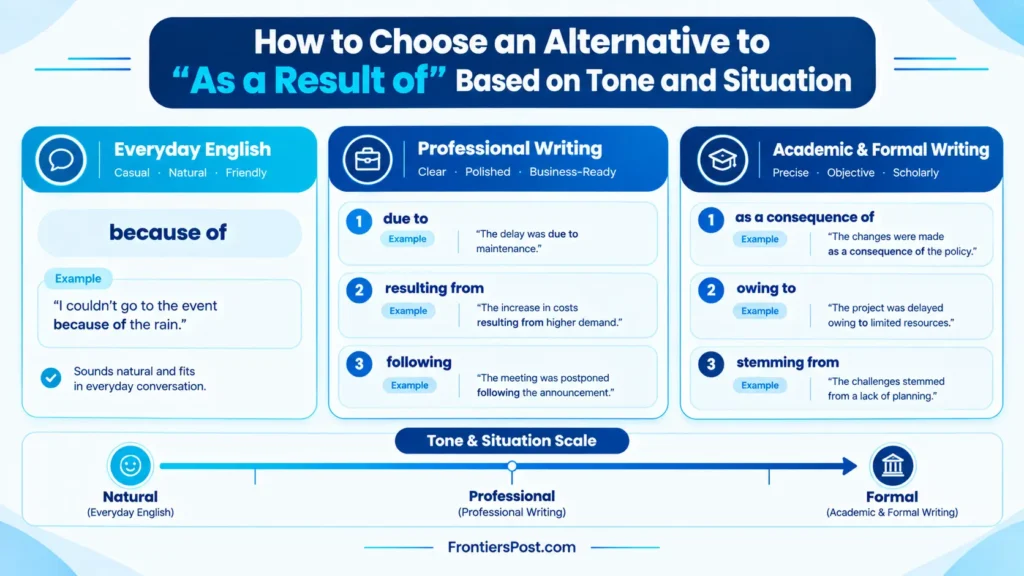
| Alternative | Best Used In | Tone |
| Because of | Everyday conversations, general writing | Natural |
| Due to | Business, reports, announcements | Professional |
| As a consequence of | Academic and analytical writing | Formal |
| Owing to | Formal writing and notices | Formal |
| On account of | Formal communication | Polished |
| Stemming from | Reports, analysis, explanations | Professional |
| Resulting from | Technical and academic writing | Formal |
| In light of | Decisions, policies, professional writing | Formal |
| Triggered by | News, business, analytical writing | Direct |
| Following | Business, news, formal writing | Concise |
Common Mistakes
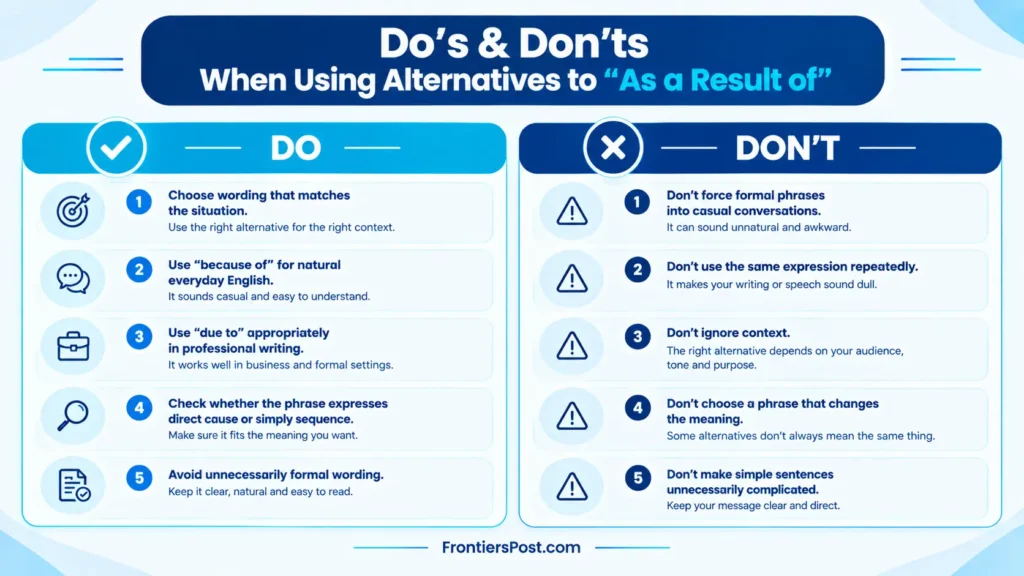
1. Using Casual Phrases in Professional Emails
Replacing “as a result of” with a very conversational expression can weaken a formal message. “Because of” is natural, but “due to” may be more suitable for an official announcement.
2. Choosing Overly Formal Language
Not every sentence needs sophisticated wording. In everyday conversation, “because of” usually sounds more natural than “owing to” or “on account of.”
3. Repeating the Same Phrase
Using “as a result of” several times in one paragraph can make your writing repetitive. Rotate between appropriate alternatives when the meaning stays accurate.
4. Ignoring Context
Not every synonym expresses exactly the same relationship. For example, “in light of” often means that information influenced a decision, while “because of” expresses a direct reason.
5. Using a Phrase That Changes the Meaning
Some alternatives emphasize different parts of the relationship. “Triggered by” suggests an initiating cause, while “following” primarily establishes sequence and context.
Frequently Asked Questions
What is the most common alternative to “as a result of”?
The most common everyday alternative is “because of.” It clearly explains the reason something happened and sounds natural in American English. For professional or formal writing, “due to” is often a better choice when the sentence structure supports it.
Is “due to” the same as “as a result of”?
In many sentences, “due to” can replace “as a result of” because both can identify a cause. However, “due to” can sound more formal, and its grammatical placement matters. Always read the entire sentence after replacing one phrase with the other.
What is a formal way to say “as a result of”?
Good formal alternatives include “owing to,” “as a consequence of,” “resulting from,” and “on account of.” Your choice depends on what you want to emphasize. For academic writing, “as a consequence of” can clearly highlight cause and effect.
What is a professional way to say “as a result of”?
“Due to,” “resulting from,” and “stemming from” work well in professional communication. For example, a business report might refer to delays “resulting from” supply issues, while a company announcement might say an office is closed “due to” maintenance.
Can I use “because of” instead of “as a result of”?
Yes. “Because of” is a natural substitute when the sentence needs to explain a cause. It is generally less formal and more conversational, making it especially useful for everyday speech, emails, general articles, and straightforward explanations.
What is another academic way to say “as a result of”?
For academic writing, consider “as a consequence of,” “resulting from,” “stemming from,” or “owing to.” These expressions can help establish a clear relationship between evidence, conditions, actions, and outcomes without relying on the same phrase repeatedly.
Is “stemming from” a synonym for “as a result of”?
Often, yes, but the emphasis is slightly different. “Stemming from” focuses on the origin or underlying source of an issue, while “as a result of” focuses more directly on the cause of an outcome. It is especially useful in analytical and professional writing.
How can I avoid repeating “as a result of” in an essay?
Vary the expression according to the meaning of each sentence. Use “because of” for straightforward causes, “due to” for formal explanations, and “as a consequence of” when you want to stress cause and effect. Avoid changing phrases simply for variety if the meaning becomes less precise.
Conclusion
There are many useful alternatives to “as a result of,” and the best one depends on your audience and the relationship between the cause and outcome. “Because of” is the most natural choice for everyday English, while “due to” works well in professional and formal communication. For more detail, see the meaning and usage of “as a result of”
For academic or analytical writing, “as a consequence of,” “resulting from,” and “stemming from” can provide greater precision. Meanwhile, “in light of” is better when new information influences a decision rather than directly causes an event.
The key is to choose an expression that matches both your meaning and your tone. A simple, accurate phrase will almost always make your writing stronger than an unnecessarily complicated one.

Sarah Mitchell is a writer and editor specializing in English usage, professional communication, vocabulary, and natural word choice. At FrontiersPost, she helps readers understand how words and phrases differ across professional, academic, and everyday contexts.