

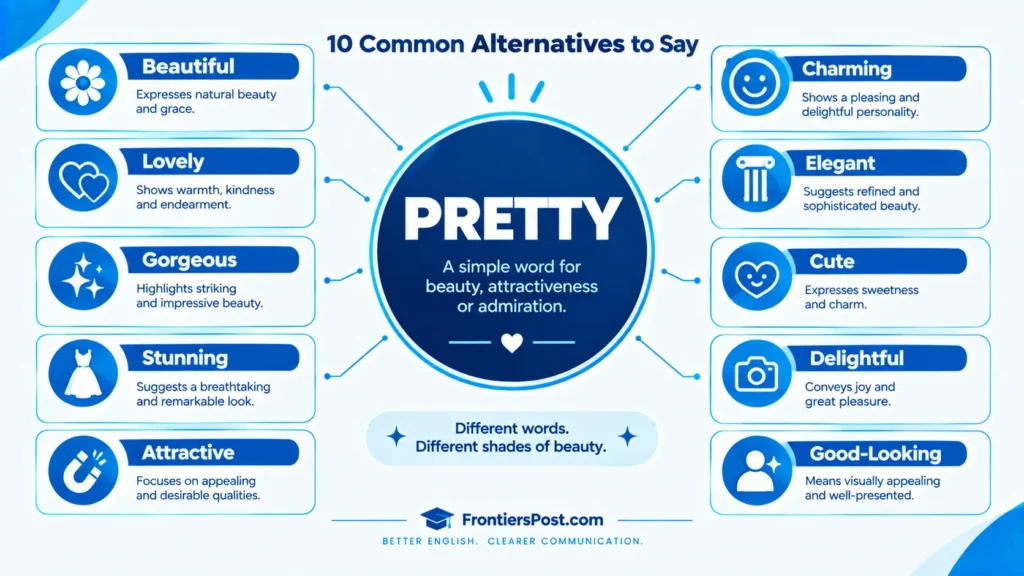
Looking for another way to say pretty? Try beautiful, attractive, lovely, gorgeous, stunning, charming, elegant, cute, delightful, or good-looking. The best choice depends on the person or thing you are describing and whether you want to sound casual, warm, professional, or more expressive.
Key Takeaways
- Beautiful is the most versatile alternative to “pretty.”
- Lovely sounds warm, friendly, and positive.
- Gorgeous and stunning express stronger admiration.
- Attractive works well when describing someone’s appearance in a more neutral way.
- Choose the alternative based on the context, tone, and level of admiration you want to express.
What Does “Another Way to Say Pretty” Mean?
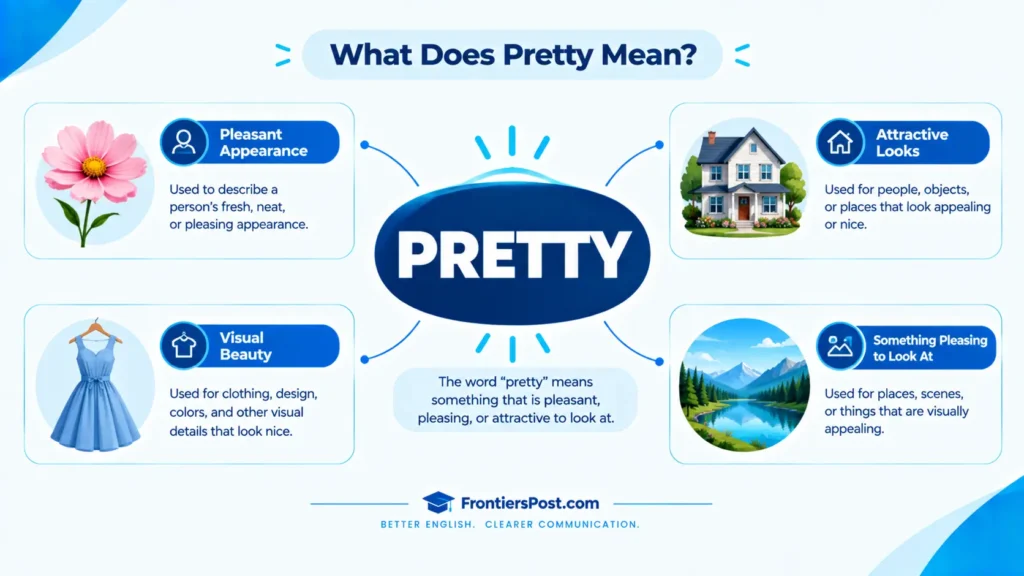
“Another way to say pretty” means finding a different word or phrase that communicates beauty, attractiveness, or visual appeal. People often search for alternatives to avoid repetition or to make their writing and conversations sound more natural.
The word pretty is common in everyday American English. It can describe people, clothes, places, objects, designs, or even ideas. However, alternatives such as “beautiful,” “lovely,” or “stunning” can express more specific shades of meaning.
Why Use Other Ways to Say “Pretty”?
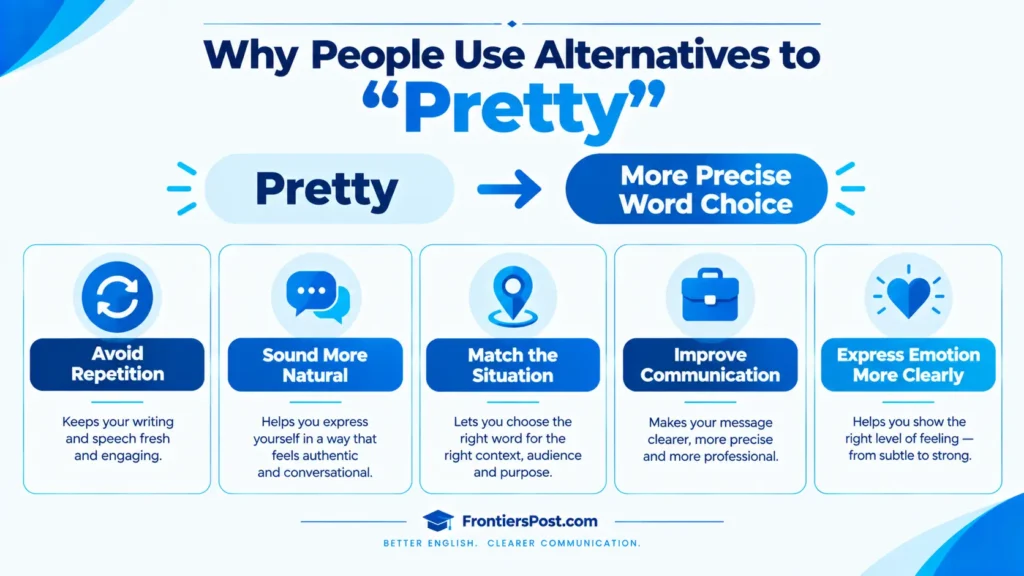
Using different words for “pretty” can make your communication more precise and expressive. The right alternative can also help you match the situation instead of using the same adjective repeatedly.
You might use another expression to:
- Avoid repeating the word “pretty.”
- Make a compliment sound more sincere.
- Express stronger admiration.
- Match a professional or casual setting.
- Describe a specific quality, such as elegance or charm.
- Make creative or personal writing more vivid.
10 Best Other Ways to Say “Pretty”
Beautiful
Meaning
Beautiful is one of the closest and most versatile alternatives to “pretty.” It describes someone or something that has qualities that create a strong sense of beauty or appeal.
Best For
- Friendly
- Warm
- Formal
- Casual
- Polite
Example 1
“You look beautiful in that blue dress.”
Example 2
“The garden was beautiful in the early morning light.”
Quick Tip
Use “beautiful” when you want a natural compliment that works in both everyday conversation and more polished writing.
Lovely
Meaning
Lovely describes something attractive, pleasant, or charming. It often feels warmer and softer than “pretty,” making it useful for friendly compliments.
Best For
- Friendly
- Warm
- Polite
- Casual
Example 1
“She has a lovely smile that makes everyone feel welcome.”
Example 2
“We had a lovely afternoon walking along the beach.”
Quick Tip
Choose “lovely” when you want your compliment to sound kind and gentle rather than intense.
Gorgeous
Meaning
Gorgeous is a strong way to describe someone or something exceptionally attractive. It is more enthusiastic than “pretty” and is especially common in casual American English.
Best For
- Casual
- Friendly
- Warm
Example 1
“Your new apartment looks gorgeous with all those plants.”
Example 2
“She looked gorgeous at the wedding.”
Quick Tip
Use “gorgeous” for enthusiastic compliments, but avoid it when a more restrained or professional tone is appropriate.
Stunning
Meaning
Stunning suggests that something is extremely beautiful or impressive. It can describe appearance, scenery, photography, architecture, fashion, and other visually impressive things.
Best For
- Formal
- Friendly
- Warm
- Casual
Example 1
“The photographer captured a stunning view of the mountains.”
Example 2
“She wore a stunning dress to the awards ceremony.”
Quick Tip
Use “stunning” when you want to communicate a stronger reaction than ordinary attractiveness.
Attractive
Meaning
Attractive means pleasing or appealing in appearance. It is more neutral and objective than words such as “gorgeous” or “stunning.”
Best For
- Professional
- Formal
- Polite
- Casual
Example 1
“The company created an attractive design for its new website.”
Example 2
“He chose an attractive color combination for the living room.”
Quick Tip
“attractive” is particularly useful when you want to describe visual appeal without sounding overly emotional.
Charming
Meaning
Charming describes someone or something that has an appealing, pleasant, or delightful quality. It can refer to appearance, personality, places, homes, or experiences.
Best For
- Friendly
- Warm
- Polite
- Formal
Example 1
“They stayed at a charming little inn near the coast.”
Example 2
“Her charming personality made it easy to start a conversation.”
Quick Tip
Use “charming” when the appeal goes beyond physical appearance and includes personality or atmosphere.
Elegant
Meaning
Elegant describes beauty that feels refined, graceful, and sophisticated. It is especially useful when “pretty” does not fully capture a polished or tasteful appearance.
Best For
- Professional
- Formal
- Polite
- Warm
Example 1
“The restaurant has an elegant interior with simple decorations.”
Example 2
“She chose an elegant black suit for the evening event.”
Quick Tip
Choose “elegant” when you want to emphasize sophistication rather than simple attractiveness.
Cute
Meaning
Cute describes something attractive in an appealing, endearing, or youthful way. It is very common in casual American English and often sounds playful.
Best For
- Casual
- Friendly
- Warm
Example 1
“Those shoes are so cute with your outfit.”
Example 2
“We found a cute little coffee shop near the bookstore.”
Quick Tip
Use “cute” for casual conversations, especially when describing clothes, pets, objects, places, or someone’s appearance.
Delightful
Meaning
Delightful describes something that gives pleasure or creates a positive feeling. While it can describe appearance, it focuses more broadly on how enjoyable or pleasing something is.
Best For
- Formal
- Friendly
- Warm
- Polite
Example 1
“The cottage had a delightful garden filled with flowers.”
Example 2
“She gave us a delightful tour of the historic neighborhood.”
Quick Tip
Use “delightful” when you want to compliment the overall pleasant quality of something, not just its looks.
Good-Looking
Meaning
Good-looking means attractive in appearance and is commonly used in everyday American English. It can describe people, objects, designs, and other things that have an appealing appearance.
Best For
- Casual
- Friendly
- Polite
- Professional
Example 1
“That new laptop is surprisingly good-looking.”
Example 2
“He is a good-looking guy with a friendly smile.”
Quick Tip
“Good-looking” is a straightforward choice when you want to sound natural without making the compliment overly dramatic.
Comparison Table
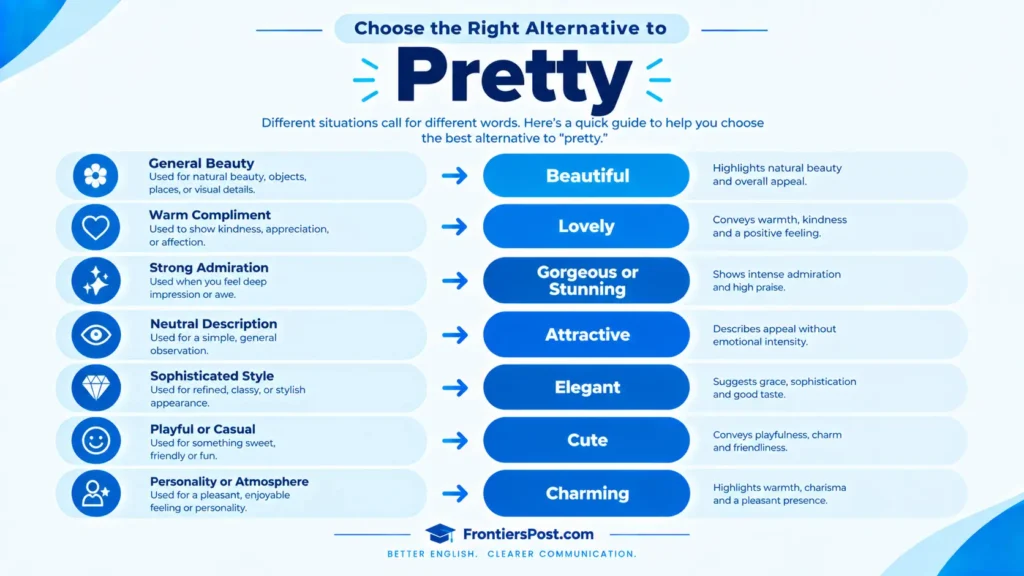
| Alternative | Best Used In | Tone |
| Beautiful | Everyday, personal, descriptive writing | Warm, positive |
| Lovely | Compliments, friendly conversations | Warm, gentle |
| Gorgeous | Casual compliments, fashion, appearance | Enthusiastic |
| Stunning | Appearance, scenery, photography | Strong, admiring |
| Attractive | Professional, descriptive, neutral contexts | Neutral, polished |
| Charming | People, places, personality, atmosphere | Warm, pleasant |
| Elegant | Fashion, design, architecture, events | Refined, sophisticated |
| Cute | Casual conversations, clothes, objects, pets | Playful, friendly |
| Delightful | Places, experiences, descriptive writing | Warm, positive |
| Good-looking | Everyday conversations, people, designs | Casual, straightforward |
Common Mistakes
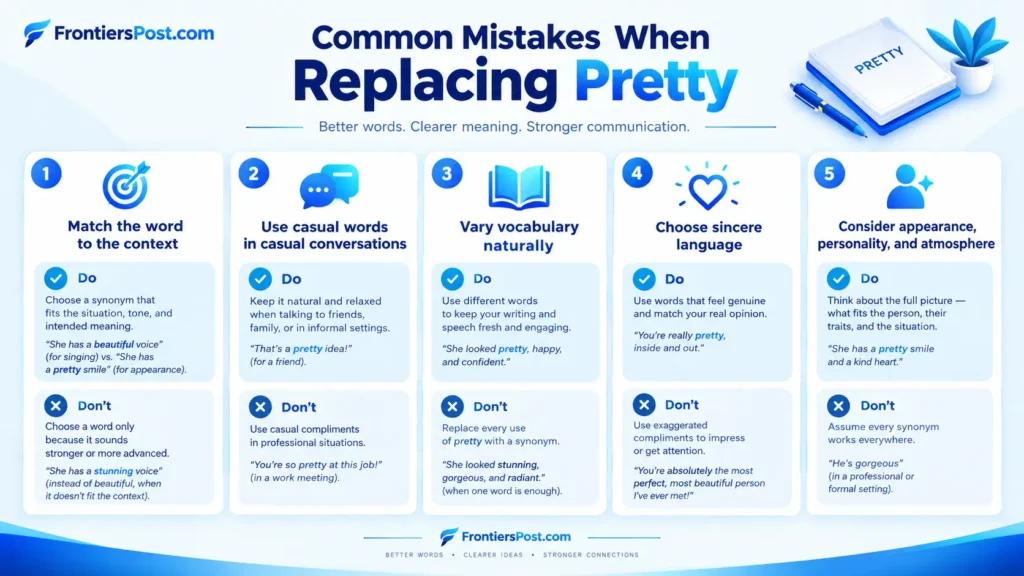
1. Using casual phrases in professional communication
Words like “gorgeous” or “cute” can sound too personal or informal in certain workplace situations. When professionalism matters, “attractive,” “elegant,” or “appealing” may be more appropriate.
2. Choosing overly formal language
Not every compliment needs a sophisticated word. Using “elegant” or “delightful” in a simple conversation can sometimes sound unnatural if “pretty” or “lovely” would fit better.
3. Repeating the same phrase
Using “pretty” several times in the same paragraph can make your writing feel repetitive. Replace it with a context-specific alternative rather than simply changing every occurrence.
4. Forgetting the context
A word that works for a person may not work equally well for a place or object. For example, “charming” can describe a town naturally, while “good-looking” may be better for a person or product.
5. Sounding insincere
Very strong words such as “stunning” and “gorgeous” can feel exaggerated if the situation does not support them. Choose language that matches your genuine level of admiration.
Frequently Asked Questions
What is the best synonym for pretty?
Beautiful is usually the best all-purpose synonym for “pretty.” It works naturally when describing people, places, objects, and visual details. However, the best choice depends on the intended tone. “Lovely” feels warmer, “gorgeous” sounds more enthusiastic, and “attractive” provides a more neutral description.
What is a more elegant word for pretty?
Elegant is a strong choice when you want to suggest refined, graceful, or sophisticated beauty. Depending on the context, “lovely,” “graceful,” “exquisite,” or “beautiful” may also work. For example, “an elegant dress” emphasizes sophistication rather than simply saying that the dress looks pretty.
What is another way to say pretty in a compliment?
For a compliment, you can say beautiful, lovely, gorgeous, stunning, charming, or cute. The best option depends on how strong you want the compliment to be. “Lovely” sounds gentle and warm, while “gorgeous” and “stunning” communicate stronger admiration.
What is a casual way to say pretty?
Cute, gorgeous, lovely, and good-looking are natural casual alternatives. “Cute” often sounds playful, while “gorgeous” creates a stronger compliment. For example, “That jacket is cute” feels relaxed, whereas “That jacket is gorgeous” shows greater enthusiasm.
How do you say pretty in a professional way?
In professional writing, consider attractive, appealing, elegant, visually appealing, or well-designed, depending on what you are describing. These choices are generally more neutral than personal compliments such as “gorgeous.” For example, “The new layout is visually appealing” sounds appropriate in a workplace or business discussion.
What is a stronger word than pretty?
Stunning and gorgeous are stronger than “pretty” in many everyday situations. “Beautiful” can also communicate strong admiration without sounding overly dramatic. For especially refined beauty, “exquisite” may be appropriate, although it is more formal and less common in ordinary conversation.
Can pretty describe things other than people?
Yes. “Pretty” can describe places, clothing, decorations, objects, colors, designs, flowers, views, and other visually appealing things. For example, you can say, “That is a pretty house” or “She chose a pretty shade of green.” Alternatives such as “beautiful,” “charming,” and “attractive” can also work.
What is the difference between pretty and beautiful?
“Pretty” often suggests pleasant or attractive appearance, while “beautiful” usually carries a stronger or more complete sense of beauty. The distinction depends on context and personal preference. “Pretty” can also sound lighter and more casual, whereas “beautiful” often feels warmer, stronger, or more heartfelt.
Conclusion
Finding another way to say “pretty” gives you more control over the tone and meaning of your communication. Beautiful is the safest all-purpose choice, while lovely adds warmth, gorgeous and stunning show stronger admiration, and attractive provides a more neutral option. For more options, explore these synonyms for pretty.
For a polished or sophisticated description, elegant works well. If you want something casual and playful, cute is a natural choice. Meanwhile, charming can describe both appearance and personality, making it useful for people and places.
The key is to consider what you are describing and how you want your words to feel. Choose the alternative that matches the situation, not simply the one that sounds strongest.

Melody Schaefer is the Founder and Editor-in-Chief of FrontiersPost, where she oversees the publication of clear, useful, and thoughtfully researched content for modern readers. Her editorial focus includes language, communication, vocabulary, writing, and practical topics that help readers understand information with greater clarity and confidence.
At FrontiersPost, Melody works with writers and editors to maintain consistent editorial standards, improve content quality, and ensure that published articles are useful, accessible, and easy to understand. She is particularly interested in clear communication and presenting complex or easily confused topics in a straightforward way.
As Editor-in-Chief, she is also responsible for guiding the site’s editorial direction, reviewing content standards, and helping ensure that articles are regularly maintained and improved as information evolves.