Another way to say fast learner on a resume is quick to learn new skills, adaptable, a rapid learner, or able to master new systems quickly. These phrases sound more professional when they match your experience and the job description. For a stronger resume, show how you learned a tool, process, or skill and applied it successfully.
Key Takeaways
- Use professional alternatives such as quick to learn new skills and adaptable instead of relying only on “fast learner.”
- Choose wording that matches the job description and the skills the employer needs.
- Show evidence of your learning ability through achievements, tools, and work examples.
- Use action verbs to describe how you learned and applied new skills.
- Keep your resume honest, specific, concise, and easy for recruiters to scan.
What Does “Another Way to Say Fast Learner on a Resume” Mean?
A fast learner is someone who can understand new information, develop skills, and apply what they learn in a short time. On a resume, this phrase tells employers that you can adjust to new responsibilities, learn workplace procedures, and become productive without needing constant guidance.
However, simply writing “I am a fast learner” may not make your application stand out. Employers can better understand your abilities when you use professional wording and provide a real example of how you learned something useful.
Where Can You Use These Phrases?
You can describe your learning ability in several parts of your resume, depending on your experience and the job requirements.
Resume Summary
Use a concise phrase to introduce your ability to learn quickly.
Example: “Adaptable entry-level professional who quickly learns new tools and workplace procedures.”
Skills Section
Include a relevant skill such as adaptability, learning agility, or rapid skill acquisition when it accurately reflects your abilities.
Work Experience
Show how you learned a system, process, or responsibility and used it to support your team.
Example: “Learned the company’s customer service software within two weeks and began resolving customer requests independently.”
Why Use Other Ways to Say “Fast Learner on a Resume”?
Choosing a more specific phrase can make your resume sound polished and relevant to the position. It also helps you explain your strengths without repeating the same wording throughout your application.
Consider these benefits:
- Avoid repetition: Use varied language across your summary, skills, and experience sections.
- Sound professional: Replace casual wording with language suited to a workplace.
- Match the role: Highlight adaptability, technical learning, or independent problem-solving based on the job.
- Build credibility: Support your claim with a measurable result or practical example.
- Improve clarity: Help recruiters understand how your learning ability can benefit their organization.
Why Specific Wording Matters
Connect Your Skill to a Result
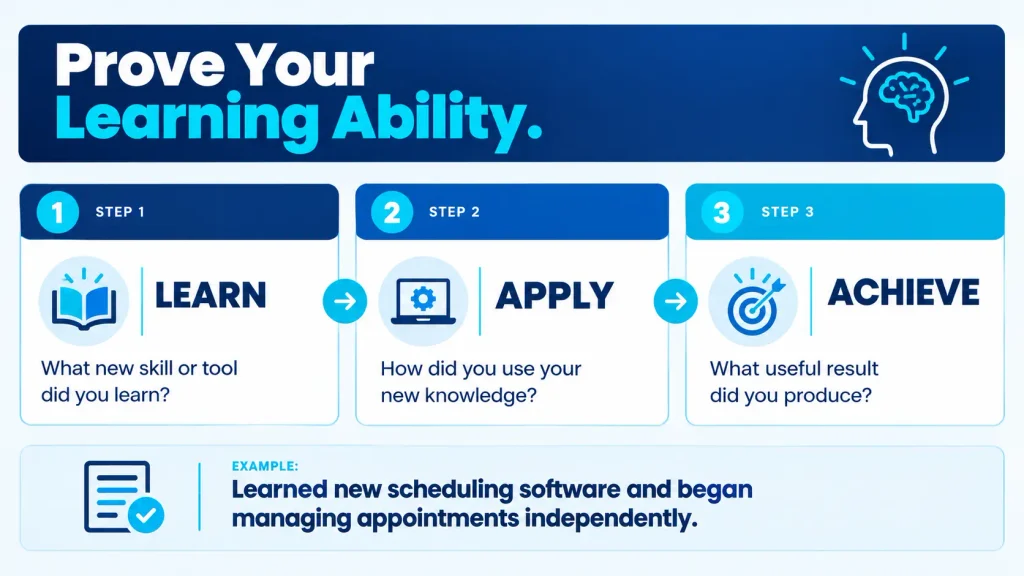
Rather than saying you learn quickly, explain what you learned and what happened afterward. For example, learning a new scheduling system and using it to manage appointments shows more than a general claim about your abilities.
Match the Employer’s Needs
If a job requires new software, emphasize technical learning. If the role involves changing priorities, focus on adaptability. The best phrase is the one that connects your strengths to the work you want to do.
10 Best Other Ways to Say “Fast Learner on a Resume”
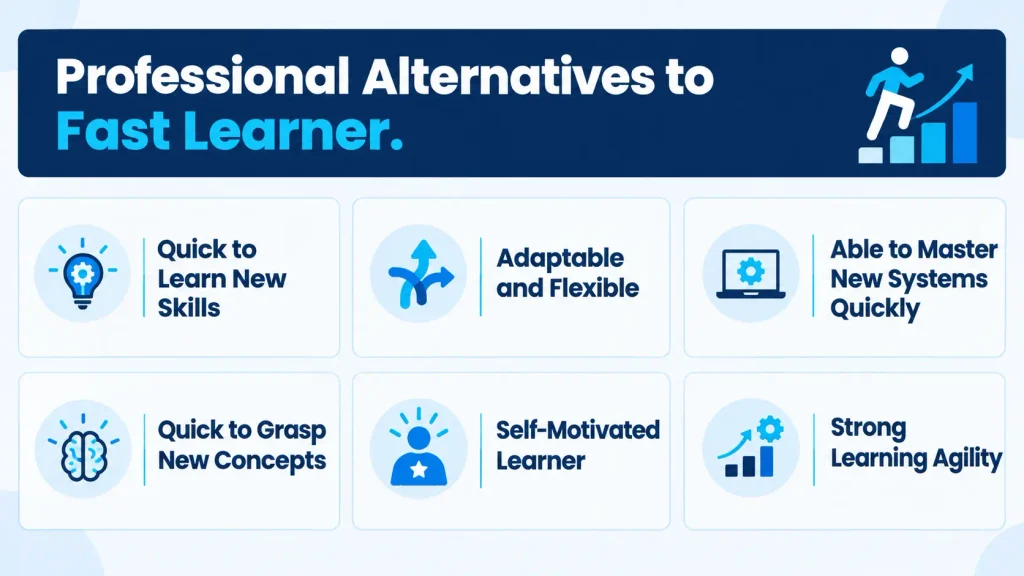
The following alternatives help you describe your learning ability in a clear, professional way. Choose the phrase that best reflects your experience and the requirements of the position.
1. Quick to Learn New Skills
Meaning
This phrase shows that you can understand new concepts and develop practical abilities in a short time. It works well for candidates who want straightforward, natural resume wording.
Best For
Professional, Formal
Example 1
“Quick to learn new skills, with the ability to support changing team priorities.”
Example 2
“Quick to learn new skills and apply feedback to improve work quality.”
Quick Tip
Use this phrase when you want a simple alternative to “fast learner” without making your resume sound overly formal.
2. Adaptable and Flexible
Meaning
Being adaptable means you can adjust to new tools, tasks, expectations, and working conditions. This phrase emphasizes your ability to respond positively to change rather than focusing only on how quickly you learn.
Best For
Professional, Formal
Example 1
“Adaptable and flexible professional who adjusts quickly to new procedures and team goals.”
Example 2
“Remained adaptable while learning revised reporting procedures during a departmental transition.”
Quick Tip
Choose this wording for jobs involving changing responsibilities, shifting priorities, or new workplace processes.
3. Able to Master New Systems Quickly
Meaning
This phrase highlights your ability to understand and use unfamiliar systems, software, or technical tools. It is particularly effective when the position requires you to learn technology or specialized workplace applications.
Best For
Professional, Formal
Example 1
“Able to master new systems quickly, including inventory tracking and scheduling software.”
Example 2
“Mastered a new customer relationship management system and used it to organize client records.”
Quick Tip
Name the actual software or system whenever possible to make your claim more convincing.
4. Quick to Grasp New Concepts
Meaning
This expression communicates that you understand new information and ideas without excessive explanation. It suits roles that require problem-solving, analysis, research, or learning unfamiliar procedures.
Best For
Professional, Formal
Example 1
“Quick to grasp new concepts and translate instructions into practical solutions.”
Example 2
“Recognized for grasping complex product information and explaining it clearly to customers.”
Quick Tip
Use this phrase when understanding information is just as important as learning a practical skill.
5. Self-Motivated Learner
Meaning
A self-motivated learner takes initiative to develop knowledge and improve performance. Unlike “fast learner,” this phrase emphasizes independence, curiosity, and a willingness to learn without constant supervision.
Best For
Professional, Friendly
Example 1
“Self-motivated learner who independently develops skills in data analysis and reporting.”
Example 2
“Pursued additional product training to provide more accurate information to customers.”
Quick Tip
Support this phrase with evidence of independent learning, such as completing training, earning a relevant certification, or mastering a new tool.
6. Demonstrates Strong Learning Agility
Meaning
Learning agility describes your ability to learn from experience, apply new knowledge, and adjust your approach when circumstances change. It is a polished phrase for candidates who handle unfamiliar challenges and use feedback effectively.
Best For
Professional, Formal
Example 1
“Demonstrates strong learning agility when adopting new workflows and team practices.”
Example 2
“Applied lessons from previous projects to improve planning and reduce repeated errors.”
Quick Tip
This phrase is especially useful for leadership, project management, and professional roles that require continuous development.
7. Proficient at Learning New Tools
Meaning
This wording emphasizes your ability to become comfortable with new tools, applications, or work methods. It is more useful than a general claim when the employer expects you to work with unfamiliar technology.
Best For
Professional, Formal
Example 1
“Proficient at learning new tools for project tracking, scheduling, and team collaboration.”
Example 2
“Learned a new design application and incorporated it into the team’s content production process.”
Quick Tip
Mention the relevant tool or explain how you used it. Avoid claiming proficiency in software you have not mastered.
8. Able to Apply Feedback Quickly
Meaning
This phrase shows that you learn from guidance and make improvements based on constructive feedback. It highlights a practical part of being a fast learner: turning advice into better performance.
Best For
Professional, Polite
Example 1
“Able to apply feedback quickly to improve written communication and documentation.”
Example 2
“Used supervisor feedback to improve order accuracy and follow established procedures.”
Quick Tip
Choose this phrase when the job involves training, mentoring, quality control, or regular performance reviews.
9. Resourceful and Eager to Learn
Meaning
Being resourceful means finding practical ways to solve problems, while being eager to learn shows enthusiasm for developing new abilities. Together, these qualities suggest that you take initiative when facing unfamiliar tasks.
Best For
Professional, Friendly
Example 1
“Resourceful and eager to learn, with a strong interest in developing technical support skills.”
Example 2
“Researched unfamiliar product features and used the findings to answer customer questions.”
Quick Tip
This phrase is particularly suitable for internships, entry-level jobs, and career changes. Pair it with a real example of initiative.
10. Able to Learn Independently
Meaning
This phrase emphasizes your ability to acquire knowledge without relying on continuous instruction. It communicates independence, discipline, and the ability to find answers through training materials, research, and practice.
Best For
Professional, Formal
Example 1
“Able to learn independently through technical documentation, online training, and hands-on practice.”
Example 2
“Learned new reporting procedures independently and followed company standards consistently.”
Quick Tip
Use this phrase when the role involves remote work, independent projects, or limited day-to-day supervision.
Comparison Table
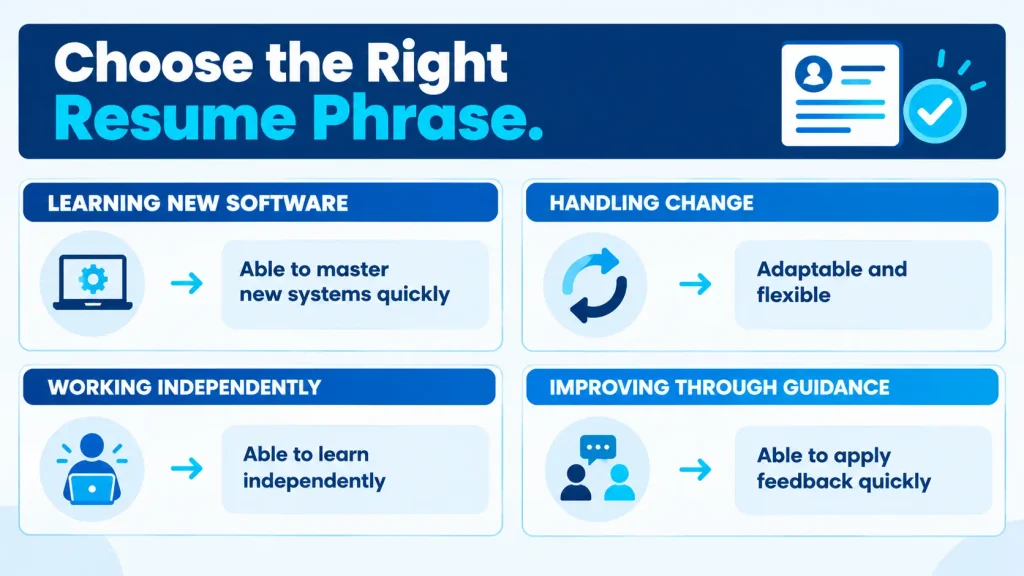
Use this table to find the best alternative for your resume and the impression you want to make.
| Alternative | Best Used In | Tone |
|---|---|---|
| Quick to learn new skills | Resume summary | Direct |
| Adaptable and flexible | Work experience | Professional |
| Able to master new systems quickly | Technical roles | Specific |
| Quick to grasp new concepts | Analytical roles | Formal |
| Self-motivated learner | Entry-level roles | Independent |
| Demonstrates strong learning agility | Leadership roles | Advanced |
| Proficient at learning new tools | Technology-focused jobs | Practical |
| Able to apply feedback quickly | Training and team roles | Cooperative |
| Resourceful and eager to learn | Internships and career changes | Enthusiastic |
| Able to learn independently | Remote and independent work | Self-reliant |
Common Mistakes
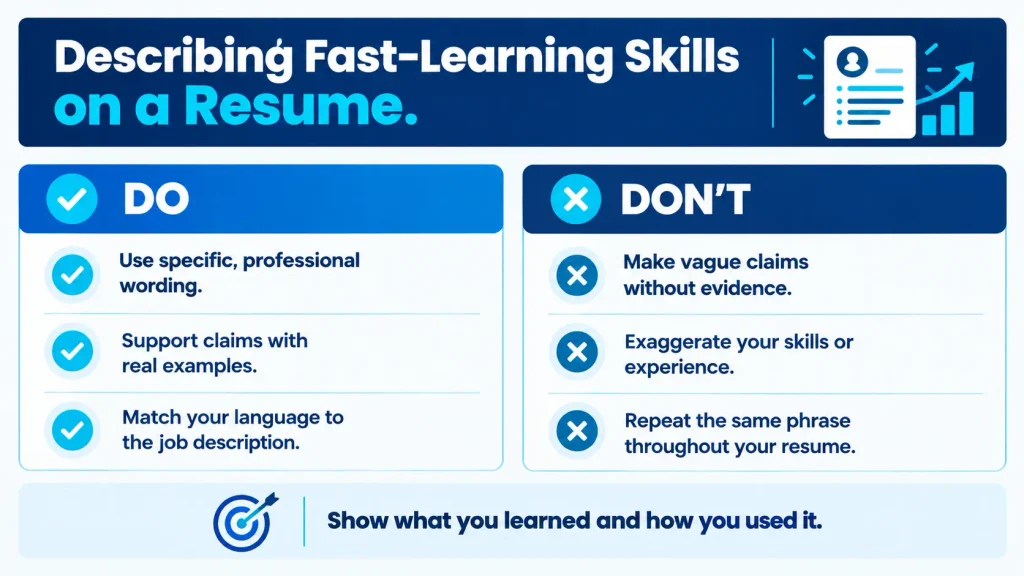
Avoid these resume-writing mistakes when describing your learning ability.
1. Using Vague Claims Without Evidence
Writing “I am a fast learner” does not explain what you can do. Add a specific example of a tool you learned, a process you mastered, or a responsibility you handled successfully.
2. Choosing Informal Language
Phrases such as “I pick things up super fast” may sound too casual for a traditional resume. Choose professional wording that matches the employer’s expectations.
3. Repeating the Same Skill Description
Using “fast learner” in your summary, skills section, and every job description makes your resume repetitive. Highlight different strengths in each section and focus on relevant accomplishments.
4. Ignoring the Job Description
A technical role may require software knowledge, while a customer service position may value learning products and procedures. Choose language that reflects the actual requirements of the job.
5. Making Claims You Cannot Support
Avoid saying you mastered a system or became an expert unless your experience supports that claim. Honest, specific descriptions build more credibility than exaggerated statements.
Frequently Asked Questions

1. What Is the Best Professional Way to Say “Fast Learner”?
“Quick to learn new skills” is a strong, natural alternative for most resumes. For technical roles, “able to master new systems quickly” may be more effective. Choose the wording that fits the position, and support it with an example whenever possible.
2. Is “Fast Learner” a Good Skill to Put on a Resume?
Yes, but it is usually stronger when you demonstrate the skill rather than list it alone. Employers want to understand how you learn and apply new information. Describe a training experience, new software you learned, or a task you mastered to make your claim more credible.
3. How Do You Describe Learning Quickly on a Resume?
Use action-oriented wording that shows what you learned and how you applied it. For example, write, “Learned the company’s scheduling software within two weeks and managed appointments independently.” This approach provides evidence of your learning ability instead of relying on a general statement.
4. What Is Another Word for “Fast Learner” on a Resume?
Useful alternatives include adaptable, quick to grasp new concepts, self-motivated learner, and learning agile. Each emphasizes a slightly different quality. Choose “adaptable” when you adjust to change, or “self-motivated learner” when you take responsibility for developing your skills.
5. Should I Put “Quick Learner” in My Resume Summary?
You can include it if learning quickly is relevant to the position, particularly when applying for entry-level roles or changing careers. However, a specific summary is often more persuasive. Explain how you learn new systems, apply feedback, or develop the skills needed for the role.
6. How Can I Prove I Am a Fast Learner on My Resume?
Give a concrete example that describes the skill you learned, the action you took, and the result. Mention relevant training, software, procedures, or certifications. If you have a measurable achievement, include it, but use only accurate figures and results you can explain in an interview.
7. How Do You Say “Fast Learner” on a Resume With No Experience?
Focus on skills developed through school, personal projects, volunteering, internships, or independent study. For example, you might describe learning a new research tool for a class project. These examples can demonstrate curiosity, initiative, and the ability to apply new knowledge without formal work experience.
8. Is “Adaptable” Better Than “Fast Learner” on a Resume?
It depends on the job. “Fast learner” emphasizes how quickly you acquire knowledge, while “adaptable” highlights your ability to adjust to new tasks and changing circumstances. If the employer values both qualities, demonstrate them through different examples rather than treating the phrases as interchangeable.
You may also find these guides useful: You’re Welcome Professionally, What to Say Instead of “Feel Free to Reach Out” and How to Say “As We Discussed” More Professionally in Emails.
Conclusion
Choosing another way to say fast learner on a resume can help you communicate your strengths more clearly and professionally. Phrases such as “quick to learn new skills,” “adaptable and flexible,” and “able to master new systems quickly” highlight different aspects of your learning ability.
The best choice depends on the position, your experience, and the employer’s expectations. If you are applying for an entry-level role, emphasize your willingness to learn and take initiative. For technical positions, highlight your ability to master new tools or systems. If you have professional experience, describe how you learned a process and used it to achieve a result.
Most importantly, do not rely on a phrase alone. Support your claim with a specific, honest example that shows how you learn and apply new knowledge. For more guidance, explore these professional resume writing tips. A strong resume does more than say you learn quickly; it demonstrates what you can accomplish because of it.

The FrontiersPost editorial team writes and reviews every guide to word and phrase alternatives, with clear meanings, tone notes and example sentences for everyday, academic and professional English.