

Looking for another way to say “talk about”? Natural alternatives include discuss, mention, address, explore, cover, refer to, touch on, go over, speak about, and communicate about. The best choice depends on context, tone, and whether you are having a casual conversation, writing professionally, or discussing an academic topic.
Key Takeaways
- Discuss is the best all-purpose alternative for professional and academic writing.
- Mention works well when you briefly refer to a subject.
- Address is useful when dealing with a specific issue, concern, or problem.
- Explore suggests examining a topic in greater depth.
- Go over is a natural, conversational choice for everyday American English.
Finding the right words can make your communication sound clearer and more natural. While “talk about” is perfectly correct, using different expressions can help you avoid repetition and choose language that better fits the situation.
Whether you are writing an email, preparing an essay, giving a presentation, or having a casual conversation, the right alternative can make your message more precise.
What Does “Another Way to Say Talk About” Mean?
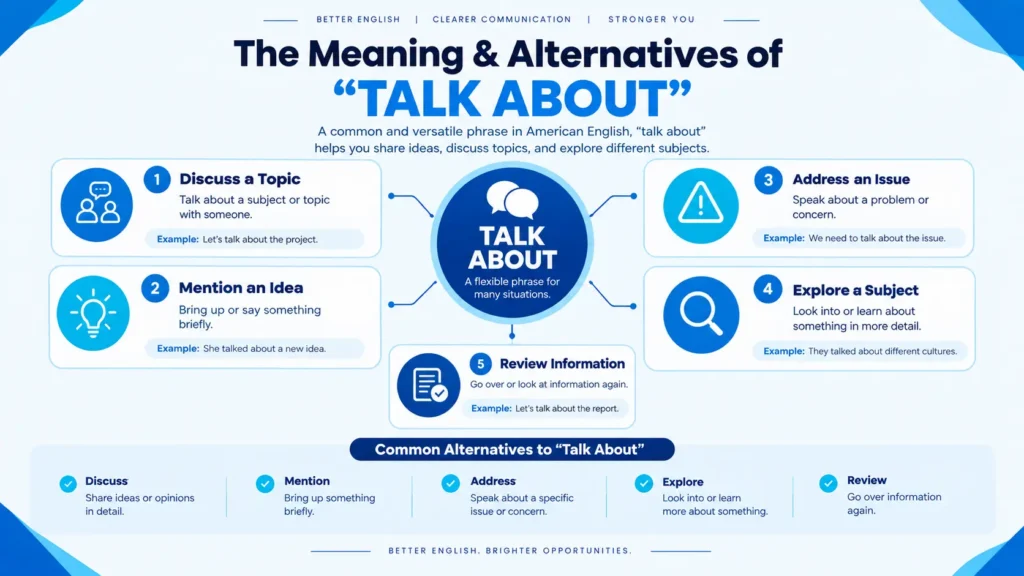
The phrase “talk about” means to discuss, mention, describe, or communicate about a particular person, subject, idea, event, or issue. It is one of the most common expressions used in everyday American English.
For example, you might say, “We need to talk about the project,” when you want to discuss the project with someone.
People often search for another way to say “talk about” because they want to sound less repetitive, more professional, more specific, or more natural. The best replacement depends on what you are actually trying to communicate.
Why Use Other Ways to Say “Talk About”?
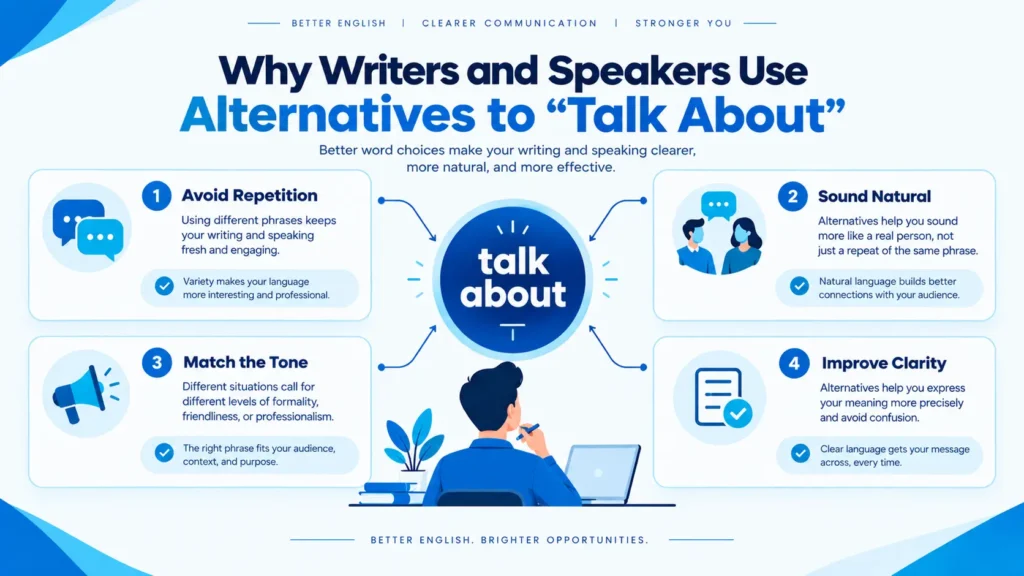
Using alternatives can improve your writing and make your conversations more precise. Different expressions also communicate slightly different meanings.
Here are some reasons to choose another phrase:
- Avoid repetition: Keep your writing from sounding repetitive.
- Sound more natural: Choose expressions that fit everyday American English.
- Match the situation: Use casual, professional, formal, or academic wording appropriately.
- Improve clarity: Select a verb that describes exactly what you are doing.
- Add precision: Show whether you are mentioning, examining, addressing, or reviewing something.
10 Best Other Ways to Say “Talk About”
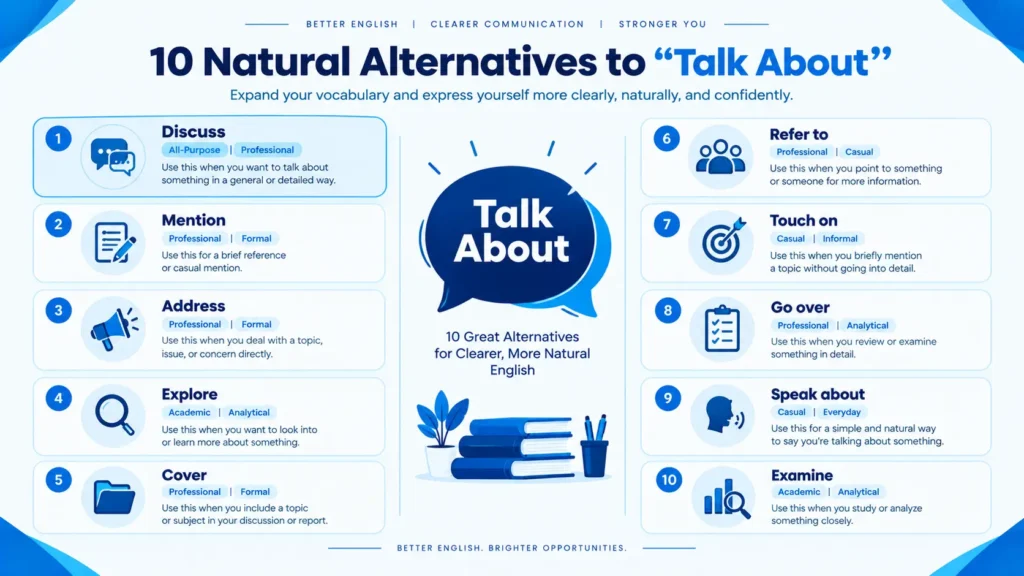
1. Discuss
Meaning
Discuss means to talk about a subject carefully or exchange ideas about it. It is one of the strongest and most versatile alternatives to “talk about.”
Best For
- Professional
- Formal
- Academic
- Polite
Example 1
We need to discuss the new marketing strategy before Friday.
Example 2
The professor will discuss several causes of climate change during the lecture.
Quick Tip
Use discuss when you want a polished alternative that works in both professional and academic writing.
2. Mention
Meaning
Mention means to refer to something briefly without necessarily discussing it in detail. It works especially well when a subject is only one small part of a larger conversation or piece of writing.
Best For
- Professional
- Casual
- Friendly
- Formal
Example 1
She mentioned the upcoming conference during our meeting.
Example 2
Don’t forget to mention your previous experience in the interview.
Quick Tip
Choose mention when you are referring to something briefly rather than having a full discussion about it.
3. Address
Meaning
Address means to deal with, respond to, or give attention to a particular subject or concern. It often sounds more purposeful than “talk about.”
Best For
- Professional
- Formal
- Academic
- Polite
Example 1
The manager plans to address the team’s concerns at tomorrow’s meeting.
Example 2
This report addresses the challenges facing small businesses.
Quick Tip
Use address for problems, concerns, questions, issues, or topics that require a response or solution.
4. Explore
Meaning
Explore suggests examining a topic carefully and considering different aspects of it. It often implies curiosity, depth, or an attempt to understand something better.
Best For
- Academic
- Professional
- Formal
Example 1
The article explores how social media affects communication.
Example 2
Let’s explore a few options before making our final decision.
Quick Tip
Use explore when the goal is to investigate an idea rather than simply mention it.
5. Cover
Meaning
Cover means to include or discuss a particular subject, usually as part of a broader conversation, lesson, report, or presentation. It is common in both professional and educational settings.
Best For
- Professional
- Academic
- Casual
Example 1
Today’s training session will cover workplace communication skills.
Example 2
The presentation covers the most important features of the new software.
Quick Tip
Use cover when you mean that a discussion, article, lesson, or presentation includes a particular topic.
6. Refer To
Meaning
Refer to means to mention or direct attention to a particular person, subject, fact, or idea. It is especially useful when you want to connect your statement to something previously discussed or written.
Best For
- Professional
- Formal
- Academic
- Polite
Example 1
The final paragraph refers to the findings from the earlier study.
Example 2
When speaking with the client, please refer to the updated proposal.
Quick Tip
Use refer to when you are pointing someone toward a specific subject, source, statement, or piece of information.
7. Touch On
Meaning
Touch on means to discuss a topic briefly or give it limited attention. It suggests that the subject is addressed but not examined in great detail.
Best For
- Professional
- Casual
- Friendly
Example 1
The speaker touched on the importance of work-life balance.
Example 2
We only have a few minutes, so I’ll touch on the main points.
Quick Tip
Use touch on when you want to emphasize that a topic receives only brief treatment.
8. Go Over
Meaning
Go over means to review, explain, or discuss something together. It is common in spoken American English and works well in relaxed professional situations.
Best For
- Casual
- Friendly
- Professional
- Polite
Example 1
Can we go over the schedule before the meeting starts?
Example 2
I’d like to go over your application with you.
Quick Tip
Use go over in conversations and informal workplace communication, but choose review or discuss for more formal writing.
9. Speak About
Meaning
Speak about means to communicate verbally about a particular subject. It can be used in everyday conversations, presentations, interviews, and formal speeches.
Best For
- Professional
- Formal
- Casual
- Friendly
Example 1
The guest speaker will speak about leadership and workplace culture.
Example 2
We spent the afternoon speaking about our plans for the future.
Quick Tip
Speak about is a straightforward replacement when the focus is on verbal communication or a speech.
10. Examine
Meaning
Examine means to look at a subject closely and carefully. It is more analytical than “talk about,” making it especially useful when discussing evidence, causes, effects, or complex ideas.
Best For
- Academic
- Formal
- Professional
Example 1
The research paper examines the effects of remote work on productivity.
Example 2
The committee will examine the proposal before approving the budget.
Quick Tip
Use examine when you want to communicate detailed analysis rather than simple conversation.
Comparison Table
| Alternative | Best Used In | Tone |
| Discuss | Professional, academic, formal | Polished |
| Mention | Professional, casual, formal | Neutral |
| Address | Professional, formal, academic | Direct |
| Explore | Academic, professional | Thoughtful |
| Cover | Professional, academic, casual | Neutral |
| Refer to | Professional, formal, academic | Precise |
| Touch on | Professional, casual | Conversational |
| Go over | Casual, friendly, professional | Relaxed |
| Speak about | Professional, formal, casual | Straightforward |
| Examine | Academic, formal, professional | Analytical |
Common Mistakes
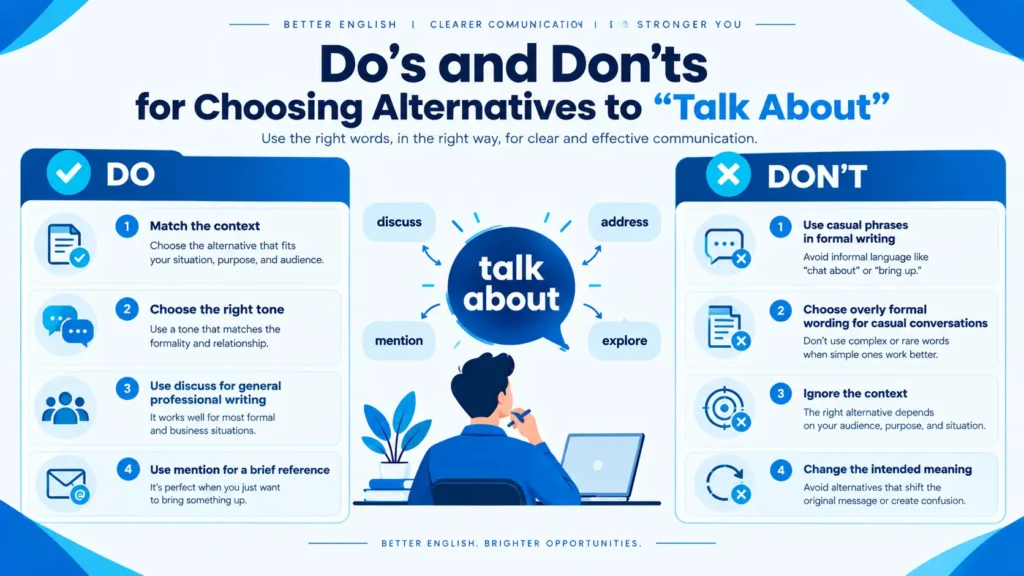
1. Using Casual Phrases in Formal Writing
Phrases such as “go over” can sound too conversational in an academic paper or formal report. In those settings, discuss, examine, or address may be more appropriate.
2. Choosing an Overly Formal Alternative
Not every situation requires sophisticated vocabulary. Using examine when you simply want to say that two friends talked about a movie can sound unnatural.
3. Repeating “Talk About” Too Often
Repeating the same phrase throughout an essay, email, or article can make the writing feel monotonous. Replace it selectively with words such as discuss, mention, explore, or address when the meaning fits.
4. Forgetting the Context
Alternatives are not always interchangeable. Mention usually suggests a brief reference, while examine implies detailed analysis.
5. Using a Word That Changes the Meaning
Replacing “talk about” with any synonym can accidentally change your intended message. Before choosing an alternative, consider whether you mean mentioning, reviewing, analyzing, addressing, or having a conversation.
Frequently Asked Questions
What is the best professional way to say “talk about”?
Discuss is usually the best professional alternative to “talk about.” It sounds clear and polished without being overly formal. For example, instead of saying, “Let’s talk about the project,” you can say, “Let’s discuss the project.” In workplace emails, meetings, reports, and presentations, discuss is a dependable choice.
What is another way to say “talk about” in an essay?
For an essay, strong alternatives include discuss, examine, explore, address, and analyze. The best option depends on your meaning. Use discuss for general consideration, explore for broader investigation, and examine or analyze when you are focusing on evidence or details.
Can I use “mention” instead of “talk about”?
Yes, but the meaning is slightly different. Mention usually means referring to something briefly, while talk about can suggest a longer or more detailed discussion. For example, “She mentioned the meeting” means she brought it up, while “She talked about the meeting” suggests that she discussed it more fully.
What is a formal way to say “talk about”?
Depending on the context, formal alternatives include discuss, address, examine, explore, and refer to. Discuss is the most broadly useful choice. Address works particularly well for issues or concerns, while examine is better when you mean to study a topic closely.
What is a casual way to say “talk about”?
In casual American English, you can use go over, speak about, chat about, or simply discuss. “Go over” is especially natural when you mean reviewing information together. For example, “Let’s go over the plans tonight” sounds relaxed and conversational.
Is “speak about” grammatically correct?
Yes, speak about is grammatically correct. It means to communicate verbally about a subject. However, talk about is generally more common in everyday American English. Speak about can sound more formal when referring to presentations, speeches, interviews, or public communication.
What is another way to say “talk about” in a business email?
Discuss is generally the safest choice for a business email. You can also use address for concerns or problems, review for documents or plans, and refer to when pointing someone toward specific information. The best word depends on the purpose of your message.
How can I avoid repeating “talk about” in my writing?
First, identify what you actually mean. If you are briefly referring to something, use mention; if you are analyzing it, use examine; if you are dealing with a concern, use address; and if you are investigating an idea, use explore. This creates natural variety without changing your meaning.
Conclusion
Choosing another way to say “talk about” can make your communication more precise, natural, and appropriate for the situation. The key is to choose an alternative based on the meaning you want to express.
For general professional or academic writing, discuss is usually the strongest choice.Use mention for a brief reference, address for an issue or concern, explore for deeper investigation, and examine for detailed analysis. In relaxed conversations, go over and speak about can sound natural and approachable.
You do not need to replace “talk about” every time you use it. The expression is perfectly natural. Instead, choose an alternative when it adds clarity, reduces repetition, or better matches your intended tone.

Sarah Mitchell is a Senior English Editor at FrontiersPost, specializing in English usage, vocabulary, word choice, grammar, and effective communication. She focuses on helping readers understand subtle differences between commonly confused words, phrases, and expressions and use them naturally in everyday, professional, and academic writing.
At FrontiersPost, Sarah researches, writes, and edits educational content with an emphasis on clarity, accuracy, and practical examples. She works closely with the editorial team to ensure that articles are easy to understand while maintaining appropriate context, meaning, and usage.
Her editorial interests include English vocabulary, synonyms, phrasing, professional communication, and the practical nuances that can make written communication more precise and effective.