
Another way to say OK depends on the situation. You can use “sounds good,” “got it,” “sure,” “absolutely,” “that works for me,” “understood,” “no problem,” “all right,” “certainly,” or “I agree.” Choose a phrase that matches your tone, relationship, and purpose, especially in professional emails and everyday conversations.
Key Takeaways
- Use “sounds good” to agree with a suggestion in a friendly way.
- Choose “understood” when acknowledging instructions or important information.
- Say “absolutely” to show enthusiasm and strong agreement.
- Use “that works for me” when confirming plans or arrangements.
- Match your response to the situation instead of using “OK” every time.
“OK” is one of the most common expressions in American English. People use it to agree, acknowledge information, accept a request, or confirm that a plan is fine.
However, the word can sometimes sound brief, neutral, or even distant in a text message or email. Choosing a more specific expression can help you communicate your meaning clearly.
Whether you are replying to a coworker, confirming plans with a friend, or responding to instructions, there are several natural alternatives to “OK.” The best choice depends on what you want to express.
What Does “Another Way to Say OK” Mean?
Looking for another way to say OK means finding a different expression that communicates agreement, understanding, acceptance, or confirmation.
For example, you might say “sounds good” when accepting a suggestion or “got it” when acknowledging instructions. In a professional email, “understood” may be more appropriate.
People commonly use these alternatives in text messages, workplace conversations, emails, meetings, and everyday discussions. Each expression has a slightly different tone, so choosing the right one helps prevent misunderstandings.
Why Use Other Ways to Say OK?

Although “OK” works in many situations, using different expressions can make your communication more precise and natural.
Consider using alternatives when you want to:
- Avoid repetition: Keep conversations from sounding repetitive.
- Show enthusiasm: Express genuine interest in an idea or invitation.
- Sound professional: Respond appropriately to workplace requests.
- Confirm understanding: Make it clear that you have received important information.
- Express agreement: Show that you accept a suggestion or decision.
- Build stronger connections: Use warmer language in personal conversations.
The goal is not to replace “OK” every time. Instead, choose a phrase that communicates the right message for the situation.
10 Best Other Ways to Say OK
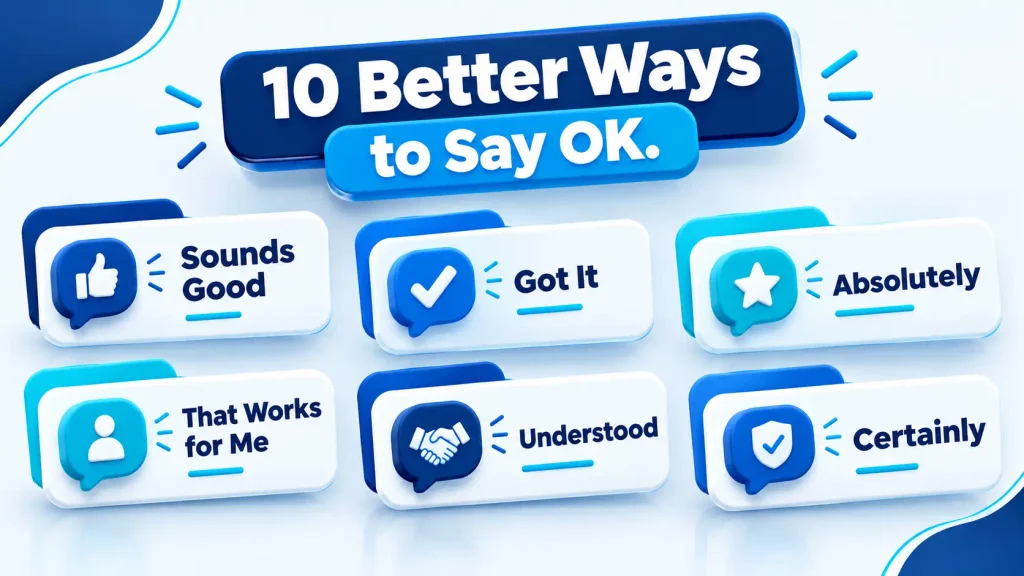
Here are 10 useful alternatives, with meanings, examples, and practical tips to help you choose the right expression.
1. Sounds Good
Meaning
“Sounds good” means that you like a suggestion or agree with a proposed plan. It is friendly, natural, and widely used in American English.
Unlike a plain “OK,” this expression often sounds more engaged. It works especially well when someone suggests a meeting time, activity, or solution.
Best For
- Casual
- Friendly
- Professional
Example 1
“Let’s review the presentation together at 2 p.m.” “Sounds good! I’ll bring my notes.”
Example 2
“We can move the project discussion to Thursday if that works better.” “Sounds good to me.”
Quick Tip
Use “sounds good” when responding to a suggestion. Avoid it when you need to confirm that you have understood serious instructions or formal requirements.
2. Got It
Meaning
“Got it” means that you understand or have received the information someone shared. It is short, direct, and common in everyday conversations.
This phrase is particularly useful when someone gives instructions or explains what you need to do next. However, it can sound too casual in some formal situations.
Best For
- Casual
- Friendly
- Professional
Example 1
“Please save the updated document in the shared folder.” “Got it. I’ll upload it shortly.”
Example 2
“Your appointment has been moved to Friday morning.” “Got it. Thanks for letting me know.”
Quick Tip
Use “got it” to acknowledge information, not necessarily to express agreement. In a formal email, “I understand” may be a better choice.
3. Absolutely
Meaning
“Absolutely” communicates strong agreement or a confident willingness to help. It sounds more enthusiastic than a simple “OK.”
This expression is useful when you want your response to feel positive and supportive. It can work in both personal conversations and professional communication.
Best For
- Friendly
- Warm
- Professional
- Polite
Example 1
“Could you help me prepare for the client meeting?” “Absolutely! Let’s go through the agenda.”
Example 2
“Would you be available to review my draft this afternoon?” “Absolutely. Send it over when you’re ready.”
Quick Tip
Choose “absolutely” when you genuinely want to show enthusiasm. For a neutral acknowledgment, a simpler phrase may sound more natural.
4. That Works for Me
Meaning
“That works for me” means that a suggested time, plan, or arrangement is acceptable. It clearly communicates agreement without sounding overly formal.
People often use this phrase when coordinating schedules or making decisions with others. It is especially helpful when confirming that a plan fits your needs.
Best For
- Professional
- Friendly
- Polite
Example 1
“Can we schedule the interview for Wednesday at 11 a.m.?” “That works for me.”
Example 2
“Let’s meet at the library instead of the coffee shop.” “That works for me. I’ll see you there.”
Quick Tip
Use this expression when agreeing to an arrangement. If you are accepting a responsibility rather than confirming a plan, “I’ll take care of it” may be more appropriate.
5. Understood
Meaning
“Understood” means that you have received and comprehended information, instructions, or expectations. It is direct and often sounds professional.
This phrase is useful in workplaces, meetings, and situations where clarity matters. Depending on the context, however, it may sound a little formal or firm.
Best For
- Professional
- Formal
- Polite
Example 1
“Please send the revised report before noon tomorrow.” “Understood. I’ll make sure it is ready on time.”
Example 2
“The presentation must follow the updated brand guidelines.” “Understood. I’ll review them before making changes.”
Quick Tip
Use “understood” when acknowledging instructions or requirements. In casual conversations with friends, “got it” usually feels more relaxed.
6. Sure
Meaning
“Sure” is a simple way to express agreement or willingness. It is common in American English and works well in everyday conversations.
The tone depends on how you say it and the words around it. A friendly “Sure, I’d be happy to” sounds more welcoming than a short reply with no additional context.
Best For
- Casual
- Friendly
- Polite
Example 1
“Could you pick up some bread on your way home?” “Sure, I’ll stop at the store.”
Example 2
“Would you mind sharing your notes from today’s class?” “Sure, I’ll send them tonight.”
Quick Tip
Add a few words when you want to sound warmer. “Sure, happy to help” feels more inviting than “Sure” alone.
7. No Problem
Meaning
“No problem” means that a request is acceptable or that helping someone will not cause difficulty. It is relaxed and reassuring.
People commonly use it when responding to a small favor, a request for help, or an apology. In highly formal situations, a more polished expression may be preferable.
Best For
- Casual
- Friendly
- Warm
Example 1
“Sorry for asking you to stay a few extra minutes.” “No problem. I have some time.”
Example 2
“Thanks for explaining how the new system works.” “No problem. I’m glad it helped.”
Quick Tip
Use “no problem” to reassure someone in an informal setting. For a formal business email, consider “You’re welcome” or “I’m happy to assist.”
8. All Right
Meaning
“All right” can express acceptance, agreement, or acknowledgment. It is a familiar expression that works in many everyday situations.
Its tone depends on context. It can sound neutral and relaxed, but a short “all right” may also suggest reluctant acceptance if the surrounding conversation is tense.
Best For
- Casual
- Friendly
- Polite
Example 1
“We’ll leave for the airport at six in the morning.” “All right. I’ll be ready.”
Example 2
“If you prefer, we can discuss the details after lunch.” “All right, let’s do that.”
Quick Tip
Use “all right” when accepting a plan or moving a conversation forward. Add a positive phrase if you want to make your agreement sound more enthusiastic.
9. Certainly
Meaning
“Certainly” is a polite and professional way to express agreement or willingness. It sounds more formal than “sure” and can be useful when responding to requests.
This phrase works well in customer service, workplace emails, and professional conversations. It communicates cooperation without sounding overly casual.
Best For
- Professional
- Formal
- Polite
Example 1
“Could you please forward the meeting notes to the entire team?” “Certainly. I’ll send them this afternoon.”
Example 2
“Would you be able to clarify the final section of the report?” “Certainly. I’ll explain the main points.”
Quick Tip
Choose “certainly” when you want to sound courteous and professional. Make sure the request is one you can actually fulfill before agreeing.
10. I Agree
Meaning
“I agree” clearly states that you share someone’s opinion, view, or conclusion. Unlike “OK,” which can simply acknowledge a message, this phrase expresses agreement directly.
It is useful in discussions, meetings, academic settings, and conversations about decisions. You can also explain why you agree to make your response more meaningful.
Best For
- Professional
- Formal
- Polite
Example 1
“Providing customers with clear instructions should reduce support requests.” “I agree. Clear guidance can prevent confusion.”
Example 2
“I think we should finish the research before choosing a final design.” “I agree. That will help us make an informed decision.”
Quick Tip
Use “I agree” when responding to an opinion or argument. If you are only acknowledging instructions, “understood” is usually more precise.
Comparison Table

Use this table to choose an alternative based on your situation and the tone you want to convey.
| Alternative | Best Used In | Tone |
|---|---|---|
| Sounds good | Accepting suggestions and plans | Friendly, positive |
| Got it | Acknowledging instructions | Direct, casual |
| Absolutely | Enthusiastic agreement | Warm, confident |
| That works for me | Confirming arrangements | Cooperative, polite |
| Understood | Acknowledging requirements | Professional, direct |
| Sure | Accepting everyday requests | Casual, relaxed |
| No problem | Responding to favors or apologies | Reassuring, friendly |
| All right | Accepting plans or decisions | Neutral, relaxed |
| Certainly | Responding to professional requests | Formal, courteous |
| I agree | Supporting an opinion or conclusion | Clear, assertive |
Common Mistakes When Using Alternatives to OK
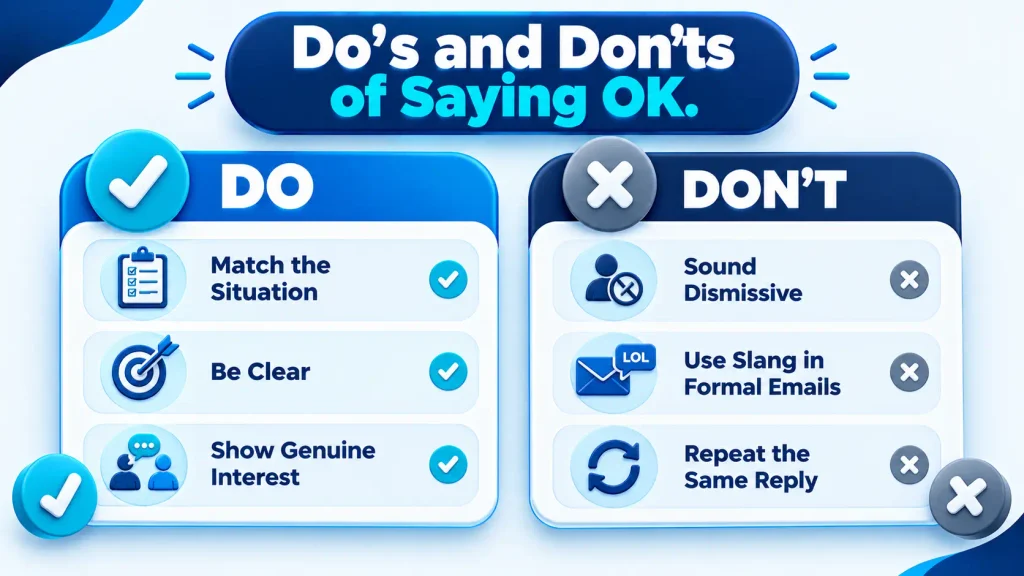
Choosing a different phrase can improve your communication, but only when it fits the context. Watch out for these five common mistakes.
1. Using Casual Phrases in Formal Emails
Expressions such as “sure” and “no problem” work well in many everyday conversations. However, a formal client email may call for “certainly” or “I understand.”
Better approach: Match your wording to the recipient and the level of formality required.
2. Choosing Overly Formal Language
Using “certainly” in every text message can make a casual conversation feel stiff. Not every exchange requires formal language.
Better approach: Save formal expressions for professional requests, business correspondence, and situations where courtesy is especially important.
3. Using the Same Response Repeatedly
Replying with “OK” to every message can make your communication sound repetitive. It may also leave people unsure whether you agree, understand, or simply received their message.
Better approach: Use “sounds good” for suggestions, “got it” for information, and “I agree” for opinions.
4. Ignoring the Context
Some alternatives express acceptance, while others communicate understanding or strong agreement. Using the wrong one can create confusion.
Better approach: Identify what the other person needs from you before responding.
5. Sounding Uninterested or Insincere
A short reply may sometimes sound dismissive, even when you intend to be polite. This is especially common in text messages, where tone is harder to interpret.
Better approach: Add a brief, genuine response when needed, such as “That sounds great” or “Absolutely, I’d be happy to help.”
Frequently Asked Questions

1. What is the best alternative to OK?
“Sounds good” is one of the most versatile alternatives when you want to agree with a suggestion or plan. However, the best choice depends on your intention. Use “got it” to acknowledge information, “understood” for instructions, and “absolutely” when you want to express enthusiastic agreement.
2. How do you say OK professionally?
Professional alternatives include “understood,” “certainly,” “that works for me,” and “I agree.” The right expression depends on the message. For example, use “understood” to acknowledge instructions and “that works for me” to confirm a meeting time or proposed arrangement.
3. What can I say instead of OK in a text?
You can use “sounds good,” “sure,” “got it,” “absolutely,” or “no problem” in casual text messages. Choose “sounds good” when accepting a plan and “got it” when acknowledging information. Adding a few words can also make a short reply feel warmer and more personal.
4. How do I respond to OK without sounding rude?
Use a response that shows interest or clarifies your meaning. For example, “Sounds good, thanks!” feels warmer when confirming a plan, while “Got it, I’ll take care of that” acknowledges a task. Your wording, punctuation, and relationship with the other person can all affect how your reply sounds.
5. Is “OK” professional in an email?
Yes. “OK” is acceptable in many workplace emails, especially when communicating with familiar colleagues. However, “understood,” “certainly,” or “that works for me” may communicate your meaning more clearly. For important instructions or formal requests, a complete sentence can prevent misunderstandings.
6. What is a polite way to say OK?
“Certainly,” “of course,” and “that works for me” can be polite alternatives, depending on the situation. Use “certainly” when agreeing to a request, and “that works for me” when accepting a proposed arrangement. “Of course” is another friendly option when you want to reassure someone that their request is welcome.
7. What is a casual way to say OK?
“Sure,” “sounds good,” “got it,” and “all right” are common casual alternatives. Friends and family often use these phrases in text messages and everyday conversations. “Sounds good” is especially useful for plans, while “got it” works best when someone shares information or gives directions.
8. What is the difference between “OK,” “got it,” and “sounds good”?
“OK” is a general response that can express acceptance or acknowledgment. “Got it” specifically signals that you understand or have received information. “Sounds good” usually means that you like a suggestion or agree with a plan. Choosing the phrase that matches your intention makes your response clearer.
Readers who used this guide also looked at Another Way to Say “Positive Attitude” for Work, Life, and Everyday Conversations, Another Way to Say “Pretty” and Another Way to Say “Rude” Without Sounding Too Harsh.
Conclusion
Finding another way to say OK can help you communicate more clearly, naturally, and confidently. Although OK is useful in almost any setting, a more specific phrase can show agreement, acknowledge instructions, or express enthusiasm.
For everyday conversations, try “sure,” “sounds good,” or “no problem.” In professional emails, “understood,” “certainly,” and “that works for me” can help you sound courteous and clear. When you strongly support someone’s idea, “absolutely” or “I agree” may be a better choice.
Remember that no single alternative works in every situation. Consider your audience, your relationship with the other person, and the message you want to convey before responding.
The best approach is simple: choose words that reflect your real intention. A thoughtful, natural response can make even a short exchange feel more professional, friendly, and effective.

The FrontiersPost editorial team writes and reviews every guide to word and phrase alternatives, with clear meanings, tone notes and example sentences for everyday, academic and professional English.