

“Not my circus, not my monkeys” means that a problem, conflict, or situation is not your responsibility and you do not want to get involved. Natural alternatives include “not my problem,” “not my responsibility,” “none of my business,” “not my concern,” and “I’m staying out of it.” The best choice depends on how direct, formal, or humorous you want to sound.
Key Takeaways
- “Not my problem” is a simple, direct alternative for casual conversations.
- “Not my responsibility” works well when discussing workplace duties or assigned tasks.
- “None of my business” fits situations involving someone else’s private affairs.
- “I’m staying out of it” works well when you want to avoid a conflict or disagreement.
- The original phrase is casual and humorous, so a more neutral expression may be better in professional situations.
Meaning of “Not My Circus, Not My Monkeys”
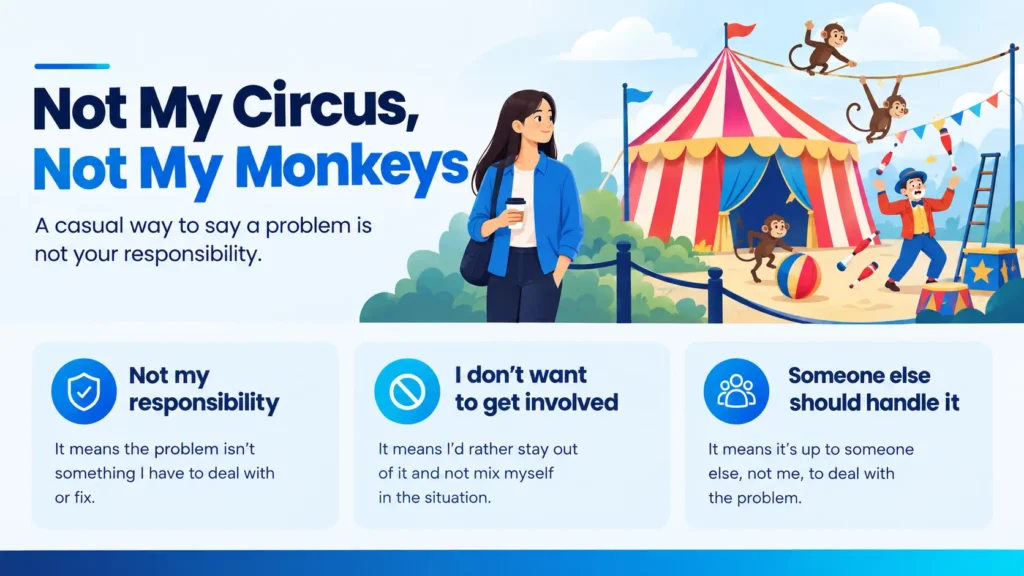
“Not my circus, not my monkeys” is a casual expression used when someone wants to say that another person’s problem or situation is not their responsibility.
The phrase creates a humorous image: if the circus and monkeys belong to someone else, you are not responsible for managing them.
It can be useful when talking with friends, commenting on unnecessary drama, or joking about a problem that does not involve you. However, its playful wording can sound dismissive in professional or sensitive situations.
The expression is commonly associated with the Polish saying “Nie mój cyrk, nie moje małpy,” although the exact history of how and when the English version entered wider use is less certain.
Why Use an Alternative?
There are several reasons to replace “not my circus, not my monkeys.”
First, the original phrase is strongly conversational. It may sound natural in a text to a friend but unusual in an academic paper or formal workplace email.
Second, some alternatives communicate responsibility more precisely. For example, “That isn’t my responsibility” clearly explains why you are not taking action.
Finally, the tone can change significantly. “None of my business” may sound blunt, while “I’ll leave that to them” can create more distance without sounding as harsh.
Best Alternatives to “Not My Circus, Not My Monkeys”
Not My Problem
Meaning
“Not my problem” directly communicates that you do not consider a situation your responsibility. It is short, familiar, and easy to use in everyday conversation.
Best For
Casual conversations, everyday situations, and straightforward statements about responsibility.
Formality
1/5 — Very casual
Example 1
“They missed the deadline, but it’s not my problem.”
Example 2
“I heard they’re arguing again, but that’s not my problem.”
Quick Tip
This is one of the closest replacements for the original phrase, but it can sound blunt. Use it carefully when speaking to someone who expects empathy or support.
Not My Responsibility
Meaning
“Not my responsibility” focuses specifically on who is expected to handle a task, issue, or problem. It is more precise than the original phrase when discussing duties.
Best For
Workplace conversations, assigned tasks, team responsibilities, and professional communication.
Formality
4/5 — Professional
Example 1
“Updating the database is not my responsibility, so I’ll leave that task with the operations team.”
Example 2
“The final approval is not my responsibility; the department manager handles it.”
Quick Tip
This is a much more professional alternative because it establishes a clear boundary without using humor.
None of My Business
Meaning
“None of my business” means that a situation is private or unrelated to you, so you do not intend to interfere.
Best For
Personal conversations, private matters, relationships, and situations involving other people’s affairs.
Formality
2/5 — Casual
Example 1
“What they decide to do with their relationship is none of my business.”
Example 2
“I heard the neighbors arguing, but their disagreement is none of my business.”
Quick Tip
This expression can sound sharp or dismissive. If you want to sound softer, try “I’d rather stay out of it.”
Not My Concern
Meaning
“Not my concern” indicates that an issue does not require your attention or involvement. It sounds more controlled and formal than “not my problem.”
Best For
Professional communication, workplace situations, and neutral statements about responsibility.
Formality
4/5 — Professional
Example 1
“The contract negotiations are not my concern; I’m responsible for the technical review.”
Example 2
“If the decision has already been made, the disagreement is no longer my concern.”
Quick Tip
Although it sounds professional, it can still feel distant. Use it when you want to establish a clear boundary rather than express sympathy.
That’s on Them
Meaning
“That’s on them” means another person is responsible for a decision, mistake, or result. It often focuses on accountability rather than simply avoiding involvement.
Best For
Informal conversations and situations where another person clearly owns the responsibility for an outcome.
Formality
2/5 — Casual
Example 1
“I warned them about the deadline. If they ignored it, that’s on them.”
Example 2
“She chose not to bring the required documents, so that’s on her.”
Quick Tip
Use this phrase when you want to emphasize that another person must deal with the result of their own decision.
I’m Staying Out of It
Meaning
“I’m staying out of it” clearly says that you have chosen not to become involved in a disagreement or difficult situation.
Best For
Conflicts, arguments, interpersonal drama, and situations where people are trying to involve you.
Formality
2/5 — Casual
Example 1
“My roommates are arguing about the lease, but I’m staying out of it.”
Example 2
“They both want me to take sides, but I’m staying out of it.”
Quick Tip
This works especially well when you are deliberately choosing not to participate rather than simply saying that a problem is not your responsibility.
I’ll Leave That to Them
Meaning
“I’ll leave that to them” means you are allowing the people responsible to handle a situation themselves.
Best For
Professional conversations, workplace decisions, and polite situations where you want to step back.
Formality
4/5 — Professional and polite
Example 1
“The design team can decide which version to use. I’ll leave that to them.”
Example 2
“They know the situation better than I do, so I’ll leave that decision to them.”
Quick Tip
This is a good choice when you want to create distance without sounding dismissive or uninterested.
Stay in Your Lane
Meaning
“Stay in your lane” tells someone to focus on their own responsibilities or area of expertise. It is more about boundaries than simply saying that something is not your responsibility.
Best For
Informal workplace conversations, teamwork, boundaries, and direct advice.
Formality
2/5 — Casual and direct
Example 1
“I’m handling the budget, and she’s managing the schedule. We should both stay in our lanes.”
Example 2
“He keeps commenting on a project he isn’t involved in. Someone needs to tell him to stay in his lane.”
Quick Tip
This can sound confrontational when directed at another person. Avoid it in sensitive professional communication unless the relationship and tone clearly allow it.
I Don’t Want to Get Involved
Meaning
“I don’t want to get involved” expresses a deliberate choice to remain outside a situation. It focuses on your decision rather than assigning blame.
Best For
Personal conflicts, workplace disagreements, sensitive situations, and interpersonal issues.
Formality
3/5 — Neutral
Example 1
“I know they’re having an argument, but I don’t want to get involved.”
Example 2
“I understand both sides, but I don’t want to get involved in their disagreement.”
Quick Tip
This is clearer and less playful than the original phrase, making it useful when you want to avoid confusion or unnecessary tension.
I’ll Stay Out of It
Meaning
“I’ll stay out of it” means you have decided not to participate in or influence a situation.
Best For
Arguments, disagreements, personal matters, and situations where you want to remain neutral.
Formality
3/5 — Neutral
Example 1
“They can work out their disagreement. I’ll stay out of it.”
Example 2
“I have my own opinion, but I’ll stay out of the discussion.”
Quick Tip
This phrase focuses on your choice not to participate rather than whether the problem technically belongs to you.
Alternatives at a Glance
| Alternative | Best Used For | Tone | Formality |
|---|---|---|---|
| Not my problem | Casual situations | Direct | 1/5 |
| Not my responsibility | Work and duties | Neutral | 4/5 |
| None of my business | Personal matters | Direct | 2/5 |
| Not my concern | Professional situations | Neutral | 4/5 |
| That’s on them | Responsibility for an outcome | Informal | 2/5 |
| I’m staying out of it | Conflicts | Neutral | 2/5 |
| I’ll leave that to them | Work and decisions | Polite | 4/5 |
| Stay in your lane | Boundaries and roles | Direct | 2/5 |
| I don’t want to get involved | Sensitive situations | Neutral | 3/5 |
| I’ll stay out of it | Disagreements | Neutral | 3/5 |
Which Alternative Should You Use?
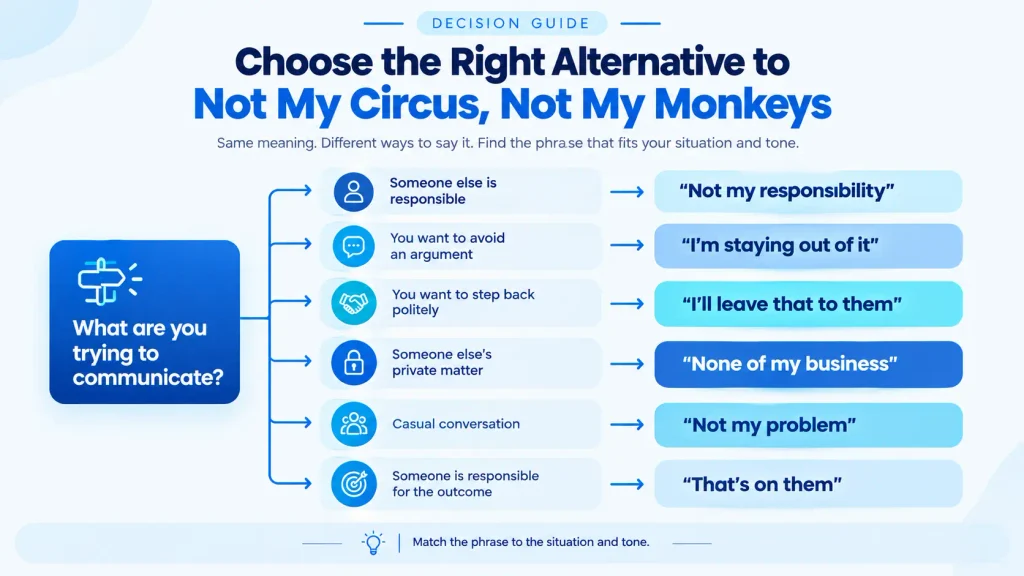
The best replacement depends on the situation, your relationship with the other person, and how strongly you want to establish a boundary.
For Casual Conversations
Recommended Option
“Not my problem.”
Why
It is short, familiar, and easy to understand. It works best when you are speaking casually and do not need to soften your message.
For Workplace Responsibilities
Recommended Option
“That isn’t my responsibility.”
Why
It clearly explains that another person or department is responsible for the task. It also sounds more professional than the original idiom.
For Someone Else’s Private Matters
Recommended Option
“None of my business.”
Why
It communicates that you recognize the situation as someone else’s personal matter and do not intend to interfere.
For Avoiding an Argument
Recommended Option
“I’m staying out of it.”
Why
It shows that you have chosen not to participate in the disagreement rather than taking one person’s side.
For Politely Stepping Back
Recommended Option
“I’ll leave that to them.”
Why
This expression creates distance while maintaining a neutral and respectful tone.
When Someone Else Is Responsible for the Outcome
Recommended Option
“That’s on them.”
Why
It makes the other person’s responsibility clear, particularly when they made the decision that led to the result.
When You Need to Establish a Boundary
Recommended Option
“Stay in your lane.”
Why
It directly tells someone to focus on their own responsibilities. However, because it can sound confrontational, it should be used carefully.
When “Not My Circus, Not My Monkeys” Works Well
The original phrase works best when the conversation is informal and the listener understands its humorous tone.
For example:
“They’ve been arguing about the seating arrangement for an hour. Not my circus, not my monkeys.”
The speaker is not necessarily angry. The unusual imagery can make the statement humorous and emphasize that the speaker does not want to become involved.
The expression can also work in social media posts, text messages, casual conversations, and lighthearted discussions.
However, the phrase is not equally appropriate in every setting. If you are communicating with a customer, manager, professor, client, or someone dealing with a sensitive issue, a more neutral expression may be better.
When to Choose a More Professional Alternative
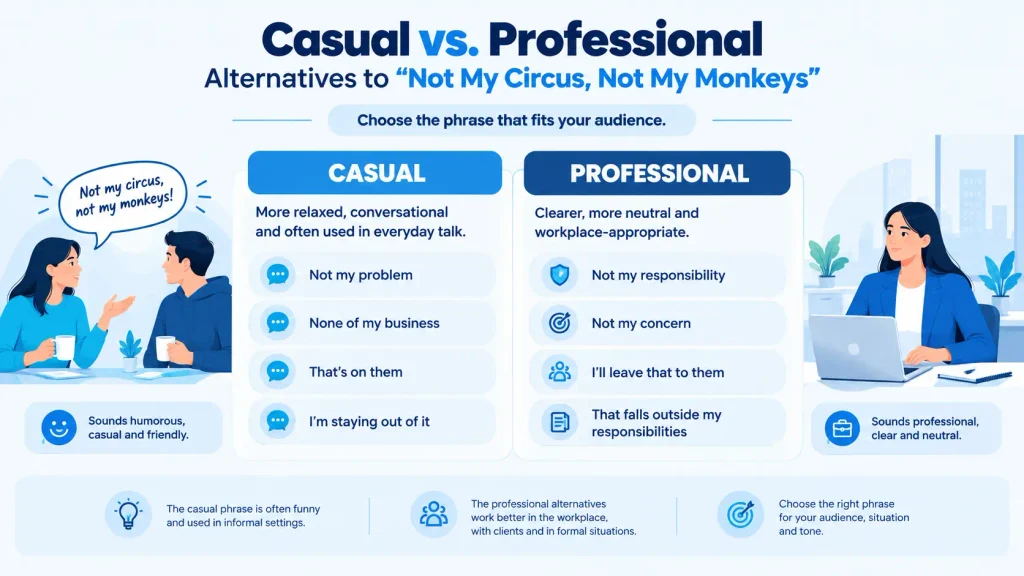
Avoid the phrase when you need to sound formal, diplomatic, or highly respectful.
For example, telling a manager:
“That’s not my circus, not my monkeys.”
could sound dismissive even if you simply mean that another team owns the task.
A better option would be:
“That falls outside my responsibilities, so I’ll leave it with the appropriate team.”
The second version makes the same basic point while clearly identifying the boundary.
Professional communication often benefits from stating responsibility directly instead of relying on a humorous idiom.
Common Mistakes to Avoid
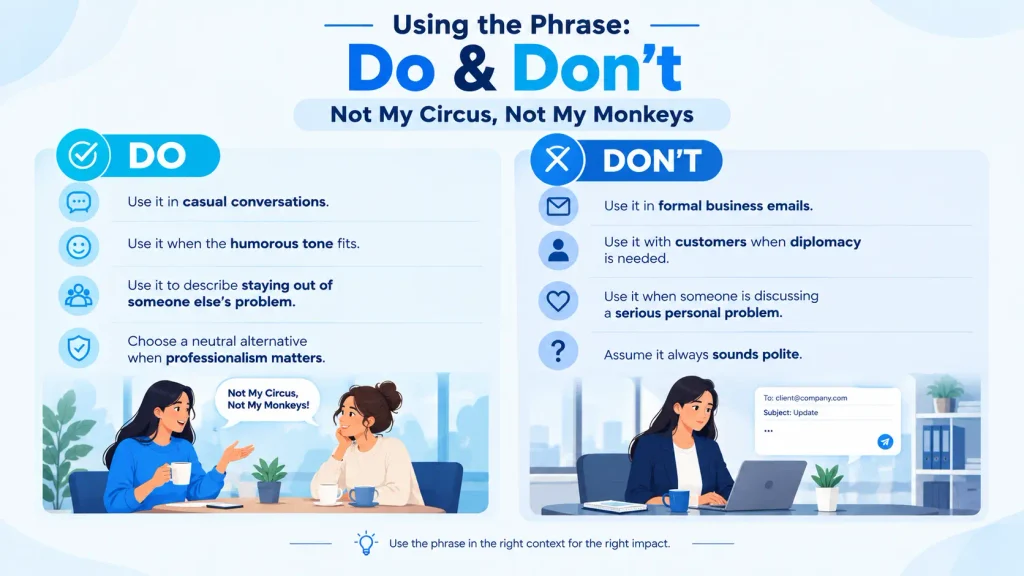
Mistake: Using “Not My Problem” in Every Situation
Why It Sounds Wrong
“Not my problem” can imply that you do not care about the consequences. It may sound especially harsh when someone is asking for help or discussing a serious issue.
Better Approach
Use “I’ll leave that to them” when you want to sound more neutral and less dismissive.
Mistake: Using “Stay in Your Lane” With a Manager
Why It Sounds Wrong
The phrase can sound confrontational or disrespectful when directed at someone in a position of authority.
Better Approach
Explain the roles directly. For example:
“I’ll handle my part, and you can handle yours.”
This establishes the boundary without using a confrontational expression.
Mistake: Using the Original Phrase in Formal Writing
Why It Sounds Wrong
“Not my circus, not my monkeys” is a conversational idiom. Its humorous imagery may not fit an academic paper, formal email, business report, or client communication.
Better Approach
Use “not my responsibility” or “outside my area of responsibility.”
Mistake: Assuming “None of My Business” Always Sounds Polite
Why It Sounds Wrong
“None of my business” can sound blunt when someone is sharing a personal problem with you.
Better Approach
Try “I’d rather not get involved” when you want to create a softer boundary.
Mistake: Confusing Responsibility With Lack of Interest
Why It Sounds Wrong
Saying “not my concern” may suggest that you simply do not care, even when you actually mean that someone else is responsible.
Better Approach
Say “That isn’t my responsibility” when responsibility is the main issue.
Frequently Asked Questions
What Is Another Way to Say “Not My Circus, Not My Monkeys”?
Natural alternatives include “not my problem,” “not my responsibility,” “none of my business,” “not my concern,” “I’m staying out of it,” and “I’ll leave that to them.” The most appropriate option depends on whether you want to sound casual, professional, neutral, or direct.
What Does “Not My Circus, Not My Monkeys” Mean?
It means that a particular problem, conflict, or situation is not your responsibility and you do not want to become involved. The phrase is usually informal and can add a humorous tone to the idea of staying away from someone else’s problems.
Is “Not My Problem” the Same as “Not My Circus, Not My Monkeys”?
The meanings are closely related, but the tone is different. “Not my problem” is shorter and more direct, while “not my circus, not my monkeys” adds humorous and colorful imagery. Both can indicate that you do not consider a situation your responsibility.
Is “Not My Circus, Not My Monkeys” Rude?
It can sound dismissive depending on the situation and tone. Among friends, it may be humorous. In a workplace, customer-service conversation, or sensitive personal discussion, a phrase such as “That isn’t my responsibility” or “I’ll leave that to them” is usually clearer and more neutral.
Can I Use “Not My Circus, Not My Monkeys” at Work?
You can use it in informal conversations with coworkers when the tone is appropriate. However, it is not ideal for formal emails, reports, client communication, or conversations where you need to sound diplomatic. “That isn’t my responsibility” is a more professional choice.
What Is a Polite Way to Say “Not My Circus, Not My Monkeys”?
Try “I’ll leave that to them,” “That isn’t within my responsibilities,” or “I’d rather stay out of it.” These expressions create distance without using the humorous or potentially dismissive imagery of the original phrase.
Is “None of My Business” a Good Alternative?
It can be, especially when you are talking about another person’s private affairs. However, it can sound blunt. If you want a softer version, “I’d rather stay out of it” communicates a similar boundary more gently.
Where Did “Not My Circus, Not My Monkeys” Come From?
The expression is commonly associated with the Polish proverb “Nie mój cyrk, nie moje małpy,” meaning “Not my circus, not my monkeys.” The exact history and earliest use of the English expression are less certain, so it is better to describe the Polish connection as an established association rather than claim a precise origin.
Conclusion
Choosing another way to say “not my circus, not my monkeys” depends mainly on your audience and the tone you want. For casual conversations, “not my problem” is short and direct, while “none of my business” works when you are talking about someone else’s private affairs.
In professional settings, “not my responsibility” and “I’ll leave that to them” make the boundary clearer without the playful tone of the original phrase. If you want to avoid a disagreement, “I’m staying out of it” is a natural choice.
The original expression remains useful when humor and informality fit the situation. You can also check the Cambridge Dictionary definition of “not my circus, not my monkeys” for its meaning and usage. When the goal is clarity, respect, or professionalism, a straightforward alternative is often the better choice.

Melody Schaefer is the Founder and Editor-in-Chief of FrontiersPost, where she oversees the publication of clear, useful, and thoughtfully researched content for modern readers. Her editorial focus includes language, communication, vocabulary, writing, and practical topics that help readers understand information with greater clarity and confidence.
At FrontiersPost, Melody works with writers and editors to maintain consistent editorial standards, improve content quality, and ensure that published articles are useful, accessible, and easy to understand. She is particularly interested in clear communication and presenting complex or easily confused topics in a straightforward way.
As Editor-in-Chief, she is also responsible for guiding the site’s editorial direction, reviewing content standards, and helping ensure that articles are regularly maintained and improved as information evolves.