
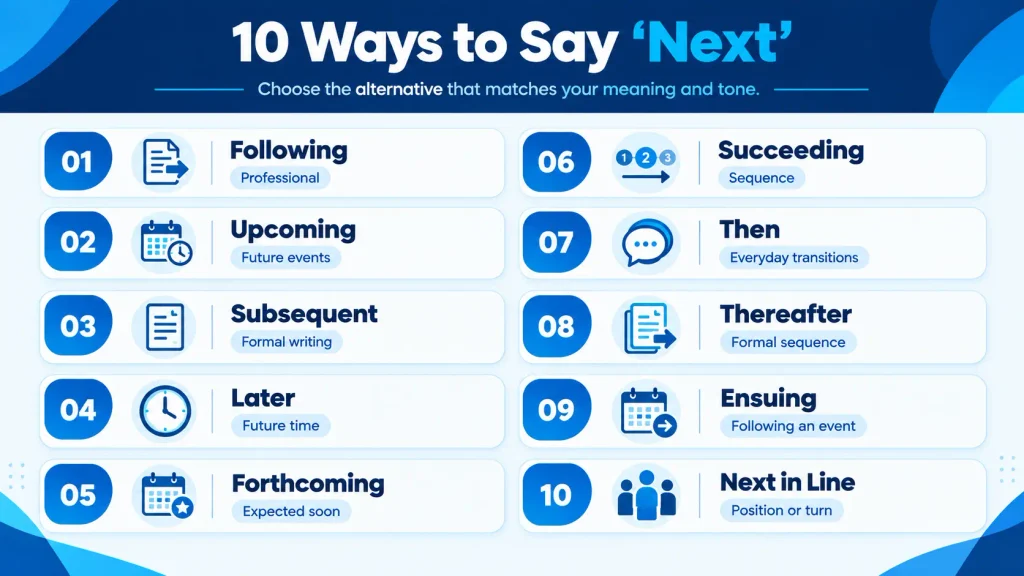
Another way to say “next” includes following, upcoming, subsequent, later, forthcoming, succeeding, then, thereafter, ensuing, and next in line. The best choice depends on context. For example, “following” works well in formal writing, while “upcoming” is natural when discussing future events, meetings, or plans.
Key Takeaways
- Following is a versatile alternative to “next” in professional and formal writing.
- Upcoming works well for future events, meetings, deadlines, and plans.
- Subsequent is especially useful in academic, technical, and formal writing.
- Then and later sound natural in everyday conversations and instructions.
- The best alternative depends on whether you mean sequence, time, order, or position.
The word “next” is common in English, but using the same word repeatedly can make your writing sound plain or repetitive. Choosing a more specific alternative can make your message clearer and better suited to the situation.
Whether you are writing an email, explaining a process, describing a future event, or talking about the order of things, there are several natural ways to replace “next.”
What Does “Another Way to Say Next” Mean?
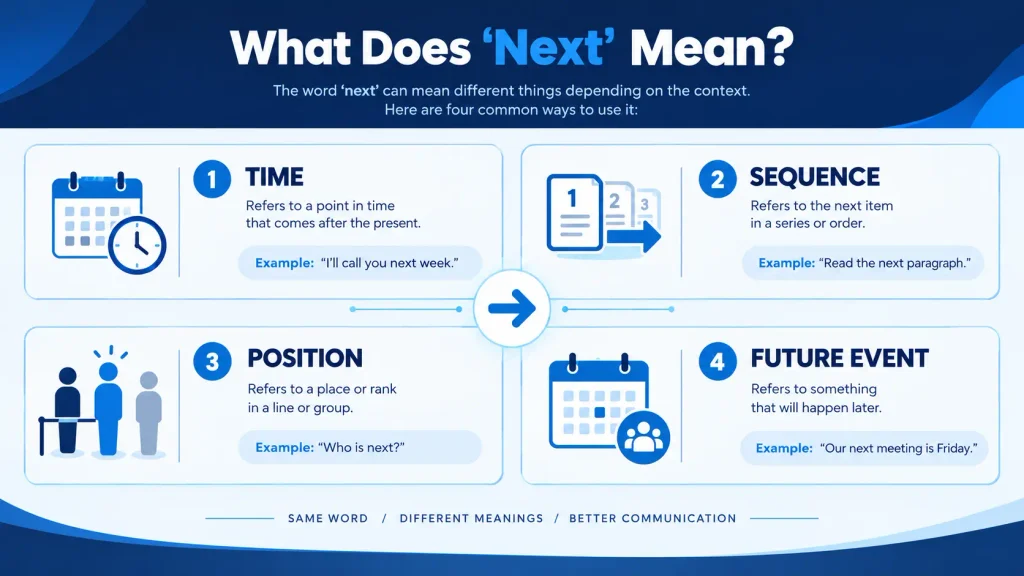
“Another way to say next” means finding a different word or phrase that communicates the same or a similar idea as “next.” The exact replacement depends on what “next” means in the sentence.
For example, “next” can refer to something that happens afterward, something coming in the future, or the person or item that follows in a sequence.
Common uses include:
- Time: “I’ll call you next week.”
- Sequence: “Read the next paragraph.”
- Order: “Who is next?”
- Future events: “Our next meeting is Friday.”
- Instructions: “Next, click the button.”
Because “next” has several meanings, the best alternative should match the context.
Why Use Other Ways to Say “Next”?
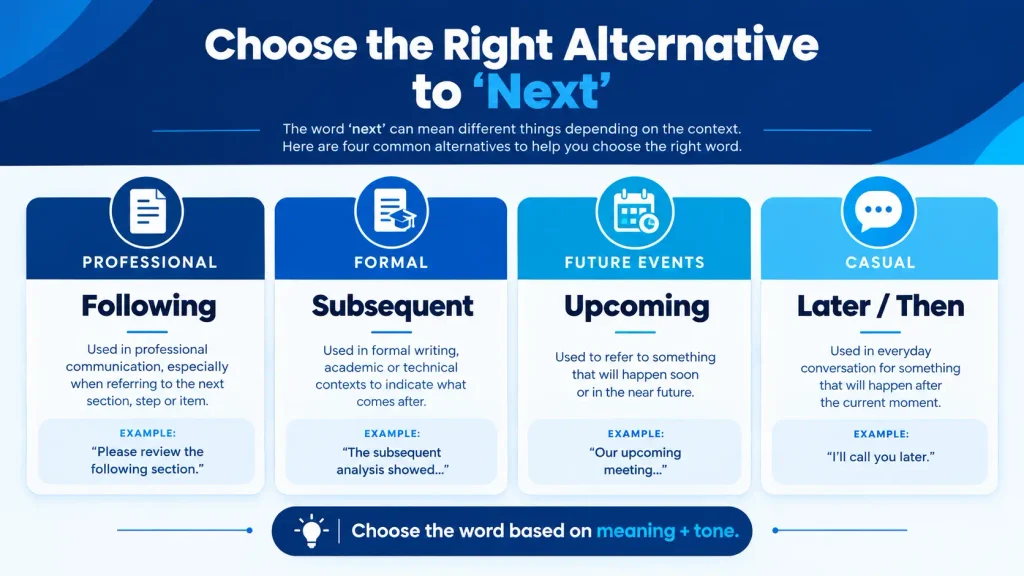
Using alternatives to “next” can make your communication more precise and natural. It also helps prevent repetition when the word appears several times in the same paragraph.
Other benefits include:
- Avoiding repetitive wording
- Making formal writing more polished
- Creating smoother transitions
- Clarifying time or sequence
- Matching professional and casual situations
- Making instructions easier to follow
For example, “subsequent” may sound appropriate in an academic paper, while “later” may feel more natural in a casual conversation.
10 Best Other Ways to Say “Next”
1. Following
Meaning
Following refers to something that comes immediately after something else in time, order, or sequence. It is one of the most flexible alternatives to “next,” especially in professional and formal writing.
Best For
- Professional
- Formal
- Polite
Example 1
Please review the following section before submitting the report.
Example 2
We discussed the issue during the following meeting.
Quick Tip
Use following when you want to clearly connect one thing to something that was just mentioned.
2. Upcoming
Meaning
Upcoming describes something that is scheduled or expected to happen in the near future. It works particularly well when talking about events, meetings, holidays, deadlines, or plans.
Best For
- Professional
- Casual
- Friendly
Example 1
I need to prepare a presentation for our upcoming meeting.
Example 2
Are you excited about the upcoming holiday weekend?
Quick Tip
Choose upcoming when “next” refers to a future event rather than the order of items.
3. Subsequent
Meaning
Subsequent means something that happens or comes after something else. It is more formal than “next” and is often used in academic, business, legal, and technical writing.
Best For
- Formal
- Professional
Example 1
The subsequent analysis revealed several important patterns.
Example 2
Any subsequent changes will be communicated to the team.
Quick Tip
Use subsequent in formal writing when you want to emphasize sequence without sounding conversational.
4. Later
Meaning
Later refers to a time after the present moment or after another event. Unlike “next,” it does not always suggest that something happens immediately afterward.
Best For
- Casual
- Friendly
- Professional
Example 1
I have a meeting now, but I can answer your questions later.
Example 2
We can discuss the budget details later this afternoon.
Quick Tip
Use later when the exact order or timing is less important than simply indicating a future point.
5. Forthcoming
Meaning
Forthcoming describes something that is expected to happen, appear, or become available soon. It has a polished tone and often appears in professional, academic, and formal communication.
Best For
- Formal
- Professional
Example 1
The company will announce the forthcoming changes next month.
Example 2
Students should prepare for the forthcoming examination.
Quick Tip
Use forthcoming when something is expected in the near future and you want a more formal tone.
6. Succeeding
Meaning
Succeeding refers to something that follows another thing in sequence or order. It is useful when discussing a series of events, periods, stages, or items.
Best For
- Formal
- Professional
Example 1
The succeeding chapters explain how the process works.
Example 2
Sales increased during the succeeding months.
Quick Tip
Use succeeding when the focus is specifically on one thing following another in an established sequence.
7. Then
Meaning
Then means at that time or afterward. It is a simple, natural alternative when explaining steps or describing what happens after an earlier action.
Best For
- Casual
- Friendly
- Professional
Example 1
Finish the application, then send it to the admissions office.
Example 2
We can grab dinner and then head home.
Quick Tip
Use then for step-by-step instructions or everyday conversations where a simple transition sounds best.
8. Thereafter
Meaning
Thereafter means from that time onward or after the event just mentioned. It is more formal than “then” or “later.”
Best For
- Formal
- Professional
Example 1
The contract will be reviewed annually thereafter.
Example 2
The employee completed the training and thereafter joined the customer service team.
Quick Tip
Use thereafter mainly in formal or business writing when referring to a period following a specific event.
9. Ensuing
Meaning
Ensuing describes something that follows an earlier event, often as a consequence or part of a sequence. It is common in formal writing and works best when the relationship between events is clear.
Best For
- Formal
- Professional
Example 1
The ensuing discussion helped the team identify several solutions.
Example 2
The ensuing weeks were filled with preparation for the launch.
Quick Tip
Use ensuing when you want to emphasize what happened after a particular event or situation.
10. Next in Line
Meaning
Next in line describes the person, item, or thing that is immediately after another in an established order. It can refer to physical position, turn-taking, or succession.
Best For
- Casual
- Friendly
- Polite
Example 1
The customer next in line can proceed to the service desk.
Example 2
After Maya finishes her presentation, I’m next in line to speak.
Quick Tip
Use next in line when talking about people or things waiting for their turn or following an established order.
Comparison Table
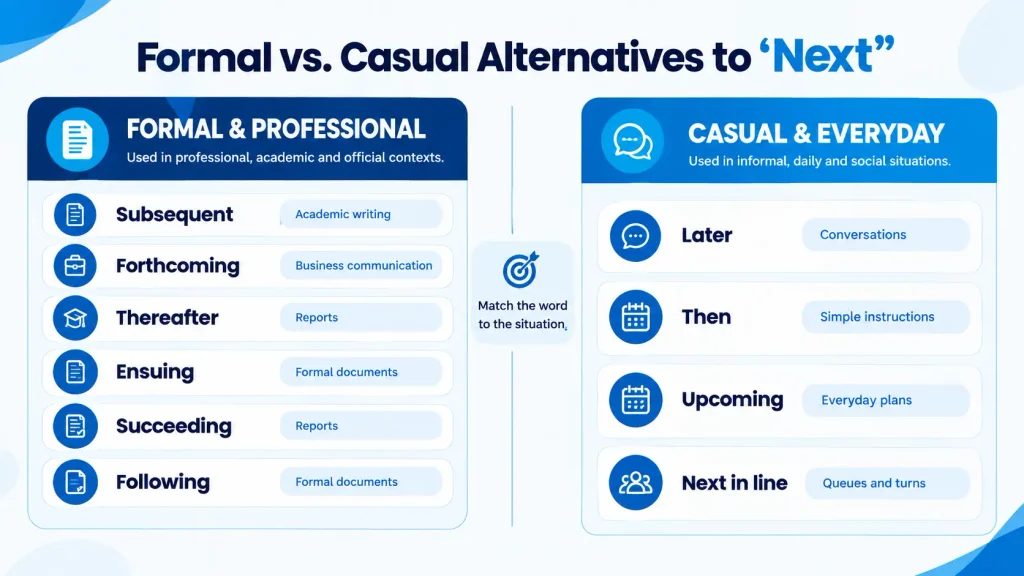
| Alternative | Best Used In | Tone |
| Following | Professional writing, documents | Professional |
| Upcoming | Events, plans, schedules | Natural |
| Subsequent | Academic and formal writing | Formal |
| Later | Conversations and future timing | Casual |
| Forthcoming | Announcements and formal writing | Formal |
| Succeeding | Sequences and periods | Formal |
| Then | Instructions and everyday speech | Casual |
| Thereafter | Business and legal writing | Formal |
| Ensuing | Formal descriptions of events | Formal |
| Next in line | Turns, positions, and queues | Casual |
Common Mistakes
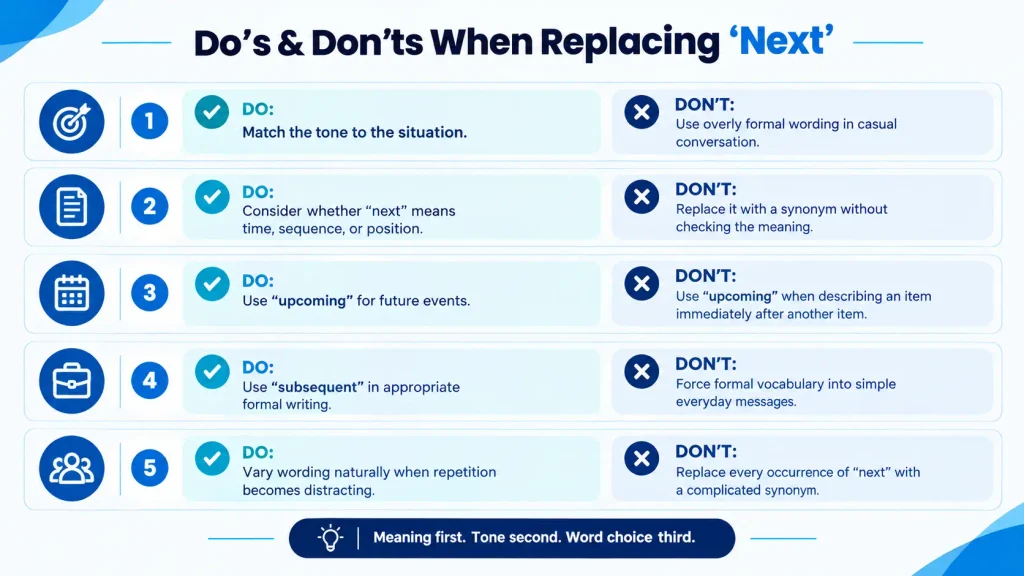
1. Using a Casual Phrase in Formal Writing
Words such as then and later are perfectly natural, but they may not always provide the precise tone required in academic or formal documents. Consider subsequent or thereafter when the context calls for a more formal style.
2. Choosing an Overly Formal Alternative
Not every sentence needs sophisticated vocabulary. Saying “I’ll call you thereafter” can sound unnatural in ordinary conversation when “I’ll call you later” would be clearer.
3. Ignoring the Meaning of “Next”
“Next” can describe time, order, position, or sequence. Replacing it with upcoming when you mean “the item immediately after this one” can change the meaning.
4. Repeating the Same Alternative
Replacing “next” with “following” does not solve the problem if “following” appears several times in the same paragraph. Vary your wording naturally when the context allows it.
5. Using a Synonym That Does Not Fit the Context
Some alternatives are more specialized than others. For example, forthcoming generally describes something expected in the future, while next in line focuses on order or position.
Frequently Asked Questions
What is a professional way to say “next”?
Following is one of the most versatile professional alternatives to “next.” For example, “Please review the following information” sounds natural in workplace communication. In more formal or academic writing, subsequent can also work well when you mean something that occurs after an earlier event.
What is another word for “next” in formal writing?
Common formal alternatives include subsequent, succeeding, forthcoming, thereafter, and ensuing. The correct choice depends on the meaning. “Subsequent” usually refers to something that follows, while “forthcoming” focuses on something expected in the future.
What is another way to say “next” in an email?
In a professional email, you can use following, upcoming, later, or subsequent, depending on the sentence. For example, “Please review the following document” works well when referring to information that appears immediately afterward.
Can I use “following” instead of “next”?
Yes. Following can replace “next” when you are describing something that comes after another item, event, or point. For example, “the following week” and “the next week” can have similar meanings, although the exact meaning may depend on the surrounding context.
What is a simple synonym for “next”?
Then and later are two simple alternatives, but they are not interchangeable in every sentence. “Then” often describes the action that follows another action, while “later” generally refers to a future time without necessarily indicating the immediate next step.
What is another way to say “next week”?
Depending on the context, you can say the following week or the upcoming week. “The following week” often relates to a previously mentioned time, while “the upcoming week” emphasizes the week that is about to begin.
What is another way to say “next step”?
Possible alternatives include following step, subsequent step, or step that follows. In professional instructions, “the following step” sounds natural. For a formal process document, “the subsequent step” may be more appropriate.
Is “forthcoming” the same as “next”?
Not exactly. Forthcoming means something expected or approaching in the future, while next can also describe position or sequence. For example, an upcoming meeting can be called a forthcoming meeting, but the next person in a line is not normally described as “forthcoming.”
Readers who used this guide also looked at Another Way to Say No, Another Way to Say “Not My Circus, Not My Monkeys and What to Say Instead of “OK”.
Conclusion
There are many natural ways to say “next,” but the best alternative depends on what you mean. Use following for a flexible professional option, upcoming for future events, and subsequent for formal or academic writing. For everyday conversations, later and then usually sound more natural.
If you are describing something that will happen soon, forthcoming can add a formal touch. For established sequences, succeeding or ensuing may be more precise, while next in line works well for turns and positions.
The key is to choose a word that matches both the meaning and the tone of your sentence. Instead of replacing “next” automatically, consider whether you are talking about time, sequence, position, or a future event.

The FrontiersPost editorial team writes and reviews every guide to word and phrase alternatives, with clear meanings, tone notes and example sentences for everyday, academic and professional English.