
If you want another way to say “I have experience,” consider phrases such as “I have a strong background in,” “I am experienced in,” “I have hands-on experience with,” and “I bring expertise in.” These alternatives help you describe your skills more naturally in resumes, cover letters, job interviews, professional emails, and everyday conversations.
Key Takeaways
- Use “I have a strong background in” to highlight your professional history and knowledge.
- Choose “I have hands-on experience with” to emphasize practical skills.
- Use “I am proficient in” when describing your ability to perform specific tasks.
- Try “I bring expertise in” to communicate specialized knowledge professionally.
- Support experience claims with specific examples, achievements, and relevant skills.
The phrase “I have experience” is useful when discussing your qualifications, skills, and professional background. However, using it repeatedly in a resume, cover letter, or job interview can make your communication sound repetitive.
Choosing more specific expressions can help you explain what you know, what you have accomplished, and how your background relates to an opportunity. Whether you are applying for a job, updating your LinkedIn profile, or writing a professional email, the following alternatives can help you communicate with confidence.
What Does “I Have Experience” Mean?

“I have experience” means that you have previously performed a task, worked in a particular field, or gained knowledge through practical involvement.
It communicates that you understand how something works because you have encountered it before. This experience may come from a full-time job, internship, volunteer position, academic project, freelance assignment, or personal work.
For example:
- I have experience in customer service.
- I have experience managing a team.
- I have experience using project management software.
Although these sentences are clear, they do not always explain the depth of your knowledge or the type of work you have performed. More specific alternatives can make your qualifications easier to understand.
Why Use Alternatives to “I Have Experience”?
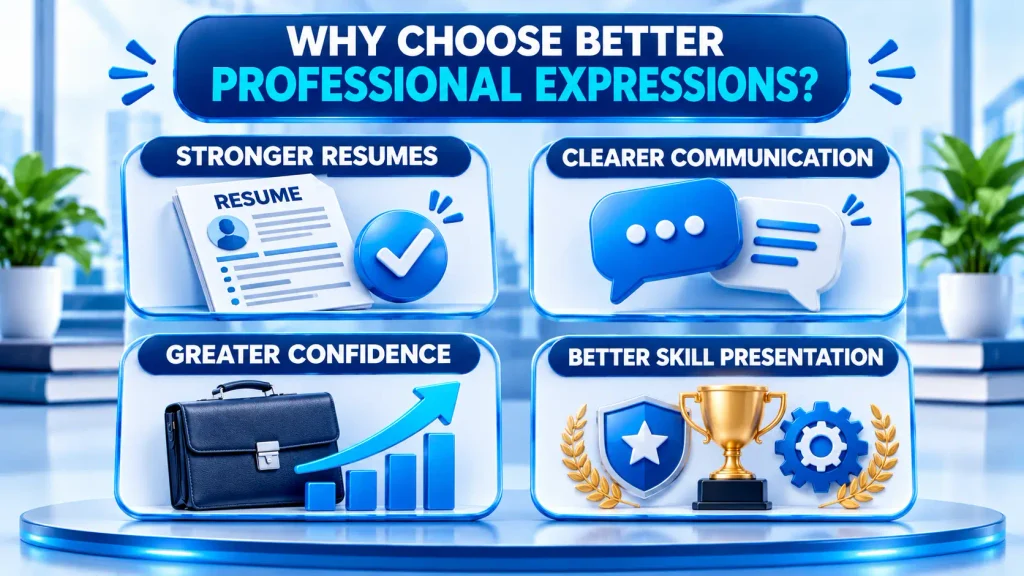
Using different expressions helps you describe your professional background with greater accuracy and confidence.
Here are several reasons to consider alternative wording:
- Improve your resume: Stronger expressions can help describe your responsibilities and qualifications more clearly.
- Sound more professional: Certain phrases communicate confidence and familiarity with your industry.
- Highlight practical skills: You can distinguish between theoretical knowledge and hands-on experience.
- Avoid repetition: Different expressions make cover letters and professional emails more engaging.
- Show your expertise: Specific wording helps employers understand what you can contribute.
The best expression depends on your experience level, the situation, and what you want the reader to understand.
10 Best Alternatives to “I Have Experience”

Here are 10 natural and professional alternatives to help you communicate your qualifications in different situations.
1. I Have a Strong Background in
Meaning and Usage
“I have a strong background in” highlights your previous education, professional history, and knowledge in a particular area.
It sounds confident and professional without making an exaggerated claim. It is especially useful when your experience comes from several roles, projects, or years of working in the same field.
Best For
- Professional resumes
- Cover letters
- Job interviews
- LinkedIn profiles
- Professional introductions
Example Sentences
- I have a strong background in digital marketing and content strategy.
- I have a strong background in financial management and business operations.
- I have a strong background in customer relations and team leadership.
Quick Tip
Use this expression when you want to emphasize your overall professional history rather than one specific task or responsibility.
2. I Am Experienced in
Meaning and Usage
“I am experienced in” is a direct and professional way to communicate that you have knowledge or practical involvement in a particular activity.
It is a natural replacement for “I have experience” and works well in formal and informal professional communication.
Best For
- Resumes
- Job applications
- Cover letters
- Professional emails
- Interviews
Example Sentences
- I am experienced in managing cross-functional teams.
- I am experienced in developing effective marketing campaigns.
- I am experienced in handling customer inquiries and resolving complaints.
Quick Tip
Follow this phrase with a relevant activity or skill. For example, say “experienced in managing projects,” not “experienced to manage projects.”
3. I Have Hands-On Experience With
Meaning and Usage
This expression emphasizes practical involvement rather than simply knowing about a subject.
It tells employers that you have actually worked with a tool, system, process, or technique. It is particularly useful when describing technical abilities or practical workplace skills.
Best For
- Technical resumes
- Software-related jobs
- Internships
- Practical projects
- Job interviews
Example Sentences
- I have hands-on experience with WordPress and website management.
- I have hands-on experience with data analysis and reporting tools.
- I have hands-on experience with managing social media campaigns.
Quick Tip
Use “hands-on experience with” when you have personally used a tool or performed a task. It is stronger than simply saying you are familiar with something.
4. I Bring Expertise in
Meaning and Usage
“I bring expertise in” communicates that you have valuable knowledge or specialized skills that can benefit an organization.
It sounds confident and professional, making it a good choice when describing what you can contribute to a company or team.
However, use it only when your knowledge genuinely supports the word “expertise.”
Best For
- Senior-level resumes
- Cover letters
- Business proposals
- Professional introductions
- Leadership interviews
Example Sentences
- I bring expertise in strategic planning and business development.
- I bring expertise in content marketing and audience engagement.
- I bring expertise in financial analysis and risk management.
Quick Tip
Choose this phrase when you want to focus on the value you offer an employer rather than simply describing your previous responsibilities.
5. I Have a Proven Track Record in
Meaning and Usage
This expression highlights a history of successful work and measurable accomplishments.
It suggests that you have demonstrated your abilities through previous results. It is particularly effective when you can support your statement with specific achievements.
Best For
- Experienced professionals
- Management resumes
- Leadership applications
- Business presentations
- Cover letters
Example Sentences
- I have a proven track record in improving customer satisfaction.
- I have a proven track record in delivering projects on time.
- I have a proven track record in developing successful marketing strategies.
Quick Tip
Use this phrase when you can demonstrate successful outcomes. Whenever possible, include measurable results to make your statement more convincing.
6. I Have a Wealth of Experience in
Meaning and Usage
“I have a wealth of experience in” emphasizes substantial experience gained over time.
It sounds polished and slightly more formal than the original expression. This phrase is useful when you have worked extensively in a particular industry or professional area.
Best For
- Experienced job applicants
- Professional biographies
- Cover letters
- Business introductions
- Senior-level positions
Example Sentences
- I have a wealth of experience in project management.
- I have a wealth of experience in education and curriculum development.
- I have a wealth of experience in managing client relationships.
Quick Tip
This expression suggests considerable experience, so avoid using it if you are just starting your career or have limited exposure to the subject.
7. My Background Includes
Meaning and Usage
“My background includes” introduces your previous responsibilities, professional roles, education, or relevant skills.
It is a flexible expression that allows you to mention several areas of experience without repeatedly using “I have experience.”
Best For
- Resumes
- Cover letters
- Professional biographies
- Job interviews
- LinkedIn summaries
Example Sentences
- My background includes project coordination and administrative support.
- My background includes teaching, curriculum development, and student mentoring.
- My background includes sales management and customer relationship building.
Quick Tip
Use this phrase when introducing multiple areas of experience. It works especially well when summarizing your professional history in a short paragraph.
8. I Am Well-Versed in
Meaning and Usage
“I am well-versed in” means that you have a good understanding of a particular subject, system, or process.
It communicates familiarity and knowledge, making it suitable for professional situations where subject understanding is important.
However, it does not always suggest that you have extensive practical experience.
Best For
- Professional emails
- Academic writing
- Technical introductions
- Business communication
- Job interviews
Example Sentences
- I am well-versed in digital marketing principles and strategies.
- I am well-versed in Microsoft Office applications.
- I am well-versed in workplace communication and administrative procedures.
Quick Tip
Use this expression when emphasizing knowledge and familiarity. If you want to highlight practical work, “hands-on experience with” may be more accurate.
9. I Have Extensive Experience in
Meaning and Usage
“I have extensive experience in” communicates that you have considerable involvement in a particular field or activity.
It is a straightforward but powerful alternative for describing a substantial professional background.
Best For
- Professional resumes
- Cover letters
- Senior-level applications
- Business communication
- Job interviews
Example Sentences
- I have extensive experience in managing large-scale projects.
- I have extensive experience in healthcare administration.
- I have extensive experience in developing business strategies.
Quick Tip
Use “extensive” only when your experience is genuinely substantial. If you have worked on only a few projects, choose a more modest expression.
10. I Have Practical Experience in
Meaning and Usage
“I have practical experience in” emphasizes the ability to apply knowledge in real situations.
It is useful when you want to show that your understanding comes from actual tasks, assignments, projects, or workplace responsibilities.
Best For
- Entry-level resumes
- Internship applications
- Academic projects
- Technical roles
- Job interviews
Example Sentences
- I have practical experience in preparing financial reports.
- I have practical experience in teaching English to young learners.
- I have practical experience in managing website content and SEO activities.
Quick Tip
This expression works particularly well for students and early-career professionals who want to demonstrate relevant experience gained through internships, coursework, or personal projects.
Comparison Table: 10 Alternatives to “I Have Experience”
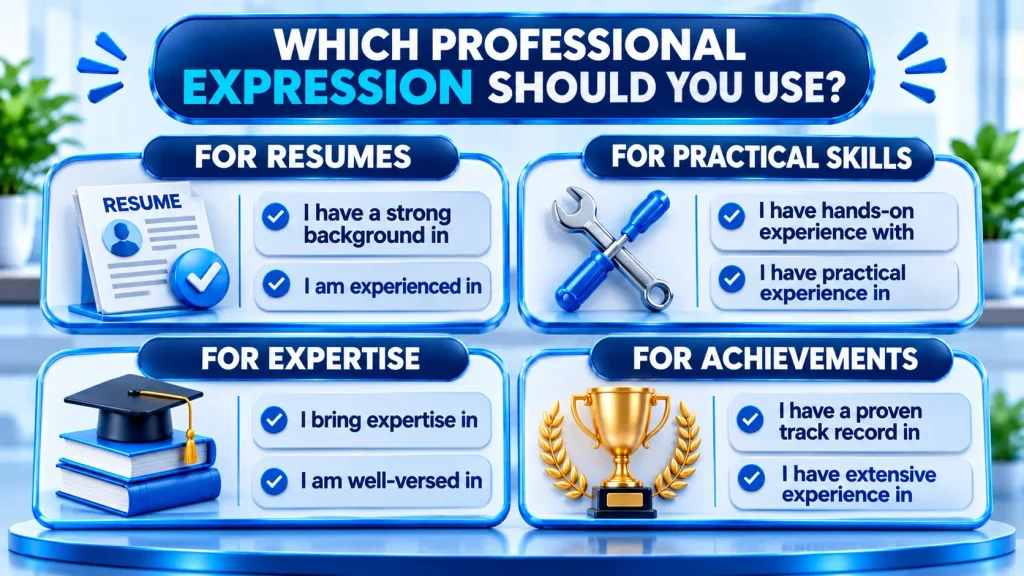
The following table makes it easier to choose the right expression for your professional situation.
| Alternative Phrase | Tone | Best Use | Formality |
|---|---|---|---|
| I have a strong background in | Confident | Resumes and interviews | High |
| I am experienced in | Direct | Job applications | High |
| I have hands-on experience with | Practical | Technical roles | High |
| I bring expertise in | Confident | Cover letters and leadership roles | High |
| I have a proven track record in | Results-focused | Senior positions | High |
| I have a wealth of experience in | Emphatic | Professional biographies | High |
| My background includes | Neutral | Resumes and introductions | High |
| I am well-versed in | Knowledgeable | Business and academic writing | High |
| I have extensive experience in | Professional | Resumes and interviews | High |
| I have practical experience in | Practical | Internships and entry-level jobs | High |
Common Mistakes to Avoid
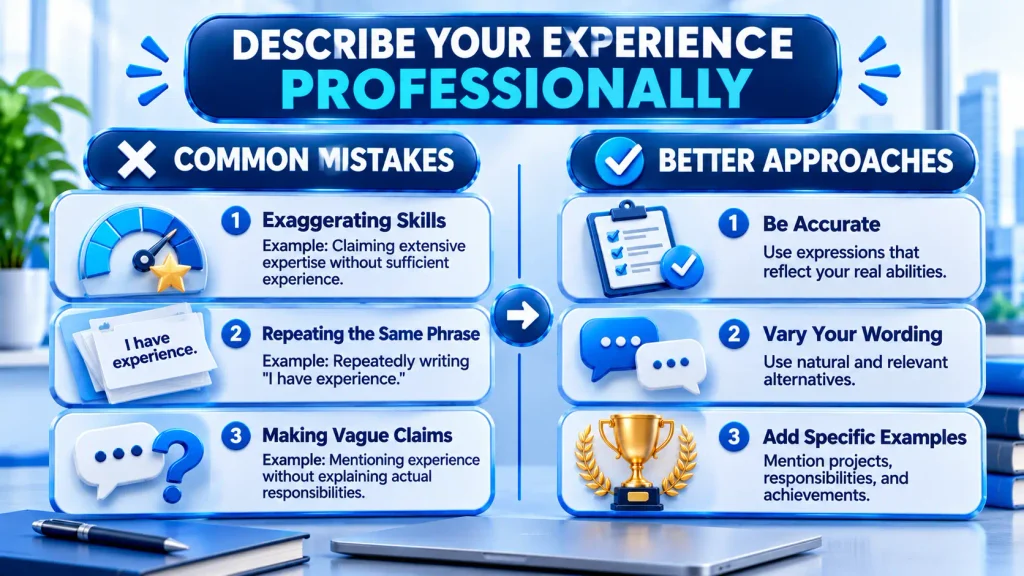
Choosing a professional alternative is only helpful when the expression accurately represents your background. Avoid these common mistakes to make your communication clearer.
1. Overstating Your Experience
Using words such as “extensive,” “expertise,” or “proven track record” without sufficient evidence can make your claims sound exaggerated.
Instead of: I bring extensive expertise in software development.
Try: I have practical experience in software development.
Choose wording that reflects your actual abilities.
2. Using the Wrong Preposition
Some expressions require specific prepositions to sound natural.
For example:
- Incorrect: I am experienced to manage projects.
- Correct: I am experienced in managing projects.
Similarly:
- Natural: I have experience with WordPress.
- Natural: I have experience in website management.
Pay attention to the structure of each expression.
3. Repeating the Same Phrase
Using “I have experience” in every paragraph of a cover letter or professional summary can make your writing repetitive.
Instead of: I have experience in marketing. I have experience in sales. I have experience in customer service.
Try: My background includes marketing, sales, and customer service.
Combining related skills makes your writing more natural and concise.
4. Describing Skills Without Examples
Simply claiming that you have experience does not explain what you can actually do.
Instead of: I have extensive experience in project management.
Try: I have extensive experience in project management, including coordinating teams, tracking deadlines, and managing project budgets.
Specific responsibilities make your statement more informative.
5. Confusing Knowledge With Practical Experience
Being familiar with a subject is not always the same as having practical experience.
For example, “I am well-versed in data analysis” emphasizes knowledge, while “I have hands-on experience with data analysis tools” suggests practical involvement.
Choose the expression that accurately describes your abilities.
Frequently Asked Questions
1. What is a professional way to say “I have experience”?
“I have a strong background in” is an excellent professional alternative. Other options include “I am experienced in,” “I have extensive experience in,” and “I bring expertise in.” Choose the expression that best reflects your qualifications and the requirements of the situation.
2. How do you say “I have experience” on a resume?
Use specific expressions such as “Experienced in project management,” “Strong background in customer service,” or “Hands-on experience with Microsoft Excel.” Include relevant responsibilities and achievements to demonstrate what you can actually do.
3. How can I say I have experience without sounding arrogant?
Choose confident but accurate wording. Expressions such as “I have practical experience in,” “My background includes,” and “I have worked on” communicate your abilities without exaggerating them. Supporting your statements with examples also makes your writing more credible.
4. What is another way to say “I have no experience”?
You can say “I am new to this field,” “I am still developing my skills,” or “I have limited professional experience.” These expressions sound more constructive and allow you to emphasize your willingness to learn.
5. How do I describe experience gained outside a job?
Mention relevant internships, volunteer activities, academic projects, freelance assignments, and personal projects. For example, you could write, “I have hands-on experience creating websites through independent projects.” This helps demonstrate practical abilities even without formal employment.
6. Is “I am experienced in” grammatically correct?
Yes. “I am experienced in” is grammatically correct and commonly used in professional communication. Follow it with a noun or a verb ending in -ing. For example, “I am experienced in customer service” or “I am experienced in managing teams.”
7. What is a strong way to describe extensive work experience?
“I have a proven track record in” is a strong option when you can demonstrate successful results. You can also use “I have extensive experience in” or “I have a wealth of experience in” to emphasize substantial professional involvement.
8. Can students say “I have experience” without having a job?
Yes. Students can describe experience gained through internships, coursework, group assignments, volunteer work, and independent projects. For example, “I have practical experience in conducting research through university projects” is a natural and accurate way to communicate relevant abilities.
Readers who used this guide also looked at Another Way to Say I Hope All Is Well, “I Hope You’re Doing Well” Email Alternatives and How to Say “I Would Love the Opportunity” More Professionally.
Conclusion
Choosing another way to say “I have experience” can make your professional communication clearer, more confident, and more engaging. Whether you are updating your resume, writing a cover letter, or preparing for a job interview, using the right expression helps you highlight your qualifications and explain what you can bring to a workplace. Understanding the meaning of professional experience can also help you describe your background more accurately.
Expressions such as “I have a strong background in,” “I have hands-on experience with,” and “I am experienced in” are useful for describing your skills and practical knowledge. If you want to emphasize your achievements, “I have a proven track record in” is a strong choice. Meanwhile, students and entry-level job seekers can use “I have practical experience in” to highlight internships, academic projects, and volunteer activities.
Ultimately, the best alternative depends on your experience level, professional goals, and the situation in which you are communicating. Choose words that accurately reflect your abilities rather than exaggerating your qualifications. By using specific, natural, and professional expressions, you can make a stronger impression and communicate your experience with greater confidence.

The FrontiersPost editorial team writes and reviews every guide to word and phrase alternatives, with clear meanings, tone notes and example sentences for everyday, academic and professional English.